









- Hengqin Cooperation Zone Shares Cross-Border E-Commerce Developments, Focusing on Macao-Hengqin Collaboration and International MarketsOct 24, 2026View details
- A Shenyang study highlights the development of the “cross-border e-commerce + industrial cluster” modelOct 24, 2026View details
- Three China Advertising Association GEO group standards take effect on October 23Oct 24, 2026View details
- Amazon Raises Fulfillment Fees Twice, Yet the Median Platform Fee Remains Around 40%Oct 22, 2026View details
- AliExpress and YouTube Partner to Expand Marketing Opportunities for Chinese Brands Going GlobalOct 22, 2026View details
- Publicis says AI marketing is developing at two speeds, with agentic AI helping win clientsOct 21, 2026View details
Website traffic has increased, but inquiries from Europe haven't. Is it still worth increasing the budget?
Website traffic is up, but European inquiries aren’t. Is it still worth increasing the budget?
Website traffic is up, but European inquiries aren’t. Is it still worth increasing the budget? First check traffic quality, the localized user experience, and the inquiry path before deciding where to allocate your budget. Rising traffic doesn’t mean your marketing is failing, but it doesn’t prove that promotion is working either. For an export business, the real question is how many of the new visitors come from target markets, are looking for suppliers, and are in a position to buy.
My view: don’t increase the overall budget just yet, but don’t immediately shut down all promotion either. Keep the channels that bring in qualified leads, and hold back any additional budget for now. Otherwise, if your website’s ability to convert visitors hasn’t changed, you may simply be paying for more visits from people who take a look and leave.
Traffic and inquiries may be coming from entirely different audiences
Start by breaking down site traffic by target country, channel, landing page, and search term. Europe is not a single market: visitors researching industrial purchases in Germany and visitors looking for consumer goods in France should not be judged by the same average. Also check your ad location settings: are your ads reaching people who are physically in the target area, or also people who have shown interest in it? The answer depends on your account’s current settings.
A common scenario is that search optimization brings in a large number of informational visitors, with growth concentrated on articles about “how to use” a product or “causes of faults,” while visits from target countries to product and specification pages remain largely unchanged. This content is valuable, but it may not generate inquiries right away. If searches with purchase intent are not increasing, publishing more articles of the same kind is usually not the most urgent investment at this point.
The same applies to advertising. Clicks may be cheap, but if search terms are attracting retail shoppers, small-quantity buyers, or job seekers while your business only supplies in bulk, more traffic may mean more work for your sales team to filter out unsuitable prospects. In that case, tighten your keyword targeting, add negative keywords, and state your minimum order requirements clearly on the landing page instead of focusing only on cost per click.
Are customers not making inquiries, or are you simply not tracking them?
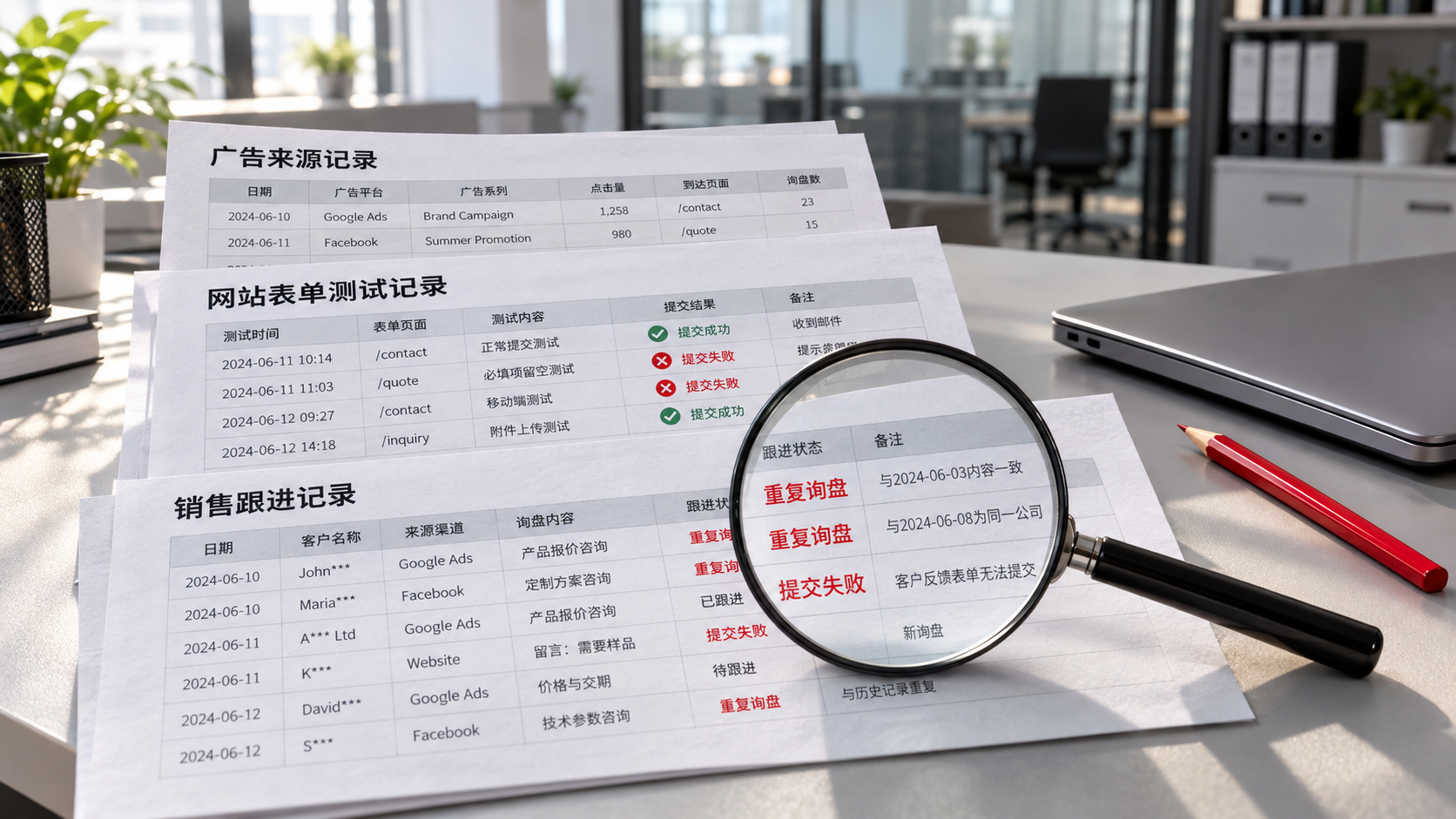
Before changing the page, go through the entire inquiry process on both a phone and a computer: can the form be submitted, are attachments restricted, does a confirmation appear, are emails ending up in spam, and does the sales team receive a notification? Tracking only clicks on the submit button can count failed submissions as conversions. Looking only at form submissions may miss direct emails, phone calls, and follow-up inquiries.
European visitor data may also be affected by users’ consent choices and browser restrictions. A decline in conversions in your analytics tool does not necessarily mean that actual inquiries have fallen. Cross-check website events against received inquiries and customer management records. If tracking or the handling of personal information is involved, check the requirements in the relevant target markets; do not bypass compliance measures just to make your reports look complete.

Industrial buyers also typically compare specifications, discuss options internally, and then contact suppliers. Don’t compare a recent increase in traffic with inquiries received during the same week. Set the observation period based on your business’s historical inquiry lag and sales cycle, rather than choosing an arbitrary number of days for everyone.
Translating your website doesn’t mean you’ve localized it for Europe
Suppose a procurement professional lands on an equipment page. They need to confirm dimensions, materials, operating conditions, lead times, and after-sales arrangements, but the page offers only claims like “reliable quality” and a few product images. Even an accurate translation is not enough to support a purchasing decision. For certifications, testing, or locally applicable standards, provide verifiable documentation relevant to the specific product. A logo alone is not a substitute for an explanation.
Prioritize high-intent product pages rather than translating the entire website all at once. The languages needed in each target market should be determined based on search demand and customer communication preferences. Pages should also clearly state the supply scope, minimum order quantity, common delivery terms, and contact information. If you cannot publish prices, explain what information is needed to prepare a quote so customers know what to do next.
Inquiry forms involve trade-offs, too. Too many fields can make it harder for a prospect to get in touch for the first time; too few may leave the sales team unable to assess their needs. You can ask for contact details, product requirements, and essential specifications, and leave more detailed purchasing information for a later conversation. The best form is not necessarily the shortest one: every required field should have a clear purpose.
Keep investing, fix the website first, or cut the budget?
If visits with purchase intent and qualified inquiries are both increasing, while total inquiry volume has changed little, you can increase the budget gradually. For example, fewer irrelevant messages and more demand for the right products are more meaningful than headline numbers. Still, review how the sales team follows up, and avoid counting unverified messages as qualified leads.
If target customers are reaching product pages but rarely getting in touch, fix the pages that are meant to convert them first. Maintain your baseline traffic while testing specification details, downloadable resources, inquiry links, and forms. Changing too many things at once often makes it difficult to tell which change worked.
If most of the additional visits come from non-target markets or people with mismatched needs, reduce the corresponding ad spend. Cheap clicks are not a reason to keep investing. You can shift the budget to countries, keyword groups, and product pages that have already generated qualified inquiries, but avoid a major scale-up when the sample size is small.
This is also what an integrated website and marketing service should help address. 易营宝 offers smart website building, multilingual websites, search optimization, and overseas advertising. When evaluating this kind of solution, the key is not the number of features, but whether the website and advertising teams can work together to identify where prospects are dropping off: where the traffic is sent, what the page tells visitors, and whether inquiries reach the sales team.
For your next budget discussion, bring three pieces of information: visits with purchase intent from target countries, a cross-check of inquiry channels, and the qualified needs identified by your sales team. If these three don’t line up yet, spend first on finding out why. If you’ve already identified a combination that consistently generates qualified inquiries, you’ll have a basis for increasing the budget.
Related Articles
 How Can Digital Marketing Consulting Use Data Analytics to Identify Ineffective Ad Spend?
 How Should You Allocate a Global Digital Marketing Budget Across Target Markets?
 How Can Foreign Trade Companies Track Lead Sources with a Multilingual Marketing System?

Related Products
 Yiyingbao SaaS Intelligent Website Building and Marketing SystemYiyingbao SaaS Intelligent Website Building and Marketing System, AI-powered no-code website building, rapid creation of multilingual B2B international websites in 10 minutes, global server acceleration, AI-powered SEO optimization, helping businesses connect efficiently with global markets. The perfect integration of technology and operation makes building an international trade website remarkably simple
 AI+SEM Intelligent Advertising Marketing SystemAI+SEM drives intelligent ad creation, empowering full-funnel precision advertising marketing. The system automatically generates weekly/monthly reports, AI recommends keywords and target countries, monitors core metrics in real-time with intelligent alerts, and enables one-click high-conversion ad solutions to help quickly acquire customers and improve ROI.
 AI+SEO Dual-Engine System Optimization ServicesYiyingbao’s AI+SEO dual-engine optimization system helps foreign trade enterprises acquire high-quality organic traffic through AI-powered keyword research, content generation, and comprehensive technical optimization, significantly improving search rankings and conversion rates.
 AI+SNS Social Media Marketing SystemYingbao AI+SNS Social Media Marketing System - Precision social capture for the social media era. Supports one-click content synchronization across major platforms like Facebook and LinkedIn. AI intelligently rewrites posts for enhanced relevance. 24/7 AI customer service and user profiling analysis empower businesses to efficiently expand into global markets.
 AI+SEO营销解决方案易营宝AI+SEO营销解决方案,通过AI批量写作、智能生成TDK、精准关键词扩词等功能,全面优化网站SEO效果,提升流量与转化率。助力企业构建高效智能网站新生态。
 AI+SEM Advertising Marketing SolutionsAI+SEM Advertising Marketing Solution leverages AI technology to deeply empower SEM ad campaigns. It automatically generates weekly/monthly reports using AI, presenting account data across multiple dimensions for comprehensive insights into campaign performance and trends. The system precisely recommends keywords and target countries, intelligently generates high-conversion ad copy, and enables one-click activation of efficient campaign plans to help businesses rapidly acquire customers. Simultaneously, it monitors core metrics in real time, intelligently identifies abnormal fluctuations, and issues timely alerts to ensure stable, high-return advertising results.
 Domain Name ServicesEasyWin provides professional domain name services, including intelligent queries, one-stop registration, brand protection, and full lifecycle management, helping businesses build a digital brand image.
 EasyOperate B2C Cross-Border E-Commerce Platform & Independent WebsiteEasyStore B2C Cross-border E-commerce Independent Store is an intelligent website building and cross-border e-commerce integrated solution independently developed by EasyStore Information Technology (Beijing) Co., Ltd. The system is specially designed for small and medium-sized as well as large export enterprises, integrating 'website building, operation, marketing, advertising, and conversion' into one, helping enterprises quickly establish cross-border e-commerce independent stores to achieve brand globalization and global sales growth.
The platform supports multiple languages, multiple currencies, and multi-channel marketing, with built-in AI intelligent translation and SEO optimization systems, suitable for mainstream markets such as Southeast Asia, Europe and America, Latin America, and the Middle East, assisting Chinese manufacturing enterprises in efficiently deploying international e-commerce strategies. SSL证书易营宝提供专业SSL安全证书服务,包括单域名和泛域名证书,确保网站数据传输加密、身份验证和完整性保护,助力企业建立安全可信的在线业务环境。









