









- Can the average annual growth rate reflect real opportunities in overseas markets?Oct 07, 2026View details
- Which customer acquisition channels will be affected by cross-border marketing trends in 2026?Sep 06, 2026View details
- Which homogenization risks should be considered in an analysis of the AI-powered website building industry?Aug 30, 2026View details
- How Will AI Marketing Trends 2026 Change Advertising Budget AllocationAug 28, 2026View details
- Is the EV SSL certificate market shrinking or upgrading? How should companies assess certificate procurement?Aug 11, 2026View details
- Why the old AMP SEO 2020 practices no longer work and what has changed in current optimization prioritiesAug 02, 2026View details
With Cross-Border Marketing Trends Changing, Should You Still Bet on a Single Channel?
A single channel can still generate orders, but it is becoming increasingly difficult for it to serve as a stable customer acquisition system. For cross-border businesses, the decision to keep relying on a particular channel should not be based solely on recent lead volume. It should also take into account whether acquisition costs can be controlled, whether customer assets remain under the company’s control, and whether the business still has room to adapt when channel rules change.
Changes in cross-border marketing trends do not mean that every business needs to expand into search, advertising, social media, content, and online stores all at once. A more practical approach is to retain the most effective primary channel while using an independent website and one or two supporting channels to address gaps. The goal is not to have a presence on every channel, but to reduce reliance on traffic from a single platform, a single advertising account, or a single search ranking.
The risks of relying on a single channel are often overlooked when growth is going well
Businesses often have good reasons for choosing a single channel: their teams know how to use it, concentrating the budget can deliver results faster, and order attribution is relatively straightforward. For example, search ads can quickly generate inquiries for certain standardized products, while visual consumer goods may achieve higher conversion rates through social content or marketplace stores.
The problem is that “effective” can easily be mistaken for “sustainable.” When bidding becomes more competitive, platform reviews become stricter, organic traffic rules change, or purchasing journeys in target markets shift, an acquisition method that once delivered steady results can lose momentum in a relatively short time. Businesses may then discover that they have collected too little customer information, their website content is weak, and they have no operational foundation across other touchpoints. The cost of recovery is far higher than it would have been to build additional channels gradually.
This is especially true for B2B export businesses, where purchasing decisions are rarely made after a single click. A buyer may discover a supplier through search, then visit its website to verify credentials, product specifications, and delivery capabilities. Alternatively, they may first see application-related content on social media and later return to a search engine to compare solutions. If a business operates only one of these entry points, it risks handing platforms opportunities for repeated interactions that should belong to the business itself.
The value of an independent website lies in supporting—not replacing—all channels
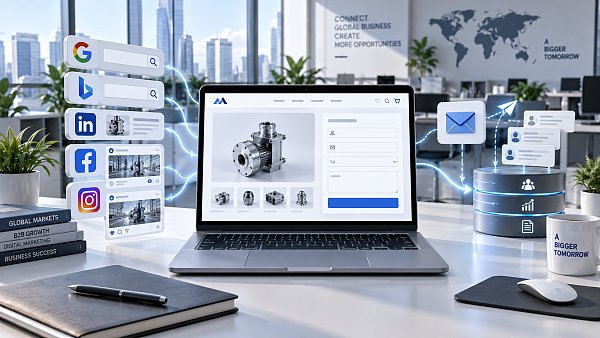
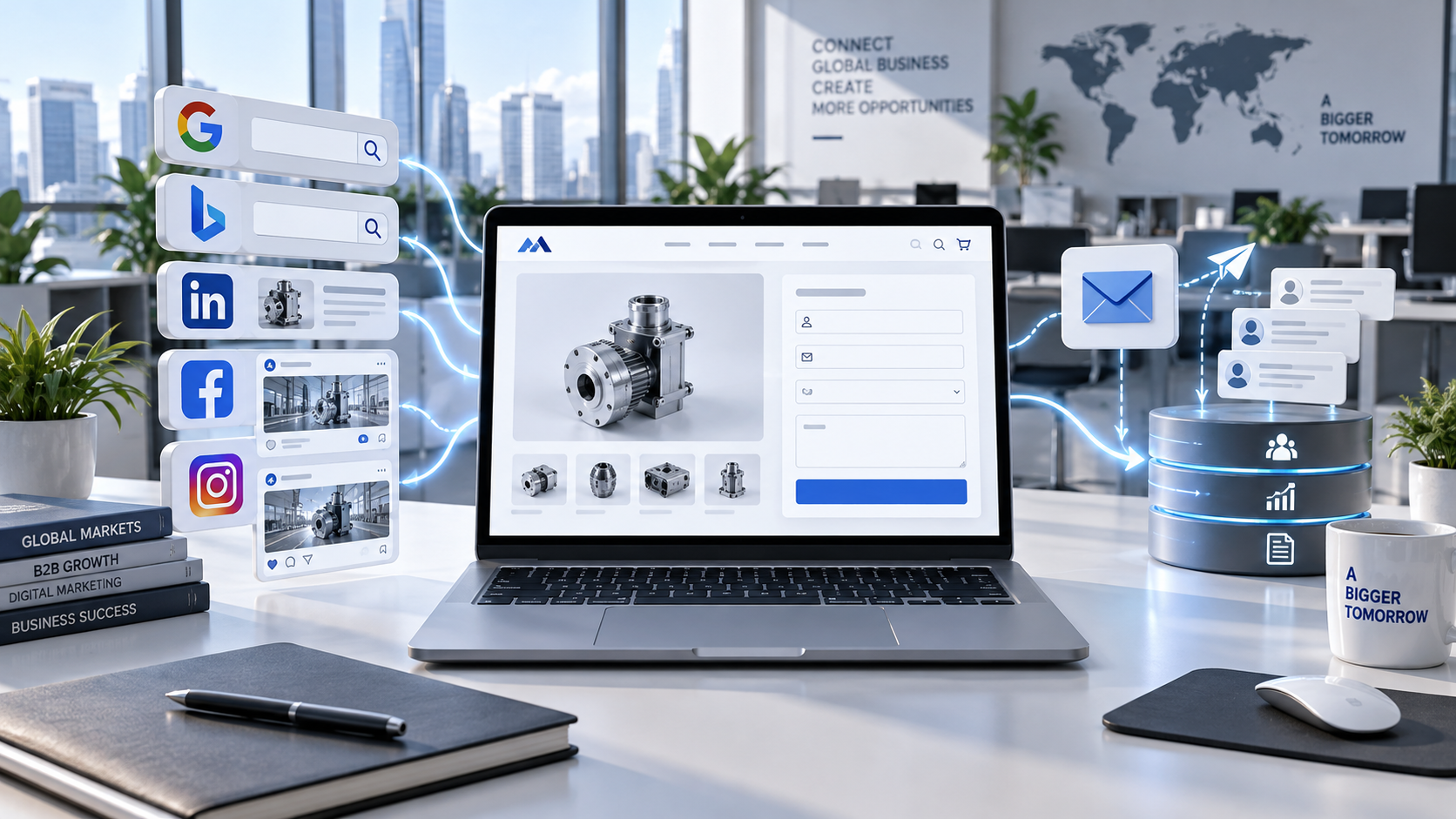
When discussing multiple channels, it is easy to fall into the misconception that an independent website, SEO, advertising, and social media are competing budget items. In practice, an independent website is more like the receiving layer of the entire marketing system. Clicks from ads, search visits, traffic from social media, and email outreach all ultimately need to lead to an owned platform that can explain products, build trust, collect leads, and support subsequent conversions.
Without a well-structured website to receive visitors, advertising budgets may continue to be spent on generic landing pages. Social media content may attract engagement but fail to turn interest into inquiries that can be followed up. Even when organic search brings visitors, they may leave because the page lacks sufficient information. This is particularly costly for complex B2B businesses such as manufacturing, equipment, components, and customized services. Buyers need more than a promotional tagline; they need to assess product capabilities, applications, differences in specifications, delivery coordination, and company reliability over time.
Therefore, the starting point for building a multichannel presence is usually not to “open another account,” but to first check whether the website can effectively support these channels: Can visitors from different countries and language groups understand the core value? Do product pages answer buyers’ basic questions? Is the inquiry process clear? Can visits, forms, phone calls, and ad conversions be tracked? Without a solid website foundation, the more channels a business adds, the more fragmented its data becomes, making it harder for the team to assess actual return on investment.
The priorities for channel mix vary at different stages of growth
Businesses do not need to use the same approach in every market. When budgets are limited and demand needs to be validated quickly, paid search or targeted social media campaigns can be used to test product-market fit. Businesses with established product lines and a steady supply of content should gradually increase their investment in organic search content and brand websites. Businesses with repeat purchases, accessory sales, or consumer brand characteristics should also consider remarketing, email outreach, and community content.
- B2B businesses focused on inquiries: Prioritize building a multilingual website, product content, and conversion tracking, then use search ads to test high-intent keywords and priority markets. SEO is suited to building a lasting presence around product categories, application-related problems, and purchasing decisions, rather than focusing only on rankings for a handful of popular keywords.
- Brands or cross-border retail businesses that rely on visual presentation: Social media and short-form video can help generate interest and build trust, but their traffic should be directed to product pages, campaign pages, or subscription channels so that customer relationships do not remain entirely within the platforms.
- Businesses entering multiple regional markets: Simply duplicating the same pages and creative assets is not advisable. Language, payment habits, delivery expectations, and industry certification requirements all affect conversion. Market priorities should be determined based on order quality and delivery capabilities.
A “mix” does not mean that the budget must be divided equally. A mature approach assigns channels different roles: advertising captures short-term demand and tests messaging; SEO builds lasting search assets; social media expands reach and builds trust; and the independent website brings content, data, and conversions together. Channels should share product information, target-market insights, and conversion data instead of pursuing surface-level metrics independently.
Changes brought by AI search first affect how content is organized
Generative search and AI question-answering tools are changing how some users find information, but they have not made company websites, search optimization, or high-quality content irrelevant. On the contrary, businesses need to pay closer attention to whether their content is clear, accurate, and well structured, and whether it directly answers the questions buyers are likely to ask.
Simply stuffing pages with repeated keywords, as was once common, does little to help users make informed decisions. To create content for both AI-powered and traditional search, businesses should focus on product definitions, suitable applications, technical limitations, selection criteria, frequently asked questions, and service scope. For cross-border businesses, multilingual content should go beyond mechanical translation. Differences in market terminology, measurement conventions, and purchasing language directly affect how easy a page is to understand and how credible it appears.
These changes may not lead to a noticeable increase in leads immediately, but they are a reminder that marketing assets should be built up in website content that can be maintained over time, product materials, and first-party data—not entrusted entirely to a single platform’s distribution.
Start by asking three questions
To assess whether to reduce reliance on a single channel, shift the discussion from “Which channel is more popular?” back to the business itself. First, if costs rise or traffic falls on the current channel, how long can it continue to support the sales pipeline? Second, what information do customers need to verify before submitting an inquiry, and has the business prepared that content? Third, can the team maintain additional channels consistently, rather than leaving them inactive after launch?
If the current channel is still delivering clear results, withdrawing from it entirely is not a rational choice. A more practical approach is to address one weak link at a time: if ad conversions are inconsistent, improve the landing pages and tracking first; if the organic search foundation is weak, build a content cluster around high-value products; if social media generates exposure but no leads, redesign the path from content to the website. The value of diversifying channels is not to spread the budget around, but to ensure that fluctuations in any one channel do not determine the ceiling for the business’s overseas growth.
Related Articles

Related Products
 Yiyingbao SaaS Intelligent Website Building and Marketing SystemYiyingbao SaaS Intelligent Website Building and Marketing System, AI-powered no-code website building, rapid creation of multilingual B2B international websites in 10 minutes, global server acceleration, AI-powered SEO optimization, helping businesses connect efficiently with global markets. The perfect integration of technology and operation makes building an international trade website remarkably simple
 AI+SEM Intelligent Advertising Marketing SystemAI+SEM drives intelligent ad creation, empowering full-funnel precision advertising marketing. The system automatically generates weekly/monthly reports, AI recommends keywords and target countries, monitors core metrics in real-time with intelligent alerts, and enables one-click high-conversion ad solutions to help quickly acquire customers and improve ROI.
 AI+SEO Dual-Engine System Optimization ServicesYiyingbao’s AI+SEO dual-engine optimization system helps foreign trade enterprises acquire high-quality organic traffic through AI-powered keyword research, content generation, and comprehensive technical optimization, significantly improving search rankings and conversion rates.
 AI+SNS Social Media Marketing SystemYingbao AI+SNS Social Media Marketing System - Precision social capture for the social media era. Supports one-click content synchronization across major platforms like Facebook and LinkedIn. AI intelligently rewrites posts for enhanced relevance. 24/7 AI customer service and user profiling analysis empower businesses to efficiently expand into global markets.
 AI+SEO营销解决方案易营宝AI+SEO营销解决方案,通过AI批量写作、智能生成TDK、精准关键词扩词等功能,全面优化网站SEO效果,提升流量与转化率。助力企业构建高效智能网站新生态。
 AI+SEM Advertising Marketing SolutionsAI+SEM Advertising Marketing Solution leverages AI technology to deeply empower SEM ad campaigns. It automatically generates weekly/monthly reports using AI, presenting account data across multiple dimensions for comprehensive insights into campaign performance and trends. The system precisely recommends keywords and target countries, intelligently generates high-conversion ad copy, and enables one-click activation of efficient campaign plans to help businesses rapidly acquire customers. Simultaneously, it monitors core metrics in real time, intelligently identifies abnormal fluctuations, and issues timely alerts to ensure stable, high-return advertising results.
 Domain Name ServicesEasyWin provides professional domain name services, including intelligent queries, one-stop registration, brand protection, and full lifecycle management, helping businesses build a digital brand image.
 EasyOperate B2C Cross-Border E-Commerce Platform & Independent WebsiteEasyStore B2C Cross-border E-commerce Independent Store is an intelligent website building and cross-border e-commerce integrated solution independently developed by EasyStore Information Technology (Beijing) Co., Ltd. The system is specially designed for small and medium-sized as well as large export enterprises, integrating 'website building, operation, marketing, advertising, and conversion' into one, helping enterprises quickly establish cross-border e-commerce independent stores to achieve brand globalization and global sales growth.
The platform supports multiple languages, multiple currencies, and multi-channel marketing, with built-in AI intelligent translation and SEO optimization systems, suitable for mainstream markets such as Southeast Asia, Europe and America, Latin America, and the Middle East, assisting Chinese manufacturing enterprises in efficiently deploying international e-commerce strategies. SSL证书易营宝提供专业SSL安全证书服务,包括单域名和泛域名证书,确保网站数据传输加密、身份验证和完整性保护,助力企业建立安全可信的在线业务环境。









