









- Can the average annual growth rate reflect real opportunities in overseas markets?Oct 07, 2026View details
- Which customer acquisition channels will be affected by cross-border marketing trends in 2026?Sep 06, 2026View details
- Which homogenization risks should be considered in an analysis of the AI-powered website building industry?Aug 30, 2026View details
- How Will AI Marketing Trends 2026 Change Advertising Budget AllocationAug 28, 2026View details
- Is the EV SSL certificate market shrinking or upgrading? How should companies assess certificate procurement?Aug 11, 2026View details
- Why the old AMP SEO 2020 practices no longer work and what has changed in current optimization prioritiesAug 02, 2026View details
Are Too Many Form Steps Often the Reason for Low Inquiry Volume on an Export Website?
Are Too Many Form Steps Often the Reason for Few Inquiries on an International Trade Website?
Introduction: Is a low number of inquiries on an international trade website really just due to too many form steps? For engineering project managers, form design, trust signals, and page response speed can all affect overseas customers’ willingness to submit an inquiry.
When project managers find that website traffic is not low and ads continue to drive visitors, yet the number of qualified inquiries remains limited, the form is often the first thing they suspect. This is not an unreasonable assumption, but simply removing fields usually does little to improve conversion results.
Before submitting an inquiry, overseas buyers assess whether the supplier is reliable, whether the product is a good fit, whether delivery capabilities are clear, and whether they will receive a professional response after leaving their contact details. Too many form steps are just one final obstacle—not the only reason.
Therefore, when analyzing why an international trade website receives few inquiries, the issue should be broken down into four areas: traffic quality, the persuasiveness of the page, the inquiry path, and sales follow-up. Engineering project managers need to identify where the bottleneck lies rather than changing the page based only on experience.
First, determine whether a complex form is really the main problem
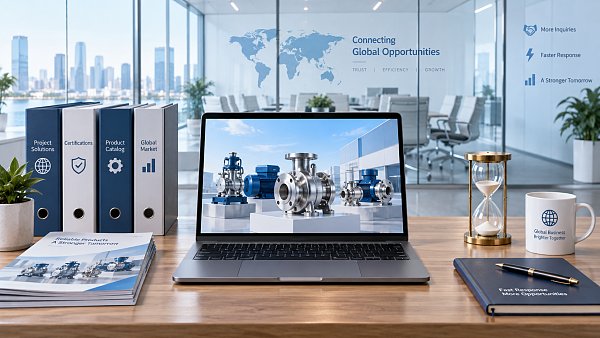
Too many form steps can indeed lower submission rates, especially among mobile visitors, first-time visitors, or customers who have not yet defined their purchasing plans. Requiring customers to fill in more than a dozen fields, upload multiple files, or register for an account can cause them to leave the page partway through.
However, B2B engineering procurement is different from purchasing ordinary consumer goods. Customers often need to provide project specifications, drawings, quantities, the destination port, or technical standards to receive a viable proposal. In this case, oversimplifying the form may generate a large number of unqualified leads and increase the sales team’s screening workload.
A more reasonable way to assess the situation is to review funnel data: the number of people who visit product pages, click the inquiry button, open the form, and complete the submission. If there is a significant drop-off after visitors open the form, prioritize reviewing the number of fields, required-field rules, and page interactions.
If customers do not click the inquiry button at all, the problem is usually not the form itself, but that the product page has failed to answer key purchasing questions. Engineering managers should avoid attributing all conversion problems to the final step, as this can obscure the page shortcomings that are actually affecting the business.
What information matters most to engineering procurement customers before they submit an inquiry?
When project-based customers visit an international trade website, they first want to know whether a product is suitable for their operating conditions, not whether the company’s promotional language is impressive. They look for specific information such as specifications, material details, applicable industries, certifications and standards, use cases, and customization limits.
For example, pages for equipment, building materials, components, or engineering services should clearly show size ranges, performance metrics, production lead times, quality control processes, and export experience. Customers are more likely to proceed to the inquiry stage and leave contact information if they can quickly make an initial assessment.
Many websites show only product images and brief descriptions, have incomplete specification tables, offer downloads that will not open, or display conflicting information across different pages. Even if the form on such a page asks only for a name and email address, professional buyers are unlikely to spend additional time communicating.
For engineering project managers, website content should take on part of the initial technical communication. Addressing frequently asked questions in advance can reduce unnecessary back-and-forth and help customers with genuine project needs better assess the company’s capabilities and suitability as a partner.
A lack of trust is often more damaging than having too many form fields
Overseas customers cannot visit a factory as easily as local buyers, so they use the website to assess whether a company is genuine, stable, and capable of fulfilling orders. The absence of a company address, photos of production facilities, certifications, team information, and project case studies can directly reduce a first-time visitor’s willingness to inquire.
For engineering orders involving substantial amounts or long timelines, customers place particular importance on risk management. They need to know which markets the company has served, whether it has experience with similar projects, whether it can provide technical support, and whether it has a clear response mechanism for quality or delivery issues.
Case studies should not simply say “the customer was satisfied” or “the project was a success.” They should explain the project’s location, customer type, challenges, solution, and delivery results. Without disclosing commercially sensitive customer information, specific details are more persuasive than general promises.
Website contact details should also be consistent and easy to verify. A business email address, phone number, WhatsApp, LinkedIn page, and office address together provide fundamental trust signals. If a website offers only an inquiry form and no other way to get in touch, customers may question whether the company is legitimate.
Page experience can amplify customer hesitation
Slow page loading is a common but easily overlooked reason for low inquiry volume on international trade websites. When overseas visitors access a site across regions, oversized first-screen images, excessive scripts, or unstable server response times can cause them to close the page before seeing the key information.
The mobile experience should not be overlooked either. Many purchasing professionals first screen suppliers on their phones and then return to a computer for a more detailed comparison. If buttons are too small, specification tables overflow horizontally, or forms do not adapt properly, the website can lose customers through a basic usability issue.
Inquiry entry points should also match the customer’s reading journey. Clear calls to inquire can be placed at the top of a product page, after the specifications, after case studies, and at the bottom of the page, but repeated pop-ups should not interrupt browsing. Engineering customers generally want to review the information before deciding whether to get in touch.
For visitors who are not yet ready to submit complete project details, offer lower-barrier options such as “Get a catalog,” “Request technical information,” or “Schedule a consultation.” This does not mean lowering lead standards; it gives customers at different stages of the purchasing process appropriate conversion paths.
Design forms in stages according to project complexity
The key to a high-quality form is not simply making it as short as possible. It should allow customers to provide the information required at their current stage with minimal effort. For an initial inquiry, retain basic fields such as name, business email, country or region, description of requirements, and contact details, while avoiding duplicate data collection.
For products requiring a quotation, optional fields can be added for quantity, specifications, purchasing timeline, and destination port. Use prompt text to explain that providing this information can help the customer receive a more accurate response. Optional fields preserve the ability to collect information without requiring customers to complete everything at once.
Complex projects can use a two-step process: first collect contact details and a project overview, then invite customers to upload drawings or technical documents or provide additional specifications. Even if customers do not proceed to the second step right away, the sales team still has an opportunity to continue the conversation with a professional response.
The page displayed after form submission is also important. Customers should immediately see a submission confirmation, an estimated response time, and optional direct contact channels. If there is no confirmation or the email is delayed, customers may doubt whether their request went through and turn to other suppliers.
Use data and follow-up processes to locate the real bottleneck
Project managers should create a basic conversion dashboard and, at a minimum, monitor visits, form open rates, submission rates, and qualified inquiry rates by country, channel, device type, and landing page. Looking only at the total number of inquiries makes it impossible to determine whether the problem lies with traffic quality or the website’s ability to convert visitors.
For example, if Google Ads drives a high volume of visits but few inquiries, the keywords may be too broad or may not match search intent. If organic search traffic is steady but inquiry quality is low, the content may be attracting visitors who are only researching, while the pages lack guidance for purchasing decisions.
Response time and response quality after submission should also be tracked. If customers have filled in the form but do not convert, the website may not be the problem. If the sales team takes more than a day to respond or sends only a templated quotation, the investment made in customer acquisition can easily be wasted during follow-up.
Platforms such as 易营宝, which integrate intelligent website building, SEO optimization, ad placement, and multilingual operations, are better suited to analyzing website data, channel sources, and inquiry behavior within a single customer journey. This helps companies identify the factors that truly affect overseas customer acquisition efficiency.
Conclusion: Reduce form steps, but do not stop there
Too many form steps may be one reason an international trade website receives few inquiries. When data shows that customers are dropping off during form completion, prioritize optimizing the fields, mobile interactions, and submission feedback. However, this is usually not the only reason an engineering-focused international trade website has low conversion rates.
A more effective approach is to first confirm that the right customers are reaching the page, then assess whether the product information is sufficient, trust signals are complete, the inquiry path is appropriate, and sales responses are timely. Only by connecting the entire conversion journey can optimization lead to sustained growth in qualified inquiries.
For engineering project managers, a website should be more than a company showcase. It should be a business tool for qualifying customers, explaining solutions, building trust, and moving conversations forward. Identify issues with data first, then make targeted adjustments to bring every overseas visit closer to a genuine business opportunity.
Related Articles

Related Products
 Yiyingbao SaaS Intelligent Website Building and Marketing SystemYiyingbao SaaS Intelligent Website Building and Marketing System, AI-powered no-code website building, rapid creation of multilingual B2B international websites in 10 minutes, global server acceleration, AI-powered SEO optimization, helping businesses connect efficiently with global markets. The perfect integration of technology and operation makes building an international trade website remarkably simple
 AI+SEM Intelligent Advertising Marketing SystemAI+SEM drives intelligent ad creation, empowering full-funnel precision advertising marketing. The system automatically generates weekly/monthly reports, AI recommends keywords and target countries, monitors core metrics in real-time with intelligent alerts, and enables one-click high-conversion ad solutions to help quickly acquire customers and improve ROI.
 AI+SEO Dual-Engine System Optimization ServicesYiyingbao’s AI+SEO dual-engine optimization system helps foreign trade enterprises acquire high-quality organic traffic through AI-powered keyword research, content generation, and comprehensive technical optimization, significantly improving search rankings and conversion rates.
 AI+SNS Social Media Marketing SystemYingbao AI+SNS Social Media Marketing System - Precision social capture for the social media era. Supports one-click content synchronization across major platforms like Facebook and LinkedIn. AI intelligently rewrites posts for enhanced relevance. 24/7 AI customer service and user profiling analysis empower businesses to efficiently expand into global markets.
 AI+SEO营销解决方案易营宝AI+SEO营销解决方案,通过AI批量写作、智能生成TDK、精准关键词扩词等功能,全面优化网站SEO效果,提升流量与转化率。助力企业构建高效智能网站新生态。
 AI+SEM Advertising Marketing SolutionsAI+SEM Advertising Marketing Solution leverages AI technology to deeply empower SEM ad campaigns. It automatically generates weekly/monthly reports using AI, presenting account data across multiple dimensions for comprehensive insights into campaign performance and trends. The system precisely recommends keywords and target countries, intelligently generates high-conversion ad copy, and enables one-click activation of efficient campaign plans to help businesses rapidly acquire customers. Simultaneously, it monitors core metrics in real time, intelligently identifies abnormal fluctuations, and issues timely alerts to ensure stable, high-return advertising results.
 Domain Name ServicesEasyWin provides professional domain name services, including intelligent queries, one-stop registration, brand protection, and full lifecycle management, helping businesses build a digital brand image.
 EasyOperate B2C Cross-Border E-Commerce Platform & Independent WebsiteEasyStore B2C Cross-border E-commerce Independent Store is an intelligent website building and cross-border e-commerce integrated solution independently developed by EasyStore Information Technology (Beijing) Co., Ltd. The system is specially designed for small and medium-sized as well as large export enterprises, integrating 'website building, operation, marketing, advertising, and conversion' into one, helping enterprises quickly establish cross-border e-commerce independent stores to achieve brand globalization and global sales growth.
The platform supports multiple languages, multiple currencies, and multi-channel marketing, with built-in AI intelligent translation and SEO optimization systems, suitable for mainstream markets such as Southeast Asia, Europe and America, Latin America, and the Middle East, assisting Chinese manufacturing enterprises in efficiently deploying international e-commerce strategies. SSL证书易营宝提供专业SSL安全证书服务,包括单域名和泛域名证书,确保网站数据传输加密、身份验证和完整性保护,助力企业建立安全可信的在线业务环境。









