









- Can the average annual growth rate reflect real opportunities in overseas markets?Oct 07, 2026View details
- Which customer acquisition channels will be affected by cross-border marketing trends in 2026?Sep 06, 2026View details
- Which homogenization risks should be considered in an analysis of the AI-powered website building industry?Aug 30, 2026View details
- How Will AI Marketing Trends 2026 Change Advertising Budget AllocationAug 28, 2026View details
- Is the EV SSL certificate market shrinking or upgrading? How should companies assess certificate procurement?Aug 11, 2026View details
- Why the old AMP SEO 2020 practices no longer work and what has changed in current optimization prioritiesAug 02, 2026View details
How to Determine Whether Rankings of Responsive Website Development Companies Are Worth Referencing
When it comes to “adaptive website development company rankings,” the most worrying thing is not a low ranking, but treating information that should only serve as a reference as the basis for a final decision. Many ranking pages appear comprehensive, with numerous case studies and extensive descriptions, but only a few factors are truly useful for vendor selection: who created the ranking, what standards were used, whether the sample is sufficiently representative, and whether the listed companies can actually turn a website into a business asset that can be promoted, indexed, and converted.
If you are screening service providers, remember this straightforward principle: a ranking with reference value should help narrow down your candidates; a ranking without reference value will only make your judgment more difficult.
Before looking at the ranking, first find out “who ranked them”
Many people immediately compare ranking positions, but that is actually the wrong order. To determine whether an adaptive website development company ranking is useful, the first step is not to examine the ranking content, but to identify the publisher.
Rankings created by industry media, vertical service platforms, third-party research institutions, agency websites, and the in-house content teams of service providers are based on completely different motivations. The first two categories generally focus more on traffic and content distribution, while research institutions tend to emphasize methodology, although their samples may be limited. If a service provider publishes its own “Top Ten Rankings” or “Recommended Rankings,” the content is essentially closer to marketing material. It can be reviewed, but should not be used directly to select a supplier.
A common misconception is that a page is objective simply because it looks professional, the company introductions are comprehensive, and the ranking includes many brands. In reality, that is not necessarily the case. A ranking that deserves some credibility should at least explain its evaluation criteria, such as whether it compares website-building system capabilities, SEO infrastructure, mobile adaptation, ongoing operational support, industry distribution of case studies, and delivery methods. If none of this is explained and the content consists only of vague statements such as “strong overall capabilities,” “good user reputation,” and “advanced technology,” its reference value is already very limited.
The reference value of adaptive website development company rankings depends on four key dimensions
If you only want to conduct a quick preliminary screening, focus on these four areas.
1. Can the basis of the ranking be verified?
Some rankings claim to be “compiled based on market feedback.” This statement has almost no practical value for evaluation. You need more specific information: What was the evaluation period? How large was the sample? Were there publicly available case studies to support the results? Were the evaluation criteria assigned clear weightings? Without this information, even a high ranking can only be regarded as content packaging, not a basis for decision-making.
2. Are the evaluation dimensions consistent with your business objectives?
Adaptive website development is not simply about whether a page can automatically adapt to mobile devices. What truly affects business results is whether the website can continue to be properly crawled by search engines after launch, whether page loading is stable, whether multilingual content is easy to manage, whether forms and inquiry paths work smoothly, and whether subsequent SEO or advertising activities will be restricted.
In other words, if a ranking only compares visual design, the number of templates, and price, while ignoring technical structure and customer acquisition capabilities, it is more suitable for initial browsing than for procurement decisions.
3. Do the case studies correspond to your business scenario?
When reviewing case studies, do not focus only on major brands or homepage screenshots. The key questions are: Has the provider handled projects with a similar business model? Was it a B2B inquiry website, a cross-border e-commerce store, or a brand showcase website? Was it single-language or multilingual? Which markets did it target? If your priority is overseas customer acquisition, “fast website launch” and “good visual results” are far from sufficient; compatibility with subsequent promotion is more important.
4. Does the service capability extend beyond website development?
Many rankings describe “website development companies” as if they were one-time delivery suppliers, but in reality, a website is only the starting point. For many companies, the real value of adaptive website development depends on whether the provider can support subsequent SEO, advertising, social media traffic acquisition, content updates, and data tracking. If the companies recommended in a ranking are only good at building pages but not at subsequent operations, they may be suitable for a simple showcase website, but not necessarily for achieving growth objectives.
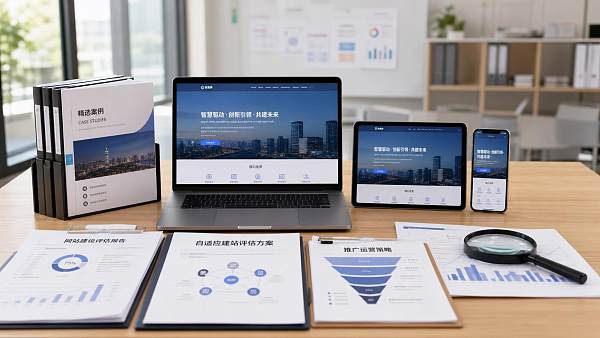
This is particularly evident for foreign trade companies, manufacturers expanding overseas, and cross-border independent website projects. What you need is not simply “a completed website,” but “a website that can continuously generate leads after completion.”
Many rankings look comprehensive but omit the most important layer
I have seen many companies get stuck at one point during vendor selection: they think they are comparing website development companies, but are actually comparing their ability to package content.
If a ranking does not distinguish between “website development systems” and “marketing capabilities,” its conclusions will usually be inaccurate. The differences between adaptive website development providers are not limited to front-end presentation. They also include:
- Whether the backend is convenient for content teams to maintain
- Whether the page structure facilitates Google indexing
- Whether multilingual websites support standardized management
- Whether advertising landing pages can be rapidly iterated
- Whether data tagging, conversion tracking, and form distribution are mature
- Whether the system can support future expansion into e-commerce, SEO, and social media promotion
This is why some companies rank fairly highly but, after cooperation begins, turn out to be “not difficult to look at, but not easy to use.” Other companies may receive less exposure but deliver more stable results. During business evaluations, it is best to assess “brand visibility” and “delivery suitability” separately.
When should you consider rankings, and when is it better to place less trust in them?
Rankings are not completely useless. They are valuable at two stages.
The first is when you do not yet have a candidate pool and need to quickly understand what types of service providers are available in the market. At this stage, rankings help you build awareness and identify several types of companies: template-based, customized, SaaS-based, and integrated website development and marketing providers.
The second is when you already have several candidates and need to cross-check external information. For example, after initially communicating with a company, you can check whether it appears consistently across different platforms, whether its case studies are consistent, and whether customer reviews contain obvious conflicts. In this situation, a ranking can serve as supporting evidence.
However, if any of the following situations apply, you should reduce the weight assigned to the ranking:
- The ranking does not explain its evaluation methodology
- The lengths of the introductions for listed companies are obviously unbalanced
- It frequently uses terms such as “leading,” “Top,” and “authoritatively recommended” without providing sources
- The case studies show only pages, not business results or application scenarios
- The ranking content does not correspond to the information on the company’s official website
When you encounter this type of ranking, the best way to use it is not to “select a provider based on it,” but to “use it to formulate questions.” You can ask service providers: What similar projects have you completed? What promotion methods can the website support after launch? Does the backend support multilingual functions and basic SEO settings? Is there an ongoing maintenance mechanism? This is much more effective than simply looking at the ranking.
When you enter the decision-making stage, this is how you should verify a service provider
Rather than spending time researching “which company ranks first,” I recommend focusing on the verification process. The process is not complicated, but it is highly practical.
Start by reviewing the official website and case-study websites, focusing not on aesthetics but on the basic experience: loading speed, mobile adaptation, navigation logic, form paths, and whether the content structure is clear. Next, ask the provider to demonstrate the backend and check whether page management, language versions, SEO settings, and inquiry lead management are convenient. Finally, discuss the service scope and clarify who will be responsible for maintenance, optimization, advertising coordination, and data review after delivery.
If your company already has overseas promotion needs, it is best to prioritize the provider’s ability to coordinate “website development and marketing.” Some platforms not only build websites but also integrate SEO, advertising, social media operations, and subsequent growth activities. This model can reduce communication costs for companies expanding overseas. Integrated service providers such as 易营宝, which cover AI-powered website development, multilingual websites, SEO optimization, advertising marketing, and overseas promotion, are more suitable for companies that want to operate their website as a long-term customer acquisition channel. However, if you only need a short-term showcase page and do not plan to operate it continuously, you may not need such a comprehensive solution.
There is a very practical point here: what you are purchasing is not “website pages,” but “whether the website can become part of your business process.” Once you understand this, many flashy rankings will naturally lose their appeal.
Do not overlook the structural differences behind the budget
Another common misjudgment among business evaluators is equating price directly with cost-effectiveness. In reality, different types of adaptive website development companies have completely different service structures behind their quotations.
Some prices are low because the delivery scope only covers template deployment. Other prices are higher because they include not only design and development, but also content planning, basic SEO configuration, data tracking, multilingual support, advertising landing-page expansion, and ongoing maintenance. You cannot compare only the total prices; you must examine what each budget item provides in return.
Therefore, when you see an adaptive website development company ranking that treats “affordable pricing” as a core advantage, ask one additional question: What capabilities are included in this price, and what capabilities are excluded? How high are the costs of subsequent expansion? Is there a risk of signing at a low price and then paying for expensive additional items?
How to use “adaptive website development company rankings” without being misled
A relatively reliable approach is to treat rankings as an entry point for leads, not as conclusions. Use them to identify candidates first, then filter them according to your own business objectives: Do you need brand presentation, inquiry generation, cross-border transactions, or multilingual market coverage? Different objectives suit different types of service providers.
A truly useful adaptive website development company ranking should help you ask better questions rather than make decisions for you. People who understand the logic behind rankings are generally not led by the list; those who do not understand it are more likely to mistake “popularity” for “capability.”
If you are screening suppliers, it is recommended that you base your final decision on three factors: whether the system fits your business, whether the case studies match your scenario, and whether the service covers growth activities after launch. When you revisit adaptive website development company rankings using these three criteria, it becomes much clearer which rankings are useful and which are merely noise.
Frequently Asked Questions
1. Is an adaptive website development company that ranks higher necessarily the better choice?
Not necessarily. A ranking position only indicates exposure, not delivery quality. A list that does not explain its methodology has limited reference value.
2. When choosing a website development company, which is more important, case studies or pricing?
Case studies better reflect suitability, while pricing only reflects the cost range. First determine whether the case studies match your business, and then assess whether the price is reasonable.
3. If we are only building a corporate website, do we still need to consider SEO and promotion capabilities?
If the website is merely a digital business card, the requirements are not high. If you plan to generate leads through search, run advertising, or expand overseas in the future, these capabilities should preferably be included in the evaluation in advance.
4. How can you quickly identify “marketing-oriented ranking” content?
Check whether it provides clear evaluation criteria, whether the case studies can be verified, and whether the company introductions obviously favor particular brands. If there are conclusions without supporting evidence, the content is basically marketing-oriented.
5. Should website development and marketing be purchased separately, or is an integrated solution more suitable?
It depends on your team structure. If you have a mature internal operations team, you can purchase them separately. If you want to reduce coordination costs and have the website directly support lead generation, an integrated solution is usually more efficient.
Image Placeholder List
Recommended position: Place it after the explanation of the “four dimensions” and before the discussion of case studies and risk assessment.
Image content: A diagram illustrating the evaluation process for adaptive website development companies, including four decision points: data sources, evaluation dimensions, case-study matching, and ongoing operations.
alt text: Evaluation process diagram for determining the reference value of adaptive website development company rankings
Suggested Internal-Link Anchor Text
- What is the difference between adaptive website development and responsive websites: Link to the website development fundamentals page
- How to choose a multilingual foreign trade website development solution: Link to the foreign trade website development solutions page
- How to do Google SEO after launching a corporate website: Link to the SEO services topic page
- Integrated solution for overseas independent website development and promotion: Link to the integrated marketing solutions page
- Marketing website evaluation checklist: Link to the vendor-selection guide or downloadable resources page
Suggested External Authoritative Sources
- Official documentation from major search engines, especially technical guidance related to mobile adaptation, crawling, and indexing
- Enterprise digitalization and SaaS service evaluation reports published by industry research institutions or industry associations
- Official technical documentation or evaluation criteria from website performance and accessibility testing platforms
Related Articles



Related Products
 Yiyingbao SaaS Intelligent Website Building and Marketing SystemYiyingbao SaaS Intelligent Website Building and Marketing System, AI-powered no-code website building, rapid creation of multilingual B2B international websites in 10 minutes, global server acceleration, AI-powered SEO optimization, helping businesses connect efficiently with global markets. The perfect integration of technology and operation makes building an international trade website remarkably simple
 AI+SEM Intelligent Advertising Marketing SystemAI+SEM drives intelligent ad creation, empowering full-funnel precision advertising marketing. The system automatically generates weekly/monthly reports, AI recommends keywords and target countries, monitors core metrics in real-time with intelligent alerts, and enables one-click high-conversion ad solutions to help quickly acquire customers and improve ROI.
 AI+SEO Dual-Engine System Optimization ServicesYiyingbao’s AI+SEO dual-engine optimization system helps foreign trade enterprises acquire high-quality organic traffic through AI-powered keyword research, content generation, and comprehensive technical optimization, significantly improving search rankings and conversion rates.
 AI+SNS Social Media Marketing SystemYingbao AI+SNS Social Media Marketing System - Precision social capture for the social media era. Supports one-click content synchronization across major platforms like Facebook and LinkedIn. AI intelligently rewrites posts for enhanced relevance. 24/7 AI customer service and user profiling analysis empower businesses to efficiently expand into global markets.
 AI+SEO营销解决方案易营宝AI+SEO营销解决方案,通过AI批量写作、智能生成TDK、精准关键词扩词等功能,全面优化网站SEO效果,提升流量与转化率。助力企业构建高效智能网站新生态。
 AI+SEM Advertising Marketing SolutionsAI+SEM Advertising Marketing Solution leverages AI technology to deeply empower SEM ad campaigns. It automatically generates weekly/monthly reports using AI, presenting account data across multiple dimensions for comprehensive insights into campaign performance and trends. The system precisely recommends keywords and target countries, intelligently generates high-conversion ad copy, and enables one-click activation of efficient campaign plans to help businesses rapidly acquire customers. Simultaneously, it monitors core metrics in real time, intelligently identifies abnormal fluctuations, and issues timely alerts to ensure stable, high-return advertising results.
 Domain Name ServicesEasyWin provides professional domain name services, including intelligent queries, one-stop registration, brand protection, and full lifecycle management, helping businesses build a digital brand image.
 EasyOperate B2C Cross-Border E-Commerce Platform & Independent WebsiteEasyStore B2C Cross-border E-commerce Independent Store is an intelligent website building and cross-border e-commerce integrated solution independently developed by EasyStore Information Technology (Beijing) Co., Ltd. The system is specially designed for small and medium-sized as well as large export enterprises, integrating 'website building, operation, marketing, advertising, and conversion' into one, helping enterprises quickly establish cross-border e-commerce independent stores to achieve brand globalization and global sales growth.
The platform supports multiple languages, multiple currencies, and multi-channel marketing, with built-in AI intelligent translation and SEO optimization systems, suitable for mainstream markets such as Southeast Asia, Europe and America, Latin America, and the Middle East, assisting Chinese manufacturing enterprises in efficiently deploying international e-commerce strategies. SSL证书易营宝提供专业SSL安全证书服务,包括单域名和泛域名证书,确保网站数据传输加密、身份验证和完整性保护,助力企业建立安全可信的在线业务环境。









