









- Can the average annual growth rate reflect real opportunities in overseas markets?Oct 07, 2026View details
- Which customer acquisition channels will be affected by cross-border marketing trends in 2026?Sep 06, 2026View details
- Which homogenization risks should be considered in an analysis of the AI-powered website building industry?Aug 30, 2026View details
- How Will AI Marketing Trends 2026 Change Advertising Budget AllocationAug 28, 2026View details
- Is the EV SSL certificate market shrinking or upgrading? How should companies assess certificate procurement?Aug 11, 2026View details
- Why the old AMP SEO 2020 practices no longer work and what has changed in current optimization prioritiesAug 02, 2026View details
Will AI search optimization change the content structure of foreign trade websites?
Over the past few years, many companies have followed a similar approach to creating content for foreign trade websites: first identify keywords, then write pages, and finally find ways to insert those keywords into titles, body copy, image descriptions, and anchor text. This approach was not entirely ineffective in the era of traditional search. However, as AI search optimization comes into the view of more businesses, the underlying logic of content planning is quietly changing. For those researching this topic, the real question worth considering is not “Should we do it?” but rather “To what extent will the content structure of a foreign trade website be reshaped?”
The answer is: significantly—and not through minor adjustments.
AI search optimization changes not only how rankings work, but also how content is understood, extracted, and recommended. Traditional search focuses more on establishing matches between webpages and keywords, whereas AI search places greater emphasis on whether a webpage can answer questions comprehensively, whether its information is clearly structured, and whether credible contextual relationships exist between topics. For foreign trade websites, this means that content planning is no longer simply about “being seen by search engines”; it must also accommodate machine understanding, user decision-making, and cross-channel distribution.
From “Page Optimization” to “Answer Organization”: The Focus of Foreign Trade Websites Is Shifting
A common reality many foreign trade companies face today is that their websites contain a substantial number of pages, including product pages, news pages, and case study pages, yet overall traffic grows slowly and inquiry quality remains inconsistent. The problem is often not whether there is content, but whether the content is organized around user questions.
The most direct impact of AI search optimization is that website content is shifting from competition between individual pages to competition between topics. For example, users may not search only for keywords such as “industrial valve supplier.” They may also search for questions such as “How can I determine whether a valve supplier supports European and American standards?” or “How can a multilingual foreign trade website improve B2B inquiry conversion?” If a website contains only isolated product descriptions without building a content network around purchasing decisions, industry standards, delivery capabilities, after-sales systems, and multilingual communication, then even if its pages are indexed, it will still be difficult for the website to secure a favorable position in AI-generated results.
In other words, what will be more valuable in the future is not “a single page packed with information,” but a group of content assets that support one another and answer a sequence of related questions.
These Clear Changes Will Emerge in Foreign Trade Website Content Planning
The first change is that website sections will become more “question-oriented.”
In the past, many companies divided their website navigation into “Home,” “Products,” “About Us,” “News,” and “Contact Us.” This structure remains useful, but it is no longer sufficient. AI search optimization favors websites that clearly communicate “what problems you solve, what scenarios you serve, and which markets you support.” As a result, content planning will include more scenario-based and knowledge-based sections, such as “Industry Applications,” “Procurement Guides,” “Delivery and Certification Information,” “Frequently Asked Questions in Overseas Markets,” and “Multilingual Solutions.”
The second change is that product pages will no longer serve only as showcases.
A common problem with traditional product pages is that they contain a list of specifications, several images, and a closing sentence inviting inquiries. For users, the information is insufficient; for AI systems, the semantics are also incomplete. In the future, product pages will often need to include usage scenarios, applicable regions, common selection questions, delivery information, and extended technical content, and may even need to establish clear connections with related knowledge pages. The significance of doing so is not only to improve conversion, but also to tell search systems that this is not an isolated page, but an information node with complete context.
The third change is that multilingual content can no longer be merely a “copied translation.”
When foreign trade companies target North America, Europe, Southeast Asia, the Middle East, or Latin America, users’ ways of asking questions, areas of concern, and industry terminology are not exactly the same. AI search optimization will amplify these differences. If a company simply translates Chinese content directly into English, Spanish, or Arabic, it will often struggle to truly cover the search expressions used by local users. Future content planning will place greater emphasis on localized semantics rather than mechanical multilingual translation.
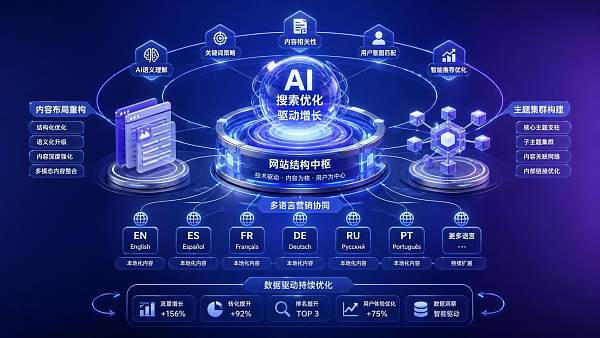
Why Do Many Foreign Trade Websites Appear to Have “Plenty of Content” but Remain Unsuitable for the AI Search Era?
Because most of them are still at the stage of “content-stuffed website building.”
Typical characteristics of these websites include complete but shallow sections, frequently updated articles with scattered topics, a large number of product pages without clear hierarchy, and pages that are disconnected from one another. After entering the website, users find it difficult to continue exploring based on their questions. After crawling the website, AI systems also struggle to determine which content is core and which is merely repetitive wording.
AI search optimization places greater value on the sense of order between pieces of content. If a website can connect “company capabilities—product capabilities—industry solutions—frequently asked questions—conversion entry points,” it is more likely to be understood and cited than a website that simply accumulates dozens of informational articles. This is also why more and more companies are beginning to focus on their internal information architecture rather than merely publishing articles.
How Should Content Planning Be Changed to Truly Align with the Trend?
One direction worth considering is to view a website as a “digital business system” rather than an “electronic brochure.”
From the perspective of an integrated website and marketing service approach, content planning should consider at least four levels: whether content can be crawled by search engines, whether it can be understood by AI, whether it enables users to quickly assess its value, and whether it can naturally support conversion. If any one of these levels is missing, performance will suffer.
For example, the homepage should not merely be a collection of slogans. It should clearly communicate the company’s core business, target markets, service audiences, and key entry points. A service page should not simply say “We provide SEO”; it should explain the coordination between Google search, advertising, social media traffic acquisition, and AI search for foreign trade companies. An article page should not exist merely to maintain an update frequency; it should also educate users, supplement topic semantics, and strengthen the website’s sense of authority.
A platform such as Yiyingbao, which integrates AI-driven intelligent website building, multilingual website development, SEO/GEO optimization, advertising marketing, and overseas social media operations, is more closely aligned with current trends not simply because it offers “many functions,” but because it views website building, content organization, promotional channels, and search visibility within the same growth logic. For foreign trade companies, this makes it easier to create synergy than purchasing a template separately, hiring a content writer separately, and placing advertisements separately.
AI Search Optimization Does Not Reduce the Importance of Technical Foundations; It Depends on Them Even More
When discussing content trends, some people tend to overlook the underlying capabilities of a website. In fact, the further AI search optimization advances, the more important a website’s technical accessibility, loading efficiency, structural organization, and network compatibility become. Even the best content cannot provide a basis for machine understanding if crawling is unstable, access speeds are slow, or the site architecture is disorganized.
This is why companies cannot focus only on frontend design when upgrading their websites. For example, upgrades to enterprise network environments and protocols can themselves affect a website’s future hosting capacity and compatibility. In some enterprise network upgrade scenarios, Internet Protocol Version 6 (IPV6) is being mentioned more frequently. It uses a 128-bit address length and offers an almost unlimited address space, while also providing advantages in speed, security, multicast support, and the native IPSec protocol. For companies that need to serve global visitors over the long term and continuously expand their digital assets, these underlying capabilities do not directly equal content optimization, but they will become an important foundation for the ongoing evolution of their websites.
The Way Foreign Trade Content Teams Work Will Also Be Reshaped
In the past, when creating content, many companies were accustomed to first asking, “What do I want to publish?” Now they should first ask, “What questions will customers ask in succession?” This is a major difference.
For example, a buyer may initially search for “a supplier of a certain type of product,” and then become concerned about “certification standards,” “minimum order quantity,” “whether customization is supported,” “delivery time,” “after-sales service,” and “whether localized services are available.” If a website’s content planning covers this decision-making journey, users are more likely to engage more deeply, and AI systems can more easily determine that the website is capable of providing comprehensive answers.
Therefore, future content teams will not merely produce articles. They will be more like designers of a knowledge path: guiding users from unfamiliar traffic to trust-building and then to communication. Articles, product pages, FAQs, case descriptions, and industry topics will all become nodes along this path.
Three Signals Companies Can Check Right Now
If you are evaluating whether your website needs adjustment, you can start by examining three areas.
First, has the website built topic clusters around its core business rather than isolated pages? Second, do important pages genuinely answer users’ questions instead of merely describing the brand? Third, do the multilingual versions use localized expressions rather than repeatedly copying the same content?
As long as these three areas have obvious shortcomings, the changes brought about by AI search optimization are likely to directly affect your future visibility and inquiry efficiency.
Ultimately, the changes in foreign trade website content planning are not anxiety caused by some new terminology, but a natural result of a maturing search environment. Users want to obtain answers more quickly, search systems want to understand content more accurately, and companies want every piece of content to support indexing, exposure, and conversion. Against this background, those who are the first to shift from “writing pages” to “building a content system” will have a greater opportunity to take the initiative in the next stage of global customer acquisition competition.
Therefore, AI search optimization is not asking companies “whether they want to redesign their websites.” It is reminding them: Is your foreign trade website already prepared to convince the world in a clearer, more structured way that is also closer to the real decision-making process?
Related Articles


Related Products
 Yiyingbao SaaS Intelligent Website Building and Marketing SystemYiyingbao SaaS Intelligent Website Building and Marketing System, AI-powered no-code website building, rapid creation of multilingual B2B international websites in 10 minutes, global server acceleration, AI-powered SEO optimization, helping businesses connect efficiently with global markets. The perfect integration of technology and operation makes building an international trade website remarkably simple
 AI+SEM Intelligent Advertising Marketing SystemAI+SEM drives intelligent ad creation, empowering full-funnel precision advertising marketing. The system automatically generates weekly/monthly reports, AI recommends keywords and target countries, monitors core metrics in real-time with intelligent alerts, and enables one-click high-conversion ad solutions to help quickly acquire customers and improve ROI.
 AI+SEO Dual-Engine System Optimization ServicesYiyingbao’s AI+SEO dual-engine optimization system helps foreign trade enterprises acquire high-quality organic traffic through AI-powered keyword research, content generation, and comprehensive technical optimization, significantly improving search rankings and conversion rates.
 AI+SNS Social Media Marketing SystemYingbao AI+SNS Social Media Marketing System - Precision social capture for the social media era. Supports one-click content synchronization across major platforms like Facebook and LinkedIn. AI intelligently rewrites posts for enhanced relevance. 24/7 AI customer service and user profiling analysis empower businesses to efficiently expand into global markets.
 AI+SEO营销解决方案易营宝AI+SEO营销解决方案,通过AI批量写作、智能生成TDK、精准关键词扩词等功能,全面优化网站SEO效果,提升流量与转化率。助力企业构建高效智能网站新生态。
 AI+SEM Advertising Marketing SolutionsAI+SEM Advertising Marketing Solution leverages AI technology to deeply empower SEM ad campaigns. It automatically generates weekly/monthly reports using AI, presenting account data across multiple dimensions for comprehensive insights into campaign performance and trends. The system precisely recommends keywords and target countries, intelligently generates high-conversion ad copy, and enables one-click activation of efficient campaign plans to help businesses rapidly acquire customers. Simultaneously, it monitors core metrics in real time, intelligently identifies abnormal fluctuations, and issues timely alerts to ensure stable, high-return advertising results.
 Domain Name ServicesEasyWin provides professional domain name services, including intelligent queries, one-stop registration, brand protection, and full lifecycle management, helping businesses build a digital brand image.
 EasyOperate B2C Cross-Border E-Commerce Platform & Independent WebsiteEasyStore B2C Cross-border E-commerce Independent Store is an intelligent website building and cross-border e-commerce integrated solution independently developed by EasyStore Information Technology (Beijing) Co., Ltd. The system is specially designed for small and medium-sized as well as large export enterprises, integrating 'website building, operation, marketing, advertising, and conversion' into one, helping enterprises quickly establish cross-border e-commerce independent stores to achieve brand globalization and global sales growth.
The platform supports multiple languages, multiple currencies, and multi-channel marketing, with built-in AI intelligent translation and SEO optimization systems, suitable for mainstream markets such as Southeast Asia, Europe and America, Latin America, and the Middle East, assisting Chinese manufacturing enterprises in efficiently deploying international e-commerce strategies. SSL证书易营宝提供专业SSL安全证书服务,包括单域名和泛域名证书,确保网站数据传输加密、身份验证和完整性保护,助力企业建立安全可信的在线业务环境。









