









- Can the average annual growth rate reflect real opportunities in overseas markets?Oct 07, 2026View details
- Which customer acquisition channels will be affected by cross-border marketing trends in 2026?Sep 06, 2026View details
- Which homogenization risks should be considered in an analysis of the AI-powered website building industry?Aug 30, 2026View details
- How Will AI Marketing Trends 2026 Change Advertising Budget AllocationAug 28, 2026View details
- Is the EV SSL certificate market shrinking or upgrading? How should companies assess certificate procurement?Aug 11, 2026View details
- Why the old AMP SEO 2020 practices no longer work and what has changed in current optimization prioritiesAug 02, 2026View details
Why Do Quotes for Multilingual Website Development Vary So Widely?
Why do quotes for multilingual website development vary so widely? For procurement professionals, the price difference is usually not simply a matter of being expensive or inexpensive, but a comprehensive difference in technical architecture, language processing, SEO capabilities, content delivery, and after-sales support. What truly deserves attention is not how much was spent on website development once, but whether the website can be seen by overseas customers, indexed by search engines, support subsequent promotion, and continuously generate inquiries.
Why do quotes for the same multilingual website development project range from several thousand to tens or even hundreds of thousands?
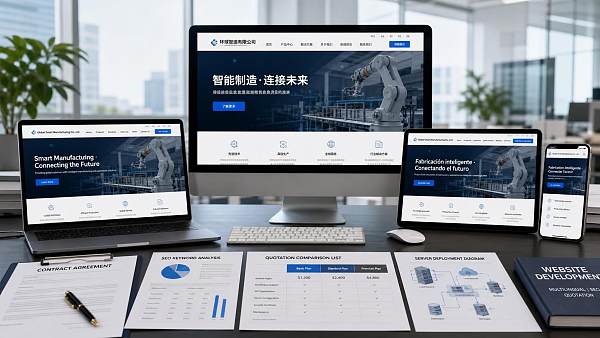
The most common challenge procurement professionals face when requesting quotations is that although all suppliers appear to be offering to build a multilingual corporate website, their prices can differ substantially. The fundamental reason is that the services covered by different quotations are not the same at all. Some only include page translation and template-based development, while others include the technical foundation, SEO structure, content strategy, and subsequent operational capabilities.
Low-cost solutions often focus on getting the website built, whereas mid- to high-priced solutions place greater emphasis on turning the website into a customer-acquisition asset. If the company only wants to display corporate information, the budget can naturally be kept lower. However, if the website is also expected to support overseas promotion, SEO indexing, advertising campaigns, and inquiry conversion, the price difference will inevitably become significant.
In other words, the reason quotes for multilingual website development vary so widely is not that the industry lacks standards, but that the procurement objects are fundamentally different. One is a static presentation page, while the other is digital marketing infrastructure for overseas markets. Their value and cost structures are inherently different.
Which components of a quotation should procurement professionals examine first?
To determine whether a quotation for multilingual website development is reasonable, do not focus only on the total price. First, break down the quotation structure. The core modules that usually determine the price include the website development system, number of pages, number of language versions, content processing method, SEO configuration, functional development, server deployment, and subsequent maintenance and support.
The aspects most easily overlooked are the number of language versions and the depth of content processing. Although many solutions claim to offer multilingual websites, they may in practice only switch between displays of machine-translated Chinese content. They provide neither localized expression nor content adaptation for the markets of different countries. This approach has a low cost, but its effectiveness is also very limited.
Another key factor is SEO capability. Some website development services only address front-end presentation and do not handle URL structures, hreflang tags, sitemaps, page metadata, multilingual indexing logic, or loading-speed optimization. After launch, these websites may appear complete, but their indexing and ranking capabilities on search engines such as Google are weak, making subsequent promotional investment more likely to be wasted.
Why do differences in technical architecture directly affect quotations and subsequent results?
A multilingual corporate website is not simply a matter of adding a few language buttons to a page. The factor that truly affects costs is whether the underlying architecture is suitable for global access and long-term expansion. If procurement focuses only on how the pages look, it is easy to overlook system-level differences, which often determine the website's operational efficiency over the following three years.
For example, some suppliers use general-purpose template websites. They can be built quickly and offered at a low price, but their scalability is limited. Later, when the company wants to add country-specific websites, create more landing pages, or conduct SEO optimization, there may be many restrictions. By contrast, a system with an independent back end, flexible multilingual content management, and configurable SEO rules requires a higher initial investment but is more suitable for ongoing operations.
Access speed and deployment locations are another example. For websites targeting markets such as North America, Europe, and Southeast Asia, the lack of appropriate overseas deployment and performance optimization may result in slow loading, high bounce rates, and poor advertising conversion. If these technical conditions are not included in the quotation scope during procurement, additional costs will often be required later.
Why are translation and localization also important sources of quotation differences?
Many companies believe that the cost of a multilingual website mainly depends on how many languages are translated. In reality, the factor that creates the greatest price differences is not the number of languages itself, but the translation method used and whether localized content processing is included. Machine translation, human proofreading, native-language polishing, and industry terminology adaptation have completely different cost structures.
For foreign trade companies, manufacturers, and brands expanding internationally, website language is not merely about allowing customers to understand the content. It must also make customers feel that the company is professional and trustworthy and that its communication conforms to local business practices. If product specifications, industry terminology, application scenarios, and service commitments are expressed inaccurately, the quality of inquiries may decline, and brand trust may even be affected.
Therefore, when comparing quotations for multilingual website development, procurement professionals should clearly ask whether the translation is produced directly by AI or reviewed by human linguists, whether native-level polishing is supported, and whether titles, selling points, and calls to action are adjusted according to the target market. Many seemingly inexpensive solutions ultimately require the company to redo the work itself, making the actual total cost far from low.
Why does SEO capability create clear tiers in quotations?
If the purpose of developing a multilingual website is to acquire overseas traffic, SEO is not an add-on but a fundamental requirement. A website with genuine SEO capabilities must consider page structure, keyword placement, indexing relationships among language versions, internal linking strategies, technical tags, and content expansion logic during the development stage. All of these increase the amount of upfront work.
Low-cost solutions generally do not include keyword research or set page themes according to the markets of different countries. As a result, although the website may have multiple language versions, the page content is highly repetitive. Search engines find it difficult to identify the independent value of each version, so indexing and ranking performance are naturally affected.
For procurement professionals, three points can help determine whether a supplier truly understands SEO: whether it provides keyword and page planning, whether it has the capability to configure multilingual technical SEO, and whether it considers subsequent content growth and promotional conversion. If none of these three capabilities is available, the website may launch on schedule, but it will be difficult for it to become a genuine customer-acquisition tool.
Where do low quotations usually cut costs, and where are the risks?
Common ways of reducing the price of low-cost multilingual website development include using templates, machine translation, simplified page structures, omitting basic SEO configuration, excluding content planning, and minimizing after-sales services. These practices can make the short-term price look attractive, but problems gradually emerge during long-term use.
The most common risk is that the website launches quickly but becomes difficult to use later. For example, the back end may be difficult to maintain, requiring repeated development whenever a new language is added; pages may lack flexibility, requiring a new website to be built for an advertising landing page; SEO permissions may be insufficient for the optimization team to take over; or the website code may be closed, making future migration difficult and tying the company to the original supplier's system.
For procurement, the cost that truly needs to be controlled is not the website development budget itself, but the hidden cost of repeatedly rebuilding the website after choosing a low-cost solution. If the initial solution cannot support promotion and growth, the subsequent investment in rebuilding the website, reworking content, and redeploying SEO is usually far higher than the additional budget that would have been spent at the beginning.
How can you determine whether a quotation for a multilingual website is reasonable?
A practical approach is to work backward from the objective. First clarify whether the website is intended for brand presentation, SEO-based customer acquisition, advertising campaign conversion, or e-commerce transactions. Different objectives correspond to different technical and content requirements, and the quotation will naturally differ. Discussing price without considering business objectives usually leads to no meaningful conclusion.
Next, establish consistent quotation criteria for comparison. Require different suppliers to quote according to the same dimensions, including the number of languages, number of pages, whether original content planning is included, translation method, SEO configuration items, development functions, delivery period, after-sales support period, and data ownership. Only when the criteria are consistent can price differences be meaningfully compared.
Finally, examine whether the service provider has integrated website development and marketing capabilities. If a multilingual website cannot connect with Google SEO, advertising campaigns, social media traffic acquisition, and AI search visibility optimization, its value will be significantly weakened. Procurement is not simply about buying a project; it is about selecting an underlying capability that can support overseas growth.
What type of multilingual website quotation is more worth accepting?
A quotation worth accepting is not necessarily the lowest one. Rather, it should clearly explain what result each cost is intended to deliver. For example, why independent language pages are needed, why technical SEO should be implemented, why content localization is necessary, and why support for future expansion is required. This type of quotation is usually more transparent and easier to approve internally.
For companies planning to develop overseas markets continuously, especially foreign trade factories, cross-border e-commerce brands, and B2B export companies, it is advisable to prioritize service providers that can combine intelligent website development, SEO optimization, advertising conversion, and subsequent growth. A corporate website is not an isolated project, but a core entry point in the international marketing process.
Platforms such as 易营宝, an AI-driven enterprise SaaS website development and overseas marketing service platform, have the advantage of not only completing multilingual website development but also coordinating SEO, advertising, social media, and AI search optimization. The one-time quotation for this type of solution may be higher than that of basic website development, but it is closer to the overseas customer-acquisition results that companies actually seek.
Conclusion: When procuring a multilingual website, the focus should not be on who is cheaper, but on who can better support growth
Returning to the initial question, why do quotations for multilingual website development vary so widely? Essentially, different solutions correspond to different levels of delivery depth and growth capabilities. A lower price may only mean that the website has been launched, while a somewhat higher price may represent the construction of overseas marketing infrastructure for the company's next three to five years.
For procurement professionals, the most effective way to evaluate a quotation is not to look only at the figures on the quotation sheet, but to determine whether the website can support operations across multiple markets, be indexed by search engines, handle promotional traffic, and be continuously improved. Only by examining these issues clearly can companies avoid low-price traps and select a multilingual website development solution with genuine business value.
Related Articles
Related Products
 Yiyingbao SaaS Intelligent Website Building and Marketing SystemYiyingbao SaaS Intelligent Website Building and Marketing System, AI-powered no-code website building, rapid creation of multilingual B2B international websites in 10 minutes, global server acceleration, AI-powered SEO optimization, helping businesses connect efficiently with global markets. The perfect integration of technology and operation makes building an international trade website remarkably simple
 AI+SEM Intelligent Advertising Marketing SystemAI+SEM drives intelligent ad creation, empowering full-funnel precision advertising marketing. The system automatically generates weekly/monthly reports, AI recommends keywords and target countries, monitors core metrics in real-time with intelligent alerts, and enables one-click high-conversion ad solutions to help quickly acquire customers and improve ROI.
 AI+SEO Dual-Engine System Optimization ServicesYiyingbao’s AI+SEO dual-engine optimization system helps foreign trade enterprises acquire high-quality organic traffic through AI-powered keyword research, content generation, and comprehensive technical optimization, significantly improving search rankings and conversion rates.
 AI+SNS Social Media Marketing SystemYingbao AI+SNS Social Media Marketing System - Precision social capture for the social media era. Supports one-click content synchronization across major platforms like Facebook and LinkedIn. AI intelligently rewrites posts for enhanced relevance. 24/7 AI customer service and user profiling analysis empower businesses to efficiently expand into global markets.
 AI+SEO营销解决方案易营宝AI+SEO营销解决方案,通过AI批量写作、智能生成TDK、精准关键词扩词等功能,全面优化网站SEO效果,提升流量与转化率。助力企业构建高效智能网站新生态。
 AI+SEM Advertising Marketing SolutionsAI+SEM Advertising Marketing Solution leverages AI technology to deeply empower SEM ad campaigns. It automatically generates weekly/monthly reports using AI, presenting account data across multiple dimensions for comprehensive insights into campaign performance and trends. The system precisely recommends keywords and target countries, intelligently generates high-conversion ad copy, and enables one-click activation of efficient campaign plans to help businesses rapidly acquire customers. Simultaneously, it monitors core metrics in real time, intelligently identifies abnormal fluctuations, and issues timely alerts to ensure stable, high-return advertising results.
 Domain Name ServicesEasyWin provides professional domain name services, including intelligent queries, one-stop registration, brand protection, and full lifecycle management, helping businesses build a digital brand image.
 EasyOperate B2C Cross-Border E-Commerce Platform & Independent WebsiteEasyStore B2C Cross-border E-commerce Independent Store is an intelligent website building and cross-border e-commerce integrated solution independently developed by EasyStore Information Technology (Beijing) Co., Ltd. The system is specially designed for small and medium-sized as well as large export enterprises, integrating 'website building, operation, marketing, advertising, and conversion' into one, helping enterprises quickly establish cross-border e-commerce independent stores to achieve brand globalization and global sales growth.
The platform supports multiple languages, multiple currencies, and multi-channel marketing, with built-in AI intelligent translation and SEO optimization systems, suitable for mainstream markets such as Southeast Asia, Europe and America, Latin America, and the Middle East, assisting Chinese manufacturing enterprises in efficiently deploying international e-commerce strategies. SSL证书易营宝提供专业SSL安全证书服务,包括单域名和泛域名证书,确保网站数据传输加密、身份验证和完整性保护,助力企业建立安全可信的在线业务环境。









