









- APEC Shenzhen Spotlight: Cross-Border E-Commerce Orders Promote Asia-Pacific Trade and Economic CooperationNov 08, 2026View details
- China-Europe Railway Express and CIIE Hold Business Matchmaking Event, Focusing on Cross-Border E-commerce B2B ExportsNov 07, 2026View details
- China’s Ministry of Commerce Responds to Additional Charges on Low-Value Imports Imposed by the EUNov 06, 2026View details
- Two Internet Development Reports Released at the 2026 World Internet ConferenceNov 05, 2026View details
- Internet Business Revenue of Enterprises Above the Designated Size Reached RMB 1.716 Trillion in the First Three Quarters, with Profits Up 17.6%Nov 05, 2026View details
- Shopify's Third-Quarter Revenue and GMV Fall Short of Expectations, Sending Shares Tumbling Before the Market OpensNov 04, 2026View details
Common Mistakes in Foreign-Language Website Optimization: Why Directly Translated Content Struggles to Attract Target Traffic
A foreign-language website being understandable does not mean it can attract traffic from its target market. Direct translation addresses language conversion, while search traffic depends on how users express their needs, what types of content search results tend to display, and whether a page genuinely answers their questions. Even if each sentence on a Chinese page is translated accurately into another language, the page may still struggle to reach target customers if its wording, page type, or purchasing information does not match their needs.
For example, when optimizing content around the Russian keyword оптимизация иностранного сайта, you cannot simply translate Chinese keywords into Russian and repeat them throughout the page. You need to determine whether searchers are looking for ways to optimize foreign-language websites or seeking services for a specific market, and then structure the content accordingly.
Why direct translation can miss search intent
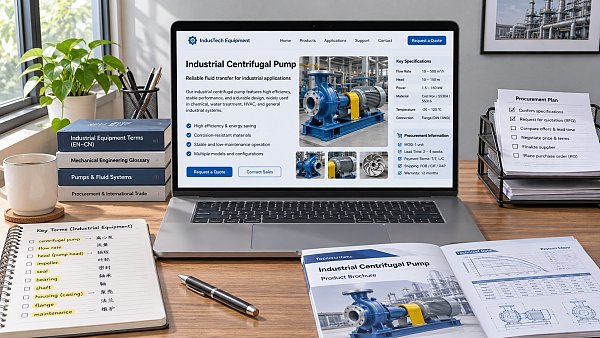
Chinese product names do not always correspond one-to-one with the terms commonly used in the target market. For the same piece of equipment, a domestic page may highlight an industry abbreviation, while overseas buyers may search using a more specific equipment name, application, or technical specification. Translating the Chinese abbreviation directly may give the page an equivalent term, but it may not cover the wording customers actually use.
Search intent is even easier to overlook. Suppose a Chinese page focuses on “equipment advantages,” while users in the target market are searching for equipment specifications, suitable materials, or supplier credentials. Even if a directly translated page appears in search results, it may struggle to attract clicks if it lacks key information. Matching or similar keywords do not mean that a page meets users’ needs.
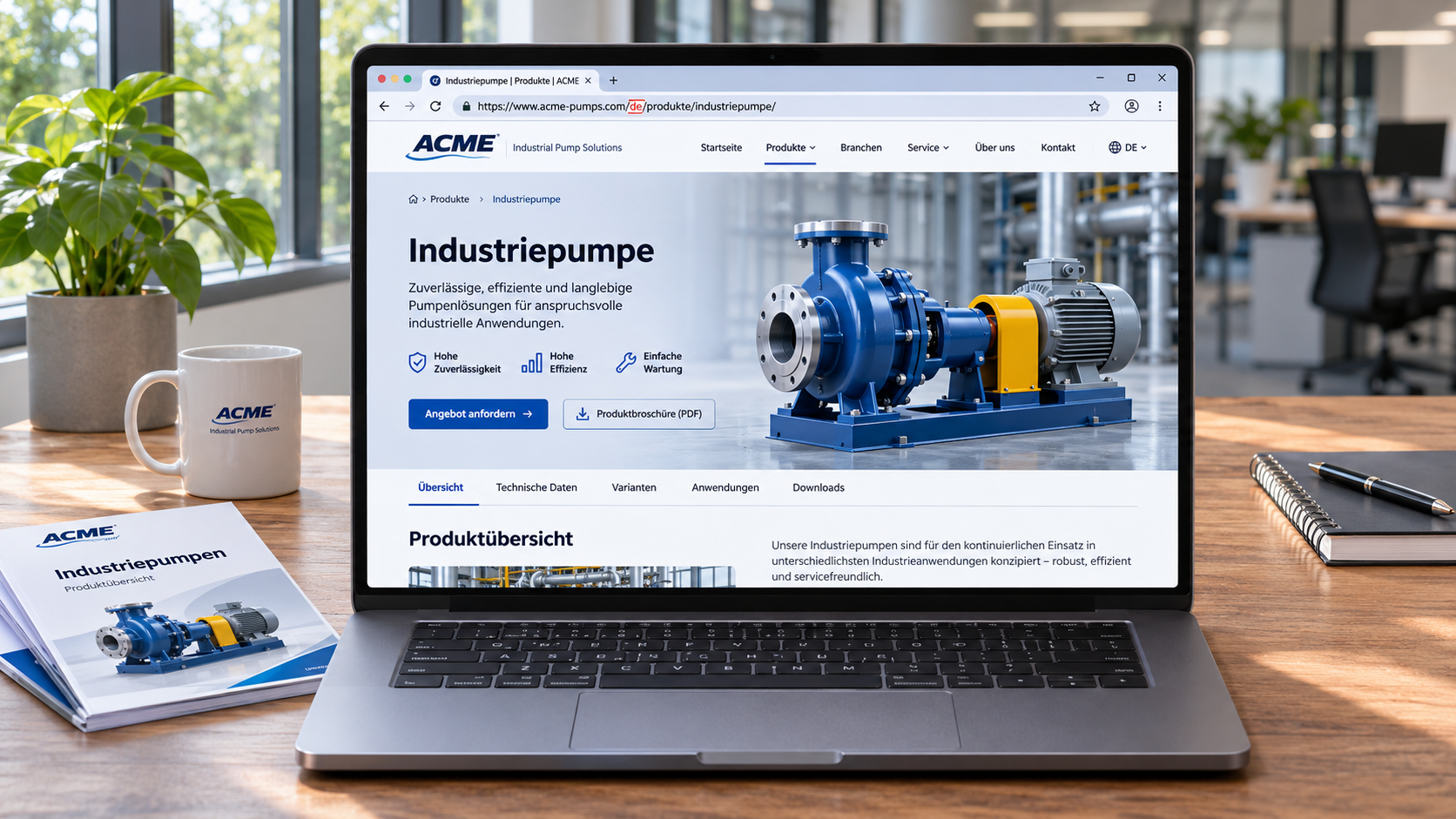
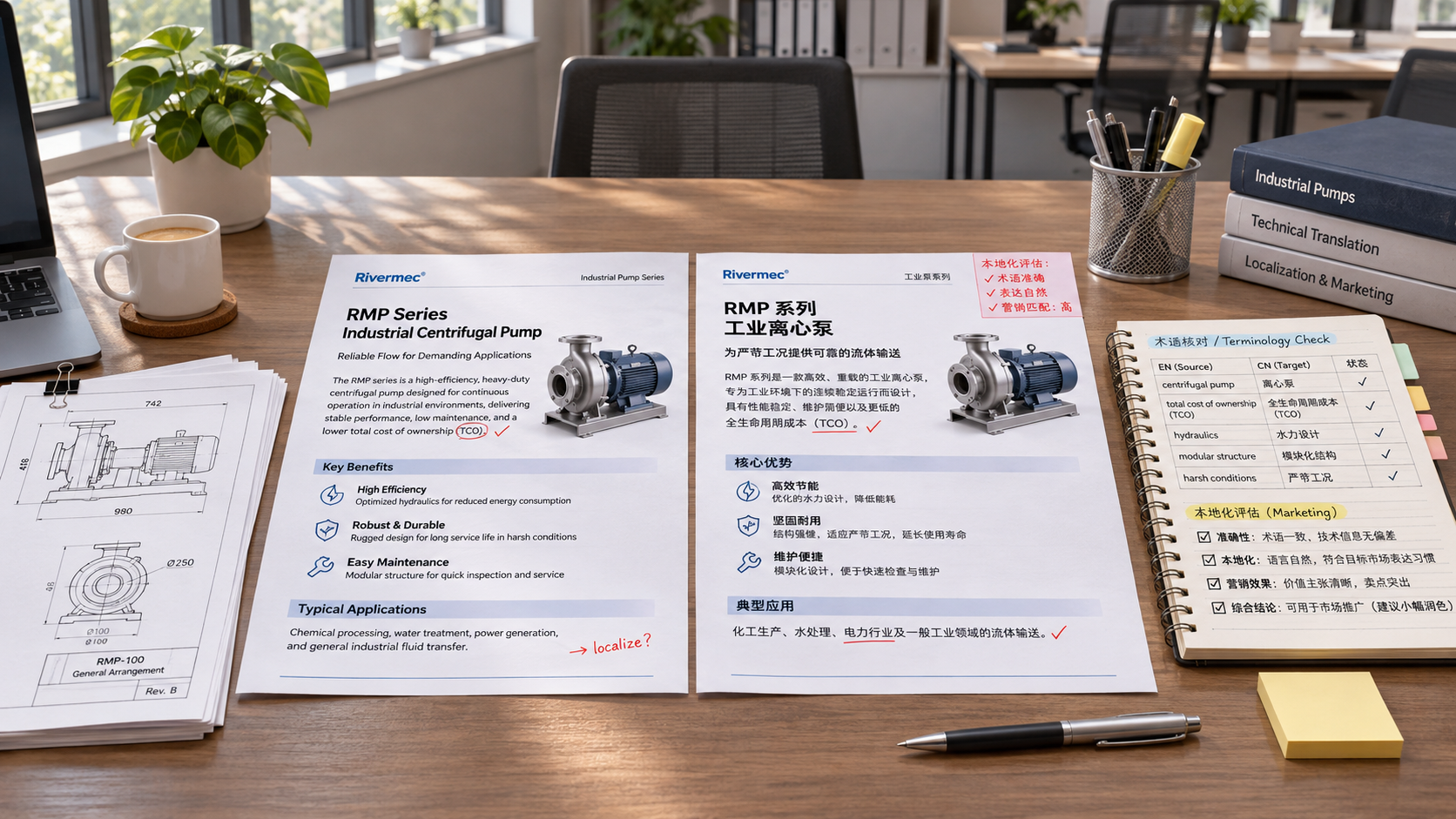
Localization involves more than replacing a few words. Units of measurement, date formats, delivery terms, product specifications, and inquiry methods all affect whether readers feel the page is relevant to their purchasing needs. If the main text is in the local language but the specification table retains unexplained Chinese abbreviations, visitors still have to guess whether the product is suitable.
Work backward from search results in the target market to shape page content
Do not generate foreign-language versions directly from a Chinese keyword list. First define the target country or region, language, and product scope. Then search in the target language for product names, applications, and related questions, and observe the titles, page types, and common phrasing in the results. Search results are only clues for evaluation; copying high-ranking pages does not mean you will achieve the same results.
You can record candidate terms in a spreadsheet and group them by intent: finding suppliers, comparing product specifications, learning about applications, or solving usage problems. Then check whether the website already has a relevant page and whether it can directly answer the question. When intents differ significantly, there is no need to force them onto the same product page. When needs are similar, avoid creating large numbers of pages with duplicate content just to cover variations in keyword forms.
For an industrial equipment page, for instance, if search results mainly show supplier directories and product specification pages, focus on checking product models, key parameters, application scope, and inquiry options. If results mainly show explanations of operating principles or usage tutorials, simply displaying product images and contact details may not be enough. The right approach still depends on the actual search results and whether the company can provide reliable information.
Search volume tools can help prioritize terms, but low search volume does not necessarily mean a term has no value. For specialized terms with precise specifications and clear purchasing intent, it is more important to verify that they match the company’s actual supply capabilities. Conversely, even a broad term with high search volume may attract visitors who are irrelevant to the business.
When revising pages, prioritize elements that affect understanding
Use natural expressions in the target language for titles and main headings. A page title should clearly describe the product or topic, rather than mechanically stringing together multiple synonyms. The main heading can differ from the page title, but both should refer to the same topic. If you use a product name or model, make sure it matches the page content.
Restructure the main text around customer needs instead of copying the original order. Company introductions and promotional statements on Chinese pages can be shortened, while specifications, conditions of use, limitations, and frequently asked questions can be placed where they are easier to find. Do not amplify performance claims through translation if they are not supported by facts. Verify any unconfirmed parameters internally before publishing.
Check that the conversion path has been localized end to end. Navigation, buttons, form prompts, and error messages that remain in Chinese can make visitors less likely to submit an inquiry. Form fields should match business needs, and contact details, response languages, and service scope should be clear to avoid attracting inquiries the company cannot handle.
When targeting the Middle East, also consider Arabic’s right-to-left reading and layout conventions. Check navigation, forms, punctuation, numbers, and mixed-language content on different devices. Arabic-language Industry Website Development and Marketing Solutions covers Arabic website development, right-to-left layouts, and translation and localization, and can serve as a reference when assessing the scope of this type of implementation. Individual pages still need to be reviewed against the language and business information of the target market.
Investigate technical reasons for “translated but no traffic”
Before adjusting content, first confirm that search engines can discover and index the page. Check that the page returns a valid status, is not blocked from crawling, and does not have a noindex directive. Use the webmaster tools provided by search engines to check the page’s indexing status. Submitting a new page does not guarantee immediate indexing; lack of indexing and poor rankings need to be investigated separately.
For multilingual websites, provide separate, stable URLs for different language or regional versions wherever possible, and make sure those pages can be reached through internal links. Where corresponding language versions exist, use hreflang to specify the language and target region, and check that the URLs in the annotations are correct and that the versions correspond to one another. These annotations help search engines understand the relationship between versions, but do not guarantee page rankings or placement in search results.
Also check whether a canonical URL incorrectly points a foreign-language page to the Chinese homepage, and whether automatic redirects prevent users or search engines from accessing the specified language version. Different language pages for the same product can each retain their own canonical URL. Do not assume that all versions should be consolidated under a single Chinese URL merely because they are translations of one another.
Use search data to identify where the problem lies
After a page goes live, use webmaster tools to review organic search performance by country, query, and page. If impressions are high but clicks are low, check whether the title is clear and whether the search intent matches, taking the competition on the search results page into account. If the page gets clicks but few inquiries, review the specification information, form, and business coverage. Do not conclude that translation is the problem based on a single metric.
If the page receives no impressions for relevant queries, first check its indexing status and the wording used in the target language, then assess whether the content is sufficient to address user needs. If the queries it receives are irrelevant to the business, check whether the page’s wording is too broad. After making changes, record what was changed and when. Once enough data has accumulated, compare results for the same country, page, and query category to avoid mistaking seasonal fluctuations or traffic from other channels for the effects of content optimization.
AI translation can be used to generate a first draft and organize terminology, but before publication, someone familiar with both the target language and the product should check technical terms, numbers, exclusions, and delivery statements. Correcting pages that have business value and are already receiving impressions makes it easier to pinpoint problems and verify changes than translating a large number of pages at once without evidence of demand.
Related Articles
 Does Spanish-language content for the Latin American market need to be localized by country?
 Should URLs Be Kept in Their Original Language After Website Content Is Translated?
 How can you evaluate the copywriting capabilities of a marketing website translation provider?

Related Products
 Yiyingbao SaaS Intelligent Website Building and Marketing SystemYiyingbao SaaS Intelligent Website Building and Marketing System, AI-powered no-code website building, rapid creation of multilingual B2B international websites in 10 minutes, global server acceleration, AI-powered SEO optimization, helping businesses connect efficiently with global markets. The perfect integration of technology and operation makes building an international trade website remarkably simple
 AI+SEM Intelligent Advertising Marketing SystemAI+SEM drives intelligent ad creation, empowering full-funnel precision advertising marketing. The system automatically generates weekly/monthly reports, AI recommends keywords and target countries, monitors core metrics in real-time with intelligent alerts, and enables one-click high-conversion ad solutions to help quickly acquire customers and improve ROI.
 AI+SEO Dual-Engine System Optimization ServicesYiyingbao’s AI+SEO dual-engine optimization system helps foreign trade enterprises acquire high-quality organic traffic through AI-powered keyword research, content generation, and comprehensive technical optimization, significantly improving search rankings and conversion rates.
 AI+SNS Social Media Marketing SystemYingbao AI+SNS Social Media Marketing System - Precision social capture for the social media era. Supports one-click content synchronization across major platforms like Facebook and LinkedIn. AI intelligently rewrites posts for enhanced relevance. 24/7 AI customer service and user profiling analysis empower businesses to efficiently expand into global markets.
 AI+SEO营销解决方案易营宝AI+SEO营销解决方案,通过AI批量写作、智能生成TDK、精准关键词扩词等功能,全面优化网站SEO效果,提升流量与转化率。助力企业构建高效智能网站新生态。
 AI+SEM Advertising Marketing SolutionsAI+SEM Advertising Marketing Solution leverages AI technology to deeply empower SEM ad campaigns. It automatically generates weekly/monthly reports using AI, presenting account data across multiple dimensions for comprehensive insights into campaign performance and trends. The system precisely recommends keywords and target countries, intelligently generates high-conversion ad copy, and enables one-click activation of efficient campaign plans to help businesses rapidly acquire customers. Simultaneously, it monitors core metrics in real time, intelligently identifies abnormal fluctuations, and issues timely alerts to ensure stable, high-return advertising results.
 Domain Name ServicesEasyWin provides professional domain name services, including intelligent queries, one-stop registration, brand protection, and full lifecycle management, helping businesses build a digital brand image.
 EasyOperate B2C Cross-Border E-Commerce Platform & Independent WebsiteEasyStore B2C Cross-border E-commerce Independent Store is an intelligent website building and cross-border e-commerce integrated solution independently developed by EasyStore Information Technology (Beijing) Co., Ltd. The system is specially designed for small and medium-sized as well as large export enterprises, integrating 'website building, operation, marketing, advertising, and conversion' into one, helping enterprises quickly establish cross-border e-commerce independent stores to achieve brand globalization and global sales growth.
The platform supports multiple languages, multiple currencies, and multi-channel marketing, with built-in AI intelligent translation and SEO optimization systems, suitable for mainstream markets such as Southeast Asia, Europe and America, Latin America, and the Middle East, assisting Chinese manufacturing enterprises in efficiently deploying international e-commerce strategies. SSL证书易营宝提供专业SSL安全证书服务,包括单域名和泛域名证书,确保网站数据传输加密、身份验证和完整性保护,助力企业建立安全可信的在线业务环境。









