









- Can the average annual growth rate reflect real opportunities in overseas markets?Oct 07, 2026View details
- Which customer acquisition channels will be affected by cross-border marketing trends in 2026?Sep 06, 2026View details
- Which homogenization risks should be considered in an analysis of the AI-powered website building industry?Aug 30, 2026View details
- How Will AI Marketing Trends 2026 Change Advertising Budget AllocationAug 28, 2026View details
- Is the EV SSL certificate market shrinking or upgrading? How should companies assess certificate procurement?Aug 11, 2026View details
- Why the old AMP SEO 2020 practices no longer work and what has changed in current optimization prioritiesAug 02, 2026View details
German Website Optimization Is More Than Translation: Key Factors in Content Localization and Google Rankings
German Website Optimization: The Problem Often Lies Beyond the “German” Itself
German website optimization is not just a matter of language conversion. optimisation site en allemand truly tests whether your pages use expressions accepted by the German-speaking market, respond to local users’ search intent, and enable Google to consistently understand, crawl, and categorize them technically. After launching a German version, many companies find that their pages appear to be “fully translated,” yet indexing is slow, rankings are weak, and bounce rates are high. The problem is usually not whether the vocabulary is correct, but that the entire information structure still follows the logic of a Chinese or English website.
The German market is generally more sensitive to content accuracy, terminology consistency, page credibility, and information completeness. This is especially true in fields such as B2B, industrial manufacturing, equipment, materials, and software services. Users will not submit an inquiry simply because of a promotional slogan. They pay more attention to whether specifications are clear, application boundaries are fully explained, contact details are reliable, and the company’s identity is clearly stated. This is why, even with the same website framework, directly translated German pages and German pages reconstructed through localization can perform significantly differently in organic search.
What Google Sees Is Not a “Translation,” but Topic Signals
From a search engine perspective, a German website is not an auxiliary version of the original site, but an independent content asset in its own language. Google will not assume that a German page is suitable for users in Germany, Austria, or Switzerland simply because it is available in German. It needs to determine whether this group of pages establishes clear semantics around a specific topic, contains content depth that can be verified in a local context, and forms consistent signals through hreflang, URL structure, internal links, title tags, body copy, and structured information.
This is also where many people misunderstand optimisation site en allemand. They focus on “translating Chinese pages into German” while overlooking how search terms are actually used in German-speaking regions. Users may not search using a company’s internal terminology. Instead, they may enter a page through commonly used industry terms, application terms, problem-related queries, or material standards. If an industrial website only retains product descriptions from the headquarters’ perspective without clearly explaining “applications, specifications, compatibility requirements, delivery methods, and after-sales service boundaries,” Google will find it difficult to determine where the page should rank in German search results.
To determine whether German content has genuinely been optimized, you can first examine these areas:
- Do the title and body copy use commonly used local industry terminology rather than directly translated internal expressions?
- Does the page cover the conditions and limitations users care about most when searching for this topic?
- Do the navigation, category pages, and detail pages form a clear topic hierarchy?
- Are contact details, company information, privacy policies, and compliance pages complete and clearly visible?
These elements may appear basic, but they directly determine whether a page is merely a “readable translation” or localized content capable of competing in rankings.
Localization Is Not Polishing; It Is Rewriting the Information Logic
Truly effective German website optimization often requires changes not only to sentences, but also to the content structure. Chinese websites commonly begin by discussing company scale, production capabilities, and service advantages before moving on to products or solutions. In the German market, this narrative order may not be efficient. After entering a page, search users generally want to see information directly related to their needs first before deciding whether to learn more about the company. In other words, the core of a German page is not to “present the company more completely,” but to “help target users confirm more quickly that the page is relevant to them.”
This restructuring is particularly evident for technical or marketing-oriented websites. For example, website development services, SEO services, and cross-border advertising should not merely state that they “cover end-to-end solutions.” Instead, their service boundaries should be broken down: which language sites are supported, whether the technical architecture facilitates crawling, how content production balances localization and indexability, and whether advertising landing pages and organic search pages are managed separately. Such information is itself part of search relevance. 易营宝 has long served multilingual websites, B2B foreign trade sites, cross-border marketplaces, and overseas marketing scenarios. In practice, its approach is closer to the collaborative logic of “technical foundation + localized content + multichannel customer acquisition” rather than simply translating pages or filling them with keywords.
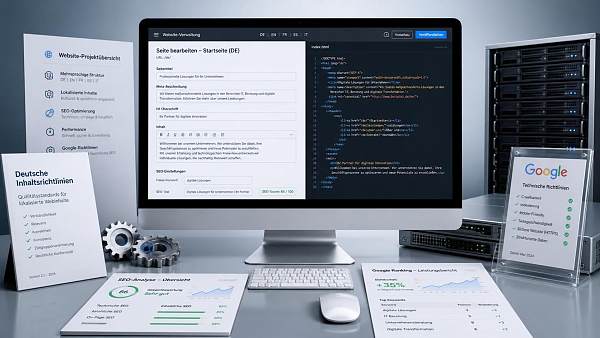
If German optimization is understood as a workflow, it includes at least four layers: language accuracy, semantic alignment, technical crawlability, and verifiable conversion. If any one layer is neglected, the results are usually unstable. Even if the wording on a page is natural, indexing can still be affected if hreflang is disorganized, canonical tags conflict, or there is too much duplicate content. Conversely, even if the technical structure is sound, rankings will be difficult to sustain if the copy merely moves sentence by sentence from the original.
Several Technical Elements Most Easily Overlooked on German Websites
Many companies assume that the challenges of multilingual SEO are all related to content. In reality, technical details determine whether optimization has the basic conditions to get started. There is no absolute answer as to whether German pages should be placed in a subdirectory, subdomain, or separate domain. However, one basic principle applies: the paths, internal links, and canonical rules of each language version must be consistent, so Google can clearly identify the page’s relationship to the site.
Another frequent issue is hreflang. Its role is not to serve as a “translation declaration,” but to tell search engines how different language or regional versions correspond to one another. German does not equal Germany. German content may target Germany, or it may also extend to Austria or Switzerland. If the business has not divided its site into country-specific versions, it should at least ensure that language versions point to one another correctly, avoiding configuration errors such as a German page pointing back to the English page or German and French pages sharing the same canonical.
Another often underestimated issue is duplicate page templates. Many SaaS website-building systems can quickly generate multilingual pages, but if category pages, tag pages, filter pages, and paginated pages lack differentiated content, they can easily create a large number of low-value duplicate pages. During a technical assessment, the question is not only whether the system can generate German pages, but also whether it can control the indexation scope, manage redirects, output standardized metadata, and support the continuous expansion of content.
Content Depth Determines “How Long You Can Rank”
The rankings of a German website do not depend solely on one keyword page rising to the top. They rely more on the completeness of the topic content. For a foreign trade independent site, for example, stable traffic generally comes from a group of mutually supporting pages: core product pages answer “what is it,” application pages answer “who is it suitable for,” FAQs answer “what are the limitations,” and pages covering company information, delivery, after-sales service, and compliance answer “can it be trusted.” This content combination makes it easier for Google to determine the website’s expertise in a particular topic.
There is a common misconception here: treating SEO content as simply writing articles. In practice, high-quality content in many technical industries does not necessarily take the form of news articles. It may consist of explanatory pages, comparison pages, specification pages, and scenario pages. As long as these pages genuinely answer the questions users search for before making a decision, they have lasting search value. Some websites even organize internal knowledge into searchable pages, which is more effective than piling up vague blog posts. Topics such as Innovative Strategies for the Development and Management of Corporate Human Resources in the Knowledge Economy Era, when placed in an appropriate knowledge section or industry insight context, can supplement the site’s content depth in terms of management, organization, or methodology. However, the prerequisite is that they must be compatible with the site’s existing topical signals rather than being inserted mechanically.
During a Technical Assessment, the Focus Should Not Stop at “Whether a German Version Exists”
When evaluating a provider’s German website solution from a technical perspective, the questions worth asking typically include: Is content produced through manual localization, AI assistance, or pure machine translation? Does keyword research distinguish between countries and industry scenarios? Does the site system support hreflang, structured data, indexation control, and multilingual URL standards? When new pages are added, can it maintain template consistency and semantic differentiation? Will advertising landing pages, organic search pages, and brand pages compete with one another for indexation signals?
This is also where an integrated “website + marketing services” solution is more valuable than isolated translation. A German website is not an independent project; it affects SEO, advertising, social media engagement, and inquiry conversion. A service model such as 易营宝’s, which connects website-building systems, AI content capabilities, SEO/GEO optimization, and advertising systems, is suitable for companies that want not only to create a German page but also to complete the overseas customer acquisition process. Especially when a company covers both the German market and other European markets, a unified technical foundation and content governance mechanism make it easier to maintain quality than decentralized outsourcing.
Whether optimisation site en allemand has been implemented effectively can be judged using a direct standard: after German-speaking users enter the page, can they quickly confirm that the company understands their problem? After Google crawls the page, can it clearly determine which topic, language, and type of need this group of content serves? The former determines conversion, while the latter determines ranking. If either side is missing, it is difficult for the site to truly gain traction.
Therefore, the focus of German website optimization has never been to “change the text into German,” but to realign the content, structure, technology, and market context. When evaluating a solution, companies will generally be closer to the actual outcome if they first assess whether the provider can clearly explain the basis for these decisions and then evaluate its execution capabilities, rather than simply comparing prices or the number of pages delivered.
Related Articles
Related Products
 Yiyingbao SaaS Intelligent Website Building and Marketing SystemYiyingbao SaaS Intelligent Website Building and Marketing System, AI-powered no-code website building, rapid creation of multilingual B2B international websites in 10 minutes, global server acceleration, AI-powered SEO optimization, helping businesses connect efficiently with global markets. The perfect integration of technology and operation makes building an international trade website remarkably simple
 AI+SEM Intelligent Advertising Marketing SystemAI+SEM drives intelligent ad creation, empowering full-funnel precision advertising marketing. The system automatically generates weekly/monthly reports, AI recommends keywords and target countries, monitors core metrics in real-time with intelligent alerts, and enables one-click high-conversion ad solutions to help quickly acquire customers and improve ROI.
 AI+SEO Dual-Engine System Optimization ServicesYiyingbao’s AI+SEO dual-engine optimization system helps foreign trade enterprises acquire high-quality organic traffic through AI-powered keyword research, content generation, and comprehensive technical optimization, significantly improving search rankings and conversion rates.
 AI+SNS Social Media Marketing SystemYingbao AI+SNS Social Media Marketing System - Precision social capture for the social media era. Supports one-click content synchronization across major platforms like Facebook and LinkedIn. AI intelligently rewrites posts for enhanced relevance. 24/7 AI customer service and user profiling analysis empower businesses to efficiently expand into global markets.
 AI+SEO营销解决方案易营宝AI+SEO营销解决方案,通过AI批量写作、智能生成TDK、精准关键词扩词等功能,全面优化网站SEO效果,提升流量与转化率。助力企业构建高效智能网站新生态。
 AI+SEM Advertising Marketing SolutionsAI+SEM Advertising Marketing Solution leverages AI technology to deeply empower SEM ad campaigns. It automatically generates weekly/monthly reports using AI, presenting account data across multiple dimensions for comprehensive insights into campaign performance and trends. The system precisely recommends keywords and target countries, intelligently generates high-conversion ad copy, and enables one-click activation of efficient campaign plans to help businesses rapidly acquire customers. Simultaneously, it monitors core metrics in real time, intelligently identifies abnormal fluctuations, and issues timely alerts to ensure stable, high-return advertising results.
 Domain Name ServicesEasyWin provides professional domain name services, including intelligent queries, one-stop registration, brand protection, and full lifecycle management, helping businesses build a digital brand image.
 EasyOperate B2C Cross-Border E-Commerce Platform & Independent WebsiteEasyStore B2C Cross-border E-commerce Independent Store is an intelligent website building and cross-border e-commerce integrated solution independently developed by EasyStore Information Technology (Beijing) Co., Ltd. The system is specially designed for small and medium-sized as well as large export enterprises, integrating 'website building, operation, marketing, advertising, and conversion' into one, helping enterprises quickly establish cross-border e-commerce independent stores to achieve brand globalization and global sales growth.
The platform supports multiple languages, multiple currencies, and multi-channel marketing, with built-in AI intelligent translation and SEO optimization systems, suitable for mainstream markets such as Southeast Asia, Europe and America, Latin America, and the Middle East, assisting Chinese manufacturing enterprises in efficiently deploying international e-commerce strategies. SSL证书易营宝提供专业SSL安全证书服务,包括单域名和泛域名证书,确保网站数据传输加密、身份验证和完整性保护,助力企业建立安全可信的在线业务环境。









