









- Can the average annual growth rate reflect real opportunities in overseas markets?Oct 07, 2026View details
- Which customer acquisition channels will be affected by cross-border marketing trends in 2026?Sep 06, 2026View details
- Which homogenization risks should be considered in an analysis of the AI-powered website building industry?Aug 30, 2026View details
- How Will AI Marketing Trends 2026 Change Advertising Budget AllocationAug 28, 2026View details
- Is the EV SSL certificate market shrinking or upgrading? How should companies assess certificate procurement?Aug 11, 2026View details
- Why the old AMP SEO 2020 practices no longer work and what has changed in current optimization prioritiesAug 02, 2026View details
Google SGE is here: What content and structural adjustments should be made to existing SEO strategies?
Google SGE Is Here: Which Parts and Structures of Existing SEO Strategies Need to Be Adjusted
Google SGE is transforming the search results page from a “link distributor” into an “answer organizer.” This is not merely a change in wording, but a shift in traffic logic. In the past, the core goal of SEO for many businesses was to push pages as high as possible in organic rankings. As generative search gradually enters the results page, however, users may first see AI-generated summaries, comparisons, recommendations, and follow-up questions. Traditional blue links still exist, but the reasons for clicking them are being redefined. For businesses, optimierung für google sge is no longer merely a matter of producing more content; it is about whether content can be extracted, cited, and trusted by machines.
This change has a particularly direct impact on the “website + marketing services integration” industry. In the past, these services emphasized a complete chain covering website development, indexing, rankings, and conversions. That chain has not disappeared, but an additional layer of generative interpretation has been added in the middle. For foreign trade companies, manufacturing factories, and cross-border sellers, the first layer of information users see before making an inquiry is increasingly likely to be a comprehensive presentation assembled by the search system from multiple sources, rather than a single webpage. The clearer the content structure, the more complete the factual information, and the stronger the site’s trust foundation, the more likely it is to enter this layer of visibility.
One of the biggest misconceptions among many businesses today is treating SGE as “writing more AI-friendly articles.” In reality, generative search does not reward vague expansion. Instead, it is more likely to filter out pages that lack source support, have loose paragraph structures, or have unclear topic boundaries. In the past, a long-form article built around a keyword might have been sufficient to cover search intent. Now, the same topic needs to be broken down into citable information units, such as definitions, applicable scenarios, parameter differences, risk warnings, regional differences, purchasing criteria, and common misconceptions. Search systems do not read simply to determine “whether an article is long”; they look for stable, extractable, and cross-verifiable knowledge blocks on the page.
This is why many websites have recently experienced a situation in which the total amount of content has increased, but clicks on high-value keywords have not risen accordingly. It is not that the content has become ineffective; rather, the way the content is organized is still stuck in the traditional SEO era. The first area that truly needs adjustment is page structure. Corporate websites, product pages, solution pages, and knowledge content pages have often been developed separately, with each section written independently. In the context of SGE, this fragmentation weakens topical credibility. A mature website should enable search systems to clearly understand three things: who you are, what problems you solve, and why you deserve to be cited. Brand information, industry scenarios, product capabilities, technical standards, delivery scope, and service regions need to support one another semantically rather than exist in isolation.
In actual projects, Yiyingbao more often sees businesses beginning to place renewed emphasis on the “underlying content infrastructure.” This is especially evident on multilingual websites. In the past, many overseas websites regarded completing the translation as equivalent to launching the site. In practice, this was more like copying Chinese materials into versions in other languages. This approach is becoming increasingly ineffective. The way search queries are expressed, purchasing concerns, and compliance sensitivities differ across markets, and SGE is also more likely to identify differences in local context when compiling answers. Content targeting North America needs to emphasize application validation, compatibility, and deployment efficiency. In Europe, users are often more sensitive to privacy, security, and website trust signals. B2B manufacturing content depends more heavily than consumer-oriented content on parameters, certifications, delivery methods, and case boundaries. Multilingual content is no longer merely about the number of pages; it is about localizing the market’s cognitive structure.
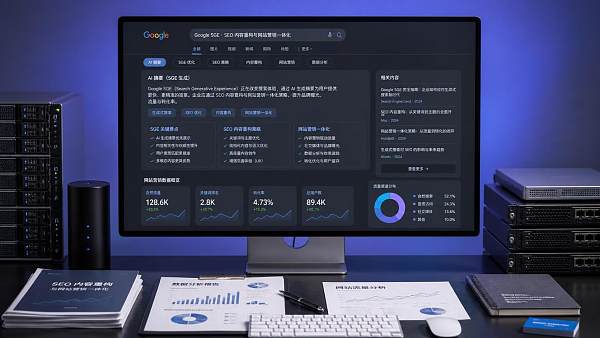
The second adjustment is often underestimated: the development of authority signals needs to shift from an “external-link-oriented” approach to a parallel focus on “verifiable on-site signals + credible off-site citations.” Google has not abandoned its assessment of experience, expertise, authoritativeness, and trustworthiness because of generative search. On the contrary, these signals will become even more important in the era of AI-generated answers. If a business wants its content to be included as a high-quality reference, it cannot rely solely on marketing language; it must strengthen the factual layer. For example, are product parameters complete? Are standard names accurate? Can service capabilities be applied to specific scenarios? Does the page provide clear information about the corporate entity? Are the contact details consistent with the regions served? Can technical capabilities correspond to actual deployment environments? Details that previously affected only conversion rates now also influence whether search systems are willing to “trust you.”
Security and accessibility signals are typical examples. Many businesses regard HTTPS as a basic configuration and stop paying attention once it is implemented. However, in the generative search phase, site security, crawl stability, and content integrity will have a more direct impact on visibility. Take the SSL certificate as an example. If a business can consistently provide HTTPS, support HSTS, reduce mixed-content issues, and ensure that pages can be accessed quickly and completely on both mobile and desktop devices, it is essentially providing search systems with a cleaner crawling environment. This infrastructure will not create a ranking miracle on its own, but when AI summaries rely more heavily on high-quality sources, it will amplify the value of the technical foundation.
The way content is written also needs to change. A common SEO copywriting practice in the past was to continuously expand explanations around a primary keyword in an attempt to capture more long-tail traffic. Now, a more effective approach is “question orientation + evidence-based expression.” For example, when discussing website development, do not merely describe its advantages. Instead, explain which architectures are suitable for different stages of international expansion, where the boundaries lie between independent websites and platform-based traffic, why multilingual websites affect indexing efficiency, and why the conversion paths of inquiry-oriented websites differ from those of brand showcase websites. When discussing advertising, do not focus only on incremental traffic acquisition. Clarify the relationship between organic search, branded keyword growth, remarketing chains, and the accumulation of content assets. SGE prefers content that can answer complex questions rather than content that merely repeats concepts.
There is also a very practical change: the “conversion path” on a corporate website must move forward. When users have already obtained partial answers on the search results page, they are often no longer in the early awareness stage when they click through to a website. Instead, they are closer to comparison, verification, and quotation requests. Pages therefore cannot remain at the level of general introductions. Product pages need to provide applicable scenarios, configuration ranges, and service boundaries more quickly. Solution pages should explain the differences in investment between various business models. Even if case studies or industry pages do not disclose customer names, they should provide reference dimensions such as project type, target market, site structure, or promotional mix whenever possible. Users are not coming to take the introductory lesson again; they are coming to determine whether you are worth engaging with further.
From the perspective of market demand, this round of changes will also accelerate the differentiation of service provider capabilities. Teams that provide only isolated SEO execution will find it increasingly difficult to explain traffic fluctuations, because changes in search results now affect content, technology, site architecture, advertising coordination, and brand signals. By contrast, service providers that can view website development, content, technical optimization, advertising data, and AI search visibility as one system will be more likely to identify new sources of growth. The value of integrated platforms such as Yiyingbao lies not simply in “doing more,” but in connecting content assets, the technical foundation, and the customer acquisition system. SGE will not make SEO disappear, but it will make isolated SEO increasingly difficult to execute.
What is worth continuing to observe is not a single interface update, but whether three signals are strengthening simultaneously: first, the extent to which answer-based summaries on search results pages are penetrating commercial queries; second, the stability of high-quality original content within citation chains; and third, whether the relationship between branded keywords, long-tail question keywords, and direct inquiries is becoming closer again. If these three aspects continue to strengthen, businesses should no longer view their content, technology, and brand budgets separately. Ultimately, optimierung für google sge is not about optimizing a particular button or sentence. It is about building a digital asset that search systems can understand, users can verify, and the business can support and convert.
For decision-makers, the most important thing to avoid at present is not moving slowly, but using old metrics to make new judgments. Looking only at the number of indexed pages, the number of keywords, or short-term fluctuations on a particular page is not enough to explain the actual trend. A more valuable perspective is this: Is your site being seen in more high-intent queries? Can your pages engage visitors who have already been educated? Is the technical foundation stable enough? Does the content have the conditions required to be extracted and cited? Those who organize these issues first will be more prepared for the next stage of search competition. Whether the results will be achieved all at once will still depend on Google’s subsequent product rollout and the depth of implementation in different markets. However, the direction is already very clear: SEO is moving from “competing for rankings” to “competing to be understood, cited, and trusted.”
Related Articles

Related Products
 Yiyingbao SaaS Intelligent Website Building and Marketing SystemYiyingbao SaaS Intelligent Website Building and Marketing System, AI-powered no-code website building, rapid creation of multilingual B2B international websites in 10 minutes, global server acceleration, AI-powered SEO optimization, helping businesses connect efficiently with global markets. The perfect integration of technology and operation makes building an international trade website remarkably simple
 AI+SEM Intelligent Advertising Marketing SystemAI+SEM drives intelligent ad creation, empowering full-funnel precision advertising marketing. The system automatically generates weekly/monthly reports, AI recommends keywords and target countries, monitors core metrics in real-time with intelligent alerts, and enables one-click high-conversion ad solutions to help quickly acquire customers and improve ROI.
 AI+SEO Dual-Engine System Optimization ServicesYiyingbao’s AI+SEO dual-engine optimization system helps foreign trade enterprises acquire high-quality organic traffic through AI-powered keyword research, content generation, and comprehensive technical optimization, significantly improving search rankings and conversion rates.
 AI+SNS Social Media Marketing SystemYingbao AI+SNS Social Media Marketing System - Precision social capture for the social media era. Supports one-click content synchronization across major platforms like Facebook and LinkedIn. AI intelligently rewrites posts for enhanced relevance. 24/7 AI customer service and user profiling analysis empower businesses to efficiently expand into global markets.
 AI+SEO营销解决方案易营宝AI+SEO营销解决方案,通过AI批量写作、智能生成TDK、精准关键词扩词等功能,全面优化网站SEO效果,提升流量与转化率。助力企业构建高效智能网站新生态。
 AI+SEM Advertising Marketing SolutionsAI+SEM Advertising Marketing Solution leverages AI technology to deeply empower SEM ad campaigns. It automatically generates weekly/monthly reports using AI, presenting account data across multiple dimensions for comprehensive insights into campaign performance and trends. The system precisely recommends keywords and target countries, intelligently generates high-conversion ad copy, and enables one-click activation of efficient campaign plans to help businesses rapidly acquire customers. Simultaneously, it monitors core metrics in real time, intelligently identifies abnormal fluctuations, and issues timely alerts to ensure stable, high-return advertising results.
 Domain Name ServicesEasyWin provides professional domain name services, including intelligent queries, one-stop registration, brand protection, and full lifecycle management, helping businesses build a digital brand image.
 EasyOperate B2C Cross-Border E-Commerce Platform & Independent WebsiteEasyStore B2C Cross-border E-commerce Independent Store is an intelligent website building and cross-border e-commerce integrated solution independently developed by EasyStore Information Technology (Beijing) Co., Ltd. The system is specially designed for small and medium-sized as well as large export enterprises, integrating 'website building, operation, marketing, advertising, and conversion' into one, helping enterprises quickly establish cross-border e-commerce independent stores to achieve brand globalization and global sales growth.
The platform supports multiple languages, multiple currencies, and multi-channel marketing, with built-in AI intelligent translation and SEO optimization systems, suitable for mainstream markets such as Southeast Asia, Europe and America, Latin America, and the Middle East, assisting Chinese manufacturing enterprises in efficiently deploying international e-commerce strategies. SSL证书易营宝提供专业SSL安全证书服务,包括单域名和泛域名证书,确保网站数据传输加密、身份验证和完整性保护,助力企业建立安全可信的在线业务环境。









