









- Why the old AMP SEO 2020 practices no longer work and what has changed in current optimization prioritiesAug 02, 2026View details
- How to Choose Topics for an Industry News Section to Attract More Organic Search TrafficJul 29, 2026View details
- Digital Marketing Shenzhen Market Insights: Why Are Companies Expanding Overseas Looking for Growth Teams in Shenzhen?Jul 31, 2026View details
- Can Zhejiang foreign trade independent websites still be developed today? Look at changes in traffic and lead generationJul 28, 2026View details
- What New Signals Are Emerging in Enterprise Services SaaS Marketing ReportsJul 27, 2026View details
- What Does a Global Traffic Ecosystem Service Provider Do? What Are the Differences from a Single Advertising AgencyJul 16, 2026View details
How to Choose an Online Marketing Outsourcing Service Provider? Assess the Risks by Evaluating Team Capabilities and Delivery Scope
How to Choose an Online Marketing Outsourcing Service Provider? Assessing Risks from Team Capabilities to Delivery Boundaries
When choosing an online marketing outsourcing service provider, the most common pitfalls are not that the service is “too expensive” or “too slow,” but that it is mistakenly viewed as a single execution outsourcing service during procurement. In actual business operations, online marketing outsourcing often involves website development, content production, channel advertising, data tracking, lead distribution, and even multilingual adaptation and an understanding of overseas platform rules. If a service provider only handles advertising while the website is managed by someone else, or can build a website but does not understand search and conversion paths, the common result is that every link is operating, but growth cannot be effectively connected.
Therefore, when evaluating this type of project, procurement teams should not focus solely on terms such as “website development,” “SEO,” and “social media operation” in the quotation. Instead, they should first clarify what exactly the other party will deliver: resources, capabilities, or only a specific part of the process leading to results. This distinction is crucial. Many risks do not emerge during contract execution; they have already been embedded during the selection stage.
First, Clarify: Are You Buying Channel Execution or Part of a Growth System?
In the industry, online marketing outsourcing appears to mean handing marketing work over to a third party, but in practice it involves two completely different service models. One focuses on “operational execution,” such as opening advertising accounts, writing several pieces of content, maintaining social media pages, and issuing regular reports. The other focuses on “growth collaboration,” taking website structure, landing pages, search indexing, advertising conversion, and inquiry handling into consideration as a whole. The former is suitable for companies that already have a clear internal strategy but lack execution resources; the latter is more suitable for companies that want to connect their website with marketing but do not have a complete overseas team.
This is why delivery can vary significantly even when the service is called outsourcing. The procurement logic is not at the same level when comparing a service provider responsible only for posting with a team capable of determining whether an independent website is suitable for traffic acquisition, whether it has a foundation for multilingual SEO, and whether it can handle B2B inquiries. Especially in integrated website and marketing service scenarios, if the service provider does not understand site structure, the technical foundation, and data feedback, even the most intensive subsequent advertising may simply direct traffic to a page with weak conversion capabilities.
This issue is even more apparent for foreign trade companies, manufacturing factories, cross-border e-commerce sellers, and brands expanding overseas. Overseas markets are not operated through a single platform; companies often need to address Google search, advertising, Facebook or LinkedIn social media outreach, and different regional language environments at the same time. A service provider that is skilled in only one channel will find it difficult to support truly integrated growth.
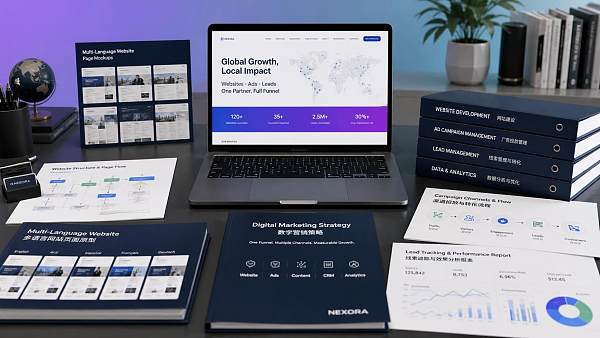
When Assessing Team Capabilities, Do Not Look Only at the Industry Names on the Case Study Page
Many procurement teams review case studies first, which is reasonable, but case studies are also the most likely to be misleading. The fact that a project has gone live does not mean that the service provider truly has a replicable methodology. A more reliable approach is to break down the team’s capabilities rather than focusing only on the displayed results.
At least four aspects should be assessed. The first is strategic capability: can the provider explain whether your target market is better suited to search-based customer acquisition, advertising-based acquisition, or social media entry? The second is content and website coordination: can it design pages and content around inquiry generation, brand awareness, or conversion objectives, rather than assigning the website and marketing to two unrelated teams? The third is data capability: can it establish a tracking chain from traffic to leads? The fourth is hands-on platform experience, including an understanding of the rules and content adaptation requirements of different platforms such as Google, Facebook, LinkedIn, Instagram, and YouTube.
If a service provider emphasizes that it can “do everything,” ask one more question: where does its core capability lie? Truly mature teams usually have a clear understanding of their strengths, the results that require client cooperation, and the metrics that are not suitable for commitment. A team that sounds less “all-powerful” during procurement is often more reliable than one that agrees to everything and deals with the consequences later.
The Technical Foundation Determines Whether Outsourcing Can Continue, Not Just Whether It Can Start
Another often underestimated point in online marketing outsourcing is the technical foundation. When a project involves intelligent website building, multilingual websites, cross-border e-commerce stores, advertising landing pages, and long-term SEO operations, the underlying system directly affects delivery efficiency and long-term sustainability.
A very practical evaluation standard is whether the website can easily support page expansion, whether it supports standardized multilingual management, whether its pages can accommodate both indexing and advertising conversion, whether content updates depend on developers, and whether data tracking and lead forms can be managed in a unified manner. These issues may appear technical, but procurement teams should not simply leave them to the technical department. Once the underlying system lacks the necessary support, every additional market, advertising page, or content format will create extra costs.
For teams that have provided long-term services to overseas markets, more and more service providers are integrating AI website building, content generation, SEO optimization, advertising management, and social media distribution into a unified system. The value of this approach is not that it “sounds advanced,” but that it reduces fragmentation. For example, can independent website content be automatically adapted to social media formats? Can social media interaction data feed back into user profiles? Can customer service conversations be linked with marketing leads? These are not issues that standalone tools can naturally resolve.
If the project itself includes overseas social media operations, tool-based capabilities such as AI+SNS Social Media Intelligent Integrated Marketing System are worth examining carefully. The key is not the system name, but whether it genuinely supports multi-platform account binding, automatic content synchronization, multilingual post generation, and a mechanism for human intervention after high-value customers are identified. The biggest concern in social media operations is not being unable to publish content, but being unable to continuously adapt content to platform rules or handle the interactions that follow.
If Delivery Boundaries Are Not Clearly Defined, the Project Will Probably Depend on Disputes Later
When procuring online marketing outsourcing, the main risk to prevent is not a single operational error, but unclear boundaries. For example, the phrase “responsible for SEO optimization” can refer to many different scopes: some providers only optimize on-page titles and descriptions, some develop content plans, and others also handle technical SEO. The same applies to “responsible for social media operations”: it may mean only posting regularly, or it may include interaction management, advertising coordination, and preliminary lead screening.
Therefore, before signing the contract, it is recommended to clarify at least the following types of issues:
Many disputes in the later stages of a project do not arise because either party did something wrong, but because the two sides have different understandings of what constitutes completion. The more complex the boundaries, the less they should rely solely on verbal promises from sales representatives.
Do Not Overlook Compliance and Security—They Are Not Concerns Only for Large Companies
As long as a project involves overseas marketing, especially social media data, customer forms, advertising accounts, and user information from multiple regions, compliance cannot be treated entirely as a technical detail. Procurement teams should at least confirm whether the service provider has clear plans for account authorization, data storage, permission levels, and customer information management. Authorization mechanisms such as OAuth2.0, sensitive data encryption and storage, GDPR-related requirements, and information security management certifications such as ISO27001 are not the only conditions determining whether to cooperate, but they can help assess whether the provider takes data and process risks seriously.
This is particularly important when social media operations are combined with intelligent customer service. If the system creates user profiles based on interaction behavior, identifies high-value customers, and automatically transfers conversations to human agents, it is even more important to examine permission management and audit trail mechanisms. The more intelligent the functions, the less governance capability should be overlooked.
Service Providers Suitable for Long-Term Cooperation Are Often Not the Ones That Make the Most Promises
From a procurement perspective, good online marketing outsourcing service providers have one clear characteristic: they can clearly distinguish between controllable and uncontrollable factors. For example, SEO is based on long-term accumulation and is not suitable for absolute short-term commitments. Advertising can be launched relatively quickly, but its results are affected by the landing page, product competitiveness, budget, and regional strategy. Social media can increase brand exposure and interaction, but it does not naturally equal inquiry growth unless content, the website, and customer service handling are all connected.
In the field of integrated website and marketing services, truly experienced teams usually place greater emphasis on system capabilities and continuous optimization instead of dividing every channel into isolated packages. For digital marketing platforms such as 易营宝 that have long served overseas markets, the core value lies not only in covering website development, SEO, advertising, and social media, but also in attempting to combine AI, big data, and localized services so that a company’s independent website can be indexed, promoted, and used to handle conversions. For procurement teams, whether this “integration” is genuine should not be determined by promotional language. It should be evaluated through the questions raised above: Does the team understand the business? Can the system provide adequate support? Are the boundaries clearly defined?
If the criteria need to be condensed further, remember this sentence: choosing an online marketing outsourcing service provider is not about finding someone to perform a few tasks for you, but about finding someone who can connect your website, traffic, and leads into a complete chain within clearly defined boundaries. Quotations and case studies can serve as starting points, but the factors that truly determine cooperation quality are the capability structure, the technical foundation, and whether risks are explained in advance.
Related Articles

Related Products
 Yiyingbao SaaS Intelligent Website Building and Marketing SystemYiyingbao SaaS Intelligent Website Building and Marketing System, AI-powered no-code website building, rapid creation of multilingual B2B international websites in 10 minutes, global server acceleration, AI-powered SEO optimization, helping businesses connect efficiently with global markets. The perfect integration of technology and operation makes building an international trade website remarkably simple
 AI+SEM Intelligent Advertising Marketing SystemAI+SEM drives intelligent ad creation, empowering full-funnel precision advertising marketing. The system automatically generates weekly/monthly reports, AI recommends keywords and target countries, monitors core metrics in real-time with intelligent alerts, and enables one-click high-conversion ad solutions to help quickly acquire customers and improve ROI.
 AI+SEO Dual-Engine System Optimization ServicesYiyingbao’s AI+SEO dual-engine optimization system helps foreign trade enterprises acquire high-quality organic traffic through AI-powered keyword research, content generation, and comprehensive technical optimization, significantly improving search rankings and conversion rates.
 AI+SNS Social Media Marketing SystemYingbao AI+SNS Social Media Marketing System - Precision social capture for the social media era. Supports one-click content synchronization across major platforms like Facebook and LinkedIn. AI intelligently rewrites posts for enhanced relevance. 24/7 AI customer service and user profiling analysis empower businesses to efficiently expand into global markets.
 AI+SEO营销解决方案易营宝AI+SEO营销解决方案,通过AI批量写作、智能生成TDK、精准关键词扩词等功能,全面优化网站SEO效果,提升流量与转化率。助力企业构建高效智能网站新生态。
 AI+SEM Advertising Marketing SolutionsAI+SEM Advertising Marketing Solution leverages AI technology to deeply empower SEM ad campaigns. It automatically generates weekly/monthly reports using AI, presenting account data across multiple dimensions for comprehensive insights into campaign performance and trends. The system precisely recommends keywords and target countries, intelligently generates high-conversion ad copy, and enables one-click activation of efficient campaign plans to help businesses rapidly acquire customers. Simultaneously, it monitors core metrics in real time, intelligently identifies abnormal fluctuations, and issues timely alerts to ensure stable, high-return advertising results.
 Domain Name ServicesEasyWin provides professional domain name services, including intelligent queries, one-stop registration, brand protection, and full lifecycle management, helping businesses build a digital brand image.
 EasyOperate B2C Cross-Border E-Commerce Platform & Independent WebsiteEasyStore B2C Cross-border E-commerce Independent Store is an intelligent website building and cross-border e-commerce integrated solution independently developed by EasyStore Information Technology (Beijing) Co., Ltd. The system is specially designed for small and medium-sized as well as large export enterprises, integrating 'website building, operation, marketing, advertising, and conversion' into one, helping enterprises quickly establish cross-border e-commerce independent stores to achieve brand globalization and global sales growth.
The platform supports multiple languages, multiple currencies, and multi-channel marketing, with built-in AI intelligent translation and SEO optimization systems, suitable for mainstream markets such as Southeast Asia, Europe and America, Latin America, and the Middle East, assisting Chinese manufacturing enterprises in efficiently deploying international e-commerce strategies. SSL证书易营宝提供专业SSL安全证书服务,包括单域名和泛域名证书,确保网站数据传输加密、身份验证和完整性保护,助力企业建立安全可信的在线业务环境。









