









- Why the old AMP SEO 2020 practices no longer work and what has changed in current optimization prioritiesAug 02, 2026View details
- How to Choose Topics for an Industry News Section to Attract More Organic Search TrafficJul 29, 2026View details
- Digital Marketing Shenzhen Market Insights: Why Are Companies Expanding Overseas Looking for Growth Teams in Shenzhen?Jul 31, 2026View details
- Can Zhejiang foreign trade independent websites still be developed today? Look at changes in traffic and lead generationJul 28, 2026View details
- What New Signals Are Emerging in Enterprise Services SaaS Marketing ReportsJul 27, 2026View details
- What Does a Global Traffic Ecosystem Service Provider Do? What Are the Differences from a Single Advertising AgencyJul 16, 2026View details
Which companies are suitable for online marketing outsourcing, and when should they get started?
When Should a Company Seriously Consider Marketing Outsourcing
Many companies are not unaware of the need to generate overseas leads. Instead, they are stuck with a more practical problem: the team has not yet been established, advertising and content efforts are inconsistent, and once the website goes live, no one continues to optimize it. In such cases, online marketing outsourcing is often not a question of “whether to try it,” but rather “whether to start now or continue handling everything internally for a while longer.”
For decision-makers, the key to determining the right time to outsource is not how large the company is, but whether its business objectives, internal capabilities, and growth pace are clearly out of alignment. The following are essentially the questions companies ask most frequently—and most often misjudge—before selecting a service provider.
Which Companies Are Best Suited to Start Outsourcing Early?
The most typical examples are three types of companies: foreign trade businesses that are just beginning to expand overseas, cross-border sellers preparing to build an independent website, and manufacturing factories that previously relied on trade shows or existing customers but now need to generate leads online.
The common issue these companies face is not that they have “no budget at all,” but that they lack mature international marketing capabilities internally. For example, they may be able to build a website but do not know how to create a multilingual structure, plan search terms, set up advertising accounts, or adjust marketing materials according to market needs. They can certainly experiment gradually on their own, but the trial-and-error period is often lengthy. This is especially true in more competitive markets such as North America, Europe, and Southeast Asia. If the first six months are missed, the cost of catching up later will be higher.
If a company has already decided to develop overseas channels but does not have a complete team, outsourcing should usually be brought in during the website planning stage rather than after the site has been completed, advertising budgets have been spent, and lead quality has become unstable.
What Signals Indicate That Internal Efficiency Will Continue to Decline Without Outsourcing?
There are three direct signals to look for.
- The website, SEO, advertising, and social media are handled by different people, but no one is ultimately responsible for lead results.
- Advertising spending continues, but the quality of forms, inquiries, and captured leads fluctuates significantly, while management cannot obtain consistent performance reviews.
- The business owner or person in charge of business personally monitors keywords, revises pages, and urges the team to provide marketing materials, indicating that the system is not operating smoothly.
Continuing to struggle internally at this point may appear to save service fees, but in reality it consumes team time, causes the company to miss valuable leads, and separates website, content, and advertising data. For decision-makers, the real focus should not be the execution cost of an individual task, but whether the lead-generation activities form a closed loop.
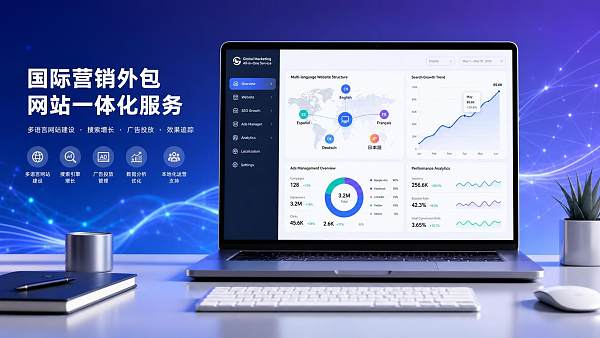
Is Online Marketing Outsourcing Only Suitable for Large Companies with Sufficient Budgets?
No. Many small and medium-sized enterprises are actually more suited to outsourcing because what they lack most is not direction, but a multidisciplinary team that can implement strategies quickly. A complete overseas marketing process typically involves website development, content, search optimization, advertising, data analysis, and lead follow-up at a minimum. Hiring all of these roles internally is not only slow, but can also lead to the problem of having “the people in place, but the methods not yet working.”
A more reasonable way to assess this is to look at two factors: first, whether the company has clearly defined markets and products; and second, whether its current internal team can execute consistently for three to six months. If the former is clear but the latter is insufficient, outsourcing has practical value.
Can Outsourcing Start Before the Website Is Completed?
Yes—and in many cases, it should start earlier. Overseas marketing is not as simple as “build a website first and then find ways to promote it.” A website designed to generate inquiries has a completely different structure from one that only presents company information. The former needs to address indexing, loading speed, conversion paths, form design, multilingual logic, and how subsequent SEO and advertising landing pages will connect.
If website development and marketing are planned separately, common problems later include pages that look good but do not convert, or advertising that performs but leads to a poor landing experience. The value of an integrated service such as Yiyingbao, which covers intelligent website development, SEO, advertising, and social media, lies precisely here: rather than carrying out only one individual task, it designs the website and lead-generation process together, reducing the need for rework later.
At Which Stages Is the Value of Outsourcing Most Evident?
There are generally four stages that are suitable for starting outsourcing, and the focus of outsourcing differs at each stage.
Many poor decisions occur precisely here: a company has clearly entered an expansion stage but still uses the marketing setup intended for the launch stage. As a result, the more channels it adds, the more disorganized its management becomes.
What Should a Company Prepare Internally Before Outsourcing?
There is no need to prepare everything perfectly, but several items must be clarified; otherwise, it will be difficult for the service provider to achieve real results.
- Target market: The difference between starting with North America and starting with Southeast Asia is significant.
- Core products: Which products are the main focus and which are only for display.
- Conversion objective: Whether the goal is inquiries, orders, appointments, or distributor recruitment.
- Sales contact: Who will follow up when a lead arrives and how quickly they will respond.
- Basic materials: Product images, specifications, qualification documents, case descriptions, and other content that can be used for pages and advertising.
Many companies attribute all problems to marketing, but the speed of sales follow-up and the completeness of information are equally important in the conversion process. Marketing is responsible for bringing people in, but internal processes must be able to handle them so that they can become opportunities.
To What Extent Should a Company Outsource Without Losing Its Core Capabilities?
A relatively reliable approach is to outsource execution and system capabilities while retaining business judgment and customer understanding internally. For example, keyword research, website construction, technical SEO optimization, advertising account management, and data dashboards can be assigned to a service provider. However, product selling points, target customer selection, pricing strategies, and sales follow-up are best controlled by the company itself.
If a company delegates all market-related decisions externally, it may save effort in the short term, but it will generally lose its ability to conduct reviews in the long term. Truly effective online marketing outsourcing does not mean that the client becomes a complete bystander. Instead, it enables the company to avoid unnecessary detours while gradually building its own basis for decision-making.
How Can You Tell Whether a Service Provider Can Execute Tasks or Deliver Results?
Looking at three things is enough.
- Can it clearly explain how to integrate the website, SEO, advertising, and social media into the same conversion process?
- Do its reports include business metrics, rather than merely surface-level data such as impressions, clicks, and follower numbers?
- Does it have localized execution capabilities, especially for multilingual pages, advertising in different regions, and content adaptation?
If a service provider is only good at executing individual tasks, the company will still need to handle the integration itself later. For companies preparing to develop overseas markets over the long term, integrated capabilities are usually more worth comparing than individual service prices.
Which Hidden Costs Are Most Easily Underestimated When Making an Outsourcing Decision?
The costs most likely to be overlooked are not service fees, but traffic costs, rework costs, and coordination costs. This is especially true when promoting an independent website. Once website traffic increases, server performance, bandwidth, and access stability will all affect conversions. The impact is even more apparent during major e-commerce promotions, content distribution, and access from multiple regions worldwide.
If a company is already operating an overseas website, supporting solutions such as website traffic packages are worth evaluating together. They are suitable for global business scenarios, can lock in traffic costs through prepayment, prioritize the deduction of outbound traffic charges, and support integration with website-building systems, BI analysis, and automated procurement processes. For teams that need to keep budgets under control while avoiding temporary fixes during traffic peaks, this type of foundational configuration is often more important than it may initially appear.
Does a Company Still Need Outsourcing If It Already Has a Marketing Department?
That depends on what the marketing department lacks. Having a team does not mean that its capabilities are complete. In many companies, the internal marketing department is more experienced in brand materials, trade show support, and coordination with domestic channels, but has limited experience in overseas search optimization, Google advertising, social media operations, and multilingual page management.
In this situation, outsourcing does not replace the internal team; it fills gaps in specialized functions. The internal team handles direction, products, and coordination, while the external team handles tools, systems, and ongoing execution. This is usually faster and more effective than building a new team from scratch.
The Final Assessment Before Starting: Act Now or Wait?
A practical standard can be used to make the decision: if the company clearly plans to obtain overseas leads through online channels in the next six months, but still lacks a stable website system, advertising mechanism, and data review capabilities internally, it is not advisable to wait any longer. The longer the company waits, the losses are often not simply “doing a little less marketing,” but the accumulated costs caused by missed market opportunities, depleted team resources, and incorrect approaches.
Conversely, if product positioning has not yet been finalized, target markets are still constantly changing, and the sales team is not able to handle leads, the company should first clarify its internal direction before starting outsourcing. The most effective time to outsource is never when a company is at its most chaotic, but when its objectives are clear and its execution capabilities are clearly unable to keep up.
Related Articles
Related Products
 Yiyingbao SaaS Intelligent Website Building and Marketing SystemYiyingbao SaaS Intelligent Website Building and Marketing System, AI-powered no-code website building, rapid creation of multilingual B2B international websites in 10 minutes, global server acceleration, AI-powered SEO optimization, helping businesses connect efficiently with global markets. The perfect integration of technology and operation makes building an international trade website remarkably simple
 AI+SEM Intelligent Advertising Marketing SystemAI+SEM drives intelligent ad creation, empowering full-funnel precision advertising marketing. The system automatically generates weekly/monthly reports, AI recommends keywords and target countries, monitors core metrics in real-time with intelligent alerts, and enables one-click high-conversion ad solutions to help quickly acquire customers and improve ROI.
 AI+SEO Dual-Engine System Optimization ServicesYiyingbao’s AI+SEO dual-engine optimization system helps foreign trade enterprises acquire high-quality organic traffic through AI-powered keyword research, content generation, and comprehensive technical optimization, significantly improving search rankings and conversion rates.
 AI+SNS Social Media Marketing SystemYingbao AI+SNS Social Media Marketing System - Precision social capture for the social media era. Supports one-click content synchronization across major platforms like Facebook and LinkedIn. AI intelligently rewrites posts for enhanced relevance. 24/7 AI customer service and user profiling analysis empower businesses to efficiently expand into global markets.
 AI+SEO营销解决方案易营宝AI+SEO营销解决方案,通过AI批量写作、智能生成TDK、精准关键词扩词等功能,全面优化网站SEO效果,提升流量与转化率。助力企业构建高效智能网站新生态。
 AI+SEM Advertising Marketing SolutionsAI+SEM Advertising Marketing Solution leverages AI technology to deeply empower SEM ad campaigns. It automatically generates weekly/monthly reports using AI, presenting account data across multiple dimensions for comprehensive insights into campaign performance and trends. The system precisely recommends keywords and target countries, intelligently generates high-conversion ad copy, and enables one-click activation of efficient campaign plans to help businesses rapidly acquire customers. Simultaneously, it monitors core metrics in real time, intelligently identifies abnormal fluctuations, and issues timely alerts to ensure stable, high-return advertising results.
 Domain Name ServicesEasyWin provides professional domain name services, including intelligent queries, one-stop registration, brand protection, and full lifecycle management, helping businesses build a digital brand image.
 EasyOperate B2C Cross-Border E-Commerce Platform & Independent WebsiteEasyStore B2C Cross-border E-commerce Independent Store is an intelligent website building and cross-border e-commerce integrated solution independently developed by EasyStore Information Technology (Beijing) Co., Ltd. The system is specially designed for small and medium-sized as well as large export enterprises, integrating 'website building, operation, marketing, advertising, and conversion' into one, helping enterprises quickly establish cross-border e-commerce independent stores to achieve brand globalization and global sales growth.
The platform supports multiple languages, multiple currencies, and multi-channel marketing, with built-in AI intelligent translation and SEO optimization systems, suitable for mainstream markets such as Southeast Asia, Europe and America, Latin America, and the Middle East, assisting Chinese manufacturing enterprises in efficiently deploying international e-commerce strategies. SSL证书易营宝提供专业SSL安全证书服务,包括单域名和泛域名证书,确保网站数据传输加密、身份验证和完整性保护,助力企业建立安全可信的在线业务环境。









