









- Which customer acquisition channels will be affected by cross-border marketing trends in 2026?Sep 06, 2026View details
- Which homogenization risks should be considered in an analysis of the AI-powered website building industry?Aug 30, 2026View details
- How Will AI Marketing Trends 2026 Change Advertising Budget AllocationAug 28, 2026View details
- Is the EV SSL certificate market shrinking or upgrading? How should companies assess certificate procurement?Aug 11, 2026View details
- Why the old AMP SEO 2020 practices no longer work and what has changed in current optimization prioritiesAug 02, 2026View details
- How to Choose Topics for an Industry News Section to Attract More Organic Search TrafficJul 29, 2026View details
Few inquiries from Google Ads? Should you check the keywords or the landing page first?
Fewer Inquiries from Google Ads? Check the Keywords or Landing Page First
When Google Ads campaigns generate no inquiries for a long time, many teams first think about increasing the budget, changing the creatives, or blaming the highly competitive nature of the industry. In practice, however, a low number of inquiries is often not caused by a single issue, but by a break somewhere in the entire conversion journey after traffic enters the website. Inaccurate keywords bring in irrelevant traffic; an ineffective landing page makes it difficult to generate form submissions, emails, or WhatsApp inquiries even when the traffic itself is relevant.
So, which should be checked first—the keywords or the landing page? The answer is not one or the other; it depends on the data and the stage where the problem is identified. For most B2B companies, especially those in foreign trade, manufacturing, and global brand expansion, the biggest risk is that “everything appears to have been done,” while the keywords, ad copy, page information, trust elements, and conversion actions do not actually match one another.
Without an integrated website and marketing perspective, ad optimization can easily remain limited to the account level. In the end, there are clicks and spending, but the sales team still says, “There are no leads.”
Before Changing the Page, Determine Whether the Problem Occurs “Before” or “After” Site Entry
A practical way to assess the situation is to break ad performance into two stages: first, whether the user was brought in accurately; and second, whether the user was persuaded after arriving.
If the ad receives impressions and has a decent click-through rate, but the search terms report contains a large number of broad terms, informational queries, recruitment terms, competitor-related terms, or traffic unrelated to the actual business, check the keywords first. These issues directly affect all subsequent data: the bounce rate is high, time on site is short, and the conversion rate is low. It may look like a page problem, but the real issue is that the wrong people arrived.
Conversely, if the keywords are already relatively focused—for example, users are searching for specific products, services, suppliers, customization, or manufacturers with clear commercial intent—and the ads consistently generate clicks but inquiries remain low, the landing page deserves closer attention. In B2B businesses, users generally do not submit an inquiry simply because of an attractive banner. They care more about whether you can meet their requirements, what you have done before, which markets you have delivered to, whether communication is convenient, and whether risks are controllable.
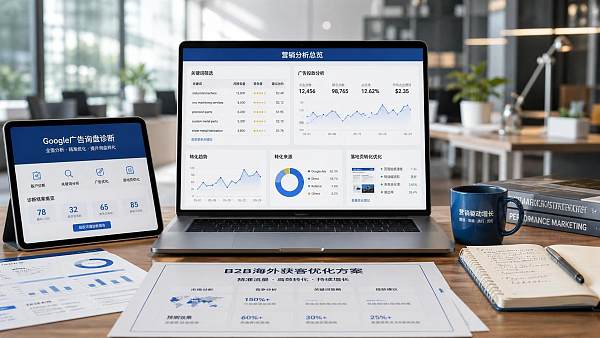
Signs That Keywords Are the Primary Problem
Many account problems are not caused by “not bidding on keywords,” but by overly broad match types and inadequate search-intent management. In Google Ads inquiry-generation campaigns, broad match without supporting negative keywords, segmentation by country and language, or separate ad groups for high-intent terms can easily consume the budget on people who are merely browsing.
There are several common signals. First, there are many clicks, but the search terms are clearly informational, such as “what is,” “how to,” “tutorial,” “free,” or “sample images.” Second, traffic from different countries is mixed together, causing the ad copy and landing page content to become misaligned. Third, too many keywords with different intentions are placed in the same ad group, such as brand terms, category terms, application terms, and price terms. The system may still run, but conversions are difficult to stabilize. Fourth, lead quality is poor: the contacts are students, competitors, or occasional individual buyers rather than purchasing staff or project managers.
In these situations, the first step is not to make major changes to the website, but to review the search terms report, match types, negative keywords, and regional and language settings. If the account has not clearly defined “who should come,” even a well-designed landing page will have its conversions dragged down by irrelevant traffic.
Signs That the Landing Page Is Holding Performance Back
Some companies face the opposite situation: the keyword selection is not bad, and the ad click cost is within an acceptable range, but inquiries still do not come in. In this case, the issue is often not that the traffic is inaccurate, but that the page has failed to persuade visitors.
The most typical problem is a disconnect between the ad promise and the page content. For example, the ad says “custom manufacturing,” “fast quotations,” and “multilingual services,” but after clicking, the user sees a presentation-oriented corporate homepage with no core products, service scope, delivery regions, or clear inquiry entry point above the fold. B2B buyers are not there to admire the design; they are there to decide whether it is worth contacting you.
Another frequent issue is that the page information is not sufficiently business-oriented. Many corporate websites are comprehensive but not well suited for advertising conversions. Product parameters may be too general, industry application scenarios may be unclear, and the page may lack certifications, production capabilities, packaging and shipping information, lead-time details, after-sales policies, or easily accessible contact information. For overseas visitors, the more cross-border the decision-making process is, the more quickly trust must be established.
Another often-overlooked issue is that the form itself discourages users. Too many fields, no feedback after submission, poor usability on mobile devices, and slow page loading can all cause visitors who originally had intent to leave immediately.
What Really Affects Inquiries Is Not a Single Page but the Entire Conversion Journey
Many operators view advertising and websites separately: the advertising account belongs to the media buyer, the website belongs to the web development company, and the content belongs to the business department. As a result, everyone completes part of the work, but no one takes responsibility for the inquiry result. In actual projects, whether Google Ads can generate inquiries depends on whether four elements connect properly: whether the keywords reflect genuine purchasing intent, whether the ad copy addresses the search motivation, whether the landing page answers core concerns, and whether the conversion path is short enough.
This is why more and more companies are focusing on integrated website and marketing services. It is not simply because “one-stop” sounds convenient, but because conversion issues inherently cross departmental boundaries. Problems seen in the account often originate on the page; after the page is improved, it may become apparent that the search terms are still not clean enough. Splitting the work is possible, but communication costs are significantly higher.
In scenarios such as foreign trade companies, multilingual websites, and cross-regional advertising, the journey is even more complex. Users in different countries have different priorities, and the emphasis of English, Russian, and Arabic pages is not exactly the same. If a page is only mechanically translated, the inquiry rate may still be unsatisfactory even when the ads generate clicks.
How to Troubleshoot More Efficiently: Review Four Groups of Data in Order
If the account is already running, review four groups of signals first instead of immediately deciding that “the page must be the problem” or “the keywords must be inaccurate.”
The first group includes impressions, click-through rate, and search-term content. These answer one main question: whether the ads are attracting the right people. The second group includes post-visit bounce rate, time on page, scrolling, and button clicks, which indicate whether users are willing to learn more. The third group concerns the conversion actions themselves, including form submissions, phone clicks, and instant-chat initiations, confirming whether the page is actually guiding users to take action. The fourth group is lead quality. If many forms are submitted but sales follow-up reveals that the contacts do not match the target audience, the problem returns to keywords and audience filtering.
There is a practical principle here: if there are not even many high-intent clicks, do not rush to optimize the page; if high-intent clicks already exist but no one converts, prioritize the page and conversion mechanism. Getting the order wrong will repeatedly consume time.
A B2B Landing Page Does Not Generate More Inquiries Simply Because It Is “Comprehensive”
Many companies have highly informative corporate websites, but an advertising landing page does not necessarily need to copy the structure of the main website. Advertising traffic arrives with a clear purpose, so the page should first answer the questions users care about most at that moment: Do you provide this product or service? Can you solve my specific need? Why should I trust you? How can I contact you now?
Therefore, truly effective pages are often not those with the most sections, but those with the shortest path. The above-the-fold section should clearly state the target customers, product capabilities, or solution direction. The middle section can add application scenarios, delivery capabilities, supported regions, and multilingual communication options. Only further down should it present case types, frequently asked questions, qualification documents, or process information. A form does not necessarily become more professional by being longer. In many cases, retaining only the necessary fields to obtain valid contact information first and allowing sales to continue the screening process leads to smoother conversions.
For companies doing business overseas, the page must also take loading speed, mobile experience, and localized expression into account. A website that appears fine in China may have completely different loading speeds and reading habits in the Middle East, Latin America, or Southeast Asia. If these issues are not addressed, account optimization will be difficult.
Why More Teams Are Integrating Website Development, Advertising, and SEO into One System
Advertising-based lead generation is not an isolated action. Many companies initially focus only on short-term advertising, only to discover later that the page structure is unfavorable for organic search indexing, the content cannot accumulate long-tail traffic, and leads stop as soon as the ads stop. This is especially true in B2B industries, where decision-making cycles are long and inquiry paths are complex. Relying on a single channel is usually unstable.
This is also why an integrated website and marketing service platform such as Yiyingbao can address practical issues more effectively. It does not simply build websites or only manage advertising campaigns, but views intelligent website building, SEO optimization, advertising, social media lead generation, and multilingual content operations as one connected journey. For companies targeting markets in North America, Europe, Southeast Asia, Japan and South Korea, the Middle East, and Russian-speaking regions, this collaborative value is highly practical: a website is not finished once it goes live; it must continuously support promotion, indexing, and conversion.
Yiyingbao Information Technology (Beijing) Co., Ltd. was established in 2013 and is headquartered in Beijing. It has long focused on global digital marketing services driven by AI and big data. What deserves particular attention is not a single feature, but its placement of AI-powered intelligent website building, advertising systems, SEO, and GEO optimization systems within a unified framework to help companies build overseas independent websites that can be promoted, indexed, and converted. For teams dealing with “clicks from ads but no growth in inquiries,” this integrated approach is closer to the root of the problem than focusing solely on account metrics.
If You Need to Take Action Now, Prioritize These Steps
First, export the search terms from the recent period and manually classify them into high-intent, low-intent, and irrelevant terms. Do not rely entirely on system recommendations; this step most clearly reveals whether the account has deviated from its intended direction.
Next, review the above-the-fold section of the landing page: Does the headline match the ad promise? Does it explain within a few seconds what you do, whom you serve, and how to contact you? Then check the form, buttons, chat tools, and mobile loading speed to confirm that users are not getting stuck at a technical or interaction point.
If you are also working on SEO or overseas social media, do not let the advertising page become an “isolated island.” Pages that can support organic search, accumulate content, and be reused across different markets generally make it easier to optimize customer acquisition costs over time.
Ultimately, when Google Ads generate too few inquiries, the question should not simply be “the keywords or the landing page?” A more accurate question is: At which step between the user’s search and inquiry submission did the journey fail to connect? Once this is identified, optimization can become effective. If you cannot determine the cause for now, at least do not focus only on the budget. Review keyword quality and the page’s ability to persuade within the same framework, and the right direction will usually become much clearer.
Related Articles

Related Products
 Yiyingbao SaaS Intelligent Website Building and Marketing SystemYiyingbao SaaS Intelligent Website Building and Marketing System, AI-powered no-code website building, rapid creation of multilingual B2B international websites in 10 minutes, global server acceleration, AI-powered SEO optimization, helping businesses connect efficiently with global markets. The perfect integration of technology and operation makes building an international trade website remarkably simple
 AI+SEM Intelligent Advertising Marketing SystemAI+SEM drives intelligent ad creation, empowering full-funnel precision advertising marketing. The system automatically generates weekly/monthly reports, AI recommends keywords and target countries, monitors core metrics in real-time with intelligent alerts, and enables one-click high-conversion ad solutions to help quickly acquire customers and improve ROI.
 AI+SEO Dual-Engine System Optimization ServicesYiyingbao’s AI+SEO dual-engine optimization system helps foreign trade enterprises acquire high-quality organic traffic through AI-powered keyword research, content generation, and comprehensive technical optimization, significantly improving search rankings and conversion rates.
 AI+SNS Social Media Marketing SystemYingbao AI+SNS Social Media Marketing System - Precision social capture for the social media era. Supports one-click content synchronization across major platforms like Facebook and LinkedIn. AI intelligently rewrites posts for enhanced relevance. 24/7 AI customer service and user profiling analysis empower businesses to efficiently expand into global markets.
 AI+SEO营销解决方案易营宝AI+SEO营销解决方案,通过AI批量写作、智能生成TDK、精准关键词扩词等功能,全面优化网站SEO效果,提升流量与转化率。助力企业构建高效智能网站新生态。
 AI+SEM Advertising Marketing SolutionsAI+SEM Advertising Marketing Solution leverages AI technology to deeply empower SEM ad campaigns. It automatically generates weekly/monthly reports using AI, presenting account data across multiple dimensions for comprehensive insights into campaign performance and trends. The system precisely recommends keywords and target countries, intelligently generates high-conversion ad copy, and enables one-click activation of efficient campaign plans to help businesses rapidly acquire customers. Simultaneously, it monitors core metrics in real time, intelligently identifies abnormal fluctuations, and issues timely alerts to ensure stable, high-return advertising results.
 Domain Name ServicesEasyWin provides professional domain name services, including intelligent queries, one-stop registration, brand protection, and full lifecycle management, helping businesses build a digital brand image.
 EasyOperate B2C Cross-Border E-Commerce Platform & Independent WebsiteEasyStore B2C Cross-border E-commerce Independent Store is an intelligent website building and cross-border e-commerce integrated solution independently developed by EasyStore Information Technology (Beijing) Co., Ltd. The system is specially designed for small and medium-sized as well as large export enterprises, integrating 'website building, operation, marketing, advertising, and conversion' into one, helping enterprises quickly establish cross-border e-commerce independent stores to achieve brand globalization and global sales growth.
The platform supports multiple languages, multiple currencies, and multi-channel marketing, with built-in AI intelligent translation and SEO optimization systems, suitable for mainstream markets such as Southeast Asia, Europe and America, Latin America, and the Middle East, assisting Chinese manufacturing enterprises in efficiently deploying international e-commerce strategies. SSL证书易营宝提供专业SSL安全证书服务,包括单域名和泛域名证书,确保网站数据传输加密、身份验证和完整性保护,助力企业建立安全可信的在线业务环境。









