









- Which customer acquisition channels will be affected by cross-border marketing trends in 2026?Sep 06, 2026View details
- Which homogenization risks should be considered in an analysis of the AI-powered website building industry?Aug 30, 2026View details
- How Will AI Marketing Trends 2026 Change Advertising Budget AllocationAug 28, 2026View details
- Is the EV SSL certificate market shrinking or upgrading? How should companies assess certificate procurement?Aug 11, 2026View details
- Why the old AMP SEO 2020 practices no longer work and what has changed in current optimization prioritiesAug 02, 2026View details
- How to Choose Topics for an Industry News Section to Attract More Organic Search TrafficJul 29, 2026View details
- Digital Marketing Shenzhen Market Insights: Why Are Companies Expanding Overseas Looking for Growth Teams in Shenzhen?Jul 31, 2026View details
- Can Zhejiang foreign trade independent websites still be developed today? Look at changes in traffic and lead generationJul 28, 2026View details
Which pages and features are essential before launching an AI-powered website quickly?
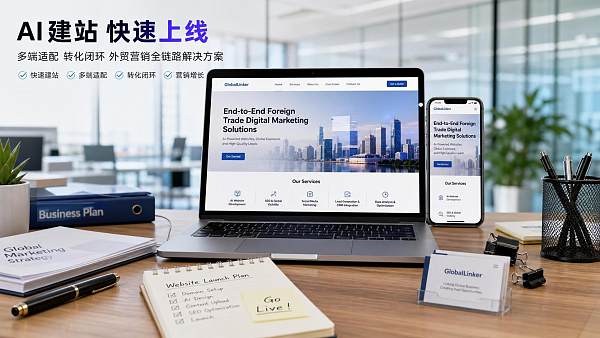
AI website building for rapid launch is becoming a practical choice for many foreign trade enterprises and international expansion teams seeking to shorten project cycles. For project managers and engineering project leaders, the real challenge is not “building a website in a few days,” but whether the website can still be promoted, indexed, used to handle inquiries, and continuously iterated after launch. Many projects, in a rush to meet milestones, regard a website as merely a collection of accessible pages. As a result, one month after launch they discover that traffic is not coming in, advertising landing pages provide poor support for conversions, business teams find the content too shallow, and sales teams cannot obtain qualified leads.
Therefore, the value of AI website building does not lie in compressing the website development process, but in building an operational foundation in less time. Within this foundation, some pages and functions can be added later, while others cannot be omitted. Once they are omitted, the cost of adding them later is often higher than building them in from the start.
From a project perspective, first determine what the “launch objective” is
Even when the goal is the rapid launch of an AI-built website, the definition of “deliverable” can vary greatly from one company to another. The most common pitfall for project leaders is treating technical launch as business launch.
If the website is only intended as a temporary brand placeholder, the pages can be relatively lightweight. However, if it must support Google indexing, advertising campaigns, overseas inquiry handling, and engagement with multilingual markets immediately after launch, the minimum configuration cannot be designed as a simple “showcase website.” Especially in the B2B foreign trade context, a website is often not the final destination but a central node in the lead-generation process. Simplifying front-end pages, omitting fields, or skipping basic SEO settings will amplify problems in subsequent advertising and conversion stages.
A relatively sound approach is to divide the launch objectives into three categories at the project initiation stage:
- Whether it is responsible for validating brand credibility;
- Whether it is responsible for search engine indexing and serving as an entry point for organic traffic;
- Whether it is responsible for inquiry conversion and sales lead collection.
As long as either of the latter two objectives is required, the core pages and basic functions should not be handled using an ultra-minimal approach.
These pages should not be omitted because they determine whether visitors continue browsing
From an engineering execution perspective, many companies build the homepage and product pages first, believing that this is enough for launch. In reality, user journeys do not consist of users viewing only the homepage. Overseas buyers, distributors, and partners often cross-check a company’s background, industry capabilities, delivery experience, and contact reliability. When the pages are incomplete, the chain of trust is broken.
At least several types of pages should be included in the initial project scope.
The homepage must not be merely a cover page introducing the company. The homepage’s task is not to pile up information, but to help visitors quickly determine who you are, what you do, which markets you serve, what your core advantages are, and where they should click next. AI-generated page copy can be produced quickly, but if the homepage lacks clear industry positioning, product category entrances, application-scenario entrances, and conversion buttons, users may still become lost after entering the site.
Product or service detail pages must not stop at “name + image.” For B2B companies, detail pages need to answer the core questions of procurement and technical teams: specifications, application scenarios, applicable industries, customization scope, delivery methods, and frequently asked questions. If the project leader postpones this part, subsequent SEO content, advertising landing pages, and links sent by sales staff will all be constrained.
The About Us page should not be omitted. Many teams believe that this page does not directly generate conversions, but the opposite is often true. For new customers making initial contact, company qualifications, factory capabilities, team background, service regions, and development history are important bases for deciding whether to continue communicating. In overseas trade scenarios in particular, the cost of building trust in unfamiliar markets is higher, and the absence of this page can directly affect visitors’ willingness to leave their contact details.
The Contact page must exist independently. Simply placing an email address in the footer does not count as completion. An independent Contact page should at least include a form, email, telephone or instant communication methods such as WhatsApp, an office address or service-region information, and basic privacy notices. For advertising campaigns and inquiry handling, the clearer the contact path, the lower the conversion loss.
Case studies, applications, or industry solution pages should be brought forward whenever possible. If a company already has established customer cases, project experience, or typical applications, presenting them by industry, scenario, or problem orientation is more persuasive than making vague introductions. For engineering leaders, although organizing this type of content can be time-consuming in the early stage, it is often a key step in improving lead quality.
Do not focus only on the number of pages; make sure the conversion path is complete
A common misjudgment in project management is to understand website delivery as the “page launch completion rate.” In actual business operations, what matters more is whether the visitor journey is smooth.
A basic closed loop generally includes: entering a page through search or advertising, understanding the company and its products, assessing credibility, expressing a need, submitting a lead, and enabling sales follow-up. If this chain is interrupted at any point, the website may perform poorly even if it goes live on schedule.
Therefore, several functions should not be omitted even during the rapid-launch stage.
Form system. This is not simply a matter of leaving a “Contact Us” option. Form fields should be designed according to business complexity: they should not be so lengthy that they affect the submission rate, nor so short that sales teams cannot obtain useful information. In the foreign trade B2B context, it is recommended that the form collect at least the company name, contact person, email address, inquiry type, product area, or message content. If CRM integration will be required later, the field logic should be standardized from the beginning.
Clear CTA layout. Many websites do have conversion buttons, but the buttons are placed inappropriately. The first screen of the homepage, product detail pages, case pages, footer, and Contact page should form a continuous guidance path rather than providing only one entry point in the top navigation.
Mobile adaptation. This is often underestimated. In overseas traffic, the proportion of mobile visits is not low in many industries【To be verified; the specific proportion varies considerably by industry and region】. If forms are difficult to complete on mobile devices, images load too slowly, or button touch areas are too small, the conversion loss will be immediate and substantial.
Basic data tracking. If visitor statistics, conversion events, and source identification are not properly configured at launch, it will be difficult to determine later whether the problem lies in traffic quality, page content, or the conversion path. Project leaders do not necessarily need to build a complex data system in the first phase, but they should at least ensure that subsequent analysis is possible.
For websites intended for overseas promotion, basic SEO elements cannot wait until “Phase Two”
Many teams regard SEO as work for the content operations stage, believing that the website can be launched first and optimized later. The problem is that if certain basic capabilities are not handled properly during website development, later rework may affect the structure, URLs, and indexing stability, and may even slow the entire promotion schedule.
For companies planning to grow through organic traffic, the following basic elements should not be omitted.
Readable and standardized URL structure. If AI website building generates confusing paths, parameterized pages, or link structures that are difficult to manage in the pursuit of speed, subsequent SEO and content expansion will become difficult.
Editable page titles, descriptions, and H tags. Without control over these basic elements, it is almost impossible to systematically optimize search performance later.
Sitemap, robots settings, and basic indexing mechanisms. These are fundamental capabilities that enable search engines to discover a site. They are not complicated, but they must not be overlooked.
Page-loading performance. Oversized images, redundant scripts, and an overloaded first screen are among the most common problems in rapid website development. For project leaders, performance is not merely a technical metric; it directly affects bounce rate, advertising quality, and search performance.
Multilingual logic. If the target markets involve multiple languages, this cannot be understood simply as “machine-translating several pages.” URL rules, switching methods, content independence, and indexing logic for different language versions all need to be planned from the beginning. Otherwise, expanding into additional languages later will become increasingly disorganized.
Often-overlooked “trust functions” frequently determine inquiry quality
In foreign trade and international expansion scenarios, many buyers will not submit an inquiry simply because a website looks attractive. They care more about whether the company is genuine, stable, and capable of delivering. For this reason, some functions that may not appear technically impressive are actually critical.
Company information display. This includes the company’s full name, business regions, establishment date, and manufacturing or service capabilities. The more ambiguous the information, the more likely overseas customers are to hesitate.
Certificates, qualifications, or compliance statements. If the company operates in an industry with certification requirements, such as materials, equipment, electronics, or medical products, displaying available compliance information can significantly increase trust. Do not include information that cannot be confirmed. It is better to be concise than to pile up inaccurate qualifications.
Privacy policy and basic compliance pages. If the website targets overseas markets and collects information through forms, privacy notices should not be completely ignored. Data compliance requirements vary by region, so the specific applicable rules should be determined in light of the target market. For cross-regional business, professional legal or compliance teams may be consulted.
Moderate use of instant communication tools. Tools such as online chat, WhatsApp, and Messenger can indeed make contact more convenient, but too many pop-ups can interfere with reading, especially on mobile devices. Projects need to balance “making contact convenient” with “avoiding disruption.”
In rapid-launch projects, the key issue to avoid is not having too few functions, but having the wrong structure
Based on execution experience, the most costly rework in AI website-building projects is usually not adding one more page of content, but rebuilding the information architecture. For example, unclear product categorization may require the navigation to be redesigned later; arbitrary URL naming may require 301 redirects later; and using one set of content for different markets may require the site to be separated into multilingual sites later. These issues may not seem fatal during the rapid-launch stage, but once SEO, advertising, and content expansion begin, they will emerge all at once.
When shortening the project schedule, project leaders should prioritize preserving three things: a clear page hierarchy, a complete conversion path, and future scalability. In other words, the first version does not need to cover everything, but it must ensure that adding content, languages, and channels later will not require starting over.
This is also why “being able to launch” and “being able to operate” are two different things. The former addresses the delivery milestone, while the latter determines marketing efficiency and lead generation.
A minimum viable solution suitable for rapid launch should meet at least these criteria
If a company wants to go live within a relatively short period without weakening the foundation for subsequent promotion, a more practical approach is not to pursue completeness all at once, but to ensure that the first phase has the minimum operational capabilities.
This standard generally includes:
- All core pages are available: homepage, product/service pages, About Us, and Contact page;
- At least one complete conversion path is functional;
- The mobile browsing and submission experience is acceptable;
- Basic SEO control elements are available;
- The structure reserves room for multilingual functionality and future expansion;
- Data tracking and lead-receiving mechanisms are connected.
For project managers, what is truly worth pursuing in the rapid launch of an AI-built website is not reducing website development time to the absolute minimum, but prioritizing and correctly implementing the elements that cannot be omitted within a limited schedule. Only then will the website be more than a static showcase after launch; it will become infrastructure capable of supporting promotion, validating the market, and enabling business growth.
If the website is viewed as part of an overseas customer-acquisition system, the criteria for selecting pages and functions become clear: anything that affects indexing, trust, conversion, and future expansion should not be omitted; anything that affects only visual completeness without affecting the business loop can instead be optimized during subsequent iterations. This approach is more aligned with actual project needs than simply pursuing a “faster launch.”
Related Articles



Related Products
 Yiyingbao SaaS Intelligent Website Building and Marketing SystemYiyingbao SaaS Intelligent Website Building and Marketing System, AI-powered no-code website building, rapid creation of multilingual B2B international websites in 10 minutes, global server acceleration, AI-powered SEO optimization, helping businesses connect efficiently with global markets. The perfect integration of technology and operation makes building an international trade website remarkably simple
 AI+SEM Intelligent Advertising Marketing SystemAI+SEM drives intelligent ad creation, empowering full-funnel precision advertising marketing. The system automatically generates weekly/monthly reports, AI recommends keywords and target countries, monitors core metrics in real-time with intelligent alerts, and enables one-click high-conversion ad solutions to help quickly acquire customers and improve ROI.
 AI+SEO Dual-Engine System Optimization ServicesYiyingbao’s AI+SEO dual-engine optimization system helps foreign trade enterprises acquire high-quality organic traffic through AI-powered keyword research, content generation, and comprehensive technical optimization, significantly improving search rankings and conversion rates.
 AI+SNS Social Media Marketing SystemYingbao AI+SNS Social Media Marketing System - Precision social capture for the social media era. Supports one-click content synchronization across major platforms like Facebook and LinkedIn. AI intelligently rewrites posts for enhanced relevance. 24/7 AI customer service and user profiling analysis empower businesses to efficiently expand into global markets.
 AI+SEO营销解决方案易营宝AI+SEO营销解决方案,通过AI批量写作、智能生成TDK、精准关键词扩词等功能,全面优化网站SEO效果,提升流量与转化率。助力企业构建高效智能网站新生态。
 AI+SEM Advertising Marketing SolutionsAI+SEM Advertising Marketing Solution leverages AI technology to deeply empower SEM ad campaigns. It automatically generates weekly/monthly reports using AI, presenting account data across multiple dimensions for comprehensive insights into campaign performance and trends. The system precisely recommends keywords and target countries, intelligently generates high-conversion ad copy, and enables one-click activation of efficient campaign plans to help businesses rapidly acquire customers. Simultaneously, it monitors core metrics in real time, intelligently identifies abnormal fluctuations, and issues timely alerts to ensure stable, high-return advertising results.
 Domain Name ServicesEasyWin provides professional domain name services, including intelligent queries, one-stop registration, brand protection, and full lifecycle management, helping businesses build a digital brand image.
 EasyOperate B2C Cross-Border E-Commerce Platform & Independent WebsiteEasyStore B2C Cross-border E-commerce Independent Store is an intelligent website building and cross-border e-commerce integrated solution independently developed by EasyStore Information Technology (Beijing) Co., Ltd. The system is specially designed for small and medium-sized as well as large export enterprises, integrating 'website building, operation, marketing, advertising, and conversion' into one, helping enterprises quickly establish cross-border e-commerce independent stores to achieve brand globalization and global sales growth.
The platform supports multiple languages, multiple currencies, and multi-channel marketing, with built-in AI intelligent translation and SEO optimization systems, suitable for mainstream markets such as Southeast Asia, Europe and America, Latin America, and the Middle East, assisting Chinese manufacturing enterprises in efficiently deploying international e-commerce strategies. SSL证书易营宝提供专业SSL安全证书服务,包括单域名和泛域名证书,确保网站数据传输加密、身份验证和完整性保护,助力企业建立安全可信的在线业务环境。









