









- Why the old AMP SEO 2020 practices no longer work and what has changed in current optimization prioritiesAug 02, 2026View details
- How to Choose Topics for an Industry News Section to Attract More Organic Search TrafficJul 29, 2026View details
- Digital Marketing Shenzhen Market Insights: Why Are Companies Expanding Overseas Looking for Growth Teams in Shenzhen?Jul 31, 2026View details
- Can Zhejiang foreign trade independent websites still be developed today? Look at changes in traffic and lead generationJul 28, 2026View details
- What New Signals Are Emerging in Enterprise Services SaaS Marketing ReportsJul 27, 2026View details
- What Does a Global Traffic Ecosystem Service Provider Do? What Are the Differences from a Single Advertising AgencyJul 16, 2026View details
How to Create a B2B Keyword Expansion Table That Balances Traffic and Lead Quality
How to Create a B2B Keyword Expansion Table That Balances Traffic and Inquiry Quality
How can you create a B2B keyword expansion table that captures search traffic while improving inquiry quality? Many teams focus on "finding more keywords" at the beginning. As a result, the table becomes increasingly extensive, the content becomes increasingly scattered, and the final outcome is growing traffic without a corresponding increase in inquiries. The problem is often not a lack of execution, but the failure to consider keywords, customer intent, purchasing stages, and landing page capabilities together from the outset.
For B2B businesses, keywords are not simply tools for collecting traffic; they are preliminary filters for sales leads. Especially in integrated website and marketing service scenarios, if a keyword expansion table serves only SEO without considering website structure, content depth, form design, regional languages, and subsequent advertising coordination, it can easily result in a situation where "the keywords rank, but the customers are not a good fit."
Therefore, a truly useful B2B keyword expansion table is not just a keyword list, but a strategic map that balances customer acquisition efficiency and inquiry quality.
Before Expanding Keywords, First Determine What Kind of Inquiries You Want
When many operators receive a task, they only know that they need to work on industry keywords, product keywords, and long-tail keywords. However, in B2B businesses, the value of different types of inquiries can vary significantly. Some prospects are looking for wholesale procurement, some are seeking OEM/ODM cooperation, some only want to download specifications, and others may even be conducting research on competitors. The keywords may appear relevant on the surface, but their commercial value can be completely different.
Therefore, before creating the table, you should answer at least three questions: Who is your ideal customer? At what stage will the customer search? Does your team currently need more traffic or more high-intent leads? For example, common high-quality keywords for manufacturing websites are not necessarily the broadest product keywords. Instead, they may be combined keywords containing clear purchasing intent, such as "supplier," "manufacturer," "OEM," "bulk order," and "custom." By contrast, some highly descriptive, educational, or informational keywords may easily generate exposure but may not necessarily produce effective inquiries.
If this step is not thought through clearly, the subsequent keyword expansion, grouping, and page creation will all be misaligned.
A Usable Table Should Contain at Least These Columns
A genuinely useful B2B keyword expansion table should not stop at "keyword + search volume." Search volume is only a reference and is far from sufficient. A more practical approach is to place keywords in a structure that supports evaluation and execution.
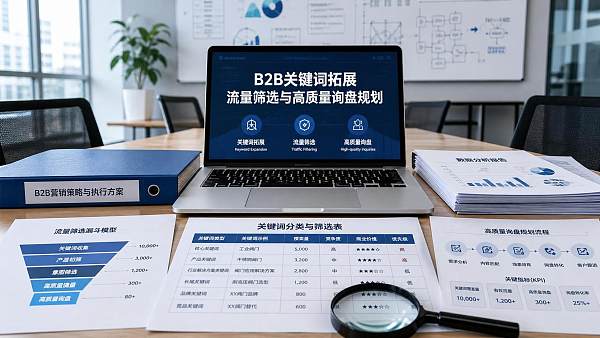
You will find that once the table includes columns such as "intent," "stage," and "page alignment," many keywords that initially appear worth pursuing are naturally filtered out. It is not that these keywords lack traffic, but that they may not suit your current business stage or your website may not be able to effectively support them yet.
High-Quality Inquiries Are Often Found in Low-Volume but High-Intent Keywords
B2C businesses often pursue scale, while B2B businesses place greater emphasis on effectiveness. One hundred visitors from broad, untargeted traffic in a month may not be as valuable as 10 highly interested procurement visitors. The most common operational mistake is to prioritize high-search-volume keywords while overlooking search expressions that are actually closer to conversion.
A common way to assess keywords is as follows: keywords modified by terms such as "price," "supplier," "manufacturer," "factory," "custom," "wholesale," "bulk," "quotation," and "specification" are generally closer to commercial decision-making. By contrast, overly broad industry concepts, definition terms, and trend-related keywords may be suitable for building awareness and content entry points, but they do not necessarily deserve most of your early-stage resources.
Of course, you should not go to the other extreme and focus only on bottom-of-funnel keywords. High-intent keywords are often more directly competitive, limited in number, and constrained in content potential. A more balanced approach is to divide keywords into three levels: the upper level for awareness and coverage, the middle level for comparison and filtering, and the lower level for inquiry conversion. This allows the website content structure and marketing activities to work together instead of operating independently.
Design the Keyword Table Together with the Website Structure, or It Will Lack Depth
Many companies assign keyword research to the content team and website development to the website team, which often leads to a typical problem: the keywords are right, but the pages are wrong. For example, keywords that should be supported by solution pages are placed in news pages; keywords suitable for product category pages are split into numerous weak pages; and some multilingual websites simply translate keywords based on Chinese-language thinking, even though users in the target market do not search that way at all.
This is why more and more companies are now emphasizing the integrated coordination of websites and marketing. A keyword table is not an independent document. It directly affects site categories, URL planning, internal linking logic, content production efficiency, and even subsequent advertising landing pages and remarketing strategies. The value of platform-based service providers such as 易营宝, which cover intelligent website building, SEO optimization, advertising, and multilingual operations, lies precisely here: rather than simply providing a single-point tool, they handle "where keywords come from, how pages support them, how traffic is distributed, and how inquiries are captured" within one integrated framework. For foreign trade companies, manufacturing plants, and brands expanding overseas, this type of coordination is often more practical than purchasing a keyword database tool separately.
Finding Keyword Sources Is Not Difficult; Establishing Filtering Criteria Is
There is no shortage of sources for B2B keyword expansion. Search suggestions, competitor pages, on-site searches, sales chat records, customer emails, trade fair Q&A, search term reports from advertising campaigns, and even questions frequently asked of presales customer service can all serve as valuable keyword sources. What truly creates a difference is whether you have a consistent set of filtering criteria.
In practice, you can focus on four dimensions. First, is the relevance sufficient? Does the keyword directly correspond to your product, service, or solution? Second, is the intent clear? Are people searching for this keyword trying to learn or looking for a supplier? Third, are the conditions for supporting the keyword mature? Does your website have sufficient content, case studies, specifications, or form design to support it? Fourth, does the market match? Some keywords may work in English-speaking markets, but their wording and conversion patterns may be completely different in Russian-speaking regions, Japan and South Korea, or the Middle East. This usually requires assessment based on local language habits rather than direct translation alone.
If the filtering criteria are unclear, the keyword table may look comprehensive, but execution will be highly disorganized: pages will overlap, keywords will not match pages, the content team will not know where to start, and sales will complain that the leads are "not precise enough."
Do Not Overlook Negative Filtering; It Has a Major Impact on Inquiry Quality
When creating an expansion table, many people only think about adding keywords and rarely consider removing them. In fact, negative filtering is especially important for B2B customer acquisition. Terms such as "free," "job," "course," "definition," "used," and "repair" may naturally deviate from the target customer in certain industries. Some keywords with DIY, learning, recruitment, or after-sales repair intent may not have low relevance, but their commercial objectives are not aligned.
These decisions affect not only the layout of SEO content but also the subsequent performance of search advertising accounts. If your organic search and advertising campaigns follow two separate sets of logic, you will often need to spend more to rework them later. By contrast, if the keyword table marks both "target keywords" and "excluded keywords" from the beginning, overall efficiency will be much higher.
After Completing the Table, What Really Matters Is Whether It Can Be Implemented
The problem for many teams is not that they do not know how to expand keywords, but that they have no next step after completing the table. To determine whether a B2B keyword expansion table is qualified, you can work backward from several outcomes: Can it clearly identify which keywords should be addressed first and which later? Can it be matched to specific pages and content owners? Can it provide sales with a clearer customer profile? Can it support coordinated distribution across SEO, advertising, social media, and even AI search content?
If it cannot achieve these objectives, the table is merely a database, not an operational tool.
In overseas marketing scenarios, this ability to implement is particularly important. Since 2013, 易营宝 has continued to provide intelligent website building and global digital marketing services. Its core approach is not to treat SEO as an isolated project, but to use its self-developed website building system, AI advertising marketing system, and AI+SEO/GEO optimization system to create a closed loop among websites, content, traffic channels, and conversion activities. For execution teams, this means that the keyword expansion table does not have to stop at the "keyword discovery" stage; it can be further integrated into page planning, content prioritization, and coordinated deployment across multiple channels.
If you are rebuilding your keyword system, the first things worth checking are not the number of keywords, but three key points: Have they been organized by purchasing stage? Do they correspond one-to-one with website pages? Are "high traffic" and "high intent" being evaluated within the same framework? Once these three aspects are handled properly, a B2B keyword expansion table can truly balance traffic and inquiry quality rather than merely appearing complete in a spreadsheet.
Related Articles
Related Products
 Yiyingbao SaaS Intelligent Website Building and Marketing SystemYiyingbao SaaS Intelligent Website Building and Marketing System, AI-powered no-code website building, rapid creation of multilingual B2B international websites in 10 minutes, global server acceleration, AI-powered SEO optimization, helping businesses connect efficiently with global markets. The perfect integration of technology and operation makes building an international trade website remarkably simple
 AI+SEM Intelligent Advertising Marketing SystemAI+SEM drives intelligent ad creation, empowering full-funnel precision advertising marketing. The system automatically generates weekly/monthly reports, AI recommends keywords and target countries, monitors core metrics in real-time with intelligent alerts, and enables one-click high-conversion ad solutions to help quickly acquire customers and improve ROI.
 AI+SEO Dual-Engine System Optimization ServicesYiyingbao’s AI+SEO dual-engine optimization system helps foreign trade enterprises acquire high-quality organic traffic through AI-powered keyword research, content generation, and comprehensive technical optimization, significantly improving search rankings and conversion rates.
 AI+SNS Social Media Marketing SystemYingbao AI+SNS Social Media Marketing System - Precision social capture for the social media era. Supports one-click content synchronization across major platforms like Facebook and LinkedIn. AI intelligently rewrites posts for enhanced relevance. 24/7 AI customer service and user profiling analysis empower businesses to efficiently expand into global markets.
 AI+SEO营销解决方案易营宝AI+SEO营销解决方案,通过AI批量写作、智能生成TDK、精准关键词扩词等功能,全面优化网站SEO效果,提升流量与转化率。助力企业构建高效智能网站新生态。
 AI+SEM Advertising Marketing SolutionsAI+SEM Advertising Marketing Solution leverages AI technology to deeply empower SEM ad campaigns. It automatically generates weekly/monthly reports using AI, presenting account data across multiple dimensions for comprehensive insights into campaign performance and trends. The system precisely recommends keywords and target countries, intelligently generates high-conversion ad copy, and enables one-click activation of efficient campaign plans to help businesses rapidly acquire customers. Simultaneously, it monitors core metrics in real time, intelligently identifies abnormal fluctuations, and issues timely alerts to ensure stable, high-return advertising results.
 Domain Name ServicesEasyWin provides professional domain name services, including intelligent queries, one-stop registration, brand protection, and full lifecycle management, helping businesses build a digital brand image.
 EasyOperate B2C Cross-Border E-Commerce Platform & Independent WebsiteEasyStore B2C Cross-border E-commerce Independent Store is an intelligent website building and cross-border e-commerce integrated solution independently developed by EasyStore Information Technology (Beijing) Co., Ltd. The system is specially designed for small and medium-sized as well as large export enterprises, integrating 'website building, operation, marketing, advertising, and conversion' into one, helping enterprises quickly establish cross-border e-commerce independent stores to achieve brand globalization and global sales growth.
The platform supports multiple languages, multiple currencies, and multi-channel marketing, with built-in AI intelligent translation and SEO optimization systems, suitable for mainstream markets such as Southeast Asia, Europe and America, Latin America, and the Middle East, assisting Chinese manufacturing enterprises in efficiently deploying international e-commerce strategies. SSL证书易营宝提供专业SSL安全证书服务,包括单域名和泛域名证书,确保网站数据传输加密、身份验证和完整性保护,助力企业建立安全可信的在线业务环境。









