









- Why the old AMP SEO 2020 practices no longer work and what has changed in current optimization prioritiesAug 02, 2026View details
- How to Choose Topics for an Industry News Section to Attract More Organic Search TrafficJul 29, 2026View details
- Digital Marketing Shenzhen Market Insights: Why Are Companies Expanding Overseas Looking for Growth Teams in Shenzhen?Jul 31, 2026View details
- Can Zhejiang foreign trade independent websites still be developed today? Look at changes in traffic and lead generationJul 28, 2026View details
- What New Signals Are Emerging in Enterprise Services SaaS Marketing ReportsJul 27, 2026View details
- What Does a Global Traffic Ecosystem Service Provider Do? What Are the Differences from a Single Advertising AgencyJul 16, 2026View details
Is AI-generated content at scale reliable? Which pages are most likely to create indexing risks?
Is AI batch-generated article content reliable? The answer is not simply “reliable” or “unreliable.” In terms of content production efficiency, AI can indeed significantly reduce writing costs. However, when it comes to SEO results, the real risk is often determined not by whether the content was written by AI, but by what type of page the content appears on and the quality and structure with which search engines crawl and evaluate it.
Many businesses mistakenly believe that as long as an article is original text, it will naturally have a chance of being indexed. In reality, the opposite is often true. Category pages, tag pages, scraped-content pages, low-quality translated pages, and large numbers of programmatic pages with nearly identical value are often more likely than standard article pages to trigger indexing problems. Understanding this is essential for improving efficiency without turning a website into a site with “a lot of content but very little indexed content.”
Is AI batch-generated article content reliable? First determine whether you are solving an efficiency problem or an SEO problem
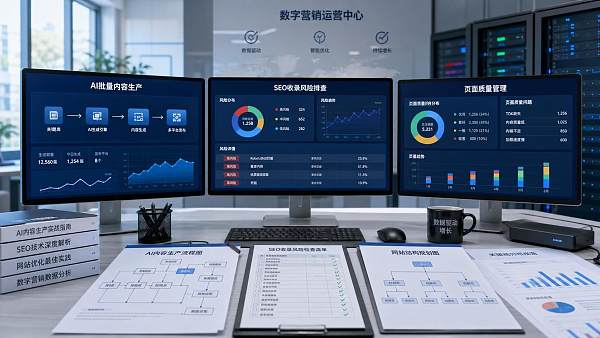
If your goal is simply to quickly supplement basic content, AI batch-generated articles can be useful. AI is suitable for organizing reference materials, expanding topics, preparing initial product descriptions, rewriting content in multiple languages, and building content frameworks. It can be particularly helpful in shortening the time required for marketing teams to launch content.
However, if your goal is to improve organic indexing, rankings, and inquiry conversion, the evaluation standard cannot stop at whether the content has been written. Search engines pay greater attention to whether a page provides genuinely new information, satisfies search intent, contains large-scale duplication, and forms a healthy content structure across the entire site.
In other words, AI can participate in content production, but it cannot replace content strategy. The truly reliable approach is to let AI handle efficiency-enhancing tasks, while editors, SEO specialists, and business personnel complete topic selection, page segmentation, fact checking, and value enhancement. Content produced in this way has a better chance of achieving stable indexing.
What target readers really care about is not whether content can be written, but whether it will be judged as low quality
Readers searching for “Is AI batch-generated article content reliable?” are usually not primarily trying to learn about AI writing tools. Their core intent is to determine whether publishing AI-generated content in batches will affect website indexing, hurt SEO, or create additional remediation costs later.
For corporate marketing managers, operations personnel, and webmasters, the main concerns are usually three questions. First, which types of pages are the most dangerous? Second, which types of content can safely use AI? Third, how can they balance production capacity, indexing, and conversion instead of merely accumulating page numbers?
Therefore, a genuinely valuable article should not devote extensive space to general introductions such as “What is AI?” or “How do search engines view AI?” Instead, it should directly tell readers which pages carry high risks, why those risks occur, what signals indicate that a website has entered a low-quality indexing state, and how to make adjustments.
Which types of pages are most likely to create indexing risks?
In practice, the pages most likely to cause problems are not a small number of high-quality AI-assisted articles, but page types that are mass-produced, highly repetitive, and lacking in clear search value. They often consume crawl budget and reduce the perceived content quality of the site as a whole.
The first category is tag pages and filter pages. Many websites automatically generate large numbers of aggregation pages based on “keyword + tag,” but the main content on these pages is extremely thin. The titles may differ, while the body text is almost identical. From a search engine’s perspective, such pages often lack independent value and may be indexed repeatedly or not indexed at all.
The second category is scraped-content pages and pseudo-original aggregation pages. On the surface, these pages may contain a substantial amount of text and may even have been rewritten by AI, but their core information still comes from other websites, with highly similar viewpoints, structures, and examples. Such pages generally lack credibility and have difficulty building sustainable ranking potential.
The third category is low-quality translated pages. This is especially common on websites targeting overseas markets. If Chinese content is simply machine-translated into English, Spanish, or another language without terminology correction, optimization for local expression, and contextual rewriting, the result can be a page where “the language is technically understandable, but users cannot really read it.”
The fourth category is programmatic batch-generated article pages. For example, replacing only regional terms, product terms, or industry terms to generate hundreds of articles that “appear different.” Although such content may be original in form, if the actual information gain is weak, search engines may still regard it as low-value templated content.
The fifth category is category pages themselves. Many companies focus only on article pages while neglecting category pages whose introductions are nearly empty, or filling them with summaries without providing topic descriptions, content navigation, or internal relationships. As a result, category pages cannot effectively support core keywords or form a clear topical structure within the site.
Why do these pages carry higher risks while some AI articles are indexed normally?
The reason is not the AI tool itself, but whether the page genuinely satisfies search intent. What search engines need to determine is not who wrote the content, but whether the page is helpful, complete, and trustworthy, and whether it provides useful information beyond existing results.
An article completed with AI assistance but supplemented by human examples, industry experience, data explanations, and clear conclusions is often more valuable than a purely human-written article that is vague and repetitive. Conversely, a group of seemingly fluent pages with no practical viewpoints or differentiated information may struggle to achieve ideal indexing even if they were not written by AI.
Therefore, the essence of the problem is “low-value mass production,” not “AI generation.” If a company uses AI to expand genuine business knowledge, organize complex information, and improve update frequency, AI can become an SEO productivity tool. If it is used only to produce large volumes and increase the number of pages, the risks will quickly become apparent.
When creating content, which pages are suitable for AI, and which require substantial human input?
Pages relatively suitable for AI involvement are generally highly standardized, based on clear information sources, and strongly verifiable. Examples include basic educational content, frequently asked questions, product parameter descriptions, explanations of industry terminology, article outlines, and initial multilingual drafts.
These types of content have one thing in common: AI can first organize the information in a structured manner, after which people can add brand experience and business judgment. This not only saves time, but also allows the team to focus its efforts on more critical pages, such as core service pages, key landing pages, and high-conversion campaign pages.
Pages that require substantial human input generally include the homepage, core product or service pages, industry solution pages, case study pages, key country or language pages, and pages targeting keywords with strong commercial intent. These pages must not only be indexed, but also support conversion, build trust, and communicate differentiation.
For services such as intelligent website building, SEO optimization, advertising, and multilingual overseas marketing, users typically have long decision cycles and compare many dimensions. If a page merely describes features in batches without clearly explaining applicable scenarios, delivery methods, how results are achieved, and common concerns, it will be difficult to generate effective inquiries.
How can you determine whether your AI content strategy is hurting indexing?
The most direct signal is that website pages are growing rapidly while indexed pages grow slowly, or that large numbers of pages show statuses such as “Crawled – currently not indexed” or “Discovered – currently not indexed.” This often indicates that search engines have begun to question the quality and necessity of some pages.
The second signal is that many pages have different titles, but only a few versions remain in search results, or multiple pages compete for the same keyword. Such problems generally indicate excessive content similarity and an unclear division of purpose between pages, which ultimately weakens the topical authority of the entire site.
The third signal is that traffic increasingly depends on branded keywords, while non-branded long-tail keywords fail to gain traction. On the surface, the website may appear to be updated regularly, but in reality it is not covering genuine search needs or building a stable topic cluster. Such content often merely “exists” without being effectively used.
The fourth signal is a high bounce rate, short time on page, and weak conversion. Even if a page is indexed, if users find the content vague, mechanical, or lacking specific answers after entering it, search engines may gradually reduce the page’s competitiveness based on behavioral feedback.
A more reliable approach is to use AI for content production and strategy for content selection
For businesses, the truly sustainable approach is not to stop using AI, but to establish a content mechanism based on “identifying the page type first, then deciding how to generate it.” First determine which pages are worth indexing, and then decide which parts can be assigned to AI and which parts must be completed in depth by people.
A more reliable process usually includes first segmenting keywords and classifying search intent, then planning the roles of category pages, topic pages, article pages, and conversion pages. AI is subsequently used to prepare initial drafts and organize reference materials, after which editors and SEO specialists uniformly handle deduplication, supplementation, verification, and internal linking optimization.
This is especially true for companies expanding overseas. If a multilingual website focuses only on page volume, it can easily develop an excess of translated pages, duplicate country pages, and highly similar product pages. By contrast, building a page system around genuine market needs that can be promoted, indexed, and converted will produce more stable results.
For an integrated platform such as 易营宝, which covers AI-powered intelligent website building, Google SEO, advertising, overseas social media, and GEO optimization, its value is not simply to “help companies publish more content.” Rather, through systematic page architecture, content quality control, and multi-channel growth planning, it enables content not only to go live but also to generate customer acquisition results.
Conclusion: AI batch-generated articles can be used, but high-risk pages must be identified first
Returning to the original question, is AI batch-generated article content reliable? The conclusion is that it can be used, provided that you treat it as a content production tool rather than a shortcut to increased indexing. The real risk lies not in AI writing itself, but in the continued expansion of low-value pages produced in batches.
The pages most likely to create indexing risks are generally not a small number of carefully refined AI articles, but tag pages, scraped-content pages, low-quality translated pages, empty category pages, and templated programmatic pages. As long as these pages exist on a large scale, the overall SEO performance of the website may be affected.
For people conducting information research, the most important point to remember is this: search engines do not reject the use of AI in content production, but they continuously eliminate pages that lack value, differentiation, and the ability to satisfy genuine user intent. Identifying high-risk pages first and then planning the content structure is the right way to balance efficiency with SEO safety.
Related Articles

Related Products
 Yiyingbao SaaS Intelligent Website Building and Marketing SystemYiyingbao SaaS Intelligent Website Building and Marketing System, AI-powered no-code website building, rapid creation of multilingual B2B international websites in 10 minutes, global server acceleration, AI-powered SEO optimization, helping businesses connect efficiently with global markets. The perfect integration of technology and operation makes building an international trade website remarkably simple
 AI+SEM Intelligent Advertising Marketing SystemAI+SEM drives intelligent ad creation, empowering full-funnel precision advertising marketing. The system automatically generates weekly/monthly reports, AI recommends keywords and target countries, monitors core metrics in real-time with intelligent alerts, and enables one-click high-conversion ad solutions to help quickly acquire customers and improve ROI.
 AI+SEO Dual-Engine System Optimization ServicesYiyingbao’s AI+SEO dual-engine optimization system helps foreign trade enterprises acquire high-quality organic traffic through AI-powered keyword research, content generation, and comprehensive technical optimization, significantly improving search rankings and conversion rates.
 AI+SNS Social Media Marketing SystemYingbao AI+SNS Social Media Marketing System - Precision social capture for the social media era. Supports one-click content synchronization across major platforms like Facebook and LinkedIn. AI intelligently rewrites posts for enhanced relevance. 24/7 AI customer service and user profiling analysis empower businesses to efficiently expand into global markets.
 AI+SEO营销解决方案易营宝AI+SEO营销解决方案,通过AI批量写作、智能生成TDK、精准关键词扩词等功能,全面优化网站SEO效果,提升流量与转化率。助力企业构建高效智能网站新生态。
 AI+SEM Advertising Marketing SolutionsAI+SEM Advertising Marketing Solution leverages AI technology to deeply empower SEM ad campaigns. It automatically generates weekly/monthly reports using AI, presenting account data across multiple dimensions for comprehensive insights into campaign performance and trends. The system precisely recommends keywords and target countries, intelligently generates high-conversion ad copy, and enables one-click activation of efficient campaign plans to help businesses rapidly acquire customers. Simultaneously, it monitors core metrics in real time, intelligently identifies abnormal fluctuations, and issues timely alerts to ensure stable, high-return advertising results.
 Domain Name ServicesEasyWin provides professional domain name services, including intelligent queries, one-stop registration, brand protection, and full lifecycle management, helping businesses build a digital brand image.
 EasyOperate B2C Cross-Border E-Commerce Platform & Independent WebsiteEasyStore B2C Cross-border E-commerce Independent Store is an intelligent website building and cross-border e-commerce integrated solution independently developed by EasyStore Information Technology (Beijing) Co., Ltd. The system is specially designed for small and medium-sized as well as large export enterprises, integrating 'website building, operation, marketing, advertising, and conversion' into one, helping enterprises quickly establish cross-border e-commerce independent stores to achieve brand globalization and global sales growth.
The platform supports multiple languages, multiple currencies, and multi-channel marketing, with built-in AI intelligent translation and SEO optimization systems, suitable for mainstream markets such as Southeast Asia, Europe and America, Latin America, and the Middle East, assisting Chinese manufacturing enterprises in efficiently deploying international e-commerce strategies. SSL证书易营宝提供专业SSL安全证书服务,包括单域名和泛域名证书,确保网站数据传输加密、身份验证和完整性保护,助力企业建立安全可信的在线业务环境。









