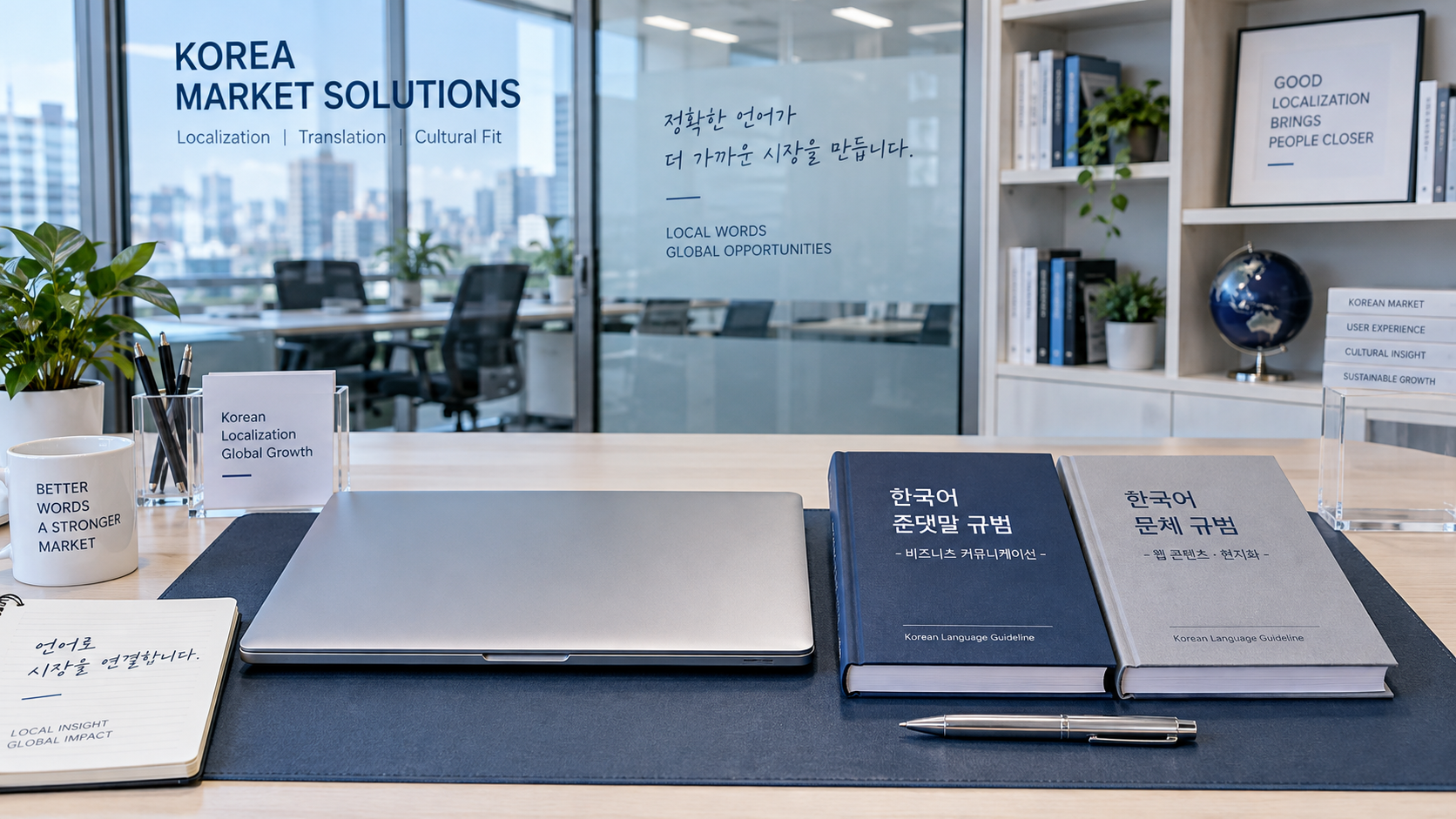
Choosing the wrong level of formality when translating website content for Korea can undermine trust. In practice, company websites and transaction-related information usually use formal polite language. Consumer-facing interactive copy can use a warmer, polite tone, while buttons should favor short, familiar action labels.
For those responsible for launching and maintaining a website, the key is to choose a tone based on each page’s purpose, then keep forms of address, sentence endings, and calls to action consistent. This helps maintain a professional brand image while avoiding product pages that sound overly stiff or customer service replies that seem perfunctory.
Distinguish between two common speech styles before deciding how to write each page
Formal polite language is common on Korean websites and often uses the following Korean sentence endings. It is suitable for company profiles, service information, business inquiries, and important notices. It conveys a composed, clear attitude, but this does not mean every heading and button needs to be a complete honorific sentence.
- Formal statements: 합니다, 제공합니다.
- Formal questions: 문의하시겠습니까?
The friendly polite style typically uses endings like the following and is common among consumer lifestyle brands, in user guidance, and in conversational customer service. It remains polite, but feels less distant. Whether to use it should be determined by the brand’s positioning and the actual wording used on comparable local websites.
- Friendly statements: 해요, 드려요.
- Friendly invitations: 확인해 보세요.
Honorific language is not limited to sentence endings; it also involves respectful expressions for people. For example, when describing what a customer does, you can use verb forms that convey respect. This is not necessary when describing product performance. Do not extend the politeness used for customers to products or systems.
A website can use different speech styles in different places, but the style should remain consistent within the same paragraph and user journey. Establishing a default style and then defining exceptions for customer service or campaign pages is easier to implement and maintain than requiring every page to use the same sentence endings.
Which honorific style works best for company websites, product pages, and customer service?
Company websites, manufacturing websites, and business service pages should generally prioritize formal polite language. Procurement professionals need to quickly verify a company’s capabilities, product specifications, and cooperation process, so the wording should be direct and clear. Avoid using excessive pleasantries or exaggerated embellishments that obscure the information.
On product detail pages, specifications, delivery, and after-sales information can be written in a clear, formal style, while buying recommendations and usage guidance can be somewhat warmer. If the brand has a more serious image overall, it can use a consistent formal style; there is no need to force conversational wording just to encourage purchases.
Customer service conversations can use either formal or friendly polite language, depending on the brand’s style. However, in situations involving complaints, refunds, or delayed delivery, explain the facts, how the issue will be handled, and the timeline first. Overly casual sentence endings may make customers feel that their concerns are not being taken seriously.
Advertising landing pages need to balance appeal with credibility. Keep headlines concise, explain the intended audience and service value in the body copy, and describe what happens after a form is submitted. A more lively advertising tone should not make information about fees or privacy ambiguous.
Why don’t buttons and forms need to use complete honorific sentences everywhere?
Buttons primarily guide users through actions, so Korean websites commonly use short nouns or action labels. Complete honorific sentences are better suited to explaining the result of an action than to filling every button. When translating, first confirm what happens when users click, then choose a label they will recognize.
- Make an inquiry: 문의하기; Request a quote: 견적 요청.
- Add to cart: 장바구니 담기; Buy now: 바로 구매.
The Chinese phrase “咨询” does not necessarily need to be translated word for word as “立即咨询,” and “提交” should not be translated without considering the business context. Sending a message, requesting a quote, and completing an order are different actions. Korean button labels should accurately describe the outcome and reduce users’ hesitation before clicking.
Form instructions should explain what users need to enter and how to correct errors. For example, if an email address is in the wrong format, prompt users to check the address rather than displaying only “Invalid input.” Polite wording can be retained, but it should not crowd out genuinely useful error guidance.
Depending on the situation, customer service can use a familiar honorific for “customer,” but it is not necessary to address readers repeatedly in the body text. In particular, do not mechanically replace every Chinese “您” with a Korean equivalent. Korean often conveys natural politeness by omitting the subject and adjusting the verb.
These translation habits are most likely to make a website sound unnatural
The first issue is inconsistent use of honorifics: the product page is very formal, a pop-up suddenly becomes casual, and an automated customer service reply switches to yet another sentence ending. Before launch, review the entire user journey for consistency rather than checking each translated file or passage in isolation.
The second issue is excessive honorific language. In Korean business communication, you generally should not elevate the product, price, or order just to sound polite. Revise such wording to show respect for the customer, and ask a Korean editor familiar with website copy to confirm that it sounds natural.
The third issue is translating generic Chinese marketing phrases literally. Expressions like “our esteemed customers” and “working together for mutual success” often do not help Korean users assess a product when they lack specific information. Replace them with details about delivery scope, response arrangements, usage conditions, or verifiable advantages.
The fourth issue is treating tone optimization as a substitute for content accuracy. Warranty coverage, return and exchange conditions, taxes, and delivery times should all be checked against actual business policies. No matter how polite the wording, it cannot compensate for unclear commitments or the loss of trust caused by inaccurate translation.
How can website teams establish a repeatable translation workflow?
Before translating, list the pages and note each page’s purpose, audience, and default speech style. Prioritize the homepage, core product pages, inquiry forms, and after-sales information, as these pages have a more direct impact on understanding and conversion. Expand to other content afterward.
Create a concise Korean style guide that records where to use formal and friendly styles, how to address customers, button terminology, product terms, and expressions to avoid. Include approved examples so translators, operations staff, and customer service teams can follow the same standards.
When using AI to generate a first draft, provide the page type, brand tone, and terminology list, and require product models, units, and specifications to be retained. A Korean editor familiar with the local market should then check the honorifics, meaning, and business commitments, with particular attention to key conversion pages.
After importing the translation into the website, check button length on mobile devices, line breaks, pop-ups, and error messages. Text that reads smoothly in a document does not necessarily provide a good on-page experience. Test key processes such as inquiries, orders, and refunds before publishing.
After choosing the right honorific style, how can you reach Korean users through search?
In addition to translating website content for Korea, find out how local users search for products and services. A literal translation of Chinese keywords may not match commonly used Korean search terms. Review search results, related terms, and comparable pages to refine headings and content priorities.
Honorific language mainly affects the reading experience and brand trust; it should not be treated as a direct ranking tactic. Search visibility also depends on whether a page answers users’ needs, whether its information is accurate, and whether the Korean-language page can be crawled, indexed, and accessed properly.
For multilingual websites, the Korean style guide can be incorporated into the website development and marketing maintenance workflow. Yiyingbao provides multilingual website development and overseas marketing services. For relevant projects, terminology, page tone, and search needs can all be included in content delivery standards.
The guiding principle is clear: use formal polite language as the foundation for company websites and important business information; use friendly polite language for consumer interactions in line with the brand’s positioning; and use familiar short phrases for buttons. With consistent guidelines, native-language review, and real-page testing, politeness can support understanding and ease of use.