









- Lazada 11.11 Mega Sale: LazMall Contributes Nearly Two-Thirds of GMVNov 23, 2026View details
- Shein’s European Revenue Falls 16% as Tighter Rules on Low-Value Direct Shipments Take EffectNov 23, 2026View details
- EU Low-Value Parcel Rules Impact Cargo Flows: Air Freight Volume from China to Europe Down 17% in OctoberNov 23, 2026View details
- Indonesia and the EU Sign Comprehensive Economic Partnership Agreement, 90.4% of Tariff Lines to Become Duty-Free ImmediatelyNov 23, 2026View details
- Qingdao Port's Imports and Exports Exceed RMB 23.699 Trillion in the First 10 Months, Drawing Attention to Port IntelligenceNov 22, 2026View details
- Ningbo Cross-Border E-Commerce Export Value Surges 94.87% Year on Year, Opening Up a New Billion-Yuan Growth TrackNov 22, 2026View details
How to submit indexing requests through Search Console and which pages should be prioritized
Before submitting an indexing request, determine whether the page meets the conditions for indexing
Submitting an indexing request in Google Search Console can help new or updated pages enter the crawl queue faster, but it is not an “instant indexing” button. Search engines will still independently assess whether a page is accessible, whether its content is valuable, whether it duplicates existing pages on the site, and whether the website as a whole meets normal crawling requirements.
Therefore, users searching for how to request indexing in Search Console do not need to submit every URL individually. A more effective approach is to first fix issues that prevent indexing, then reserve limited indexing requests for pages that can generate inquiries, traffic, or structural value for the site.
Before submitting, you can quickly check four things: whether the page returns a normal status when opened; whether noindex has been added by mistake; whether it is blocked by robots.txt; and whether the page has crawlable internal links. If these basic conditions are not met, submitting a request will usually only result in an “indexing requested” status and will not improve the final indexing outcome.
How to submit an indexing request through Search Console
The process is not complicated. After entering the relevant website property, use the “URL Inspection” tool at the top to paste the complete URL. The page will show whether the URL has been indexed by Google, when it was last crawled, and whether there are any crawling or indexing restrictions.
If the page has not yet been indexed, or if the content has undergone significant updates, you can click “Test Live URL” and, after the test is complete, select “Request Indexing.” For pages that are already indexed, repeated submission is usually unnecessary if you have only changed a title, replaced a small number of images, or made minor wording adjustments; search engines will discover such changes during subsequent crawls.
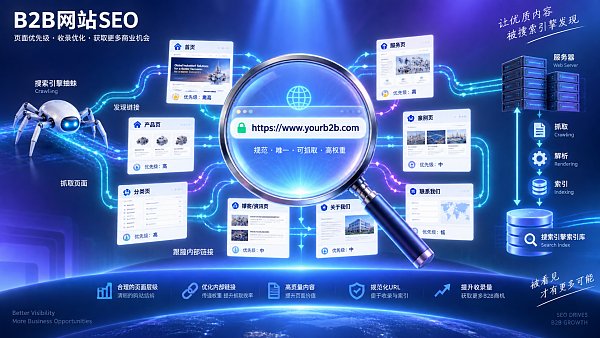
There are two details that are easily overlooked. First, you must submit the canonical URL. If the same page has multiple versions, such as versions with parameters, trailing slashes, HTTP and HTTPS, or www and non-www, submitting a non-canonical version may not achieve the expected result. Second, “indexable” in the tool means there are no obvious technical obstacles; it does not mean the page will definitely be indexed or ranked.
Which pages should be submitted first to make indexing requests worthwhile
For export-oriented B2B websites, multilingual corporate websites, and cross-border online stores, priority should be determined by both business value and page uniqueness. Even if a page is technically sound, it may not be worth prioritizing for indexing if it only contains mass-copied product descriptions or similar regional pages.
- Newly published core product or solution pages: These pages correspond to clear products, service capabilities, or procurement needs, and include complete specifications, application descriptions, delivery information, and calls to action. Such pages often represent the first step from organic search into the inquiry process.
- Important industry content pages: For example, topics such as procurement decisions, technical selection, use and maintenance, and compliance preparation. The content needs to answer questions independently rather than simply combining multiple keywords.
- New target-market or language versions: The prerequisite is that translation and localized content have actually been completed, and that hreflang, page language, currency, and inquiry paths have no obvious errors. Simply mechanically copying the original text into different language directories offers limited value in rushing to request indexing.
- Key pages whose URLs have changed after a redesign: Old pages should be redirected to their corresponding new pages via 301 redirects. Submit the new pages only after adding them to the sitemap and internal links. Submitting only the new URLs while leaving old URLs to return 404 errors or allowing multiple versions to coexist will often slow down the cleanup process.
- Important time-sensitive pages: Such as campaign landing pages, updated product catalogs, and key document download pages. The prerequisite is that the page itself is not temporary content that will be taken offline shortly or have its address changed frequently.
Some research-oriented content can also become high-quality indexing targets, such as research pages built around complex decision-making topics. Content such as Research on optimization paths for bank wealth management systems is suitable as a page that can accumulate search value only when it clearly explains the research scope, core conclusions, and reading value, and has a reasonable connection to the website’s topic, rather than being published in isolation merely for indexing.
Which pages are not recommended for immediate submission
Internal search result pages, filtered parameter pages, test pages, duplicate product pages, empty tag pages, and thin category pages are generally not worth consuming indexing requests. For e-commerce websites, when a single product generates multiple URLs due to color, size, sorting, or promotional parameters, canonical tags, parameter rules, and internal links should be addressed first rather than submitting each URL individually.
In addition, pages that have just been published but whose main content is incomplete, whose images or forms are broken, whose language content is mixed, or whose canonical points to another page are not suitable as priority targets. An indexing request cannot replace page quality control. When search engines crawl pages with unstable quality, even if they are eventually indexed, they are unlikely to become stable sources of organic traffic.
Where to investigate if a page is not indexed after submission
First, review the reason stated in the URL Inspection report. If it shows “Crawled - currently not indexed” or “Discovered - currently not indexed,” the issue is often not the submission action itself, but rather page value, duplication, website crawl resource allocation, or internal linking signals.
At this point, check whether the page is highly similar to existing product pages, blog pages, or language versions; whether it has only isolated entry points; whether its title and body truly address the user’s search query; whether it is included in the sitemap; and whether important content relies on script loading and cannot be presented consistently. For B2B pages, also confirm whether product parameters, applicable industries, customization scope, certifications, or delivery information are sufficiently specific. The closer the content is to the information real buyers need to compare, the more likely it is to establish independent page value.
Do not repeatedly click Request Indexing simply because the page has not been indexed within a few days. A more appropriate sequence is to correct page and site signals, add relevant internal links, and then wait for the next crawl. An indexing request is suitable for reminding search engines that “there is a URL here worth revisiting”; it cannot replace ongoing content development, website structure maintenance, and technical SEO checks.
Related Articles
 Google’s Sleep-Learning Architecture Draws Attention: How Search Absorbs New Knowledge
 How can you optimize the title tag to accurately reflect a page’s topic?
 How Should International Digital Agencies Develop SEO Strategies for Multiple Markets?


Related Products
 Yiyingbao SaaS Intelligent Website Building and Marketing SystemYiyingbao SaaS Intelligent Website Building and Marketing System, AI-powered no-code website building, rapid creation of multilingual B2B international websites in 10 minutes, global server acceleration, AI-powered SEO optimization, helping businesses connect efficiently with global markets. The perfect integration of technology and operation makes building an international trade website remarkably simple
 AI+SEM Intelligent Advertising Marketing SystemAI+SEM drives intelligent ad creation, empowering full-funnel precision advertising marketing. The system automatically generates weekly/monthly reports, AI recommends keywords and target countries, monitors core metrics in real-time with intelligent alerts, and enables one-click high-conversion ad solutions to help quickly acquire customers and improve ROI.
 AI+SEO Dual-Engine System Optimization ServicesYiyingbao’s AI+SEO dual-engine optimization system helps foreign trade enterprises acquire high-quality organic traffic through AI-powered keyword research, content generation, and comprehensive technical optimization, significantly improving search rankings and conversion rates.
 AI+SNS Social Media Marketing SystemYingbao AI+SNS Social Media Marketing System - Precision social capture for the social media era. Supports one-click content synchronization across major platforms like Facebook and LinkedIn. AI intelligently rewrites posts for enhanced relevance. 24/7 AI customer service and user profiling analysis empower businesses to efficiently expand into global markets.
 AI+SEO营销解决方案易营宝AI+SEO营销解决方案,通过AI批量写作、智能生成TDK、精准关键词扩词等功能,全面优化网站SEO效果,提升流量与转化率。助力企业构建高效智能网站新生态。
 AI+SEM Advertising Marketing SolutionsAI+SEM Advertising Marketing Solution leverages AI technology to deeply empower SEM ad campaigns. It automatically generates weekly/monthly reports using AI, presenting account data across multiple dimensions for comprehensive insights into campaign performance and trends. The system precisely recommends keywords and target countries, intelligently generates high-conversion ad copy, and enables one-click activation of efficient campaign plans to help businesses rapidly acquire customers. Simultaneously, it monitors core metrics in real time, intelligently identifies abnormal fluctuations, and issues timely alerts to ensure stable, high-return advertising results.
 Domain Name ServicesEasyWin provides professional domain name services, including intelligent queries, one-stop registration, brand protection, and full lifecycle management, helping businesses build a digital brand image.
 EasyOperate B2C Cross-Border E-Commerce Platform & Independent WebsiteEasyStore B2C Cross-border E-commerce Independent Store is an intelligent website building and cross-border e-commerce integrated solution independently developed by EasyStore Information Technology (Beijing) Co., Ltd. The system is specially designed for small and medium-sized as well as large export enterprises, integrating 'website building, operation, marketing, advertising, and conversion' into one, helping enterprises quickly establish cross-border e-commerce independent stores to achieve brand globalization and global sales growth.
The platform supports multiple languages, multiple currencies, and multi-channel marketing, with built-in AI intelligent translation and SEO optimization systems, suitable for mainstream markets such as Southeast Asia, Europe and America, Latin America, and the Middle East, assisting Chinese manufacturing enterprises in efficiently deploying international e-commerce strategies. SSL证书易营宝提供专业SSL安全证书服务,包括单域名和泛域名证书,确保网站数据传输加密、身份验证和完整性保护,助力企业建立安全可信的在线业务环境。









