









- Why the old AMP SEO 2020 practices no longer work and what has changed in current optimization prioritiesAug 02, 2026View details
- How to Choose Topics for an Industry News Section to Attract More Organic Search TrafficJul 29, 2026View details
- Digital Marketing Shenzhen Market Insights: Why Are Companies Expanding Overseas Looking for Growth Teams in Shenzhen?Jul 31, 2026View details
- Can Zhejiang foreign trade independent websites still be developed today? Look at changes in traffic and lead generationJul 28, 2026View details
- What New Signals Are Emerging in Enterprise Services SaaS Marketing ReportsJul 27, 2026View details
- What Does a Global Traffic Ecosystem Service Provider Do? What Are the Differences from a Single Advertising AgencyJul 16, 2026View details
Which Ineffective Keywords Should Be Avoided in B2B Keyword Planning?
Eliminate Inefficient Keywords First So Your Keyword Layout Does Not Go to Waste
When companies plan their B2B keyword layout, the easiest trap to fall into is not choosing too few keywords, but choosing keywords that are too “busy.” They may appear to have decent search volume, but in reality, they only bring in broad traffic and low-intent clicks, or even consume your budget and content resources on people who are unlikely to convert. When screening keywords around B2B keywords / company, the real task is not to fill the page with keywords, but to first remove those that sound relevant but are actually ineffective.
I have seen many corporate websites pursue “big keywords” across their homepages, category pages, and article pages, only to receive very few inquiries. The problem is usually not the website itself, but misaligned keyword intent. For B2B keywords, business relevance, the buyer’s stage, and the industry scenario matter more than traffic volume alone.
Avoid These Types of Keywords First
The first type is overly broad keywords, such as “marketing,” “solutions,” “products,” and “services,” which lack an industry, purpose, country, or scenario. The problem is straightforward: the search audience is too scattered, making it difficult for the page to clearly communicate what you actually sell. For business decision-makers, these keywords are generally suitable only for brand exposure, not as primary lead-generation keywords.
The second type is keywords that do not match the business stage. For example, if your goal is to generate inquiries but you use a large number of learning-oriented or educational keywords, such as “what is,” “how to get started,” or “introduction to the principles.” This does not mean these keywords cannot be used, but they should be placed in the content nurturing layer rather than taking up valuable space on your homepage, product pages, and core landing pages. The criterion is simple: if people searching for a keyword are most likely just trying to understand a concept rather than preparing to contact a supplier, that keyword should not be prioritized.
The third type is keywords with overly broad meanings and weak purchasing intent. For example, the same keyword may have very different meanings across countries, job roles, and budget levels, while the search results may also include many irrelevant audiences. For foreign trade companies, manufacturing factories, and cross-border sellers, these keywords can easily mix genuine buyers with students, job seekers, and industry researchers. As a result, conversion performance becomes naturally unstable.
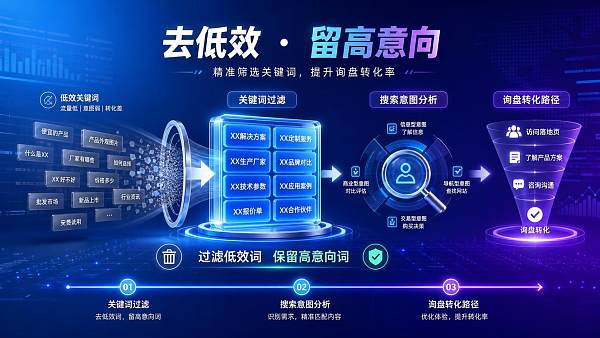
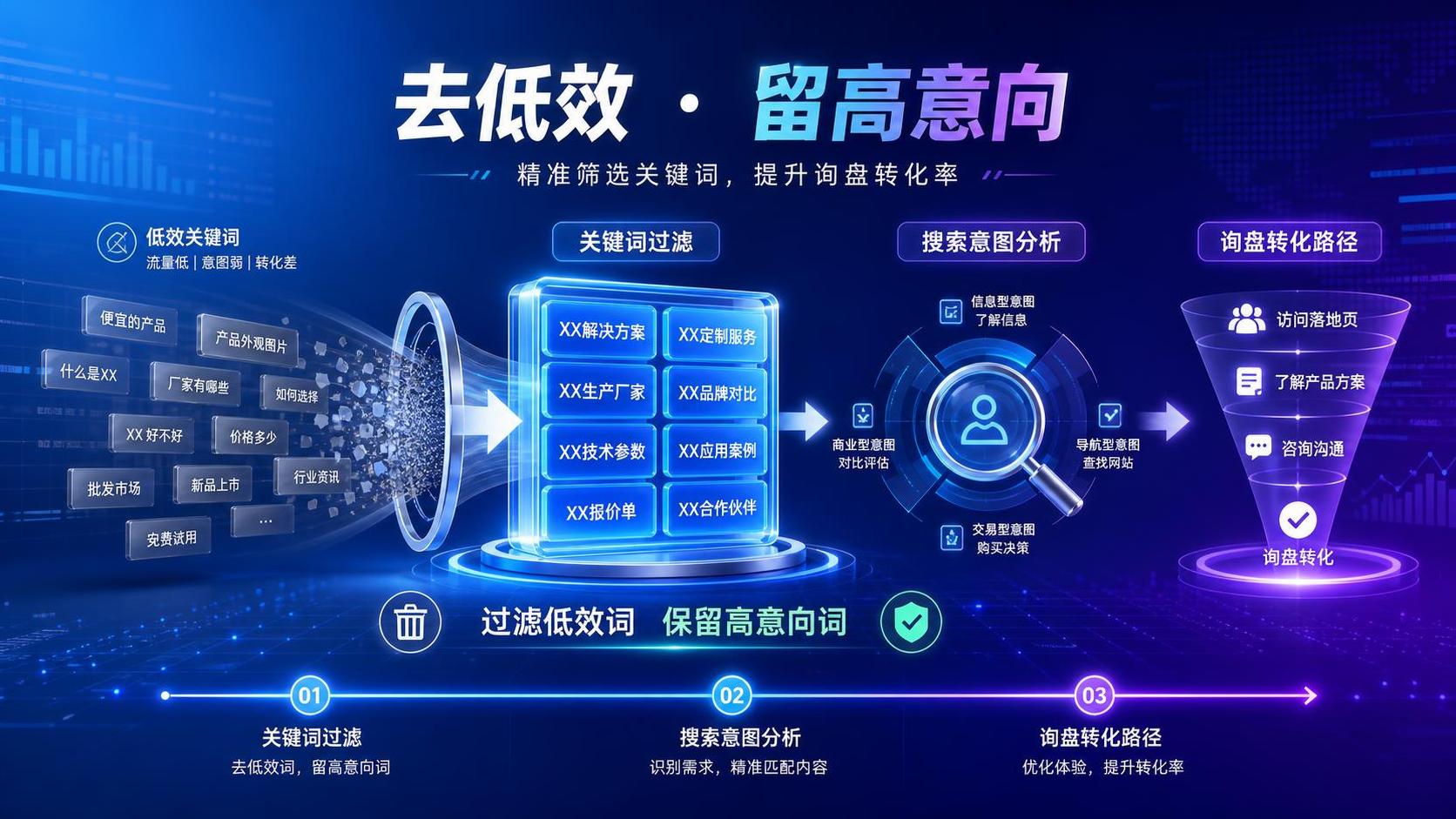
Identifying Business Actions Behind Keywords Matters More Than Looking at Search Volume
Truly valuable B2B keywords can usually be linked to a clear action, such as requesting a quote, comparing prices, finding suppliers, reviewing case studies, checking specifications, or evaluating the scope of delivery. Conversely, if a keyword can only bring visitors but cannot drive the next step, it should be approached cautiously no matter how popular it is. Many companies include numerous “industry name + generic description” phrases in their keyword lists. Although the coverage appears broad, these phrases do not tell the content team what to write or the advertising team whom to target.
At this point, you can apply a direct screening process by asking three questions about every keyword. Are people searching for this keyword looking for a supplier or learning something? Can the page naturally address this need? After clicking through, is the user likely to submit their information, make an inquiry, or leave immediately? If two of the three questions cannot be answered, the keyword should most likely be downgraded.
If your team is working on both advertising and SEO, keyword roles should be further differentiated. For example, some high-intent keywords are suitable for direct advertising. You can use the AI+SEM advertising and marketing solution to quickly validate countries, industries, and conversion copy, and then decide which keywords are worth developing into long-term content. This is much more efficient than committing all your resources to website rankings from the beginning.
Do Not Be Misled by Keywords That “Look Professional”
Another common type of inefficient keyword looks like a professional industry term but is actually not specific enough. It may contain only technical or methodological terms without indicating the product type, application industry, or purchasing scenario. Such keywords may look “appropriate” on a website, but they are not sufficiently clear for either search engines or users. Search systems need to understand the page topic, while buyers need to quickly determine whether you can meet their business needs.
The most practical way to determine whether this type of keyword is inefficient is not to rely on intuition, but to examine the search engine results page. If the results mainly consist of encyclopedias, news, tutorials, and forum discussions rather than supplier pages, product pages, or solution pages, the keyword likely has weak commercial intent. For a corporate website, you can retain a small number of such keywords for awareness building, but do not repeatedly spend core resources on them.
Country and Regional Keywords Should Not Be Added Randomly
Many companies like to add country or regional names after keywords because they believe this makes the keywords more precise. The direction is not wrong, but the prerequisite is that your page must genuinely be able to serve that market. If even one element, such as language versions, currency conventions, delivery methods, contact information, compliance statements, or case study presentation, is clearly mismatched, traffic will be lost. Country keywords are not decorations; they determine whether the page aligns with local purchasing logic.
Therefore, regional keywords should be considered together with the website structure. Which countries are worth creating dedicated landing pages for, which markets should first be tested with content pages, and which keywords are more suitable for advertising than organic rankings should all be determined based on your actual delivery capabilities. Do not rush to expand into countries for which you lack the corresponding market capabilities.
Reclassify Your Keyword List Based on Conversion Potential
In practice, I recommend dividing B2B keywords into three levels instead of placing everything into one large table. The top level consists of high-transaction-intent keywords that directly indicate purchasing, inquiries, quotations, or supplier selection. The middle level consists of solution-oriented keywords focused on industries, scenarios, and product combinations. The bottom level consists of awareness-oriented keywords used to develop content, build the brand, and cover long-tail searches. This approach keeps the website structure organized and prevents advertising and content from competing for the same resources.
If the team uses only one keyword list, common consequences include overly broad keywords on the homepage, article pages competing with product pages for keywords, and advertising keywords conflicting with SEO keywords. In the end, the website may appear to have achieved substantial indexing, while genuinely valuable pages fail to gain visibility. Once the keyword list is layered, these conflicts are greatly reduced.
A Simple Review Sequence
- First, remove keywords that are completely generic and cannot be linked to a business action.
- Then, place learning-oriented and educational keywords separately in the content layer so they do not occupy primary conversion positions.
- Next, check whether regional keywords match the page language, delivery capabilities, and contact information.
- Finally, check whether the keyword list corresponds to the page structure and avoid having multiple pages compete repeatedly for the same keyword.
For companies planning their B2B keyword layout, the biggest concern is not having too few keywords, but allowing inefficient keywords to occupy valuable positions. The reliable approach is to examine search intent first, then business fulfillment capabilities, and finally whether the page can convert visitors. Once the keyword list is organized in this order, subsequent content planning, advertising, and landing page design will become much more streamlined, and your budget will no longer be wasted on keywords that look popular but generate no actual business.
Related Articles

Related Products
 Yiyingbao SaaS Intelligent Website Building and Marketing SystemYiyingbao SaaS Intelligent Website Building and Marketing System, AI-powered no-code website building, rapid creation of multilingual B2B international websites in 10 minutes, global server acceleration, AI-powered SEO optimization, helping businesses connect efficiently with global markets. The perfect integration of technology and operation makes building an international trade website remarkably simple
 AI+SEM Intelligent Advertising Marketing SystemAI+SEM drives intelligent ad creation, empowering full-funnel precision advertising marketing. The system automatically generates weekly/monthly reports, AI recommends keywords and target countries, monitors core metrics in real-time with intelligent alerts, and enables one-click high-conversion ad solutions to help quickly acquire customers and improve ROI.
 AI+SEO Dual-Engine System Optimization ServicesYiyingbao’s AI+SEO dual-engine optimization system helps foreign trade enterprises acquire high-quality organic traffic through AI-powered keyword research, content generation, and comprehensive technical optimization, significantly improving search rankings and conversion rates.
 AI+SNS Social Media Marketing SystemYingbao AI+SNS Social Media Marketing System - Precision social capture for the social media era. Supports one-click content synchronization across major platforms like Facebook and LinkedIn. AI intelligently rewrites posts for enhanced relevance. 24/7 AI customer service and user profiling analysis empower businesses to efficiently expand into global markets.
 AI+SEO营销解决方案易营宝AI+SEO营销解决方案,通过AI批量写作、智能生成TDK、精准关键词扩词等功能,全面优化网站SEO效果,提升流量与转化率。助力企业构建高效智能网站新生态。
 AI+SEM Advertising Marketing SolutionsAI+SEM Advertising Marketing Solution leverages AI technology to deeply empower SEM ad campaigns. It automatically generates weekly/monthly reports using AI, presenting account data across multiple dimensions for comprehensive insights into campaign performance and trends. The system precisely recommends keywords and target countries, intelligently generates high-conversion ad copy, and enables one-click activation of efficient campaign plans to help businesses rapidly acquire customers. Simultaneously, it monitors core metrics in real time, intelligently identifies abnormal fluctuations, and issues timely alerts to ensure stable, high-return advertising results.
 Domain Name ServicesEasyWin provides professional domain name services, including intelligent queries, one-stop registration, brand protection, and full lifecycle management, helping businesses build a digital brand image.
 EasyOperate B2C Cross-Border E-Commerce Platform & Independent WebsiteEasyStore B2C Cross-border E-commerce Independent Store is an intelligent website building and cross-border e-commerce integrated solution independently developed by EasyStore Information Technology (Beijing) Co., Ltd. The system is specially designed for small and medium-sized as well as large export enterprises, integrating 'website building, operation, marketing, advertising, and conversion' into one, helping enterprises quickly establish cross-border e-commerce independent stores to achieve brand globalization and global sales growth.
The platform supports multiple languages, multiple currencies, and multi-channel marketing, with built-in AI intelligent translation and SEO optimization systems, suitable for mainstream markets such as Southeast Asia, Europe and America, Latin America, and the Middle East, assisting Chinese manufacturing enterprises in efficiently deploying international e-commerce strategies. SSL证书易营宝提供专业SSL安全证书服务,包括单域名和泛域名证书,确保网站数据传输加密、身份验证和完整性保护,助力企业建立安全可信的在线业务环境。









