









- Why the old AMP SEO 2020 practices no longer work and what has changed in current optimization prioritiesAug 02, 2026View details
- How to Choose Topics for an Industry News Section to Attract More Organic Search TrafficJul 29, 2026View details
- Digital Marketing Shenzhen Market Insights: Why Are Companies Expanding Overseas Looking for Growth Teams in Shenzhen?Jul 31, 2026View details
- Can Zhejiang foreign trade independent websites still be developed today? Look at changes in traffic and lead generationJul 28, 2026View details
- What New Signals Are Emerging in Enterprise Services SaaS Marketing ReportsJul 27, 2026View details
- What Does a Global Traffic Ecosystem Service Provider Do? What Are the Differences from a Single Advertising AgencyJul 16, 2026View details
Google ranking keyword fluctuations: check these three factors first
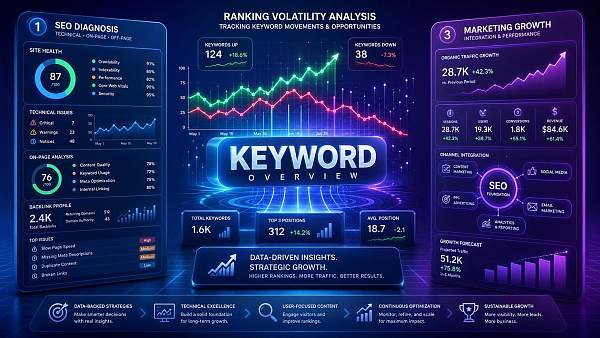
Google Ranking Keyword Fluctuations: Start by Looking at These Three Types of Factors
When you discover that a group of keywords has suddenly risen or fallen, the easiest mistake to make is to immediately change the title, delete content, or rebuild the page. Regarding mots clés google classement, the truly experienced approach is not to “take action first,” but to first determine where the fluctuation comes from. Google ranking changes do not simply reflect page quality; they are also affected by search engine rules, the site's own condition, and the competitive market environment. When these three types of factors are viewed together, conclusions are often inaccurate; when they are separated, the problem becomes much easier to identify.
During technical evaluations, many professionals ask: Why does the keyword position still change when the page, indexing status, and backlinks are all the same? The reason is that rankings are not static scores, but dynamic sorting results. Google continuously reinterprets search intent and reevaluates page quality, while also incorporating new competitors, content freshness, regional signals, and device performance into its rankings. A fluctuation does not necessarily mean that there is a problem with the site; however, if it remains abnormal after continuous observation, each factor should be investigated according to priority.
First Determine Whether the Algorithm or Search Results Environment Has Changed
The first type of factor is usually not caused by the webmaster, but by Google's adjustments to its ranking logic or the way search results are displayed. The three most common situations are core algorithm updates, spam content updates, and changes in search results page placements. The first two directly affect rankings, while the last may cause click-through rates to decline even without visibly changing organic ranking positions, leading teams to mistakenly believe that their “keyword rankings have been lost.”
Technically, this type of fluctuation has a typical characteristic: it is not limited to an individual page. Instead, similar trends may appear across the same type of pages, the same directory, or even multiple websites at the same time. For example, websites that originally relied on thin-content aggregation pages for traffic may experience a collective decline after algorithm rules become stricter. Conversely, pages with complete information, clear structures, and a closer match to search intent often gradually recover after an update. At this stage, the biggest mistake is to focus only on a single keyword. Individual keyword rankings may fluctuate, but the overall trends of keyword groups, page groups, and directory groups provide a clearer indication of the issue.
If you manage a multilingual or international website, this step is especially important. Search results do not change at the same speed across different regions and languages. French, English, and German markets often respond differently to content authority and local relevance. Many teams look at query results from only one country and then apply their conclusions to the entire website, ultimately deleting content that was originally effective in other markets.
A practical approach is to extend the timeline to 28 or even 90 days, and then cross-check impressions, average ranking, click-through rate, and indexing status. If the fluctuation is only short-term and is not accompanied by crawling issues, indexing issues, or page quality warnings, observing the situation is often more prudent than immediately redesigning the website. For companies engaged in global marketing, this is also why an intelligent website-building and SEO system should not provide only a “ranking increase or decrease” dashboard. It should also allow algorithm fluctuations, page status, and market distribution to be viewed from the same perspective. For platforms such as YIYINGBAO that cover website building, SEO, and advertising, one of their values lies in reducing misjudgments caused by relying on isolated data points.
For On-Site Optimization Issues, the Focus Is Not on “Whether It Has Been Done,” but on “Whether It Matches Search Intent”
The second type of factor comes from within the site. Many pages appear to have all the necessary “SEO elements”: the title contains keywords, the description includes selling points, and the body is not particularly short, yet the rankings still cannot be maintained. The problem is often not whether optimization has been performed, but whether the wrong thing has been optimized. Google is increasingly evaluating pages based on whether they provide what users are truly looking for, rather than simply whether keywords appear on the page.
For a query such as mots clés google classement, searchers usually do not want to read a simple definition. They want to know why keyword rankings fluctuate, how to determine the cause, and which situations require attention. If the page instead provides general introductory information about SEO, it may be difficult to remain near the top even when all basic tags are complete. In other words, the core of on-site optimization has shifted from “keyword matching” to “problem matching.”
When investigating on-site issues, focus on several points: whether the page truly serves a single intent, whether the content contains a large number of repetitive paragraphs, whether template fields overshadow the main information, whether internal links direct authority to the correct pages, and whether mobile loading and interactions affect crawling and user experience. If multiple pages compete for the same keyword, or if category pages, article pages, and product pages all target the same intent, ranking fluctuations may not indicate that the “page is not strong enough.” Instead, they may result from conflicting on-site signals.
There is also a common misunderstanding here: some people equate content update frequency with content quality, repeatedly adding paragraphs, inserting keywords, and changing publication dates whenever rankings fall. In fact, if the existing page structure already meets user needs, frequent and ineffective modifications may interfere with Google's assessment of the page's stability. What is genuinely worth changing includes insufficient supporting evidence, a confusing information hierarchy, unclear page boundaries, or technical details that hinder indexing, such as incorrect canonical tags, unmerged duplicate URLs, or confusing language-version markup.
In enterprise projects, these issues often occur in systems where “the website can go live but is not suitable for long-term optimization.” An editable page is not necessarily a page that can be continuously understood and expanded. For international trade websites, manufacturing websites, and cross-border e-commerce stores, if the underlying website-building system does not properly design the URL structure, language management, page speed, structured layout, and content expansion mechanisms, subsequent SEO fluctuations will be amplified, while teams may easily attribute all responsibility to content editors.
Do Not Overlook External Competition: Many “Ranking Drops” Actually Mean That Others Have Become Stronger
The third type of factor comes from the external environment, especially changes in competing pages. Rankings represent relative positions, not absolute scores. The fact that your page has not changed does not mean that its ranking cannot decline. As long as competitors make further progress in content depth, link quality, brand signals, or user behavior feedback, your position may move down. When many teams see organic traffic decline, their first reaction is to suspect a website technical issue. After investigation, however, the real reason may simply be that a new group of stronger pages has replaced the previous pages on the first page of search results.
This type of fluctuation is identified differently from algorithm fluctuations. It is more likely to appear as a decline in some keywords rather than changes across the entire site or directory. In addition, the SERP may begin to display page types that are more closely aligned with new search intent. For example, articles may have previously dominated, but later tool pages, topic pages, video pages, or brand website pages may become more prominent. If you continue using the old page structure to compete for rankings, even extensive detailed optimization may simply refine the wrong direction.
Experienced teams do not look only at “how many positions I have dropped.” They also ask, “Why are the pages currently ranking at the top able to move up?” They examine whether the content organization, information granularity, page format, link sources, and brand exposure of those pages have changed the original competitive standard for the keyword. For some technical and solution-related keywords, top-ranking pages increasingly resemble in-depth explanatory articles rather than brief introductions. For some transactional keywords, they increasingly favor product pages, comparison pages, or localized landing pages. Once the competitive environment changes its model, previous optimization experience needs to be reevaluated.
This is also why SEO evaluations cannot focus only on on-site metrics. Sometimes, to help business departments understand where resources can deliver greater value, other management concepts may be used as an analogy. For example, Strategies for Applying Lean Cost Concepts to Enterprise Inventory Management emphasizes that resource allocation cannot be separated from turnover efficiency. The same principle applies to search competition: not every keyword deserves the same amount of human effort. Only after identifying which keywords have experienced changes in their competitive barriers can you decide whether to continue refining them, adjust the page format, or switch to a more attainable set of keywords.
The Investigation Sequence Is More Important Than the “Optimization Actions”
In practice, it is recommended that the investigation sequence be standardized. First determine whether the fluctuation is industry-wide, then examine the site's technical and content status, and finally analyze competitor changes. If this sequence is reversed, it is easy to make incorrect fixes. For example, making major page changes during an algorithm update can make it difficult to determine afterward whether a ranking recovery resulted from the natural rebound following the end of the update or from the changes themselves. Technical evaluators do not need to “immediately provide an action.” They need to isolate the variables first.
A relatively reliable observation framework can be summarized in four questions: How broad is the fluctuation—is it site-wide or localized? How long has it lasted—is it a short-term fluctuation or a shift in trend? What types of queries are affected—informational, transactional, or branded? Are ranking changes accompanied by simultaneous abnormalities in crawling, indexing, click-through rate, or page experience metrics? Until these four questions have been answered clearly, hastily rewriting content, changing templates, or deleting pages is usually premature.
For websites that rely on overseas customer acquisition, this assessment must not be conducted in isolation. The website-building system, SEO data, advertising landing pages, social media traffic acquisition, and AI search visibility are inherently connected. If an organic ranking fluctuation happens to coincide with poor performance on advertising landing pages, a high bounce rate, or inconsistent content versions, the issue may not be a single-level change in Google's ranking system. Instead, it may be that the entire customer acquisition chain is sending unstable signals to search engines. The value of a mature platform lies not only in combining tools, but also in connecting and interpreting these signals.
Truly understanding mots clés google classement is not about learning to watch a ranking curve. It is about learning to distinguish the sources behind fluctuations. Algorithms, on-site factors, and competition may appear simple, but the difficulty is that they often occur simultaneously. Only by separating the causes into layers before deciding whether to adjust pages, add content, or change the structure can you avoid allowing surface-level figures to drive your judgment. For technical evaluations, this is more valuable than any single rise or fall in rankings.
Related Articles
Related Products
 Yiyingbao SaaS Intelligent Website Building and Marketing SystemYiyingbao SaaS Intelligent Website Building and Marketing System, AI-powered no-code website building, rapid creation of multilingual B2B international websites in 10 minutes, global server acceleration, AI-powered SEO optimization, helping businesses connect efficiently with global markets. The perfect integration of technology and operation makes building an international trade website remarkably simple
 AI+SEM Intelligent Advertising Marketing SystemAI+SEM drives intelligent ad creation, empowering full-funnel precision advertising marketing. The system automatically generates weekly/monthly reports, AI recommends keywords and target countries, monitors core metrics in real-time with intelligent alerts, and enables one-click high-conversion ad solutions to help quickly acquire customers and improve ROI.
 AI+SEO Dual-Engine System Optimization ServicesYiyingbao’s AI+SEO dual-engine optimization system helps foreign trade enterprises acquire high-quality organic traffic through AI-powered keyword research, content generation, and comprehensive technical optimization, significantly improving search rankings and conversion rates.
 AI+SNS Social Media Marketing SystemYingbao AI+SNS Social Media Marketing System - Precision social capture for the social media era. Supports one-click content synchronization across major platforms like Facebook and LinkedIn. AI intelligently rewrites posts for enhanced relevance. 24/7 AI customer service and user profiling analysis empower businesses to efficiently expand into global markets.
 AI+SEO营销解决方案易营宝AI+SEO营销解决方案,通过AI批量写作、智能生成TDK、精准关键词扩词等功能,全面优化网站SEO效果,提升流量与转化率。助力企业构建高效智能网站新生态。
 AI+SEM Advertising Marketing SolutionsAI+SEM Advertising Marketing Solution leverages AI technology to deeply empower SEM ad campaigns. It automatically generates weekly/monthly reports using AI, presenting account data across multiple dimensions for comprehensive insights into campaign performance and trends. The system precisely recommends keywords and target countries, intelligently generates high-conversion ad copy, and enables one-click activation of efficient campaign plans to help businesses rapidly acquire customers. Simultaneously, it monitors core metrics in real time, intelligently identifies abnormal fluctuations, and issues timely alerts to ensure stable, high-return advertising results.
 Domain Name ServicesEasyWin provides professional domain name services, including intelligent queries, one-stop registration, brand protection, and full lifecycle management, helping businesses build a digital brand image.
 EasyOperate B2C Cross-Border E-Commerce Platform & Independent WebsiteEasyStore B2C Cross-border E-commerce Independent Store is an intelligent website building and cross-border e-commerce integrated solution independently developed by EasyStore Information Technology (Beijing) Co., Ltd. The system is specially designed for small and medium-sized as well as large export enterprises, integrating 'website building, operation, marketing, advertising, and conversion' into one, helping enterprises quickly establish cross-border e-commerce independent stores to achieve brand globalization and global sales growth.
The platform supports multiple languages, multiple currencies, and multi-channel marketing, with built-in AI intelligent translation and SEO optimization systems, suitable for mainstream markets such as Southeast Asia, Europe and America, Latin America, and the Middle East, assisting Chinese manufacturing enterprises in efficiently deploying international e-commerce strategies. SSL证书易营宝提供专业SSL安全证书服务,包括单域名和泛域名证书,确保网站数据传输加密、身份验证和完整性保护,助力企业建立安全可信的在线业务环境。









