









- Which customer acquisition channels will be affected by cross-border marketing trends in 2026?Sep 06, 2026View details
- Which homogenization risks should be considered in an analysis of the AI-powered website building industry?Aug 30, 2026View details
- How Will AI Marketing Trends 2026 Change Advertising Budget AllocationAug 28, 2026View details
- Is the EV SSL certificate market shrinking or upgrading? How should companies assess certificate procurement?Aug 11, 2026View details
- Why the old AMP SEO 2020 practices no longer work and what has changed in current optimization prioritiesAug 02, 2026View details
- How to Choose Topics for an Industry News Section to Attract More Organic Search TrafficJul 29, 2026View details
How to Optimize Meta Ads: Start with the Conversion Funnel
How Should Meta Ads Be Optimized? Start with the Conversion Funnel
How should Meta ads be optimized? Many teams immediately focus on click-through rate, cost per thousand impressions, and creative engagement data. The reports may look fine, yet leads remain unstable. The problem is often not in the advertising interface, but in the journey after the ad is clicked: Does the page load fast enough? Is the form too long? Does the landing page information match the promise made in the ad? Is the inquiry entry convenient? Does the sales team follow up promptly? Anyone who has actually managed projects knows that Meta traffic is not inherently “poor”; it simply exposes problems in the funnel more quickly.
For an integrated website and marketing services business, the conversion funnel is not a single page but a series of continuous actions. Users spend little time in a social media environment, are strongly driven by emotion, and face little cost when leaving. Ad creatives are responsible for bringing people in, but whether costs can ultimately be controlled often depends on the “invisible” details, such as the structure of the independent website, form design, pixel event reporting, customer service response, and backend lead distribution. For platforms such as 易营宝 that cover intelligent website building, ad placement, SEO optimization, and social media operations, the value lies not only in acquiring leads at the front end, but also in turning “promotable, indexable, and convertible” into a complete path.
There is a common misconception that should be clarified first. Many companies understand Meta optimization as “testing more creatives, changing audiences more frequently, and increasing the budget.” That is not wrong, but if the product cannot be explained clearly within the first three seconds of the landing page, the mobile button is obstructed, or the form requires seven or eight pieces of information, even the best audience will be wasted. This is particularly true for foreign trade manufacturing and B2B inquiry projects. Users coming from ads may not be ready to place an order immediately; they are more likely conducting an initial screening. In this situation, the task of the page is not to force a conversion, but to reduce the friction of making an inquiry and encourage users to leave information that can be followed up.
Identify Where Volume Is Dropping Before Adjusting the Budget
If the account is already running, the order of analysis should usually be reversed: examine the funnel first, then the ads. A practical approach is to divide the conversion path into four stages: seeing the ad, entering the page, taking an inquiry action, and completing subsequent follow-up. Poor performance at each stage points to different problems.
A low click-through rate is usually related to the creative, audience, or pricing strategy. A normal click-through rate but a short landing-page visit usually indicates problems with page relevance, loading speed, or the information density above the fold. If users stay on the page for a reasonable amount of time but few submit the form, the issue is often related to trust signals, field settings, button paths, or device compatibility. If the number of form submissions appears substantial but the proportion of genuinely qualified leads is low, it is no longer enough to blame the ads. Sales qualification criteria, follow-up timing, and whether the page promise is too broad must all be reviewed together.
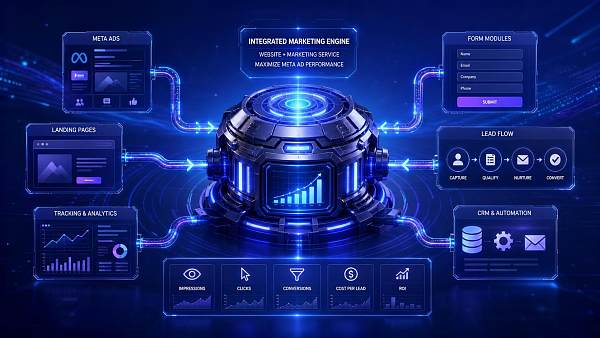
This is also why many companies repeatedly fail to scale their Meta campaigns. The front end may barely generate leads, but once spending is scaled, low-intent traffic floods in and the already fragile funnel immediately becomes distorted. On the surface, the ads appear to be getting more expensive; in reality, the supporting system was not ready.
B2B Inquiry Websites and B2C Independent Stores Require Different Optimization Logic
When discussing how Meta ads should be optimized, many people tend to combine different types of businesses. In reality, B2B and B2C have completely different funnel objectives, and their evaluation methods differ as well.
B2B foreign trade inquiry websites place greater emphasis on whether users are willing to communicate. After entering the site, this type of visitor generally will not complete a complex decision within a few minutes. Therefore, the page should focus on industry fit, factory capabilities, delivery scope, qualifications, frequently asked questions, and contact options. Do not include too many form fields. First collect core information such as the name, email address, and requirements description, then have sales complete the details later. If users are required from the outset to provide company size, purchase volume, target market, and budget range, the conversion rate is often significantly affected. The core of optimization here is not to filter every lead as cleanly as possible, but to control the proportion of invalid inquiries while ensuring that high-potential users are not blocked at the first step.
B2C cross-border stores are different. Users are more easily influenced by price, shipping costs, reviews, payment methods, and return information. After the ad creative generates interest, if the product page has no reviews, variant selection is complicated, the checkout process is too long, or payment lacks a sense of trust, no amount of budget adjustment will prevent users from abandoning their carts. In this scenario, Meta ad optimization can hardly be separated from the shopping experience itself. The practical significance of solutions such as 易营宝’s self-developed cross-border store system lies in connecting the ad landing page, product details, conversion event tracking, and subsequent remarketing. Otherwise, the data learned by the advertising system will become increasingly biased.
For Multilingual, Multi-Regional Campaigns, the Problem Often Lies in Using “One Page for the Whole World”
Another common situation in global expansion projects is that campaigns are separated by country, while the pages are not adapted by region. Reading habits, trust triggers, and mobile network conditions differ across users in North America, Europe, Southeast Asia, and the Middle East. Not every market needs a completely independent website, but at the very least, companies should avoid directly applying the same copy, form, and call-to-action buttons across all regions.
For example, if a multilingual page is merely mechanically translated, and the selling points promised in the ad do not match the landing-page wording, the user’s first reaction is often not to continue browsing, but to question whether the brand is professional. In some regions, mobile network conditions are also average. If the page images are too large and there are too many scripts, cold traffic from Meta can easily leave before seeing the key information. In this situation, saying that “the ads are not precise” is not entirely accurate. It is more like the funnel has not been simplified according to actual local conditions.
Therefore, creating a multilingual independent website does not end when the language versions are completed. An ad landing page should consider at least three factors: whether the above-the-fold information is localized, whether the form and contact methods suit local user habits, and whether the page is sufficiently lightweight. For websites targeting global markets, funnel optimization and website-building capabilities should not be viewed separately.
Poor Lead Quality Does Not Necessarily Mean the Audience Is Wrong
The situation that makes companies most anxious is having “quantity but no quality.” At this point, many teams immediately narrow their targeting or even cut the budget. However, based on project experience, low-quality leads do not necessarily originate from the advertising layer. If the ad copy sets the barrier too low, the page does not explain the applicable scope in advance, or customer service takes too long to respond initially, these factors can all amplify the problem of users who appear to have a need but are actually a poor fit.
This is especially true for marketing services, website-building services, and software solutions. Before converting, users first assess whether you “understand my business.” If the landing page contains only generic selling points and no industry-specific content—for example, what matters to manufacturers, cross-border sellers, and brands expanding overseas—leads will naturally be broad and less qualified. Narrowing the page is often more effective than simply narrowing the audience. This is why some service providers separate websites, SEO, advertising, and social media into detailed offerings: users are not buying an abstract service, but looking for a growth path suited to their own business structure.
In terms of content engagement, it can also be helpful to include appropriate methodology-oriented information. For example, some teams may reference research-based content such as Practical Challenges and Countermeasures for Fintech to Promote Enterprise Innovation on the page as an extension. The purpose is not to pile on information, but to help highly informed customers quickly assess whether the service provider has a systematic perspective. The prerequisite is that the content be integrated naturally without overshadowing the main conversion path.
If Technical Tracking Is Not Properly Set Up, Subsequent Optimization Will Become Increasingly Guess-Based
Many companies believe ad optimization is an operational task, but a considerable portion of the problem is technical. Confusing pixel event definitions, a success page that fails to trigger, button clicks being mixed with actual form submissions, and different channels using the same conversion definition can all directly affect Meta’s learning. The account may appear to be “automatically optimizing,” while it is actually learning from noise.
For companies with independent websites and multi-channel advertising needs, the biggest concern is that the front-end page and CRM rules are being changed while no one synchronizes and verifies the ad events. Over time, teams find that there are more and more reports, but none can answer the real questions: Which market, type of page, group of creatives, or inquiry entry is closer to an effective conversion? A practical advantage of an integrated platform such as 易营宝 is that website development, event tracking, and marketing systems can more easily use consistent definitions, reducing the internal friction caused by every department believing that its own part is working properly.
If your company is currently dealing with high Meta advertising costs, unstable lead quality, or weak remarketing performance, do not rush to rebuild the account structure. First verify page loading, event tracking, form paths, inquiry entries, and sales response, then return to review the creatives and budget. This is usually more efficient.
These Are the Small Things You Should Confirm First
Ultimately, Meta ad optimization is not a single-point action, but a health check of the entire conversion funnel. Ads only bring people to the door. Whether they can enter, whether they are willing to leave their contact information, and whether someone can properly follow up afterward—all of these links will be reflected in advertising costs if any one of them becomes weak. For foreign trade companies, manufacturing factories, cross-border e-commerce sellers, and brands expanding overseas, the sooner website development, content, tracking, advertising, and backend follow-up are viewed on the same map, the more detours can be avoided. What should truly be addressed first has never been the budget button, but the point where users are dropping out.
Related Articles



Related Products
 Yiyingbao SaaS Intelligent Website Building and Marketing SystemYiyingbao SaaS Intelligent Website Building and Marketing System, AI-powered no-code website building, rapid creation of multilingual B2B international websites in 10 minutes, global server acceleration, AI-powered SEO optimization, helping businesses connect efficiently with global markets. The perfect integration of technology and operation makes building an international trade website remarkably simple
 AI+SEM Intelligent Advertising Marketing SystemAI+SEM drives intelligent ad creation, empowering full-funnel precision advertising marketing. The system automatically generates weekly/monthly reports, AI recommends keywords and target countries, monitors core metrics in real-time with intelligent alerts, and enables one-click high-conversion ad solutions to help quickly acquire customers and improve ROI.
 AI+SEO Dual-Engine System Optimization ServicesYiyingbao’s AI+SEO dual-engine optimization system helps foreign trade enterprises acquire high-quality organic traffic through AI-powered keyword research, content generation, and comprehensive technical optimization, significantly improving search rankings and conversion rates.
 AI+SNS Social Media Marketing SystemYingbao AI+SNS Social Media Marketing System - Precision social capture for the social media era. Supports one-click content synchronization across major platforms like Facebook and LinkedIn. AI intelligently rewrites posts for enhanced relevance. 24/7 AI customer service and user profiling analysis empower businesses to efficiently expand into global markets.
 AI+SEO营销解决方案易营宝AI+SEO营销解决方案,通过AI批量写作、智能生成TDK、精准关键词扩词等功能,全面优化网站SEO效果,提升流量与转化率。助力企业构建高效智能网站新生态。
 AI+SEM Advertising Marketing SolutionsAI+SEM Advertising Marketing Solution leverages AI technology to deeply empower SEM ad campaigns. It automatically generates weekly/monthly reports using AI, presenting account data across multiple dimensions for comprehensive insights into campaign performance and trends. The system precisely recommends keywords and target countries, intelligently generates high-conversion ad copy, and enables one-click activation of efficient campaign plans to help businesses rapidly acquire customers. Simultaneously, it monitors core metrics in real time, intelligently identifies abnormal fluctuations, and issues timely alerts to ensure stable, high-return advertising results.
 Domain Name ServicesEasyWin provides professional domain name services, including intelligent queries, one-stop registration, brand protection, and full lifecycle management, helping businesses build a digital brand image.
 EasyOperate B2C Cross-Border E-Commerce Platform & Independent WebsiteEasyStore B2C Cross-border E-commerce Independent Store is an intelligent website building and cross-border e-commerce integrated solution independently developed by EasyStore Information Technology (Beijing) Co., Ltd. The system is specially designed for small and medium-sized as well as large export enterprises, integrating 'website building, operation, marketing, advertising, and conversion' into one, helping enterprises quickly establish cross-border e-commerce independent stores to achieve brand globalization and global sales growth.
The platform supports multiple languages, multiple currencies, and multi-channel marketing, with built-in AI intelligent translation and SEO optimization systems, suitable for mainstream markets such as Southeast Asia, Europe and America, Latin America, and the Middle East, assisting Chinese manufacturing enterprises in efficiently deploying international e-commerce strategies. SSL证书易营宝提供专业SSL安全证书服务,包括单域名和泛域名证书,确保网站数据传输加密、身份验证和完整性保护,助力企业建立安全可信的在线业务环境。









