









- Can the average annual growth rate reflect real opportunities in overseas markets?Oct 07, 2026View details
- Which customer acquisition channels will be affected by cross-border marketing trends in 2026?Sep 06, 2026View details
- Which homogenization risks should be considered in an analysis of the AI-powered website building industry?Aug 30, 2026View details
- How Will AI Marketing Trends 2026 Change Advertising Budget AllocationAug 28, 2026View details
- Is the EV SSL certificate market shrinking or upgrading? How should companies assess certificate procurement?Aug 11, 2026View details
- Why the old AMP SEO 2020 practices no longer work and what has changed in current optimization prioritiesAug 02, 2026View details
What is usually not properly defined when the rework rate for independent website translations is high?
When people mention a high rework rate in standalone website translation, their first reaction is often that the translator did not understand the content or that the client kept making changes. In actual maintenance work, however, a more common situation is that the rules were not clearly defined at the beginning, so whoever takes over the work has to make repeated changes. An inconsistent terminology list, undefined page tone, unconfirmed SEO keywords, and no character limit for buttons all affect the number of revisions more than how quickly the translation is completed.
If you are currently struggling with repeated revisions to multilingual pages, pages being taken offline after launch, or clients repeatedly saying that the meaning is correct but the wording does not feel natural, do not rush to focus on the translators. First check whether the website rules have been fully defined. Once standalone website translation enters a cycle of rework, it often indicates a lack of standards at the beginning of the project, rather than a lack of manpower.
The Parts That Usually Require the Most Rework Are Not the Main Text, but the Parts No One Decided on in Advance
Here is a direct assessment: the four most common sources of a high rework rate in standalone website translation are terminology standards, page purpose, keyword strategy, and the review process. If any two of these four areas are not properly defined, the subsequent work will generally be difficult to manage.
A common situation in after-sales maintenance is that the product manager provides a Chinese page, the sales team adds an English requirement, and the owner suddenly adds that it should feel more like a local website. This sounds reasonable, but it does not provide an actionable standard. What does more like a local website mean? Does it mean more conversational wording or more industry-specific terminology? Should it use American English, British English, or the business English commonly used in the Middle East market? If these points are not clarified, translators can only make assumptions.
Many teams believe that rework is a translation quality issue, but in reality it is more like a systematic error caused by incomplete input information.
Several Upfront Settings That Are Most Easily Overlooked in Standalone Website Translation
First, a terminology list is not an optional attachment; it is a rework control mechanism.
This is especially important for B2B foreign trade websites. Product names, material names, process names, certification names, and application terms must be standardized in advance. For example, the same term may be translated as “solution” on the homepage, “application” on the product page, and “use case” on the download page. Readers may not consider this incorrect, but it can weaken the brand’s professional image, and clients may easily request different changes page by page during review.
At a minimum, a terminology list should define three types of content: approved translations, prohibited translations, and interchangeable translations. Without this step, maintenance personnel have to treat every revision as if they were starting a new project.
Second, different page objectives require different translation standards.
This is one of the points many teams overlook most easily. The content tasks of a company profile page, product detail page, SEO content page, and advertising landing page are fundamentally different. A company profile focuses more on credibility, a product page on accuracy, an SEO page on balancing keywords with natural expression, and a landing page on conversion actions. If everything is handled as a simple process of translating Chinese directly into English, rework is almost inevitable.
I recommend marking each page before translation, for example:
- Brand presentation pages: prioritize natural, credible, and concise language
- Product specification pages: prioritize accuracy, consistency, and minimal ambiguity
- SEO content pages: prioritize search-oriented wording and clear structure
- Form and inquiry pages: prioritize clear actions and a low barrier to understanding
With these labels, reviewers will not use a literary standard to revise product specifications, nor use the tone of a technical manual for marketing pages.
Third, if SEO keywords are not defined in advance, the later revisions will be the most extensive.
The biggest difference between standalone website translation and ordinary document translation is that it has to address search engines, not just human readers. Many pages require rework because, after launch, the team discovers that the keywords were not incorporated correctly, requiring the title, URL, description, and body copy to be redone.
For example, a Chinese term may generally refer to custom packaging machinery, but users in different English-speaking markets may be more likely to search for “custom packaging machine,” “packaging equipment manufacturer,” or a more specific product term. If the primary keywords, supporting keywords, and prohibited keywords are not listed in advance, the SEO and content teams will usually revise the completed translation again, resulting in rework.
During maintenance, the most reliable approach is not to pursue the most polished translation in a single attempt, but to first confirm the wording used in searches. As an integrated service provider focused on intelligent website development, multilingual websites, and overseas marketing, Yiyingbao’s value lies in viewing website development, SEO optimization, and content localization as one integrated process rather than as several disconnected stages. This ensures that when standalone website translation is revised, the team does not pursue keywords on one hand while overturning the original structure on the other.
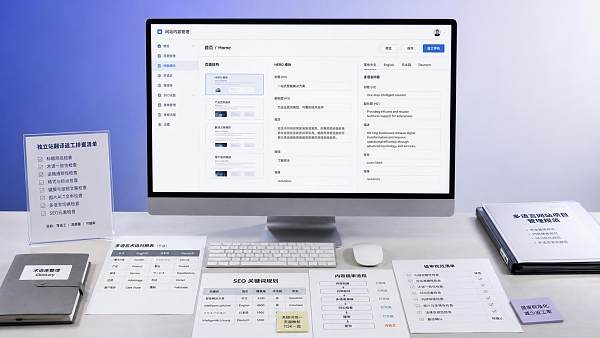
Fourth, if the review and approval process is too loose, everyone can make changes and no one can clearly explain the final version.
Much rework is not caused by problems with the content itself, but by poor version management. Sales submits one version, the client revises another, operations polishes it again, and the technical team deletes a section during implementation. In the end, no one knows which version is authoritative.
What truly reduces rework is not simply having everyone communicate more, but clearly defining role boundaries:
- Who is responsible for confirming terminology
- Who is responsible for the brand tone
- Who is responsible for SEO keywords
- Who has final approval authority
- Which post-launch changes count as new requirements and which are corrections to the original requirements
As long as the final decision-maker is not clearly identified, standalone website translation can easily become caught in repeated discussions over details.
Some Rework Appears to Be a Translation Problem but Is Actually a Technical Page Problem
This is particularly common during the after-sales stage. The text may be correct, yet the client still requests changes because the page experience has undermined the value of the content.
For example, translated button copy may become longer and wrap unattractively on mobile devices. Slow access in certain countries may lead clients to believe that the English website looks unprofessional. Delays in form submission may cause users to lose patience, prompting the team to question whether the copy is clear enough. Some of these issues are not related to whether the translation is good, but to the combined impact of access speed, dynamic request response, and page presentation on conversion judgments.
If your website targets visitors from multiple overseas regions and contains many multilingual pages, the technical layer cannot focus only on whether the site opens. It must also consider whether access is stable in different regions. Solutions such as Global CDN Acceleration for B2B Foreign Trade Website Development are suitable for addressing cross-border access fluctuations, slow loading of static resources, and long waits for form requests. They do not directly reduce translation rework, but they can reduce misjudgments caused by pages appearing to have content problems simply because they load slowly. This distinction is important.
How to Troubleshoot Most Efficiently During the Maintenance Stage
Once rework has already occurred, it is not advisable to revise pages one by one without a plan. A more effective approach is to troubleshoot in sequence.
First check whether the problem is related to terminology. If the same product name appears under different names on multiple pages, standardize it first instead of rushing to polish the wording.
Next check whether the page objective is misaligned. If a page that should generate inquiries is filled with content about the company’s history, making more detailed wording changes will not solve the problem.
Then check whether the SEO keywords are off target. In particular, if the title, opening paragraph, subheadings, image alt text, and Meta description do not match the intended search wording, revising the body copy will only address minor issues.
Only then should you review the tone, sentence length, and detailed wording. Many teams do this in the reverse order: they begin by asking for wording to sound more natural, and the content becomes increasingly inconsistent.
If you want to make future maintenance easier, you can establish a minimum viable set of guidelines. It does not need to be extensive; it only needs to be practical:
- One terminology list
- One guide explaining the writing style for each page type
- One keyword checklist
- One multilingual launch checklist
The checklist should ideally include several practical items: whether the title exceeds the length limit, whether buttons wrap onto multiple lines, whether form fields are consistent, whether hreflang corresponds to the URL structure, whether text in images has also been translated, and whether downloaded filenames need to be localized. Many rework issues ultimately get stuck on these small details.
When It Is Not Appropriate to Rush into Reworking the Standalone Website Translation
If the structure of the original website is already disorganized and the Chinese content itself has not been standardized, a large-scale retranslation is usually not cost-effective. Once the Chinese content is revised after one round of translation, the foreign-language versions will have to be revised again.
Another situation is when the market direction has not yet been determined. If the target countries, key products, and keyword direction have not been confirmed, quickly rolling out the entire website in more than a dozen languages will usually result in a high rework rate. Starting with the core languages and core pages is more stable.
Maintenance personnel often take the blame for this: if the website goes live quickly, the subsequent work is full of patching and revisions; if it goes live slowly, they are accused of delaying progress. In short, standalone website translation is not merely a language task. It is inherently connected to website structure, SEO strategy, user access experience, and business objectives. A one-stop service such as Yiyingbao’s, covering website development, SEO, advertising, and multilingual operations, is suited to scenarios that require coordination rather than isolated handling. If only one or two news updates need to be revised, there is no need to make the process unnecessarily complex.
What Really Reduces the Rework Rate Is Not Translating Faster, but Defining the Rules First
The most difficult part of maintenance work is not making revisions, but making revisions that have no reusable value. Having to debate the same issue again on a different page the next day is what consumes the most time.
So, returning to the question at the beginning: what usually causes a high rework rate in standalone website translation? In most cases, the issue is not how to translate a particular sentence, but that the terminology, page objectives, SEO keywords, and review mechanism have not been defined. Once these four areas are tightened up, subsequent changes will be significantly reduced and page quality will become more consistent.
If you already have a multilingual website that requires frequent rework, do not first look for a more capable translator. Start by completing the rules and guidelines. For standalone website translation, clear rules are what truly save time.
Frequently Asked Questions
For a high rework rate in standalone website translation, should terminology or page copy be revised first?
Revise the terminology first. If terminology is inconsistent, all subsequent polishing may be wasted.
Can SEO pages be translated directly from Chinese?
It is generally not recommended. Search wording should be confirmed based on the habits of the target market. Direct translation can easily produce the right words but miss the intended search intent.
Does every page require localized rewriting?
Not necessarily. Pages such as product specifications and certification descriptions prioritize accuracy and do not require excessive polishing. Brand pages and landing pages, on the other hand, require more natural expression.
If conversion is poor after a page goes live, is it necessarily a translation problem?
Not necessarily. Access speed, form response, mobile presentation, and page structure can all affect the evaluation and should be investigated together.
Image Placeholder List
img_01: Recommended placement after the sections related to “SEO keywords, terminology list, and review process”; the image may show a troubleshooting workflow for translation rework on a multilingual website; alt text: Standalone website translation rework troubleshooting flowchart
Suggested Internal Link Anchor Text
- How to Plan Multilingual Website Development in Advance: recommended link to the multilingual website development solutions page
- How to Structure SEO Keywords for a B2B Standalone Website: recommended link to the SEO optimization topic page
- How to Troubleshoot a Low Conversion Rate on a B2B Website Form: recommended link to the conversion optimization article page
- Common Reasons for Slow Access to Overseas Websites: recommended link to the website performance optimization page
Suggested Authoritative External Sources
- Official search engine documentation, such as relevant pages from Google Search Central
- Materials from internationalization and localization industry associations
- Official technical documentation from CDN or website performance monitoring platforms
Related Articles



Related Products
 Yiyingbao SaaS Intelligent Website Building and Marketing SystemYiyingbao SaaS Intelligent Website Building and Marketing System, AI-powered no-code website building, rapid creation of multilingual B2B international websites in 10 minutes, global server acceleration, AI-powered SEO optimization, helping businesses connect efficiently with global markets. The perfect integration of technology and operation makes building an international trade website remarkably simple
 AI+SEM Intelligent Advertising Marketing SystemAI+SEM drives intelligent ad creation, empowering full-funnel precision advertising marketing. The system automatically generates weekly/monthly reports, AI recommends keywords and target countries, monitors core metrics in real-time with intelligent alerts, and enables one-click high-conversion ad solutions to help quickly acquire customers and improve ROI.
 AI+SEO Dual-Engine System Optimization ServicesYiyingbao’s AI+SEO dual-engine optimization system helps foreign trade enterprises acquire high-quality organic traffic through AI-powered keyword research, content generation, and comprehensive technical optimization, significantly improving search rankings and conversion rates.
 AI+SNS Social Media Marketing SystemYingbao AI+SNS Social Media Marketing System - Precision social capture for the social media era. Supports one-click content synchronization across major platforms like Facebook and LinkedIn. AI intelligently rewrites posts for enhanced relevance. 24/7 AI customer service and user profiling analysis empower businesses to efficiently expand into global markets.
 AI+SEO营销解决方案易营宝AI+SEO营销解决方案,通过AI批量写作、智能生成TDK、精准关键词扩词等功能,全面优化网站SEO效果,提升流量与转化率。助力企业构建高效智能网站新生态。
 AI+SEM Advertising Marketing SolutionsAI+SEM Advertising Marketing Solution leverages AI technology to deeply empower SEM ad campaigns. It automatically generates weekly/monthly reports using AI, presenting account data across multiple dimensions for comprehensive insights into campaign performance and trends. The system precisely recommends keywords and target countries, intelligently generates high-conversion ad copy, and enables one-click activation of efficient campaign plans to help businesses rapidly acquire customers. Simultaneously, it monitors core metrics in real time, intelligently identifies abnormal fluctuations, and issues timely alerts to ensure stable, high-return advertising results.
 Domain Name ServicesEasyWin provides professional domain name services, including intelligent queries, one-stop registration, brand protection, and full lifecycle management, helping businesses build a digital brand image.
 EasyOperate B2C Cross-Border E-Commerce Platform & Independent WebsiteEasyStore B2C Cross-border E-commerce Independent Store is an intelligent website building and cross-border e-commerce integrated solution independently developed by EasyStore Information Technology (Beijing) Co., Ltd. The system is specially designed for small and medium-sized as well as large export enterprises, integrating 'website building, operation, marketing, advertising, and conversion' into one, helping enterprises quickly establish cross-border e-commerce independent stores to achieve brand globalization and global sales growth.
The platform supports multiple languages, multiple currencies, and multi-channel marketing, with built-in AI intelligent translation and SEO optimization systems, suitable for mainstream markets such as Southeast Asia, Europe and America, Latin America, and the Middle East, assisting Chinese manufacturing enterprises in efficiently deploying international e-commerce strategies. SSL证书易营宝提供专业SSL安全证书服务,包括单域名和泛域名证书,确保网站数据传输加密、身份验证和完整性保护,助力企业建立安全可信的在线业务环境。









