









- Which customer acquisition channels will be affected by cross-border marketing trends in 2026?Sep 06, 2026View details
- Which homogenization risks should be considered in an analysis of the AI-powered website building industry?Aug 30, 2026View details
- How Will AI Marketing Trends 2026 Change Advertising Budget AllocationAug 28, 2026View details
- Is the EV SSL certificate market shrinking or upgrading? How should companies assess certificate procurement?Aug 11, 2026View details
- Why the old AMP SEO 2020 practices no longer work and what has changed in current optimization prioritiesAug 02, 2026View details
- How to Choose Topics for an Industry News Section to Attract More Organic Search TrafficJul 29, 2026View details
Should You Change the Title or Content Structure First for AI Search Visibility Optimization
When optimizing AI search visibility, should you revise the title first or adjust the content structure first? In most cases, you should examine the content structure first and then decide whether the title needs to be adjusted. This is because both AI search and traditional search are placing increasing emphasis on whether content is easy to understand, information is complete, and pages allow answers to be extracted quickly. The title is certainly important, but if the content structure is disorganized, the hierarchy is unclear, and key information is scattered, changing the title alone will hardly improve the page's visibility and conversion performance in any meaningful way.
For businesses evaluating optimization priorities, the essence of this question is not "which is more important, the title or the structure," but rather "which one is currently having a greater impact on whether the page can be understood, cited, and recommended." If the page topic is already accurate but the expression is not clear enough, prioritizing content structure adjustments will be more effective. If the page topic has shifted and the title does not match search intent, optimizing the title becomes more meaningful.
Why AI Search Visibility Optimization Cannot Focus Only on the Title
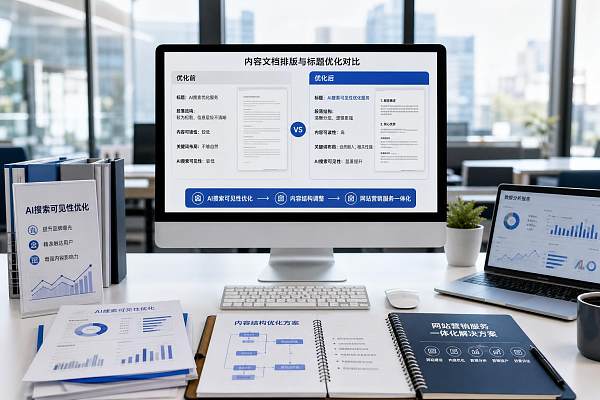
When many businesses optimize for AI search visibility, their first reaction is to change the title because it is the most obvious element and the easiest place to start. In practice, however, the title is only the "entry signal" for the page topic. It determines how platforms and users understand the page at first glance, but it cannot independently determine whether the content deserves to be crawled, summarized, cited, or recommended.
This is especially true in AI search scenarios, where systems pay greater attention to whether a page provides a clear problem definition, a complete answer structure, extractable key points, and support for users to make judgments quickly. In other words, AI does not merely "see the title"; it also "dissects the content." If the body of the page does not develop around the question, even a highly precise title will struggle to achieve the desired performance.
This is also why many websites still deliver only mediocre results after optimization: the title appears professional, but the content lacks hierarchy, the answer is buried too deeply, the paragraphs are overly lengthy, and neither users nor search systems can quickly identify the key points. The result is often slow indexing, weak visibility, short visit durations after clicks, and even an impact on subsequent conversions.
What Users Really Want to Know Is Which Step Is More Cost-Effective to Take First
Readers searching for "AI search visibility optimization" generally do not just want to hear concepts. They want to know what to change first in actual practice, how to achieve a higher return on investment, and how to reduce the cost of trial and error. These information-seeking users are usually at the stage of comparing solutions. They care about the basis for making judgments rather than abstract theories.
For these readers, the core questions typically include four points: First, what do the title and content structure each affect? Second, when should the title be revised first? Third, when must the structure be adjusted first? Fourth, how can they avoid making extensive changes without achieving results? Only when these questions are answered clearly does the article truly provide search value.
Therefore, the article should not distribute its focus evenly across general statements such as "the title is important" and "the structure is also important." Instead, it should provide an actionable decision-making framework. Only by helping readers identify page problems can it help them understand how AI search visibility optimization actually works.
When to Revise the Title First: Inaccurate Topic, Misaligned Intent, or Incorrect Entry Signal
If the biggest problem with a page is that the title itself is inaccurate, revising the title first is reasonable. For example, the page may actually discuss "how to improve AI search exposure for an international trade independent website," while the title says "Analysis of Digital Marketing Trends." This creates an unclear topic signal, making it difficult for search systems to determine the page's core value and preventing users from developing a clear willingness to click.
Another common situation is that the title does not match the user's search intent. Users may be looking for evaluation methods, an order of operations, or effectiveness assessment, while the title focuses on conceptual introductions, industry vision, or brand messaging. Even if the page contains useful information, the front-end entry point has already lost its competitiveness, so prioritizing title adjustments will be more direct.
However, title optimization does not mean simply adding keywords. An effective title should cover the core topic, the user's question, and the direction of the content at the same time. For a keyword such as "AI search visibility optimization," the title should ideally reflect evaluation, methodology, priorities, or practical scenarios rather than merely repeating the keyword itself.
When to Adjust the Content Structure First: The Page Has a Topic, but the Answers Are Not Clearly Organized
If the page title is generally accurate and aligned with search intent, but users still find it difficult to understand the key points after reading, the problem is probably in the content structure. Common symptoms of this type of page include an overly long introduction, the core conclusion appearing too late, insufficient logical connections between paragraphs, or multiple questions being answered together.
In an AI search environment, these structural problems are magnified. When processing a page, systems first identify clear relationships between questions and answers. If the page lacks clear subheadings, sequential expression, and a focus on key judgments, the content is less likely to be extracted into a summary and is less conducive to building strong visibility.
This is particularly true for corporate websites. Many marketing pages do not lack content; rather, they lack an "understandable way of expressing it." Clarifying the structure often improves page quality more effectively than changing the title alone. This is because structural optimization directly affects reading efficiency, information extraction efficiency, and whether users are willing to continue browsing the next section of content.
A More Reliable Practical Sequence: Identify the Page Problem First, Then Optimize the Structure from "Subheadings to Body Text"
Based on practical website marketing experience, the more reliable approach is not to change the title prematurely, but to first identify the page's primary problem. You can begin by examining three signals: whether the title accurately matches search intent, whether the first two screenfuls of the body provide an answer, and whether the page hierarchy allows users to scan it quickly. If the latter two are clearly inadequate, the structure should generally be addressed first.
When optimizing the structure, it is recommended to start with the subheading system. Subheadings determine the cognitive path through the entire piece of content and also determine how search systems understand the division of roles among paragraphs. A good structure generally develops around questions such as "What is the problem? Why is it important? When should the title be revised first? When should the structure be adjusted first? How should priorities be determined? How should the plan be implemented?" rather than randomly piling up information.
Once the subheadings are clear, supplementing each section with its core viewpoints, application scenarios, and evaluation criteria will significantly improve readability. If you then find that the original title can no longer accurately summarize the new structure, you can return to optimize the title. This usually produces more consistent page messaging and represents a workflow more aligned with the logic of AI search visibility optimization.
When Making Decisions, Businesses Should Look Beyond Rankings and Focus on Comprehension Efficiency and Conversion Efficiency
When optimizing pages, many businesses tend to focus only on whether they have rankings or whether their pages have been indexed, while overlooking a more important question: can users understand your answer in the shortest possible time? The value of AI search visibility optimization is not merely to make a page appear, but also to ensure that the page is trusted, accepted, and visited further during the user's decision-making process.
If the title is made highly attractive but users cannot find a clear conclusion after clicking through, the bounce rate and communication conversions will generally not be favorable. In contrast, if the content structure is clear and the key points are explicit, even moderate title optimization can make it easier for the page to establish a professional impression and improve inquiry and subsequent communication efficiency.
This is particularly important for international trade companies, manufacturing factories, cross-border brands, and independent website operation teams. Their goal in creating content is not simply to "publish articles," but to use their websites to receive search traffic, build trust with overseas customers, and ultimately support inquiry generation and long-term growth. When deciding the optimization sequence, they must return to this business objective.
Conclusion: For Most Pages, Adjusting the Structure Before Optimizing the Title Usually Produces More Stable Results
Returning to the original question—when optimizing AI search visibility, should you revise the title or the content structure first? The general rule is: if the title direction is clearly wrong, revise the title first; if the title is broadly accurate but the content is poorly organized, adjust the structure first. In most corporate website scenarios, the latter is actually more common, so optimizing the structure first is usually more reliable and more likely to produce sustained results.
More precisely, title optimization addresses "who you want to attract to click," while content structure optimization addresses "whether users and AI systems can quickly understand you." The former determines the entry point, while the latter determines how value is communicated. Only when the two are consistent does the page have a better chance of achieving improved visibility, comprehension, and conversion performance in AI search.
Therefore, in actual execution, it is recommended to first examine whether the page is truly organized around the user's questions, and then optimize the title wording. This approach is not only more consistent with search logic, but also better aligned with the long-term growth objectives of corporate websites. For businesses seeking to balance website development, SEO, content delivery, and global marketing performance, this is the more pragmatic optimization path.
Related Articles


Related Products
 Yiyingbao SaaS Intelligent Website Building and Marketing SystemYiyingbao SaaS Intelligent Website Building and Marketing System, AI-powered no-code website building, rapid creation of multilingual B2B international websites in 10 minutes, global server acceleration, AI-powered SEO optimization, helping businesses connect efficiently with global markets. The perfect integration of technology and operation makes building an international trade website remarkably simple
 AI+SEM Intelligent Advertising Marketing SystemAI+SEM drives intelligent ad creation, empowering full-funnel precision advertising marketing. The system automatically generates weekly/monthly reports, AI recommends keywords and target countries, monitors core metrics in real-time with intelligent alerts, and enables one-click high-conversion ad solutions to help quickly acquire customers and improve ROI.
 AI+SEO Dual-Engine System Optimization ServicesYiyingbao’s AI+SEO dual-engine optimization system helps foreign trade enterprises acquire high-quality organic traffic through AI-powered keyword research, content generation, and comprehensive technical optimization, significantly improving search rankings and conversion rates.
 AI+SNS Social Media Marketing SystemYingbao AI+SNS Social Media Marketing System - Precision social capture for the social media era. Supports one-click content synchronization across major platforms like Facebook and LinkedIn. AI intelligently rewrites posts for enhanced relevance. 24/7 AI customer service and user profiling analysis empower businesses to efficiently expand into global markets.
 AI+SEO营销解决方案易营宝AI+SEO营销解决方案,通过AI批量写作、智能生成TDK、精准关键词扩词等功能,全面优化网站SEO效果,提升流量与转化率。助力企业构建高效智能网站新生态。
 AI+SEM Advertising Marketing SolutionsAI+SEM Advertising Marketing Solution leverages AI technology to deeply empower SEM ad campaigns. It automatically generates weekly/monthly reports using AI, presenting account data across multiple dimensions for comprehensive insights into campaign performance and trends. The system precisely recommends keywords and target countries, intelligently generates high-conversion ad copy, and enables one-click activation of efficient campaign plans to help businesses rapidly acquire customers. Simultaneously, it monitors core metrics in real time, intelligently identifies abnormal fluctuations, and issues timely alerts to ensure stable, high-return advertising results.
 Domain Name ServicesEasyWin provides professional domain name services, including intelligent queries, one-stop registration, brand protection, and full lifecycle management, helping businesses build a digital brand image.
 EasyOperate B2C Cross-Border E-Commerce Platform & Independent WebsiteEasyStore B2C Cross-border E-commerce Independent Store is an intelligent website building and cross-border e-commerce integrated solution independently developed by EasyStore Information Technology (Beijing) Co., Ltd. The system is specially designed for small and medium-sized as well as large export enterprises, integrating 'website building, operation, marketing, advertising, and conversion' into one, helping enterprises quickly establish cross-border e-commerce independent stores to achieve brand globalization and global sales growth.
The platform supports multiple languages, multiple currencies, and multi-channel marketing, with built-in AI intelligent translation and SEO optimization systems, suitable for mainstream markets such as Southeast Asia, Europe and America, Latin America, and the Middle East, assisting Chinese manufacturing enterprises in efficiently deploying international e-commerce strategies. SSL证书易营宝提供专业SSL安全证书服务,包括单域名和泛域名证书,确保网站数据传输加密、身份验证和完整性保护,助力企业建立安全可信的在线业务环境。









