









- Can the average annual growth rate reflect real opportunities in overseas markets?Oct 07, 2026View details
- Which customer acquisition channels will be affected by cross-border marketing trends in 2026?Sep 06, 2026View details
- Which homogenization risks should be considered in an analysis of the AI-powered website building industry?Aug 30, 2026View details
- How Will AI Marketing Trends 2026 Change Advertising Budget AllocationAug 28, 2026View details
- Is the EV SSL certificate market shrinking or upgrading? How should companies assess certificate procurement?Aug 11, 2026View details
- Why the old AMP SEO 2020 practices no longer work and what has changed in current optimization prioritiesAug 02, 2026View details
How Can B2B Website Translation Balance Professionalism and Inquiry Conversion?
B2B Website Translation Is Never Just About “Getting the Translation Right”
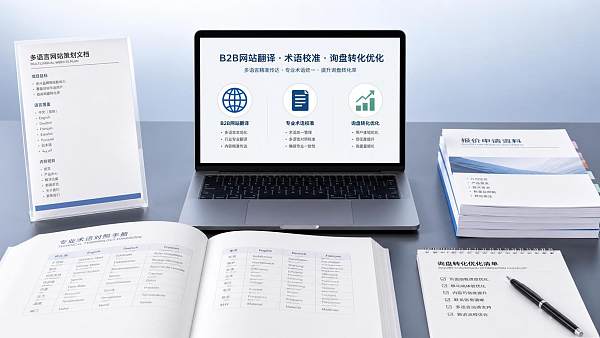
For websites designed to generate leads overseas, many teams initially view translation as a language process: changing Chinese into English, Russian, or Spanish, and considering the task complete once visitors can understand the page. However, what truly affects inquiries is often not whether the grammar is flawless, but whether target customers can determine within 30 seconds: Are you familiar with this industry? Can you solve my problem? Will communication be difficult and costly?
This is why B2B website translation often gets stuck between “professionalism” and “conversion rate.” If it focuses too much on literal accuracy, the page may read like technical documentation; if it leans too heavily toward marketing language, procurement, engineering, and business evaluation personnel may find it insufficiently rigorous. Especially for equipment manufacturing, industrial components, and cross-border supply chain businesses, a website is not simply a brand showcase. It is responsible for filtering potential customers, lowering communication barriers, and helping customers initiate inquiries.
In actual projects, well-translated B2B websites are usually not the ones with the most impressive language. Rather, they successfully address industry terminology, purchasing decision logic, and the page conversion path at the same time.
First Distinguish Between Three Types of Content: Not Every Page Should Be Translated in the Same Way
The root cause of poor translation results on many corporate websites is the use of one uniform language standard across the entire site. In reality, B2B websites contain at least three types of content, and their translation strategies should be clearly differentiated.
The first type is technical and specifications pages. These pages are most vulnerable to over-interpretation. Product names, materials, specifications, applicable standards, process flows, and certification descriptions must all be expressed precisely. Any ambiguity can directly affect trust. Customers may not point out the error immediately, but they may assume that you are unprofessional or worry that subsequent communication will also contain discrepancies.
The second type is solution and application scenario pages. Here, it is not enough to use accurate terminology; customers must also understand “how this product is used in my situation.” If the entire page reads like a product manual, the desire to submit an inquiry is usually low. An effective approach is to use business language familiar to the target industry and clearly explain application results, delivery scope, and supporting services.
The third type is conversion pages, such as Contact Us, quote request, sample request, and landing pages. The most common issue with these pages is that the translation is correct but fails to prompt action. For example, translating “立即咨询” into a very awkward expression, or making form instructions too long and vague, can affect the submission rate.
Professional Translation Does Not Mean Filling the Page with Technical Terms
Many companies place special emphasis on the statement, “Our industry is highly specialized, so the translation must be rigorous.” This direction is correct, but it can easily go astray in practice: the page becomes packed with technical terms, sentences become long and rigid, and customers lose the desire to continue reading. B2B buyers are not reading a textbook. They are more concerned with several questions: What do you provide? What operating conditions is it suitable for? Can it be customized? What are the lead time and cooperation arrangements? Who will handle issues if they arise?
Therefore, the core of professionalism is not only accurate terminology, but also the correct information hierarchy. Parameters, processes, interfaces, materials, and certification scope must be precise. But where plain language is appropriate, it should be used—for example, when discussing industry pain points, delivery processes, after-sales cooperation, and inquiry access points.
This is particularly evident on multilingual websites. Customers in different markets do not have the same tolerance for information density. Customers in Europe and the United States are generally accustomed to quickly identifying key points, so the page structure should be clear. Some customers in Russian-speaking regions, the Middle East, and Latin America place greater emphasis on localized expression and communication credibility. If the page is merely a “replica of English thinking,” its results are often limited.
The Details That Affect Inquiry Conversion Are Often These
What truly determines whether a customer will submit an inquiry is not necessarily the main headline on the homepage, but some easily overlooked translation details.
One is product naming. Many domestic companies use internal names or model names. If these are transferred directly to a foreign-language website, customers may not be able to find them through search or understand the differences. A more reliable approach is to retain necessary model numbers while adding common industry names and application descriptions. This supports both search visibility and customer evaluation.
Another is capability statements. Expressions commonly used in Chinese, such as “strong capabilities,” “quality assurance,” and “many years of experience,” often sound vague on foreign-language websites. B2B customers would rather see which service stages you support, what customization requirements you can handle, what documentation you usually provide, and who is responsible for advancing the project. This is not about making the copy more “marketing-oriented,” but about making it more verifiable.
Forms and buttons are another factor. They look simple, but they have a substantial impact on conversion. For example, “获取报价,” “索取目录,” “提交项目需求,” and “预约沟通” trigger different psychological responses. For high-value businesses with long decision-making cycles, directly asking customers to “place an order now” is clearly inappropriate. Providing an action entry point that better matches the purchasing process is usually more natural.
Translation Should Be Considered Together with Website Development, SEO, and Advertising, Not Handled Separately
At the execution level, many companies tend to separate these tasks too much: build the website first, translate it afterward, and then consider SEO and advertising. As a result, translators do not know which search terms the page will target, website developers do not know which content is most important for conversion, and the marketing department discovers that advertising landing pages lack key information.
A more reasonable approach is to place language, localization, search intent, and the inquiry path within the same framework from the beginning. For example, whether a page targets “people learning about a product” or “people comparing suppliers” determines its title, content density, case-study organization, and CTA settings. If B2B website translation is separated from this logic, the final result is often complete content but mediocre lead quality.
This is also the value of integrated services. For service teams such as 易营宝 that have long worked on intelligent website development, multilingual website construction, SEO optimization, advertising, and overseas social media coordination, the advantage lies not only in having more tools, but also in being able to assess whether translation supports lead generation within the operation of the entire website. Especially for foreign trade factories, cross-border e-commerce sellers, and brands expanding overseas, a website is not an isolated project, but the starting point of the entire overseas customer acquisition process.
Russian-Speaking Markets Are One of the Scenarios That Best Reveal Differences in Translation Quality
The Russian market is highly representative. Many companies assume that translating an English website into Russian is sufficient, but the actual results are often unsatisfactory. The reasons are not complicated: on the one hand, local Russian expression differs considerably from English structure; on the other hand, search entry points, domain name preferences, and page trust elements are not exactly the same.
If a company has cross-border e-commerce or customer acquisition needs in Russian-speaking regions, it generally needs to consider factors beyond language during website development. These may include whether a ru domain is required, whether SSL certificate configuration is in place, whether on-site keywords reflect local search habits, and whether the basic optimization principles of Yandex have been taken into account. Looking only at translation solves only half of the problem.
These projects are better handled through a systematic solution, such as Russian Industry Website Development and Marketing Solutions, which considers Russian website development, AI-powered intelligent translation, keyword expansion, and Yandex optimization tools as connected components. The benefit is not simply that “more functions are included,” but that rework is reduced: the page is built according to the communication and search logic of the target market from the outset, leaving greater room for subsequent optimization.
How to Determine Whether Your Existing Website Translation Is Worth Reworking
It is not always necessary to rebuild the entire site. In many cases, several signals can help determine the severity of the problem.
If the website receives some traffic but very few inquiries, first examine high-intent pages: whether the language on product pages, application pages, and contact pages reads like a “translated version,” whether purchasing decision information is missing, and whether button wording matches the habits of the target market.
If both indexing and exposure are weak, the issue may involve more than translation itself. It may also relate to page structure, keyword mapping, multilingual URL planning, title wording, and technical implementation. For multilingual websites in particular, simply adding translated content without properly designing the site architecture and search entry points makes even accurate copy difficult to find.
If inquiries are coming in but their quality is poor, the page language is often too broad and has attracted a large amount of mismatched traffic. In this case, the content boundaries should be narrowed, and the applicable scope, minimum order requirements, customization conditions, and service regions should be clearly stated. For B2B websites, more leads are not always better. Many companies only later discover that the cost of screening leads can also be very high.
A More Reliable Implementation Method Is “AI Efficiency + Human Correction + Marketing Review”
When discussing B2B website translation today, AI cannot be ignored. AI can significantly improve the efficiency of producing initial drafts, especially for large numbers of product pages, basic information pages, and pages with repetitive structures. However, if the goal is inquiry conversion, relying entirely on machine-generated output still involves considerable risk. Ambiguous industry terminology, distorted scenario-based expression, and CTAs that do not match market habits are not issues that a basic language model can consistently solve.
A practical process usually consists of three steps: first, use AI to complete the basic translation and terminology standardization; then have an industry professional correct key pages; finally, have marketing or operations personnel review search terms, user paths, and conversion-oriented wording. This approach balances efficiency while preserving professionalism.
For teams integrating website development and marketing, this process is easier to implement. They understand not only the text, but also the on-site structure, advertising landing page requirements, SEO layout, and differences among markets. 易营宝 continues to invest in its AI intelligent website development system, AI+SEO/GEO optimization system, and advertising marketing system. In essence, it is also addressing this issue: ensuring that content is not generated in isolation, but serves the overall goal of being “promotable, indexable, and convertible.”
If a company is evaluating a multilingual corporate website or overseas independent site, the most valuable question about translation is not “How much does it cost per word?” but “Which pages determine inquiries, which information must remain accurate, and which expressions must be localized?” When the right questions are asked, the solution usually stays on the right track. After all, for a B2B website, translation is not a final step; it is itself part of the path to conversion.
Related Articles


Related Products
 Yiyingbao SaaS Intelligent Website Building and Marketing SystemYiyingbao SaaS Intelligent Website Building and Marketing System, AI-powered no-code website building, rapid creation of multilingual B2B international websites in 10 minutes, global server acceleration, AI-powered SEO optimization, helping businesses connect efficiently with global markets. The perfect integration of technology and operation makes building an international trade website remarkably simple
 AI+SEM Intelligent Advertising Marketing SystemAI+SEM drives intelligent ad creation, empowering full-funnel precision advertising marketing. The system automatically generates weekly/monthly reports, AI recommends keywords and target countries, monitors core metrics in real-time with intelligent alerts, and enables one-click high-conversion ad solutions to help quickly acquire customers and improve ROI.
 AI+SEO Dual-Engine System Optimization ServicesYiyingbao’s AI+SEO dual-engine optimization system helps foreign trade enterprises acquire high-quality organic traffic through AI-powered keyword research, content generation, and comprehensive technical optimization, significantly improving search rankings and conversion rates.
 AI+SNS Social Media Marketing SystemYingbao AI+SNS Social Media Marketing System - Precision social capture for the social media era. Supports one-click content synchronization across major platforms like Facebook and LinkedIn. AI intelligently rewrites posts for enhanced relevance. 24/7 AI customer service and user profiling analysis empower businesses to efficiently expand into global markets.
 AI+SEO营销解决方案易营宝AI+SEO营销解决方案,通过AI批量写作、智能生成TDK、精准关键词扩词等功能,全面优化网站SEO效果,提升流量与转化率。助力企业构建高效智能网站新生态。
 AI+SEM Advertising Marketing SolutionsAI+SEM Advertising Marketing Solution leverages AI technology to deeply empower SEM ad campaigns. It automatically generates weekly/monthly reports using AI, presenting account data across multiple dimensions for comprehensive insights into campaign performance and trends. The system precisely recommends keywords and target countries, intelligently generates high-conversion ad copy, and enables one-click activation of efficient campaign plans to help businesses rapidly acquire customers. Simultaneously, it monitors core metrics in real time, intelligently identifies abnormal fluctuations, and issues timely alerts to ensure stable, high-return advertising results.
 Domain Name ServicesEasyWin provides professional domain name services, including intelligent queries, one-stop registration, brand protection, and full lifecycle management, helping businesses build a digital brand image.
 EasyOperate B2C Cross-Border E-Commerce Platform & Independent WebsiteEasyStore B2C Cross-border E-commerce Independent Store is an intelligent website building and cross-border e-commerce integrated solution independently developed by EasyStore Information Technology (Beijing) Co., Ltd. The system is specially designed for small and medium-sized as well as large export enterprises, integrating 'website building, operation, marketing, advertising, and conversion' into one, helping enterprises quickly establish cross-border e-commerce independent stores to achieve brand globalization and global sales growth.
The platform supports multiple languages, multiple currencies, and multi-channel marketing, with built-in AI intelligent translation and SEO optimization systems, suitable for mainstream markets such as Southeast Asia, Europe and America, Latin America, and the Middle East, assisting Chinese manufacturing enterprises in efficiently deploying international e-commerce strategies. SSL证书易营宝提供专业SSL安全证书服务,包括单域名和泛域名证书,确保网站数据传输加密、身份验证和完整性保护,助力企业建立安全可信的在线业务环境。









