









- Can the average annual growth rate reflect real opportunities in overseas markets?Oct 07, 2026View details
- Which customer acquisition channels will be affected by cross-border marketing trends in 2026?Sep 06, 2026View details
- Which homogenization risks should be considered in an analysis of the AI-powered website building industry?Aug 30, 2026View details
- How Will AI Marketing Trends 2026 Change Advertising Budget AllocationAug 28, 2026View details
- Is the EV SSL certificate market shrinking or upgrading? How should companies assess certificate procurement?Aug 11, 2026View details
- Why the old AMP SEO 2020 practices no longer work and what has changed in current optimization prioritiesAug 02, 2026View details
What Features Should a Website Building System for the Middle East Market Include?
When companies turn their attention to markets such as Saudi Arabia, the UAE, Qatar, and Kuwait, they often first ask, “Can the website be made available in Arabic?” But once they actually launch the site, run advertisements, and receive inquiries, teams realize that language is only the entry point. Incorrect page direction, slow mobile loading, unsuitable payment methods, and forms that fail to capture valid leads can all prevent early investments from converting into orders.
Therefore, evaluating the capabilities of a website-building system for the Middle East market should not be limited to whether its templates look attractive or how quickly a website can be built. For manufacturers, foreign trade brands, and cross-border sellers seeking long-term development in regional markets, a website should simultaneously serve branding, search indexing, advertising conversion, lead management, and localized conversion.
Arabic Support Should Go Beyond “Being Translatable”
The Middle East is not a single-language environment. Arabic is an important language of communication, but English is also common in business procurement, cross-border e-commerce, and high-value consumer scenarios. Different countries also vary in expression habits, industry terminology, and content preferences. A website-building system should at least support independent websites or independent language-version management for Arabic and English, while leaving room for the future addition of languages such as French and Turkish.
More importantly, it requires complete right-to-left (RTL) layout adaptation. An Arabic page is not simply text aligned to the right; navigation hierarchy, button positions, icon directions, carousel transitions, form fields, and shopping cart flows must all follow right-to-left reading logic. If a system can only translate text but cannot automatically or flexibly adjust component directions, users will clearly find the page “awkward,” which will undermine brand credibility.
When selecting a solution, companies can ask the provider to demonstrate on site: after switching the same product page to Arabic, do the menu, specification table, inquiry form, and mobile page remain usable? Can different language versions independently set titles, descriptions, images, and call-to-action buttons, rather than sharing a rigid set of content?
Mobile Experience Is a Fundamental Requirement for Middle East Website-Building Systems
Middle Eastern users frequently browse social media, search for products, and enter advertising landing pages via mobile phones. Especially in social media traffic acquisition, short-video product promotion, and instant communication scenarios, visits often occur on mobile devices. If a website is still designed primarily for desktop and then compressed onto mobile screens, the common result is a crowded above-the-fold section, difficult-to-complete forms, and slow-loading product images, causing users to leave within seconds.
Key features to consider include responsive page editing, separate mobile preview and fine-tuning, automatic image compression and lazy loading, CDN acceleration, one-click form activation, and quick contact options such as WhatsApp, telephone, and email. B2B companies should ensure that actions such as “Get a Quote,” “Download Catalog,” and “Schedule a Consultation” remain clearly visible at all times; B2C stores, meanwhile, should shorten the path from product browsing to checkout and payment.
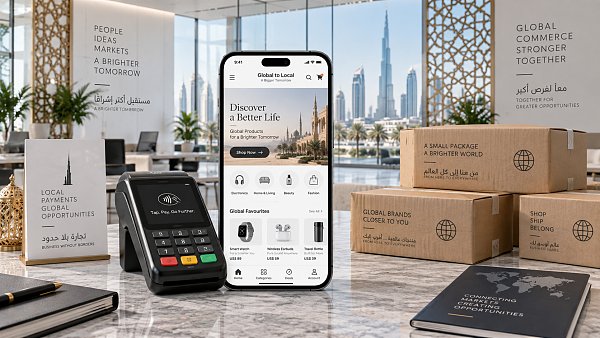
Payment, Currency, and Logistics Information Must Match Actual Transaction Habits
For exporters of equipment, building materials, and industrial products that mainly rely on inquiries, local payment may not be the top priority. However, for cross-border stores selling branded retail products, consumer electronics, cosmetics, home furnishings, and similar goods, payment capabilities directly affect transactions. Middle Eastern consumers do not have exactly the same level of acceptance of bank card payments, digital wallets, cash on delivery, and other methods, and settlement preferences also differ by country.
A website-building system suitable for the Middle East market should have scalable payment integration capabilities and support configuration of currencies, taxes, delivery instructions, and return and exchange policies by country or site. Front-end price displays should be clear, preventing users from discovering only at checkout that the currency, shipping fees, or taxes differ from their expectations. If complete local payment integration is not yet available, priority should be given to establishing a controllable process of “order submission—manual confirmation—multi-channel payment,” rather than leaving users facing a checkout page they cannot complete.
Cultural Adaptation Determines Whether Visitors Are Willing to Stay
Localization in the Middle East market does not mean simply piling regional elements onto a page. What truly affects user judgment is often the tone of the content, visual choices, and the way information is presented. For example, images of people, clothing, holiday messaging, family scenarios, and product usage methods should all avoid unnecessary conflicts with local culture and religious customs. Marketing occasions such as Ramadan, Eid al-Fitr, and National Day promotions also require the system to support quick changes to banners, campaign pages, promotional rules, and advertising landing pages.
In the B2B sector, local buyers usually pay close attention to company qualifications, delivery capabilities, project experience, after-sales responsiveness, and contact information. The website-building system should enable companies to flexibly create certification pages, factory pages, solution pages, and industry application pages, and present content in different language versions that is better aligned with local customer decision-making processes, rather than merely displaying an English product brochure.
SEO and Advertising Conversion Must Be Designed from the Website-Building Stage
Many companies treat website launch and promotion separately: they build the site first, then conduct Google SEO or advertising campaigns. The issue is that if the underlying system does not reserve capabilities for SEO and data tracking, companies often have to repeatedly change URLs, add tags, and rebuild page structures later, which affects indexing and slows down promotional efforts.
When evaluating Middle East website-building system capabilities, key checks should include support for custom URLs, page Titles and Meta Descriptions, H tags, image Alt text, sitemaps, robots configuration, 301 redirects, and structured data. Multilingual sites should also support canonical links and language-version associations to reduce indexing issues caused by duplicate content. For Arabic content, keywords and page titles should preferably be optimized independently, rather than directly using translations from English pages.
On the advertising side, attention should be paid to conversion tracking: whether Google Ads, Meta pixels, GA4, form events, phone clicks, and WhatsApp clicks can be recorded accurately. Only by distinguishing the lead quality generated by a particular country, language, and channel can a company determine where to allocate more budget, instead of merely looking at traffic growth.
Back-End Operational Capabilities Determine Whether Teams Can Continuously Use the Website
Corporate decision-makers often overlook a practical issue: who will maintain the website after it goes live? If every product parameter update, image replacement, or campaign publication depends on technical personnel, market opportunities can easily be missed. A good system should enable operations staff to complete page editing, product updates, content publishing, and form viewing within their assigned permissions, while retaining approval, backup, and version rollback mechanisms.
For companies with multiple markets and product lines, capabilities such as site duplication, centralized asset management, form lead synchronization, customer tagging, and data dashboards should also be considered. Headquarters can maintain brand standards, while regional teams can adjust content according to local pace. This better meets actual operational needs than “one website for all markets.”
When Selecting a Solution, Consider Using Three Questions to Eliminate Unsuitable Options
First, does it truly support Arabic RTL and complete mobile adaptation, rather than merely offering a translation plug-in? Second, can it connect the website, SEO, advertising tracking, and social media leads, ensuring that every promotional effort delivers measurable results? Third, does the provider understand the content, payment, and communication scenarios of the Middle East market and offer ongoing support during subsequent operations?
AI website-building and overseas marketing platforms such as Yiyingbao, designed for businesses expanding overseas, can use their cloud intelligent website-building, multilingual website development, cross-border store, SEO/GEO optimization, and advertising marketing capabilities collaboratively within the same business workflow. For companies, the value lies not only in building a website faster, but also in reducing the losses caused by separately procuring and repeatedly integrating website building, promotion, and data analysis.
Middle East market opportunities are highly attractive, but users will not naturally develop trust simply because a company has “entered the Middle East.” When selecting a website-building system, it should be viewed as digital business infrastructure for local customers: the language reads naturally, mobile use is comfortable, the site can be found through search, advertisements can lead effectively to it, and leads can be followed up in time. Only then can a website have the opportunity to evolve from a display window into a channel for continuously acquiring business opportunities.
Related Articles

Related Products
 Yiyingbao SaaS Intelligent Website Building and Marketing SystemYiyingbao SaaS Intelligent Website Building and Marketing System, AI-powered no-code website building, rapid creation of multilingual B2B international websites in 10 minutes, global server acceleration, AI-powered SEO optimization, helping businesses connect efficiently with global markets. The perfect integration of technology and operation makes building an international trade website remarkably simple
 AI+SEM Intelligent Advertising Marketing SystemAI+SEM drives intelligent ad creation, empowering full-funnel precision advertising marketing. The system automatically generates weekly/monthly reports, AI recommends keywords and target countries, monitors core metrics in real-time with intelligent alerts, and enables one-click high-conversion ad solutions to help quickly acquire customers and improve ROI.
 AI+SEO Dual-Engine System Optimization ServicesYiyingbao’s AI+SEO dual-engine optimization system helps foreign trade enterprises acquire high-quality organic traffic through AI-powered keyword research, content generation, and comprehensive technical optimization, significantly improving search rankings and conversion rates.
 AI+SNS Social Media Marketing SystemYingbao AI+SNS Social Media Marketing System - Precision social capture for the social media era. Supports one-click content synchronization across major platforms like Facebook and LinkedIn. AI intelligently rewrites posts for enhanced relevance. 24/7 AI customer service and user profiling analysis empower businesses to efficiently expand into global markets.
 AI+SEO营销解决方案易营宝AI+SEO营销解决方案,通过AI批量写作、智能生成TDK、精准关键词扩词等功能,全面优化网站SEO效果,提升流量与转化率。助力企业构建高效智能网站新生态。
 AI+SEM Advertising Marketing SolutionsAI+SEM Advertising Marketing Solution leverages AI technology to deeply empower SEM ad campaigns. It automatically generates weekly/monthly reports using AI, presenting account data across multiple dimensions for comprehensive insights into campaign performance and trends. The system precisely recommends keywords and target countries, intelligently generates high-conversion ad copy, and enables one-click activation of efficient campaign plans to help businesses rapidly acquire customers. Simultaneously, it monitors core metrics in real time, intelligently identifies abnormal fluctuations, and issues timely alerts to ensure stable, high-return advertising results.
 Domain Name ServicesEasyWin provides professional domain name services, including intelligent queries, one-stop registration, brand protection, and full lifecycle management, helping businesses build a digital brand image.
 EasyOperate B2C Cross-Border E-Commerce Platform & Independent WebsiteEasyStore B2C Cross-border E-commerce Independent Store is an intelligent website building and cross-border e-commerce integrated solution independently developed by EasyStore Information Technology (Beijing) Co., Ltd. The system is specially designed for small and medium-sized as well as large export enterprises, integrating 'website building, operation, marketing, advertising, and conversion' into one, helping enterprises quickly establish cross-border e-commerce independent stores to achieve brand globalization and global sales growth.
The platform supports multiple languages, multiple currencies, and multi-channel marketing, with built-in AI intelligent translation and SEO optimization systems, suitable for mainstream markets such as Southeast Asia, Europe and America, Latin America, and the Middle East, assisting Chinese manufacturing enterprises in efficiently deploying international e-commerce strategies. SSL证书易营宝提供专业SSL安全证书服务,包括单域名和泛域名证书,确保网站数据传输加密、身份验证和完整性保护,助力企业建立安全可信的在线业务环境。









