









- Can the average annual growth rate reflect real opportunities in overseas markets?Oct 07, 2026View details
- Which customer acquisition channels will be affected by cross-border marketing trends in 2026?Sep 06, 2026View details
- Which homogenization risks should be considered in an analysis of the AI-powered website building industry?Aug 30, 2026View details
- How Will AI Marketing Trends 2026 Change Advertising Budget AllocationAug 28, 2026View details
- Is the EV SSL certificate market shrinking or upgrading? How should companies assess certificate procurement?Aug 11, 2026View details
- Why the old AMP SEO 2020 practices no longer work and what has changed in current optimization prioritiesAug 02, 2026View details
Which stage of the purchase process is most likely to be hindered by errors in cross-border e-commerce store translation?
When translation errors occur in a cross-border e-commerce store, the first thing they often undermine is not traffic, but users’ trust before placing an order. From product information and price comprehension to payment confirmation, any discrepancy in the details may cause the transaction to be lost at the final step.
When reviewing the performance of a cross-border e-commerce store, many project managers tend to attribute problems to advertising, page speed, payment channels, or inventory coordination. However, on multilingual websites, the factor that truly causes orders to fail at the final step is often translation quality that has not kept pace with the business process. Traffic can arrive, products can be viewed, and users may even add products to their carts, but they may ultimately abandon payment because of an inaccurate delivery statement, an ambiguous size term, or a refund expression that does not conform to local conventions.
For project managers, this is not merely a copywriting issue, but a typical delivery-chain issue: translation errors are amplified at multiple points, and the part most likely to suffer in the end is the conversion confirmation stage before payment.
What is most easily undermined is not browsing, but “order confirmation”
Translation errors in cross-border e-commerce stores usually have an impact at three levels.
The first level is misunderstanding. Users may not understand the content, misinterpret product specifications, or be unclear about the applicable scope. This affects time on page and bounce rate, but may not be immediately fatal, because users may continue comparing products.
The second level is hesitation when making a choice. Unclear translations of specifications, materials, warranties, or delivery times may cause users to repeatedly verify information before adding a product to the cart, slowing the conversion path.
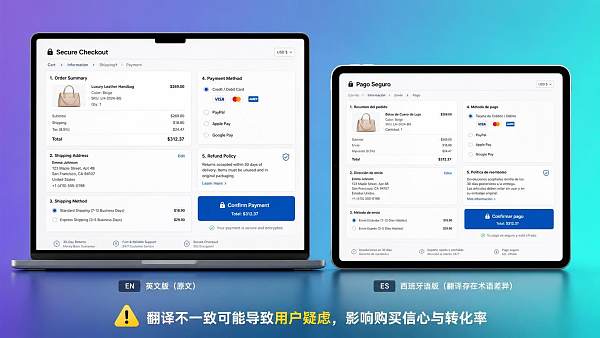
The third and most critical level is the point at which the transaction breaks: distrust before payment. At this stage, users already have an intention to purchase. Any imprecise translation is no longer regarded as a “minor issue,” but is directly interpreted as a sign that the website is unprofessional, after-sales service is unreliable, or the transaction involves risk.
This is why many cross-border e-commerce stores appear to have “normal traffic and normal add-to-cart activity,” while their checkout conversion rates remain consistently low. It is not that users do not want to buy; rather, when confirming responsibility, price, logistics, and after-sales service at the final stage, the translation makes them afraid to purchase.
Which translation errors are most likely to cause orders to be lost at the final step?
One category involves unclear expressions of prices and fees. For example, whether taxes are included, whether shipping costs are charged separately, the conditions applicable to discounts, and the rounding rules after currency conversion. If the English, German, and French pages use inconsistent wording, users may easily suspect that an “extra charge” will appear at checkout. This inconsistency is particularly sensitive in the European market, where consumers have higher expectations regarding tax-inclusive prices, return conditions, and payment transparency.
Another category involves overly literal translations of delivery commitments. If “Estimated delivery within 7–15 days” is translated as “Guaranteed delivery within 7–15 days,” as understood by local users, any delay may directly trigger complaints. Conversely, if “business days” is simply written as “days,” users may misunderstand whether weekends are included. Project teams often treat this as a customer service issue, but the root cause is actually unclear language definitions on the front end.
Another common problem is inaccurate translation of product specifications and conditions of use. This is particularly common with clothing, home furnishings, industrial accessories, and electronic accessories. If units of measurement, interface standards, compatible models, load-bearing ranges, and operating environments are translated by machine without considering the target market’s language conventions, users may worry about purchasing the wrong product. This can result in lost B2C orders and cause small B2B purchases to stop before an inquiry is submitted.
There is also the problem of payment and after-sales terms that do not conform to local language conventions. For example, the Chinese-style sentence “The refund will be returned to the original payment method after review” may sound stiff or even ambiguous when translated directly into many languages. When users see vague payment security information, return and exchange terms, or privacy policies on the checkout page, they will instinctively leave rather than risk continuing with the payment.
The most common misjudgment in project execution: treating translation as a final step before launch
When scheduling cross-border e-commerce projects, many teams place translation after development, product selection, and payment integration, treating it as “content filling.” This sequence itself creates risks. Unlike a corporate presentation website, translation for an e-commerce store directly participates in the transaction: product pages, shopping carts, checkout pages, email notifications, after-sales pages, privacy terms, and SEO landing pages collectively determine whether users are willing to complete payment.
When translation is introduced too late, three common results arise:
First, page fields have already been hard-coded, and changes in the length of the target language cause buttons to shift, forms to be truncated, and checkout steps on mobile devices to behave abnormally;
Second, product data is updated asynchronously across language versions, resulting in inconsistencies between front-end displays and checkout information;
Third, customer service, advertising, landing pages, and the main content of the store do not use a consistent language system, creating an obvious disconnect after users enter through an advertisement.
For engineering project managers, this means translation should not be handled as an independent content outsourcing task. Instead, it should be incorporated into the implementation scope of a multilingual e-commerce store and advanced together with information architecture, field design, front-end adaptation, SEO, and local compliance.
What truly affects transactions is not just “translating correctly,” but “maintaining consistent business semantics”
The difficulty of translating a cross-border e-commerce store lies not in replacing one word with another, but in whether the meaning of the transaction can remain consistent throughout the entire process.
Consider a simple example: the product details page states “Customization available,” the shopping cart note field says “Leave a message for special requirements,” but the after-sales terms on the checkout page do not specify whether customized products can be returned or exchanged. Even if the grammar of each statement is correct, users will stop before payment as long as the meanings are not consistent.
When developing a multilingual e-commerce store, project teams should first establish at least four sets of semantic rules:
First, how to express core product attributes, especially models, specifications, materials, and functional selling points;
Second, how to express transaction rules, including prices, taxes, shipping costs, delivery times, and after-sales service;
Third, how to express trust-related information, including payment security, brand credentials, review mechanisms, and privacy policies;
Fourth, how to express exception handling, including out-of-stock situations, delays, refunds, and order modifications.
If these four sets of rules are not standardized into a terminology database and incorporated into processes, even the best translation resources will struggle to support transactions consistently over the long term.
From a project implementation perspective, how should cross-border e-commerce translation be managed?
The effective approach is not to “have native translators completely redo the entire website,” but to establish a language management mechanism suited to the operating pace of an e-commerce store.
Step one: classify content by priority instead of processing the entire website uniformly. Product details, checkout pages, delivery policies, return and exchange policies, and payment prompts are highly sensitive to conversions, so they must take priority over blogs, brand stories, or secondary sections. When a project has a limited budget, these pages that directly influence payment decisions are where resources should truly be invested first.
Step two: establish a terminology glossary and prohibited expressions. This is especially important for specification terms, industry terms, and after-sales terms. Engineering managers are most concerned about different suppliers, editors, and campaign pages each using their own wording. When the same concept appears in three or four forms on the same website, users naturally lose trust.
Step three: incorporate translation into the version update mechanism. The most common problem with cross-border e-commerce stores is not that the initial version was translated poorly, but that multilingual pages are not synchronized after product information is modified. For example, the English page may have updated its inventory rules while the Spanish page still contains the old content. Systems with automatic synchronization capabilities can significantly reduce this risk. For example, platforms such as multilingual website solutions for foreign trade create value not only through translation efficiency, but also by linking multilingual content with e-commerce operations and updates, preventing project management failures in which “one change is made while several others are missed.”
Step four: use data to identify translation problems instead of relying only on subjective review. If a website in a particular language has stable traffic and normal add-to-cart activity but an unusually low checkout conversion rate, do not rush to replace the payment channel. First check whether there are major exit points on the checkout, logistics, or returns pages in that language. Truly mature multilingual e-commerce management is not about checking for typographical errors after launch, but about determining whether the conversion funnels in different languages are healthy.
Why should project managers focus on “localization” rather than just “multilingual support”?
If cross-border e-commerce translation remains limited to literal conversion, the work often becomes increasingly burdensome. This is because you will later discover that the same sentence cannot be reused directly in different markets.
North American users focus on delivery and payment convenience, European users place greater emphasis on tax transparency and privacy compliance, and the Middle East market has different preferences regarding language tone, payment habits, and page layout. If there is no localization awareness during project execution, continuous rework will follow: rewriting CTAs, adjusting policy pages, modifying email templates, supplementing privacy terms, and correcting promises on advertising landing pages.
This is why some companies no longer look only at “how many languages are supported” when selecting a solution. They also evaluate whether it supports localized content review, multilingual SEO, automatic meta tag generation, and conversion monitoring by language. Translation is no longer an isolated module, but infrastructure that affects customer acquisition, conversion, compliance, and maintenance costs.
From the perspective of implementation efficiency, solutions suited to project teams should typically have several characteristics: multilingual versions can be updated synchronously after product information changes; marketing tools and analytics can be segmented by language; websites remain stable to access in major overseas regions; and privacy policies and data processing comply with international rules such as GDPR. These capabilities determine not whether a page looks attractive, but whether a project can operate stably.
The real issue to resolve is who is responsible for transaction losses caused by translation
The most troublesome aspect of translation errors in cross-border e-commerce stores is that responsibility is often dispersed. Operations considers it a technical issue, technology considers it a content issue, the translation provider considers the product information incomplete, and customer service bears the complaints at the end of the process. As a result, the problem persists without anyone truly closing the loop.
What project managers need to do is not personally proofread every sentence, but clearly define the boundaries of responsibility: who maintains the original product data, who reviews high-risk pages, who tracks checkout conversions in each language, who conducts spot checks after version updates, and who is responsible for localizing policies and transaction terms. Only by placing translation back within the project management system, rather than treating it as temporary copywriting, can transaction losses be effectively controlled.
The aspect most likely to be undermined by cross-border e-commerce translation errors is not front-end exposure, but users’ trust confirmation when they are close to making a payment. Once this step is disrupted, the effectiveness of the preceding advertising, SEO, promotions, and product selection will all be reduced. For teams implementing a multilingual e-commerce store, what truly deserves priority is often not “whether there are more languages,” but “whether every language can safely guide users through to completed payment.”
Related Articles



Related Products
 Yiyingbao SaaS Intelligent Website Building and Marketing SystemYiyingbao SaaS Intelligent Website Building and Marketing System, AI-powered no-code website building, rapid creation of multilingual B2B international websites in 10 minutes, global server acceleration, AI-powered SEO optimization, helping businesses connect efficiently with global markets. The perfect integration of technology and operation makes building an international trade website remarkably simple
 AI+SEM Intelligent Advertising Marketing SystemAI+SEM drives intelligent ad creation, empowering full-funnel precision advertising marketing. The system automatically generates weekly/monthly reports, AI recommends keywords and target countries, monitors core metrics in real-time with intelligent alerts, and enables one-click high-conversion ad solutions to help quickly acquire customers and improve ROI.
 AI+SEO Dual-Engine System Optimization ServicesYiyingbao’s AI+SEO dual-engine optimization system helps foreign trade enterprises acquire high-quality organic traffic through AI-powered keyword research, content generation, and comprehensive technical optimization, significantly improving search rankings and conversion rates.
 AI+SNS Social Media Marketing SystemYingbao AI+SNS Social Media Marketing System - Precision social capture for the social media era. Supports one-click content synchronization across major platforms like Facebook and LinkedIn. AI intelligently rewrites posts for enhanced relevance. 24/7 AI customer service and user profiling analysis empower businesses to efficiently expand into global markets.
 AI+SEO营销解决方案易营宝AI+SEO营销解决方案,通过AI批量写作、智能生成TDK、精准关键词扩词等功能,全面优化网站SEO效果,提升流量与转化率。助力企业构建高效智能网站新生态。
 AI+SEM Advertising Marketing SolutionsAI+SEM Advertising Marketing Solution leverages AI technology to deeply empower SEM ad campaigns. It automatically generates weekly/monthly reports using AI, presenting account data across multiple dimensions for comprehensive insights into campaign performance and trends. The system precisely recommends keywords and target countries, intelligently generates high-conversion ad copy, and enables one-click activation of efficient campaign plans to help businesses rapidly acquire customers. Simultaneously, it monitors core metrics in real time, intelligently identifies abnormal fluctuations, and issues timely alerts to ensure stable, high-return advertising results.
 Domain Name ServicesEasyWin provides professional domain name services, including intelligent queries, one-stop registration, brand protection, and full lifecycle management, helping businesses build a digital brand image.
 EasyOperate B2C Cross-Border E-Commerce Platform & Independent WebsiteEasyStore B2C Cross-border E-commerce Independent Store is an intelligent website building and cross-border e-commerce integrated solution independently developed by EasyStore Information Technology (Beijing) Co., Ltd. The system is specially designed for small and medium-sized as well as large export enterprises, integrating 'website building, operation, marketing, advertising, and conversion' into one, helping enterprises quickly establish cross-border e-commerce independent stores to achieve brand globalization and global sales growth.
The platform supports multiple languages, multiple currencies, and multi-channel marketing, with built-in AI intelligent translation and SEO optimization systems, suitable for mainstream markets such as Southeast Asia, Europe and America, Latin America, and the Middle East, assisting Chinese manufacturing enterprises in efficiently deploying international e-commerce strategies. SSL证书易营宝提供专业SSL安全证书服务,包括单域名和泛域名证书,确保网站数据传输加密、身份验证和完整性保护,助力企业建立安全可信的在线业务环境。









