









- Can the average annual growth rate reflect real opportunities in overseas markets?Oct 07, 2026View details
- Which customer acquisition channels will be affected by cross-border marketing trends in 2026?Sep 06, 2026View details
- Which homogenization risks should be considered in an analysis of the AI-powered website building industry?Aug 30, 2026View details
- How Will AI Marketing Trends 2026 Change Advertising Budget AllocationAug 28, 2026View details
- Is the EV SSL certificate market shrinking or upgrading? How should companies assess certificate procurement?Aug 11, 2026View details
- Why the old AMP SEO 2020 practices no longer work and what has changed in current optimization prioritiesAug 02, 2026View details
Why do Common SEO Problems Always Appear After a Website Redesign
Why Do Common SEO Issues Always Appear in Clusters After a Redesign?
A website may appear to run normally in daily operations, but once it is redesigned, SEO issues seem to be suddenly amplified: pages that previously ranked drop in visibility, old links stop working, search engines begin repeatedly crawling invalid URLs, and even inquiry forms may see lower conversion rates because of structural changes. Many maintenance personnel have an intuitive feeling that the redesign itself is not necessarily the problem; rather, it exposes the previously overlooked technical debt, content gaps, and marketing coordination issues all at once.
This is why after-sales maintenance should not focus only on whether the “page is live” or whether the “style is correct.” What truly determines whether a website remains stable after a redesign is often its URL strategy, redirect rules, template structure, indexing signals, tracking data, content inheritance, and whether the technical and marketing teams aligned in advance. This is particularly evident for international trade websites, independent websites, and multilingual corporate websites.
The Problem Does Not Start on the Redesign Day; It Is Embedded Beforehand
Many people interpret traffic fluctuations after a redesign as a sign that “search engines need time to adapt.” This is not entirely wrong, but it only tells half the story. More commonly, the old website already has issues such as a confusing page hierarchy, duplicate titles, weak content, accumulated broken links, and average mobile experience. Because the old site had remained stable for a long time, search engines were still willing to maintain a certain level of trust. Once the redesign disrupts the original structure, search engines need to reassess the correspondence between pages, and those hidden issues break out all at once.
This is especially common in projects integrating websites and marketing services. A redesign is not merely a visual replacement. It is usually accompanied by section restructuring, expansion of language versions, changes to form paths, replacement of landing pages, the addition of JavaScript components, and even migration to a new website system. If any one of these steps is excluded from the unified launch checklist, SEO issues can develop from isolated anomalies into a chain reaction.
The Four Most Common Types of Failures After a Redesign
The first is uncontrolled URLs. Old pages are deleted and the URL rules for new pages are changed, but one-to-one—or at least one-to-many—301 redirects are not configured. This directly leads to lost indexing, broken backlink equity, and interrupted user access. Maintenance personnel often check only the homepage and a few key sections, while the pages that actually encounter problems are often long-tail pages such as product detail pages, news pages, and case study pages.
The second is a change in template signals. It may appear to be only a front-end style change, but in reality it may also affect key elements such as title tags, body content structure, breadcrumbs, internal linking modules, canonical tags, and hreflang. On multilingual websites in particular, if language versions reference one another incorrectly, search engines may treat different languages as duplicate pages or deliver the wrong language to the wrong market.
The third is blocked crawling paths. Common post-redesign issues include overly restrictive robots settings, test environments that remain blocked, important content loaded late through front-end scripts, abnormal paths for images and document resources, and sitemaps that are not updated synchronously. These problems may not immediately make pages disappear, but they can cause search engines to judge the website as less stable.
The fourth is a broken conversion path. Many SEO issues appear on the surface to be ranking problems, but in reality the marketing path has been shortened. For example, a page may retain its keywords while removing technical parameters, industry scenarios, trust signals, and consultation entry points. Search traffic remains, but users cannot find the next step, resulting in “visits without inquiries.”
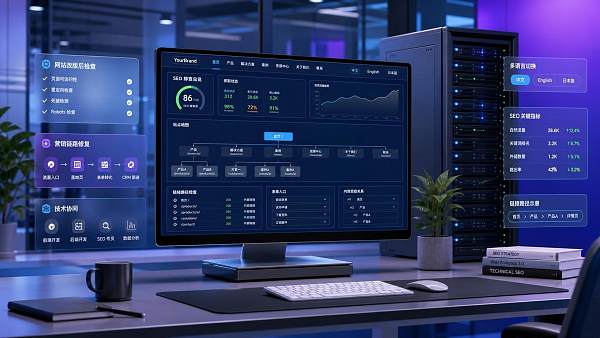
What Should After-Sales Maintenance Personnel Check First?
If the redesign has already gone live, it is not advisable to immediately make large-scale changes to titles or rewrite content. Starting with a structural review is more efficient. In practice, priorities can usually be arranged as follows:
- Extract the core URLs from the old website and verify that they correctly redirect to the closest corresponding pages on the new website;
- Check response codes, focusing on whether there are large numbers of 404 errors, chained 302 redirects, or 500 errors;
- Confirm that the new website retains the title semantics, main body content, and internal linking relationships of core pages;
- Verify whether the XML sitemap, robots, canonical, and multilingual tags have been updated synchronously;
- Check whether forms, buttons, telephone numbers, emails, and download entry points are working properly;
- Compare the natural-traffic landing pages before and after the redesign to identify pages with traffic losses rather than looking only at total traffic.
The core of this review process is not to “fix SEO separately,” but to determine whether search performance, user access, and conversion actions have all been affected by the same redesign. If maintenance personnel only fix broken links without examining the inquiry path, many problems will recur.
Why Are Problems More Likely to Be Compressed into the Same Time Period in Integrated Projects?
Many companies now coordinate website development, content, advertising, and SEO rather than simply building a corporate website. This approach improves execution speed, but it also concentrates risk. Once the website structure changes, advertising landing pages, remarketing tracking, social media entry points, and search landing pages may all change at the same time. As a result, minor problems that were originally dispersed can be triggered all at once during the launch window.
Based on project experience, the genuinely reliable approach is not to add SEO as a remedy after launch, but to involve it during the requirements stage. For a service provider like Yiyingbao, which has long worked on intelligent website development, SEO optimization, advertising, and multilingual website coordination, the advantage is not merely having more tools. It is the ability to view website development logic and customer acquisition logic on the same overall framework. Since 2013, the company has focused on global digital marketing services and built cloud-based intelligent website development systems, cross-border e-commerce systems, AI advertising marketing systems, and AI+SEO/GEO optimization systems around AI and big data. In essence, these systems reduce the disconnect between “the website is live but cannot be promoted,” “it can be promoted but is difficult to index,” and “it is indexed but does not convert.”
This is important for the maintenance side. After-sales service is not afraid of problems; what it fears is the mutual impact between systems without a unified basis for assessment. This is particularly true for multilingual projects targeting different markets, including North America, Europe, Southeast Asia, Japan and South Korea, and the Middle East. If technical redesign, content migration, and advertising schedules are not synchronized, subsequent troubleshooting costs can be very high.
Not Every Page Should Be Retained “As Is”
Another common misconception during a redesign is to mechanically retain every old page in order to avoid SEO issues. This is not necessarily the right approach. For low-quality pages with no traffic or conversions and duplicated topics, retaining them may instead dilute the website’s topical focus. During maintenance, content should be divided into three categories: core pages that must be inherited, duplicate pages that can be consolidated, and invalid pages that should be phased out.
When making this assessment, do not look only at whether a page has been indexed; also consider whether it supports real business needs. For example, on websites of industrial manufacturing, environmental protection equipment, and packaging material companies, pages contain not only keywords but also technical explanations, scenario descriptions, qualification credentials, and inquiry entry points. If a redesign retains only an attractive visual design while removing this pre-purchase information, conversions may decline even if rankings recover.
This is especially evident on industry-specific topic pages. For pages such as Papermaking, Packaging, Environmental Protection, the real value is not simply “displaying an industry name,” but whether a clear single-column structure, scenario-based images, solution waterfall sections, technical commitment icon modules, and high-conversion appointment forms can clearly communicate brand capabilities, application boundaries, and consultation paths. Once the information structure becomes more logical, it is easier for users to understand and more convenient for the maintenance team to continuously improve.
Recovery After a Redesign Does Not Rely on Luck but on Timing and Process
Some websites fail to recover within a week after launch, so the team begins frequently changing TDKs, renaming sections, deleting pages, and replacing copy. This often makes the problem even more disorganized. A more reliable approach is to first ensure that technical signals are stable, then observe crawling and indexing, and only afterward address content and conversion.
The actual process can be divided into three stages. During the first 1 to 3 days after launch, focus on error codes, redirects, crawling obstacles, and form functionality. During the first 1 to 2 weeks, observe how search engines replace old URLs with new ones and check whether key landing pages have recovered. After that, content enhancement and internal-link restructuring can be carried out based on pages with traffic losses and low-conversion pages. This approach allows the maintenance team to distinguish more quickly between a “technical failure” and insufficient “content competitiveness.”
If the company is also responsible for overseas promotion, recovery assessments should not rely on data from a single search engine. They should also incorporate advertising landing page performance, the quality of social media traffic, and the effectiveness of inquiries. The reason Yiyingbao emphasizes an all-in-one approach is not conceptual packaging, but that customer acquisition for independent websites is now rarely determined by a single channel. Any structural change after a redesign may simultaneously affect organic search, ad quality scores, and the user decision-making path.
The Focus of Maintenance Is Shifting from “Fixing Pages” to “Managing Growth Interfaces”
Today, SEO issues can no longer be understood simply as several technical abnormalities. For after-sales maintenance personnel, they are more like a signal of website health: whether search engines can understand the site, whether users can access it, and whether the business can convert them. Redesigns are prone to problems because these three levels may all be changed within a short period.
Therefore, the genuinely effective response is not to wait for traffic to decline before taking action, but to prepare page mappings, launch checks, crawl validation, and conversion regression checklists before every redesign. If the project also involves multiple languages, overseas advertising, or the restructuring of industry-specific topic pages, it is best to place technology, content, and marketing within the same delivery schedule. Even if fluctuations occur, the team can quickly determine whether they are caused by structural issues, content issues, or channel handoff issues, instead of repeatedly going around in circles among scattered failures.
If you are dealing with post-redesign anomalies, the first thing worth confirming is not “how much have the keywords dropped,” but which key pages have lost their original correspondence and which consultation paths have been unintentionally cut off. Once these two issues are accurately identified, subsequent recovery efforts will have a clear direction.
Related Articles



Related Products
 Yiyingbao SaaS Intelligent Website Building and Marketing SystemYiyingbao SaaS Intelligent Website Building and Marketing System, AI-powered no-code website building, rapid creation of multilingual B2B international websites in 10 minutes, global server acceleration, AI-powered SEO optimization, helping businesses connect efficiently with global markets. The perfect integration of technology and operation makes building an international trade website remarkably simple
 AI+SEM Intelligent Advertising Marketing SystemAI+SEM drives intelligent ad creation, empowering full-funnel precision advertising marketing. The system automatically generates weekly/monthly reports, AI recommends keywords and target countries, monitors core metrics in real-time with intelligent alerts, and enables one-click high-conversion ad solutions to help quickly acquire customers and improve ROI.
 AI+SEO Dual-Engine System Optimization ServicesYiyingbao’s AI+SEO dual-engine optimization system helps foreign trade enterprises acquire high-quality organic traffic through AI-powered keyword research, content generation, and comprehensive technical optimization, significantly improving search rankings and conversion rates.
 AI+SNS Social Media Marketing SystemYingbao AI+SNS Social Media Marketing System - Precision social capture for the social media era. Supports one-click content synchronization across major platforms like Facebook and LinkedIn. AI intelligently rewrites posts for enhanced relevance. 24/7 AI customer service and user profiling analysis empower businesses to efficiently expand into global markets.
 AI+SEO营销解决方案易营宝AI+SEO营销解决方案,通过AI批量写作、智能生成TDK、精准关键词扩词等功能,全面优化网站SEO效果,提升流量与转化率。助力企业构建高效智能网站新生态。
 AI+SEM Advertising Marketing SolutionsAI+SEM Advertising Marketing Solution leverages AI technology to deeply empower SEM ad campaigns. It automatically generates weekly/monthly reports using AI, presenting account data across multiple dimensions for comprehensive insights into campaign performance and trends. The system precisely recommends keywords and target countries, intelligently generates high-conversion ad copy, and enables one-click activation of efficient campaign plans to help businesses rapidly acquire customers. Simultaneously, it monitors core metrics in real time, intelligently identifies abnormal fluctuations, and issues timely alerts to ensure stable, high-return advertising results.
 Domain Name ServicesEasyWin provides professional domain name services, including intelligent queries, one-stop registration, brand protection, and full lifecycle management, helping businesses build a digital brand image.
 EasyOperate B2C Cross-Border E-Commerce Platform & Independent WebsiteEasyStore B2C Cross-border E-commerce Independent Store is an intelligent website building and cross-border e-commerce integrated solution independently developed by EasyStore Information Technology (Beijing) Co., Ltd. The system is specially designed for small and medium-sized as well as large export enterprises, integrating 'website building, operation, marketing, advertising, and conversion' into one, helping enterprises quickly establish cross-border e-commerce independent stores to achieve brand globalization and global sales growth.
The platform supports multiple languages, multiple currencies, and multi-channel marketing, with built-in AI intelligent translation and SEO optimization systems, suitable for mainstream markets such as Southeast Asia, Europe and America, Latin America, and the Middle East, assisting Chinese manufacturing enterprises in efficiently deploying international e-commerce strategies. SSL证书易营宝提供专业SSL安全证书服务,包括单域名和泛域名证书,确保网站数据传输加密、身份验证和完整性保护,助力企业建立安全可信的在线业务环境。









