









- Which customer acquisition channels will be affected by cross-border marketing trends in 2026?Sep 06, 2026View details
- Which homogenization risks should be considered in an analysis of the AI-powered website building industry?Aug 30, 2026View details
- How Will AI Marketing Trends 2026 Change Advertising Budget AllocationAug 28, 2026View details
- Is the EV SSL certificate market shrinking or upgrading? How should companies assess certificate procurement?Aug 11, 2026View details
- Why the old AMP SEO 2020 practices no longer work and what has changed in current optimization prioritiesAug 02, 2026View details
- How to Choose Topics for an Industry News Section to Attract More Organic Search TrafficJul 29, 2026View details
- Digital Marketing Shenzhen Market Insights: Why Are Companies Expanding Overseas Looking for Growth Teams in Shenzhen?Jul 31, 2026View details
- Can Zhejiang foreign trade independent websites still be developed today? Look at changes in traffic and lead generationJul 28, 2026View details
Can a SaaS website system be built quickly? Comparing template launch speed and secondary development restrictions
Is Rapid SaaS Website Building Feasible? First, See What “Fast” Can Solve
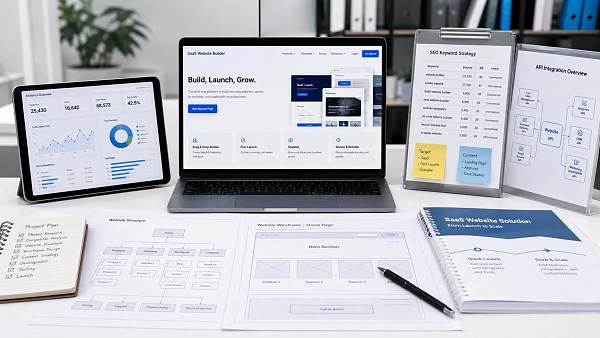
Rapid SaaS website building has indeed been very popular in recent years. The reason is not complicated: many companies are moving faster in their overseas expansion, and official websites, landing pages, and multilingual sites all need to go live as quickly as possible, while technical teams are often short-staffed. Template-based delivery therefore looks very attractive.
However, from a selection perspective, the question is not only whether it can be launched quickly, but also whether this kind of speed can last. A fast first launch does not mean smooth subsequent operations. Once a site truly enters the business cycle, content management, SEO expansion, ad landing page iteration, data integration, and secondary development will all begin to affect results.
Therefore, the feasibility of rapid SaaS website building is not mainly about “whether it can go live,” but about “whether it can continue to grow after going live.” If the template is fast but the architecture is restrictive, every later step will become slower, and such a solution may not be suitable for long-term use.
This is especially true in a website + marketing services integrated scenario, where the website is not a static display page, but the foundation for customer acquisition. It needs to support search traffic, ad traffic, and social media traffic, and also sustain lead conversion and subsequent analysis. From this perspective, speed is only the first layer; scalability is the deciding factor.
The Real Advantages of Template Launch Speed
First, the conclusion: rapid SaaS website building is feasible in standardized requirements, and it is usually highly efficient. For brand launches, short-term campaigns, themed events, and basic multilingual official websites, such systems can often compress the launch cycle from weeks to days.
This efficiency mainly comes from three aspects. First, templates and components are already preset. Second, servers, deployment, certificates, and security updates are handled uniformly by the platform. Third, backend content management is generally more intuitive, so non-R&D staff can also participate in maintenance.
If a company’s current top priority is “have a site first, then advertise,” then rapid SaaS website building is indeed more advantageous than traditional custom development. It can quickly create a minimum viable site and help the business validate market feedback as early as possible.
From recent changes, more and more teams no longer separate website building from marketing procurement. The reason is very practical: a site that only looks good is no longer enough. A website must have indexing capability, conversion capability, and continuous iteration capability in order to truly carry growth tasks.
- Suitable for rapid launch of standard corporate websites, product showcase pages, and recruitment pages
- Suitable for synchronous rollout of multilingual basic websites
- Suitable for themed landing page development during the ad testing phase
- Suitable for direct promotion by business departments that lack a dedicated R&D team
Second-Launch Constraints Are Often Revealed After Growth, Not at Initial Launch
The real bottleneck usually appears after the business starts growing. Template sites may feel smooth when they first go live, but once you need to expand page structure, integrate external systems, modify form logic, or rewrite page strategies, limitations become visible one by one.
Common issues include: fixed page structures, insufficiently flexible field models, limited URL rules, an inflexible code layer, insufficient interface openness, a simple permission system, and high costs for data export and migration. These issues do not affect the initial launch, but they do affect later growth efficiency.
This also means that when evaluating rapid SaaS website building, you should not only look at whether the demo backend is easy to use, but also whether the platform supports business upgrades. This is especially true for B2B foreign trade, cross-border independent sites, and marketing-oriented official websites, where later on there is usually a need for more complex lead collection, content matrices, and SEO structure adjustments.
If a platform builds “speed” on top of “closure,” then a low threshold in the short term may be exchanged for high costs in the long term. The most common result is that the time saved in the early stage is later paid back through higher migration, rebuilding, and coordination costs.
Key constraints are usually concentrated in four areas
- Front-end presentation is constrained by templates, with insufficient brand differentiation
- SEO structure adjustment space is limited, affecting indexing and ranking strategies
- Interface capabilities are relatively weak, making deep integration with CRM, ERP, and advertising systems difficult
- Data migration is not smooth, and later platform replacement costs are relatively high
Speed and Constraints: How Should They Be Compared to Be Decision-Relevant?
A more effective evaluation method is not to simply oppose template sites and custom sites, but to break the issue down by time dimension. In the initial stage, focus on speed; in the mid-stage, focus on operational efficiency; and in the long-term, focus on scalability. Only when all three stages pass can the solution be considered stable.
The comparison below is closer to the logic used in real procurement decisions.
If business rhythm is clear, marketing activities are intensive, and future system integration and content-scale requirements already exist, then simply pursuing rapid SaaS website building is often not enough. What truly has decision value is whether it can still keep running after it goes live.
In a Website + Marketing Services Integrated Scenario, What Capabilities Should Be Evaluated?
In real business, a website is only the starting point, not the end point. A solution that can support growth should ideally have website building, SEO, ad landing page, content management, lead collection, and data analysis capabilities at the same time. Only then can losses caused by system fragmentation be reduced.
From YiYingBao’s perspective, it is closer to a combined logic of “platform-based SaaS website system rapid building + marketing expansion.” Relying on its self-developed cloud intelligent website system, cross-border e-commerce mall system, AI advertising marketing system, and AI+SEO/GEO optimization system, the focus is not only on building the site, but on turning the site into a business asset that is promotable, indexable, and convertible.
This solution is more realistic for export companies. For example, foreign trade official websites, multilingual sites, B2C independent sites, ad landing pages, and overseas social media traffic generation are often not operated separately. They share content, data, and customer acquisition goals. The higher the degree of platform integration, the lower the later coordination cost.
A more obvious signal is that companies are now paying more and more attention to AI search visibility, long-term Google SEO growth, and coordinated multi-channel ad delivery. A template page alone is already hard to support these requirements. A system that supports continuous optimization has greater value.
When evaluating, focus on these five points
- Whether the page model can be flexibly expanded, rather than just replacing copy and images
- Whether SEO rules are configurable, including URL, titles, structured data, and multilingual strategies
- Whether forms, inquiries, memberships, products, or lead data can be connected with external systems
- Whether data export, backup, and migration are clear, to avoid platform lock-in risks
- Whether later marketing capabilities can work in sync, avoiding separate battles between website building and promotion
Conclusion: Rapid SaaS Website Building Is Feasible, But the Premise Is “Fast Without Breaking”
Returning to the original question, rapid SaaS website building is certainly feasible, and in many scenarios it is very effective. But if the goal is only to go live, any template may seem good enough; if the goal is continuous customer acquisition and long-term growth, the evaluation criteria must be much stricter.
A more stable approach is to prioritize platform solutions that balance template efficiency and scalability. They can satisfy initial speed while also supporting SEO, advertising, social media, AI search, and business system linkage. Such a website is not a one-time delivery item, but a growth infrastructure that can keep scaling.
Therefore, when making a selection conclusion, it is worth reframing the question: after this SaaS website system is rapidly built, can it still support business changes six months later, and is it still worth continued investment one year later? If you can answer these two questions, the decision usually will not be off-track.
Related Articles


Related Products
 Yiyingbao SaaS Intelligent Website Building and Marketing SystemYiyingbao SaaS Intelligent Website Building and Marketing System, AI-powered no-code website building, rapid creation of multilingual B2B international websites in 10 minutes, global server acceleration, AI-powered SEO optimization, helping businesses connect efficiently with global markets. The perfect integration of technology and operation makes building an international trade website remarkably simple
 AI+SEM Intelligent Advertising Marketing SystemAI+SEM drives intelligent ad creation, empowering full-funnel precision advertising marketing. The system automatically generates weekly/monthly reports, AI recommends keywords and target countries, monitors core metrics in real-time with intelligent alerts, and enables one-click high-conversion ad solutions to help quickly acquire customers and improve ROI.
 AI+SEO Dual-Engine System Optimization ServicesYiyingbao’s AI+SEO dual-engine optimization system helps foreign trade enterprises acquire high-quality organic traffic through AI-powered keyword research, content generation, and comprehensive technical optimization, significantly improving search rankings and conversion rates.
 AI+SNS Social Media Marketing SystemYingbao AI+SNS Social Media Marketing System - Precision social capture for the social media era. Supports one-click content synchronization across major platforms like Facebook and LinkedIn. AI intelligently rewrites posts for enhanced relevance. 24/7 AI customer service and user profiling analysis empower businesses to efficiently expand into global markets.
 AI+SEO营销解决方案易营宝AI+SEO营销解决方案,通过AI批量写作、智能生成TDK、精准关键词扩词等功能,全面优化网站SEO效果,提升流量与转化率。助力企业构建高效智能网站新生态。
 AI+SEM Advertising Marketing SolutionsAI+SEM Advertising Marketing Solution leverages AI technology to deeply empower SEM ad campaigns. It automatically generates weekly/monthly reports using AI, presenting account data across multiple dimensions for comprehensive insights into campaign performance and trends. The system precisely recommends keywords and target countries, intelligently generates high-conversion ad copy, and enables one-click activation of efficient campaign plans to help businesses rapidly acquire customers. Simultaneously, it monitors core metrics in real time, intelligently identifies abnormal fluctuations, and issues timely alerts to ensure stable, high-return advertising results.
 Domain Name ServicesEasyWin provides professional domain name services, including intelligent queries, one-stop registration, brand protection, and full lifecycle management, helping businesses build a digital brand image.
 EasyOperate B2C Cross-Border E-Commerce Platform & Independent WebsiteEasyStore B2C Cross-border E-commerce Independent Store is an intelligent website building and cross-border e-commerce integrated solution independently developed by EasyStore Information Technology (Beijing) Co., Ltd. The system is specially designed for small and medium-sized as well as large export enterprises, integrating 'website building, operation, marketing, advertising, and conversion' into one, helping enterprises quickly establish cross-border e-commerce independent stores to achieve brand globalization and global sales growth.
The platform supports multiple languages, multiple currencies, and multi-channel marketing, with built-in AI intelligent translation and SEO optimization systems, suitable for mainstream markets such as Southeast Asia, Europe and America, Latin America, and the Middle East, assisting Chinese manufacturing enterprises in efficiently deploying international e-commerce strategies. SSL证书易营宝提供专业SSL安全证书服务,包括单域名和泛域名证书,确保网站数据传输加密、身份验证和完整性保护,助力企业建立安全可信的在线业务环境。









