









- Which customer acquisition channels will be affected by cross-border marketing trends in 2026?Sep 06, 2026View details
- Which homogenization risks should be considered in an analysis of the AI-powered website building industry?Aug 30, 2026View details
- How Will AI Marketing Trends 2026 Change Advertising Budget AllocationAug 28, 2026View details
- Is the EV SSL certificate market shrinking or upgrading? How should companies assess certificate procurement?Aug 11, 2026View details
- Why the old AMP SEO 2020 practices no longer work and what has changed in current optimization prioritiesAug 02, 2026View details
- How to Choose Topics for an Industry News Section to Attract More Organic Search TrafficJul 29, 2026View details
How to evaluate a Portuguese independent website builder service provider? Language localization and payment setup considerations
Why can’t you just compare prices when choosing a Portuguese website development service provider?
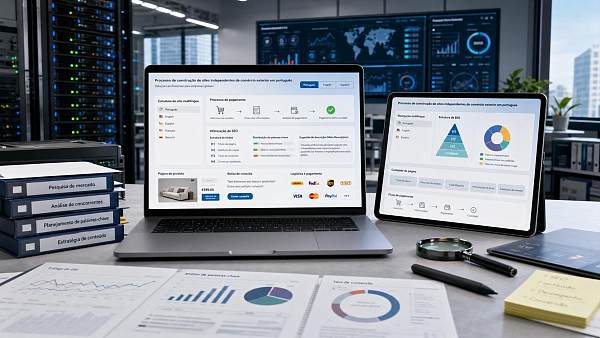
Choosing a Portuguese website development service provider may look like you are only building a multilingual website, but in practice it involves language, local conventions, payment routes, marketing foundations, and ongoing operations.
If you only focus on the quote, you often overlook more critical costs. For example, if the page translation does not match local search habits, the site may go live but still be difficult for search engines to index, making it hard to generate effective inquiries.
A more common situation is that the front-end pages are fully completed, but backend permissions, form leads, payment integration, and data tracking are not connected. Every subsequent step then requires additional development, which can push the budget off track instead.
Therefore, when evaluating a Portuguese website development service provider, the key is not only whether they can build the site, but whether they can help you promote it, collect payments, and sustain operations after launch.
In website plus marketing integrated projects, this difference is especially obvious. A team with website building, SEO, advertising, and social media coordination capabilities is usually better able to prevent rework risks in advance.
When evaluating a Portuguese website development service provider, which core capabilities should you look at first?
To determine whether a service provider is worth shortlisting, you can first focus on four dimensions: language localization, technical architecture, transaction routes, and growth support. Look less at promotion claims and more at verifiable capabilities.
For internal comparison, you can usually start with a screening table.
If a service provider can only handle page design and cannot explain traffic acquisition and data closed loop, they are usually not suitable for taking on a complete Portuguese website development project.
What should language localization really include? You can’t just look at whether it “can be translated”, right?
No. The localization capability of a Portuguese website development service provider goes far beyond translating Chinese content into Portuguese. What truly affects conversion is whether the language matches local users’ reading and search habits.
First, confirm whether the target market is Brazil or Portugal and other European Portuguese markets. The two differ in wording, tone, payment preferences, and marketing expression, and mixing them will directly hurt professionalism.
Next, check whether the page structure is localized. Many sites translate the text accurately, but navigation, trust copy, and after-sales instructions still follow Chinese thinking, which increases user comprehension costs and also raises bounce rates.
Also pay attention to keyword deployment. Excellent Portuguese website development service providers will break down product terms, scenario terms, regional terms, and long-tail query terms instead of simply stuffing a few core keywords across the entire site.
- Whether page titles and descriptions are rewritten according to Portuguese search habits
- Whether inquiry forms and button copy are natural and easy to understand
- Whether cases, qualifications, and delivery instructions convey local trust
- Whether blog or help content supports long-term SEO accumulation
In practice, platforms with global project experience are more likely to handle this well. A team like YiYingBao, which provides long-term services across multiple regional markets, usually designs website building, SEO, and multilingual content strategies together rather than handling them separately.
Sales deployment is often overlooked. Which issues should be confirmed before building the site?
This is where many projects get stuck. Going live is not difficult; the difficult part is enabling users to complete payment smoothly, or enabling leads to move smoothly into the follow-up sales process. The later you think about sales deployment, the higher the risk of rework.
If it is a B2C or online transaction scenario, at minimum you need to confirm payment channels, supported currencies, settlement cycles, risk control rules, refund logic, and mobile payment experience in advance.
If the focus is B2B lead generation, the priorities shift to form leads, automatic replies, CRM integration, WhatsApp or email distribution, and ad data backflow. These are also part of the pre-transaction route.
A reliable Portuguese website development service provider will usually clarify the target market, customer unit price, shipping method, and transaction model at the project initiation stage, because this information directly determines the payment solution and page structure.
What needs to be confirmed in advance is that payment is not a standalone plugin. It affects shopping cart, shipping, tax display, order notifications, and even the design logic of SEO landing pages and ad landing pages.
How should technical architecture be judged so the site will not be hard to promote after launch?
When evaluating technical architecture, do not stop at whether the pages look good. What really matters is whether the site can continue expanding content, running ads, integrating data, doing SEO, and replicating into multiple markets later on.
A more common way to judge is to see whether the service provider can clearly explain the following points.
- Whether multilingual URLs are independent for search engine recognition
- Whether page loading speed has been optimized through compression and caching
- Whether pixel, conversion tracking, and ad asset deployment are supported
- Whether the backend can independently add pages, articles, and landing pages
- Whether permission management, backup, and security protection mechanisms are in place
If the service provider uses a closed system but cannot provide SEO control settings, structured content management, and marketing expansion interfaces, many future growth actions will be limited.
This is also why more and more companies prefer platforms with self-developed systems. Taking YiYingBao as an example, its cloud intelligent website building, cross-border store system, and AI marketing system are coordinated together, making them suitable for projects that need to continue with SEO, advertising, and social media traffic after the site is built.
Why can the delivery outcome differ so much even among the same type of service providers?
The gap is often not in homepage design, but in methodology. Teams that only deliver websites usually aim to go live on time; teams that integrate website and marketing services extend their goals to indexing, conversion, and subsequent growth.
These two types of service providers differ significantly in solution depth. The former focuses more on page quantity and visual effects, while the latter incorporates keyword structure, conversion paths, content rhythm, and data feedback into the project scope.
If the project is aimed at the Portuguese market, the difference becomes even greater. Simply translating and building a site is hard to cover local content operations, ad landing page testing, and search visibility improvement, all of which are long-term processes.
Platforms with more than ten years of overseas digital marketing experience are usually better able to build a complete growth loop. In particular, teams that cover website building, SEO, ad placement, social media operations, and AI search optimization tend to execute more cohesively.
Before the formal screening, what checklist is recommended?
If you want the comparison process to be more efficient, you can standardize the questions in advance. This not only makes horizontal comparison easier, but also quickly filters out Portuguese website development service providers who only talk in concepts and lack practical landing experience.
Ultimately, whether a company is suitable does not depend on how lively the proposal sounds, but on whether it can turn website development, localized content, payment deployment, and growth execution into a complete path.
If you are currently screening Portuguese website development service providers, a more stable approach is to first sort out the target market, business model, and transaction boundaries, and then use a unified standard to evaluate solution, timeline, risk, and subsequent input.
The benefit of doing this is very direct: you are less likely to be misled by a low price, and it is also easier to find a partner that can truly support long-term overseas growth.
Related Articles



Related Products
 Yiyingbao SaaS Intelligent Website Building and Marketing SystemYiyingbao SaaS Intelligent Website Building and Marketing System, AI-powered no-code website building, rapid creation of multilingual B2B international websites in 10 minutes, global server acceleration, AI-powered SEO optimization, helping businesses connect efficiently with global markets. The perfect integration of technology and operation makes building an international trade website remarkably simple
 AI+SEM Intelligent Advertising Marketing SystemAI+SEM drives intelligent ad creation, empowering full-funnel precision advertising marketing. The system automatically generates weekly/monthly reports, AI recommends keywords and target countries, monitors core metrics in real-time with intelligent alerts, and enables one-click high-conversion ad solutions to help quickly acquire customers and improve ROI.
 AI+SEO Dual-Engine System Optimization ServicesYiyingbao’s AI+SEO dual-engine optimization system helps foreign trade enterprises acquire high-quality organic traffic through AI-powered keyword research, content generation, and comprehensive technical optimization, significantly improving search rankings and conversion rates.
 AI+SNS Social Media Marketing SystemYingbao AI+SNS Social Media Marketing System - Precision social capture for the social media era. Supports one-click content synchronization across major platforms like Facebook and LinkedIn. AI intelligently rewrites posts for enhanced relevance. 24/7 AI customer service and user profiling analysis empower businesses to efficiently expand into global markets.
 AI+SEO营销解决方案易营宝AI+SEO营销解决方案,通过AI批量写作、智能生成TDK、精准关键词扩词等功能,全面优化网站SEO效果,提升流量与转化率。助力企业构建高效智能网站新生态。
 AI+SEM Advertising Marketing SolutionsAI+SEM Advertising Marketing Solution leverages AI technology to deeply empower SEM ad campaigns. It automatically generates weekly/monthly reports using AI, presenting account data across multiple dimensions for comprehensive insights into campaign performance and trends. The system precisely recommends keywords and target countries, intelligently generates high-conversion ad copy, and enables one-click activation of efficient campaign plans to help businesses rapidly acquire customers. Simultaneously, it monitors core metrics in real time, intelligently identifies abnormal fluctuations, and issues timely alerts to ensure stable, high-return advertising results.
 Domain Name ServicesEasyWin provides professional domain name services, including intelligent queries, one-stop registration, brand protection, and full lifecycle management, helping businesses build a digital brand image.
 EasyOperate B2C Cross-Border E-Commerce Platform & Independent WebsiteEasyStore B2C Cross-border E-commerce Independent Store is an intelligent website building and cross-border e-commerce integrated solution independently developed by EasyStore Information Technology (Beijing) Co., Ltd. The system is specially designed for small and medium-sized as well as large export enterprises, integrating 'website building, operation, marketing, advertising, and conversion' into one, helping enterprises quickly establish cross-border e-commerce independent stores to achieve brand globalization and global sales growth.
The platform supports multiple languages, multiple currencies, and multi-channel marketing, with built-in AI intelligent translation and SEO optimization systems, suitable for mainstream markets such as Southeast Asia, Europe and America, Latin America, and the Middle East, assisting Chinese manufacturing enterprises in efficiently deploying international e-commerce strategies. SSL证书易营宝提供专业SSL安全证书服务,包括单域名和泛域名证书,确保网站数据传输加密、身份验证和完整性保护,助力企业建立安全可信的在线业务环境。









