- Quelles canaux d’acquisition de clients les tendances du marketing transfrontalier en 2026 influenceront-elles ?Sep 06, 2026Voir les détails
- Quels risques d’homogénéisation faut-il identifier dans l’analyse du secteur de la création intelligente de sites web ?Aug 30, 2026Voir les détails
- Comment les tendances du marketing par IA en 2026 vont-elles modifier la répartition des budgets publicitaires ?Aug 28, 2026Voir les détails
- Le marché de l’authentification EV SSL est-il en contraction ou en phase de montée en gamme ? Comment les entreprises doivent-elles évaluer l’achat de certificats ?Aug 11, 2026Voir les détails
- Pourquoi les anciennes méthodes d’AMP SEO 2020 ne sont-elles plus efficaces et quelles sont les évolutions actuelles des priorités d’optimisation ?Aug 02, 2026Voir les détails
- Comment choisir les sujets de la rubrique Actualités du secteur pour générer plus facilement du trafic de recherche organiqueJul 29, 2026Voir les détails
- Observation du marché du Digital Marketing Shenzhen : pourquoi les entreprises tournées vers l'international recherchent-elles des équipes de croissance à Shenzhen ?Jul 31, 2026Voir les détails
- Un site indépendant pour le commerce extérieur dans le Zhejiang est-il encore pertinent aujourd’hui ? Analysez l’évolution du trafic et de l’acquisition de clientsJul 28, 2026Voir les détails
Le système de création de sites SaaS permet-il une mise en place rapide ?
SaaS website building system: is fast deployment feasible? First, see what “fast” can solve
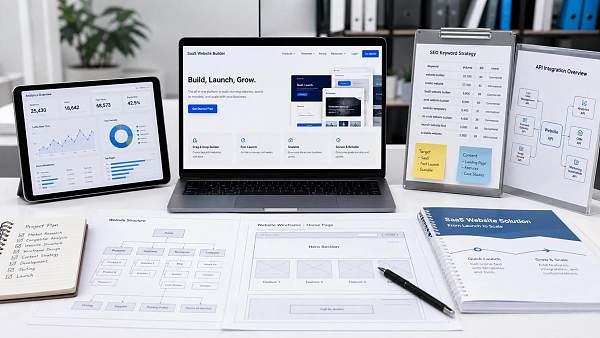
Fast deployment with a SaaS website building system has indeed been very popular in recent years. The reason is not complicated: many enterprises are accelerating their overseas expansion, and official websites, landing pages, and multilingual sites all need to go live as quickly as possible, while technical teams are often short on manpower. Template-based delivery therefore looks very attractive.
But from a selection perspective, the question is not only whether it can be fast, but also how long this kind of speed can last. A fast first launch does not mean smooth subsequent operation. Once a site truly enters its business cycle, content management, SEO expansion, ad landing page iteration, data integration, and secondary development will all start to affect results.
So, when evaluating whether a SaaS website building system can be deployed quickly, the core is not “can it go live”, but “can it keep growing after launch”. If the template is fast but the architecture has many limitations, every later step will become slower, and such a solution may not be suitable for long-term use.
Especially in an integrated website + marketing services scenario, a website is not a static display page, but the foundation for customer acquisition. It needs to handle search traffic, ad traffic, and social traffic, while also supporting lead conversion and follow-up analysis. In this sense, speed is only the first layer; scalability is the decisive factor.
The real advantages of template launch speed
In short, SaaS website building systems are feasible in standardized scenarios, and they are usually highly efficient. For brand launches, short-term campaigns, event pages, and multilingual basic websites, such systems can often shorten the launch cycle from weeks to days.
This efficiency mainly comes from three aspects. First, templates and components are already preconfigured. Second, servers, deployment, certificates, and security updates are handled uniformly by the platform. Third, backend content management is generally more intuitive, so even non-R&D staff can participate in maintenance.
If a company’s current top priority is “have a site first, then advertise”, then a SaaS website building system is indeed more advantageous than traditional custom development. It can quickly create a minimum viable site and help the business validate market feedback as early as possible.
Looking at recent changes, more and more teams no longer separate website building from marketing procurement. The reason is very practical: simply making a site that can be viewed is already not enough. A website must have indexing ability, conversion ability, and continuous iteration ability to truly support growth tasks.
- Suitable for fast launch of standard corporate websites, product showcase pages, and recruitment pages
- Suitable for simultaneous publication of multilingual basic sites
- Suitable for building topic landing pages during ad testing periods
- Suitable for business departments that lack a dedicated R&D team to directly promote projects
Dual restrictions are often exposed not at launch, but after growth
The real bottleneck usually appears after the business starts growing. Template sites often look smooth when they first go live, but once you need to expand page structure, integrate external systems, modify form logic, or rewrite page strategy, the limitations become apparent step by step.
Common issues include: fixed page structure, insufficient flexibility in field models, limited URL rules, inability to deeply modify the code layer, insufficient openness of interfaces, a simplistic permission system, and high costs for data export and migration. These issues do not affect the first launch, but they will affect subsequent growth efficiency.
This also means that when evaluating a SaaS website building system, you should not only look at whether the demo backend is easy to use, but also whether the platform supports business upgrades. Especially for B2B foreign trade, cross-border independent sites, and marketing-oriented official websites, later stages often involve more complex lead collection, content matrix, and SEO structure adjustment needs.
If a platform builds “fast” on the basis of “closedness”, a short-term low threshold is very likely to be exchanged for high long-term costs. The most common result is that the time saved in the early stage has to be paid back later through higher migration, reconstruction, and coordination costs.
Key limitations usually concentrate in four areas
- Front-end presentation is constrained by templates, and brand differentiation is insufficient
- SEO structure has limited room for adjustment, affecting indexing and ranking strategies
- Interface capabilities are relatively weak, making it difficult to deeply integrate with CRM, ERP, and advertising systems
- Data migration is not smooth, and later platform replacement costs are relatively high
Speed versus limitations: how should they be compared to make a decision?
A more effective evaluation method is not to simply set template sites and custom sites against each other, but to break the issue down into a time dimension. In the early stage, look at launch speed; in the mid stage, look at operational efficiency; in the long term, look at scalability. Only when all three stages pass can the solution be considered stable.
The comparison below is closer to the actual decision-making logic in procurement.
If the business pace is clear, marketing actions are concentrated, and future needs include system integration and content scaling, then simply pursuing a SaaS website building system with fast deployment is often not enough. What truly has decision value is whether it can still keep running after being launched quickly.
In an integrated website + marketing services scenario, which capabilities matter more?
In actual business, a website is only the starting point, not the end point. A solution that can support growth is best equipped with website building, SEO, ad landing pages, content management, lead collection, and data analysis capabilities at the same time. Only then can losses caused by system fragmentation be reduced.
From EasyYingbao’s path, it is closer to a combined logic of “platform-type SaaS website building system fast deployment + marketing expansion”. Relying on its self-developed cloud intelligent website building system, cross-border e-commerce system, AI advertising marketing system, and AI+SEO/GEO optimization system, the focus is not just on building the site, but on turning the site into a promotable, indexable, and convertible business asset.
This approach is more realistic for export-oriented enterprises. For foreign trade official websites, multilingual sites, B2C independent sites, ad landing pages, and overseas social media traffic acquisition, these are often not operated separately. They share content, share data, and also share customer acquisition goals. The higher the degree of platform integration, the lower the subsequent coordination cost.
A more obvious signal is that companies are paying more and more attention to AI search visibility, Google SEO long-term growth, and multi-channel ad delivery coordination. Only template pages can hardly support these requirements. A system that supports continuous optimization is more valuable.
When evaluating, focus on checking these five items
- Can the page model be flexibly expanded, rather than just swapping copy and images?
- Are SEO rules configurable, including URL, title, structured information, and multilingual strategies?
- Does it support the integration of forms, inquiries, memberships, products, or lead data with external systems?
- Are data export, backup, and migration clear, so as to avoid platform lock-in risks?
- Is the subsequent marketing capability aligned with source-side collaboration, so as to avoid website building and promotion operating independently?
Conclusion: SaaS website building system fast deployment is feasible, but the premise is “fast without dying”
Back to the original question, fast deployment of a SaaS website building system is certainly feasible, and in many scenarios it is highly effective. But if the goal is only to go live, any template may seem good enough; if the goal is to continuously acquire customers and achieve long-term growth, the evaluation criteria must be much stricter.
A more stable approach is to prioritize a platform solution that balances template efficiency and scalability. It can satisfy early-stage speed and also support SEO, advertising, social media, AI search, and business system linkage. A website like this is not a one-time delivery item, but a growth foundation that can continue to scale.
Therefore, when making a selection, it is worth reframing the question as follows: after this SaaS website building system is deployed quickly, can it still support business changes in six months? After one year, is it still worth continuing to invest in? If these two questions can be answered, the decision usually will not be off track.
Articles connexes
![]() Budget publicitaire Facebook limité ? Ne vous précipitez pas pour augmenter vos dépenses !
Budget publicitaire Facebook limité ? Ne vous précipitez pas pour augmenter vos dépenses !![]() Vous investissez également dans Google et Facebook : pourquoi toutes vos demandes de renseignements sur les roulements sont-elles non qualifiées ?
Vous investissez également dans Google et Facebook : pourquoi toutes vos demandes de renseignements sur les roulements sont-elles non qualifiées ?![]() Vous faites de la publicité sur Facebook pour des engins de chantier, mais vos demandes sont toutes de mauvaise qualité ? Voici où se situe le problème.
Vous faites de la publicité sur Facebook pour des engins de chantier, mais vos demandes sont toutes de mauvaise qualité ? Voici où se situe le problème.



Produits associés
 Système SaaS de création de sites web et de marketing intelligent YiyingbaoSystème SaaS de création de sites web et de marketing intelligent Yiyingbao, création de sites sans code pilotée par l’IA, mise en place rapide d’un site web multilingue indépendant pour le commerce international en 10 minutes, accélération par des serveurs répartis dans le monde entier, optimisation SEO intelligente par l’IA, pour aider les entreprises à se connecter efficacement aux marchés mondiaux. L’intégration parfaite de la technologie et de la simplicité d’utilisation rend la création de sites web pour le commerce international extrêmement simple.
 Services d’optimisation du système à double moteur AI+SEOLe système d’optimisation à double moteur AI+SEO de 易营宝 s’appuie sur l’exploration intelligente de mots-clés par l’IA, la génération de contenu et une optimisation technique complète afin d’aider les entreprises de commerce extérieur à obtenir un trafic organique de haute qualité et à améliorer considérablement leur classement dans les moteurs de recherche ainsi que leur taux de conversion.
 Système de marketing publicitaire intelligent AI+SEMAI+SEM propulse une création publicitaire intelligente, permettant un marketing publicitaire précis sur toute la chaîne. Le système génère automatiquement des rapports hebdomadaires/mensuels, l'IA recommande des mots-clés et des pays de diffusion, surveille en temps réel les indicateurs clés et fournit des alertes intelligentes, lance en un clic des solutions de diffusion à haut taux de conversion, aidant à acquérir rapidement des clients et à améliorer le ROI.
 Système de marketing sur les réseaux sociaux AI+SNSSystème de marketing intelligent Yingyingbao AI+SNS pour les réseaux sociaux - Capture sociale précise pour l'ère des réseaux sociaux. Prend en charge la synchronisation du contenu en un clic sur les principales plateformes, notamment Facebook et LinkedIn. La réécriture des publications alimentée par l'IA améliore la localisation. Un service client intelligent disponible 24 h/24, 7 j/7 et l'analyse du profil des utilisateurs permettent aux entreprises de se développer efficacement sur les marchés mondiaux.
 Solutions marketing publicitaire IA+SEMLes solutions publicitaires SEM basées sur l'IA exploitent l'intelligence artificielle pour améliorer considérablement la gestion des campagnes SEM. Grâce à l'IA, elles génèrent des rapports hebdomadaires et mensuels qui présentent les données des comptes sous plusieurs angles, permettant ainsi une supervision complète des performances et des tendances publicitaires. L'IA fournit des recommandations précises sur les mots-clés et les pays cibles, rédige de manière intelligente des textes publicitaires à fort taux de conversion et lance des campagnes efficaces en un seul clic, accélérant ainsi l'acquisition de clients pour les entreprises. Parallèlement, le système surveille les indicateurs clés en temps réel, identifie intelligemment les fluctuations anormales et émet des alertes en temps opportun, garantissant ainsi des performances publicitaires stables et des rendements élevés.
 AI+SEO营销解决方案易营宝AI+SEO营销解决方案,通过AI批量写作、智能生成TDK、精准关键词扩词等功能,全面优化网站SEO效果,提升流量与转化率。助力企业构建高效智能网站新生态。
 Services de noms de domaineEasy Marketing propose des services professionnels de noms de domaine, comprenant la recherche intelligente, l'enregistrement en un clic, la protection de marque et la gestion complète du cycle de vie, aidant les entreprises à construire une image de marque numérique.
 EasySell B2C Place de Marché Transfrontalière, Site Indépendant易营宝B2C跨境商城独立站是由易营宝信息科技(北京)有限公司自主研发的智能建站与跨境电商一体化解决方案。系统专为中小型及大型出口企业打造,集“建站、运营、营销、投放、转化”于一体,帮助企业快速打造跨境电商独立站,实现品牌出海与全球销售增长。
平台支持多语言、多币种、多渠道营销,内置AI智能翻译与SEO优化系统,适配东南亚、欧美、拉美、中东等主流市场,助力中国制造企业高效布局国际电商版图。 B2B2C双模式独立站解决方案易营宝推出的B2B2C双模式独立站解决方案,专为同时开展批发与零售业务的企业打造。平台支持商品价格展示、商品多规格管理、购物车与购物车弹窗、购物车总价计算,以及统一批量询价等功能,帮助企业以更高效、更直观的方式触达B端与C端客户。通过云建站、大数据分析与广告智能投放体系,助力企业打破渠道壁垒,实现国内外市场拓展与品牌价值提升。