









- Which customer acquisition channels will be affected by cross-border marketing trends in 2026?Sep 06, 2026View details
- Which homogenization risks should be considered in an analysis of the AI-powered website building industry?Aug 30, 2026View details
- How Will AI Marketing Trends 2026 Change Advertising Budget AllocationAug 28, 2026View details
- Is the EV SSL certificate market shrinking or upgrading? How should companies assess certificate procurement?Aug 11, 2026View details
- Why the old AMP SEO 2020 practices no longer work and what has changed in current optimization prioritiesAug 02, 2026View details
- How to Choose Topics for an Industry News Section to Attract More Organic Search TrafficJul 29, 2026View details
- Digital Marketing Shenzhen Market Insights: Why Are Companies Expanding Overseas Looking for Growth Teams in Shenzhen?Jul 31, 2026View details
- Can Zhejiang foreign trade independent websites still be developed today? Look at changes in traffic and lead generationJul 28, 2026View details
Can SEO and Google Ads be done at the same time?
Can SEO and Google Ads be carried out at the same time? Yes. For most companies expanding overseas, implementing both is often more effective than focusing on only one. SEO builds long-term organic traffic, while Google Ads quickly generates exposure and inquiries. Together, they make it easier to balance short-term conversions with long-term growth.
Readers searching for this question are usually not looking for a conceptual explanation. They want to determine whether investing in both channels is worthwhile, how to allocate their budget, whether the two will conflict, and which one should come first at different stages. For business managers, the key concerns are always customer acquisition efficiency, return on investment, and sustainability.
From a practical perspective, SEO and Google Ads are not an either-or choice. They are suitable for coordinated implementation within the same overseas marketing strategy. This is particularly true for foreign trade companies, manufacturing factories, cross-border brands, and independent website sellers that rely on their websites to generate leads. Using both channels often makes it easier to establish a stable source of global traffic.
Why SEO and Google Ads Work Well Together
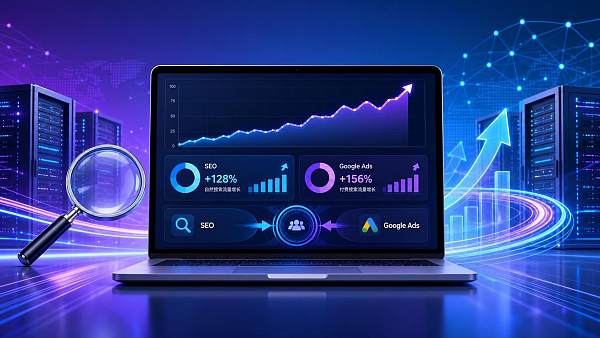
Many companies mistakenly believe that if they are already running Google Ads, there is no need to invest in SEO, or that advertising is unnecessary once SEO is in place. In reality, the two channels address customer acquisition needs at different stages and with different timelines. Their goal is the same, but the paths are different.
The advantage of Google Ads is that it delivers results quickly. Once a website is launched, it can obtain impressions, clicks, and inquiries relatively quickly, as long as the account structure, keywords, and landing pages are set up properly. For new product launches, market testing, campaign traffic generation, and short-term sales acceleration, the value of advertising is highly direct.
The advantage of SEO is long-term compounding growth. High-quality content, website structure, technical optimization, and backlink accumulation gradually build a website’s authority in search engines. Once keyword rankings become stable, a company can continue to obtain relatively low-cost organic traffic and reduce its reliance on individual advertising expenditures.
So, can SEO and Google Ads be carried out at the same time? Not only can they, but they are also highly complementary. Advertising helps companies quickly test strategies and obtain results, while SEO helps build brand assets and long-term traffic. Working together, the two enable a website to generate leads immediately while gradually reducing overall customer acquisition costs.
What Companies Really Need to Consider Is Not Whether They Can Do Both, but Whether It Is Worthwhile
For business leaders, the real question is usually not whether it is technically possible, but whether it is necessary from a business perspective. To determine whether implementing both channels is worthwhile, the key is to assess the company’s current stage and its customer acquisition requirements.
If a company is just entering overseas markets, has no stable source of traffic, and has not yet identified high-converting keywords, Google Ads is more suitable as an initial traffic acquisition tool. It can quickly validate which countries, products, and search terms are more likely to generate inquiries and sales.
If a company already has a solid website foundation, a clear product line, and a desire to reduce long-term customer acquisition costs rather than rely heavily on its advertising budget every month, SEO should be implemented at the same time. Organic rankings do not appear overnight; the earlier SEO begins, the more significant the returns will be later.
The most effective approach is usually not to complete one channel first and then start the other. Instead, companies should establish a combined strategy within the limits of their budget. Advertising is responsible for speed, while SEO is responsible for building lasting value; advertising is used for validation, while SEO is used for amplification; advertising captures opportunities, while SEO secures the market position.
What Practical Benefits Can Companies Gain by Implementing SEO and Google Ads Together?
First, the traffic structure becomes more stable. If a company relies only on advertising, traffic may decline rapidly once campaigns are paused. If it relies only on SEO, growth may be slow at the beginning. By combining the two, a company gains both immediate traffic and steadily growing organic traffic, giving it stronger overall resilience against risk.
Second, keyword decisions become more accurate. Google Ads can quickly test which search terms generate click-throughs, conversions, and commercial value. These high-value keywords can then be incorporated into SEO content and page optimization plans. This is more efficient than selecting keywords based solely on assumptions or experience.
Third, page conversion optimization becomes easier. Advertising campaigns often encourage companies to continuously improve their landing pages, including headlines, selling points, forms, trust elements, and page speed. These improvements also benefit SEO because search rankings and user experience are closely connected.
Fourth, brand exposure becomes more comprehensive. When a company appears in both ad placements and organic rankings on the search results page, users generally become more familiar with and trusting of the brand. In highly competitive overseas markets, this dual presence can often increase the likelihood of clicks and inquiries.
Which Companies Are Particularly Suited to Implementing Both Channels at the Same Time?
The first category is B2B foreign trade companies. These companies generally have longer sales cycles, and customers make decisions more cautiously. Google Ads can help them obtain inquiries quickly, while SEO is suitable for continuously building visibility around product keywords, application keywords, regional keywords, and procurement-related search terms, thereby improving the quality of long-term leads.
The second category is manufacturing factories and companies taking their brands overseas. They typically need to demonstrate their capabilities, cases, certifications, production capacity, and services over the long term. Relying solely on advertising to generate clicks is not enough. They also need to build a professional image through SEO content so that overseas customers continue to see the brand across multiple searches.
The third category is cross-border independent websites and B2C e-commerce stores. Advertising is suitable for promotional campaigns, best-selling product testing, and new product launches, while SEO is suitable for capturing traffic from category keywords, review keywords, use-case keywords, and long-tail keywords. Combining the two channels can improve both sales momentum and the proportion of organic conversions.
The fourth category is companies expanding into multilingual markets. When targeting North America, Europe, Southeast Asia, the Middle East, Japan and South Korea, Latin America, and other regions, companies often need a more flexible traffic strategy. Advertising can be used to open up specific markets first, while SEO can gradually expand multilingual content and localized search visibility.
What Are the Most Common Concerns When Implementing Both Channels?
The most common concern is whether the budget will be spread too thin. This concern is reasonable, but the issue is not whether both channels are implemented simultaneously. The key is whether their roles are clearly defined. If advertising and SEO are handled separately without unified objectives, keyword strategies, and page plans, the budget can easily be wasted.
The second concern is whether the two channels will affect each other. In reality, Google will not improve organic rankings simply because you run ads, nor will SEO affect ad approval. The two systems operate independently, but they can create strong synergies in terms of data and conversions.
The third concern is that team execution will be difficult. Indeed, if website development, SEO optimization, advertising, and data analysis are disconnected, execution efficiency will be low. A more reasonable approach is to consider indexing, speed, conversion paths, and landing page compatibility with advertising from the website development stage.
The fourth concern is that SEO results may not be visible in the short term. This concern is valid, which is precisely why companies should not treat SEO as something to be addressed “later.” The later it starts, the later the benefits will arrive. The right approach is to use advertising to deliver short-term results while using SEO to build future traffic assets.
A More Efficient Approach Is to Place SEO and Advertising Within the Same Growth Cycle
Truly mature companies do not treat SEO and Google Ads as two isolated projects. Instead, they consider the website, content, keywords, landing pages, conversion paths, and data reviews as a unified system. Only in this way can every part of the budget serve the same growth objective.
For example, high-converting search terms identified through advertising can guide SEO content topics. High-traffic pages generated by SEO articles can be used to build remarketing audiences for advertising. The website’s technical optimization, page speed, and mobile experience can also affect the performance of both channels at the same time.
This integrated strategy is particularly important for companies expanding overseas. Customer acquisition in overseas markets is often not achieved through a single point of success. It is the combined result of the website’s ability to handle traffic, search visibility, advertising efficiency, content effectiveness, and localized operations. A weakness in any one of these areas can slow down conversions.
The value of an integrated service platform such as 易营宝, which covers AI-powered website development, Google SEO optimization, Google Ads management, social media marketing, and multilingual independent website development, lies in helping companies integrate these activities instead of allowing each channel to operate independently.
How Should Companies Determine the Right SEO and Advertising Configuration for Their Current Stage?
If a company is just starting out, has a weak website foundation, and urgently needs inquiries in the short term, it is recommended to use Google Ads to acquire traffic first while immediately beginning foundational SEO work, including website structure, core pages, keyword research, and content planning. This approach delivers results while ensuring that the opportunity for long-term accumulation is not missed.
If a company has been running advertising campaigns continuously but its customer acquisition costs are rising, it should accelerate its SEO investment. This often indicates excessive reliance on paid traffic. Establishing a second growth curve through organic search can ease future budget pressure.
If a company already has a certain SEO foundation but traffic growth is slow, it can also use Google Ads to increase exposure for key markets and key products. This is especially suitable for new products, peak-season periods, and competitive keyword testing. It helps create a more balanced overall traffic structure and prevents the company from relying too heavily on the gradual improvement of organic rankings.
There is no fixed budget ratio suitable for every company. However, allocations can generally be adjusted dynamically according to the company’s stage. In the early stage, the focus can be placed more on advertising; in the middle stage, advertising and SEO can run in parallel; and in the later stage, the advertising structure can be gradually optimized as organic traffic grows. This is generally more stable than relying on only one channel over the long term.
Conclusion: SEO and Google Ads Are Not Substitutes but a Growth Combination
Returning to the original question, can SEO and Google Ads be carried out at the same time? The answer is clear: yes. For most companies seeking to expand into overseas markets, implementing both is often a more practical and effective choice. The prerequisite is a clear strategy and coordinated execution, rather than simply adding budgets together.
If a company focuses only on the short term, it can easily become trapped in a passive situation of continually buying traffic. If it focuses only on the long term, it may miss important market opportunities. By placing SEO and Google Ads within the same marketing system, a company can more effectively balance immediate inquiries, brand building, and sustainable long-term growth.
For foreign trade companies, manufacturing factories, cross-border sellers, and brands expanding overseas, the question worth considering is no longer whether to implement both channels, but how to coordinate them earlier and more effectively, enabling the website to become an overseas customer acquisition platform that can be promoted, indexed, and converted.
Related Articles
Related Products
 Yiyingbao SaaS Intelligent Website Building and Marketing SystemYiyingbao SaaS Intelligent Website Building and Marketing System, AI-powered no-code website building, rapid creation of multilingual B2B international websites in 10 minutes, global server acceleration, AI-powered SEO optimization, helping businesses connect efficiently with global markets. The perfect integration of technology and operation makes building an international trade website remarkably simple
 AI+SEM Intelligent Advertising Marketing SystemAI+SEM drives intelligent ad creation, empowering full-funnel precision advertising marketing. The system automatically generates weekly/monthly reports, AI recommends keywords and target countries, monitors core metrics in real-time with intelligent alerts, and enables one-click high-conversion ad solutions to help quickly acquire customers and improve ROI.
 AI+SEO Dual-Engine System Optimization ServicesYiyingbao’s AI+SEO dual-engine optimization system helps foreign trade enterprises acquire high-quality organic traffic through AI-powered keyword research, content generation, and comprehensive technical optimization, significantly improving search rankings and conversion rates.
 AI+SNS Social Media Marketing SystemYingbao AI+SNS Social Media Marketing System - Precision social capture for the social media era. Supports one-click content synchronization across major platforms like Facebook and LinkedIn. AI intelligently rewrites posts for enhanced relevance. 24/7 AI customer service and user profiling analysis empower businesses to efficiently expand into global markets.
 AI+SEO营销解决方案易营宝AI+SEO营销解决方案,通过AI批量写作、智能生成TDK、精准关键词扩词等功能,全面优化网站SEO效果,提升流量与转化率。助力企业构建高效智能网站新生态。
 AI+SEM Advertising Marketing SolutionsAI+SEM Advertising Marketing Solution leverages AI technology to deeply empower SEM ad campaigns. It automatically generates weekly/monthly reports using AI, presenting account data across multiple dimensions for comprehensive insights into campaign performance and trends. The system precisely recommends keywords and target countries, intelligently generates high-conversion ad copy, and enables one-click activation of efficient campaign plans to help businesses rapidly acquire customers. Simultaneously, it monitors core metrics in real time, intelligently identifies abnormal fluctuations, and issues timely alerts to ensure stable, high-return advertising results.
 Domain Name ServicesEasyWin provides professional domain name services, including intelligent queries, one-stop registration, brand protection, and full lifecycle management, helping businesses build a digital brand image.
 EasyOperate B2C Cross-Border E-Commerce Platform & Independent WebsiteEasyStore B2C Cross-border E-commerce Independent Store is an intelligent website building and cross-border e-commerce integrated solution independently developed by EasyStore Information Technology (Beijing) Co., Ltd. The system is specially designed for small and medium-sized as well as large export enterprises, integrating 'website building, operation, marketing, advertising, and conversion' into one, helping enterprises quickly establish cross-border e-commerce independent stores to achieve brand globalization and global sales growth.
The platform supports multiple languages, multiple currencies, and multi-channel marketing, with built-in AI intelligent translation and SEO optimization systems, suitable for mainstream markets such as Southeast Asia, Europe and America, Latin America, and the Middle East, assisting Chinese manufacturing enterprises in efficiently deploying international e-commerce strategies. SSL证书易营宝提供专业SSL安全证书服务,包括单域名和泛域名证书,确保网站数据传输加密、身份验证和完整性保护,助力企业建立安全可信的在线业务环境。









