









- Which customer acquisition channels will be affected by cross-border marketing trends in 2026?Sep 06, 2026View details
- Which homogenization risks should be considered in an analysis of the AI-powered website building industry?Aug 30, 2026View details
- How Will AI Marketing Trends 2026 Change Advertising Budget AllocationAug 28, 2026View details
- Is the EV SSL certificate market shrinking or upgrading? How should companies assess certificate procurement?Aug 11, 2026View details
- Why the old AMP SEO 2020 practices no longer work and what has changed in current optimization prioritiesAug 02, 2026View details
- How to Choose Topics for an Industry News Section to Attract More Organic Search TrafficJul 29, 2026View details
How should keywords be selected for SEO on an international trade website?
How should SEO keywords be selected for a foreign trade website? The key is not the number of keywords, but accurately identifying customer search intent, industry scenarios, and conversion value. Only by choosing the right keywords can a website generate leads more easily, achieve more stable rankings, and attract more targeted traffic.
Why does keyword selection determine inquiry quality when doing SEO for a foreign trade website?
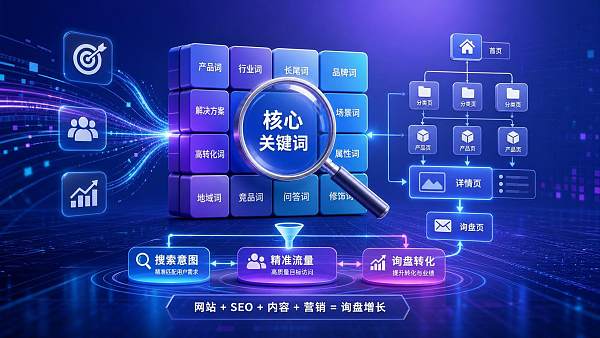
When optimizing a foreign trade website, many companies first think about publishing more articles and creating more pages, while overlooking the core question: how should SEO keywords be selected for a foreign trade website? If the keyword direction is wrong, the traffic will come from students, competitors, or users with low intent rather than buyers.
For companies in the integrated website and marketing services industry, keywords affect not only rankings, but also directly influence website architecture, content planning, advertising coordination, and subsequent conversion paths. For B2B foreign trade companies in particular, keyword strategy often determines inquiry costs and the efficiency of overseas market expansion.
For its integrated services covering AI-powered website building, multilingual website development, Google SEO optimization, and overseas marketing, Yiyingbao typically starts by creating keyword tiers and then uses them to plan website sections, landing pages, and content topics. This approach makes the website more suitable for indexing, ranking, and conversion from the moment it goes online.
- Accurately selected keywords enable pages to match buyers' actual search needs, resulting in lower bounce rates.
- A well-planned keyword layout creates a clearer website structure and makes it easier for search engines to understand the business priorities.
- When keywords are combined with products, regions, and languages, they are better suited for multilingual websites and segmented markets.
How should SEO keywords be selected for a foreign trade website? Start by identifying these 4 types of search intent
If you are still wondering how to select SEO keywords for a foreign trade website, do not rush to use tools. First determine why users are searching. The keywords behind a search correspond to different stages of the purchasing process, and different stages require different types of pages.
The table below can help determine whether a keyword should be placed on a product page, solutions page, or blog content page.
The core meaning of this table is that not every keyword should target the homepage, and not all traffic is worth pursuing. The truly effective approach is to assign page types according to search intent, so that each keyword corresponds to a specific conversion action.
What characteristics do high-conversion keywords typically have?
High-conversion keywords are usually not the ones with the highest traffic, but those closer to a purchasing action. For example, long-tail keywords containing limiting conditions such as material, application, certification, industry, region, quantity, or customization are usually more likely to generate qualified inquiries than broad keywords.
- Product attributes: model, size, material, process, and standard.
- Commercial intent: supplier, manufacturer, exporter, price, quote.
- Application scenarios: for construction, for food packaging, for industrial use, and so on.
Which common mistakes in keyword selection are most likely to waste foreign trade website traffic?
Many companies know they need to use keywords, but do not know how to select SEO keywords for a foreign trade website without taking the wrong path. In actual projects, the most common problem is not failing to do keyword optimization, but making the keyword strategy too broad, too scattered, or too focused on “self-expression.”
Mistake 1: Focusing only on broad keywords without segmentation
Broad keywords face strong competition, require a long time to produce results, and have unclear intent. For new websites or small and medium-sized foreign trade companies, instead of focusing on generic industry keywords, it is better to prioritize product long-tail keywords, regional keywords, application keywords, and question-based keywords to secure convertible traffic first.
Mistake 2: Replacing customer search terms with internal company terminology
Companies are accustomed to using internal model numbers, abbreviations, or direct Chinese translations, but overseas buyers may not search in the same way. Keyword selection must be based on the actual language used in the target market. This is especially important in North America, Europe, the Middle East, and Southeast Asia, where search habits vary significantly.
Mistake 3: Disconnecting keywords from the website structure
Many keywords may be selected without corresponding sections or pages to support them, resulting in keyword stuffing on the homepage, randomly published articles, and repetitive product pages. When coordinating website development and SEO, Yiyingbao places greater emphasis on integrated planning of “keyword groups—sections—pages—content—conversion” to reduce rework costs.
How should SEO keywords be selected for a foreign trade website? In practice, proceed in these 5 steps
If a company wants to put its keyword strategy into practice, it can proceed in the order of “market—product—page—content—conversion.” This approach is suitable not only for SEO, but also for subsequent coordination with advertising and social media traffic acquisition.
- First define the target market and language versions, clarifying whether the primary focus is North America, Europe, or Southeast Asia, as keyword databases vary greatly by region.
- Then break down the product lines and identify core products, high-margin products, traffic-attraction products, and customized products to avoid placing all keywords on a single page.
- When selecting keywords, evaluate search volume, competition, commercial value, and page relevance together rather than focusing only on popularity.
- Assign keywords to the homepage, category pages, detail pages, case study pages, and blog pages to create a clear internal site map.
- After launch, continuously monitor indexing, rankings, click-through rates, and inquiry data, eliminating low-quality keywords and strengthening high-conversion keywords.
This method is particularly important for multilingual foreign trade websites. Different languages involve not only translation, but also localization, search habits, and page structure adaptation. Only with the right keywords can a multilingual website be more than merely “international-looking.”
How do keyword priorities differ among different types of foreign trade companies?
How SEO keywords should be selected for a foreign trade website also depends on the company's business model. Keyword strategies differ for manufacturing factories, cross-border e-commerce brands, and B2B trading companies. The table below can be used as a reference for selection.
The table shows that there is no universal answer for keywords; the only question is whether they match the business objectives. Yiyingbao's advantage lies in combining AI-powered website building, SEO, advertising, and localized operations, enabling keyword strategies to move beyond research and directly into execution.
Why should website development, SEO, and advertising be considered together?
Many companies purchase website development, SEO, and advertising separately, which often results in websites that are unsuitable for indexing, mismatches between keywords and landing pages, and advertising leads that cannot be effectively nurtured. How to select SEO keywords for a foreign trade website cannot, in essence, be separated from the overall marketing process.
Which companies are better suited to an integrated solution?
- Companies preparing to build an overseas independent website but lacking clear sections and a content architecture.
- Companies that already have a website but experience long-term indexing failures, poor rankings, and low-quality inquiries.
- Teams expanding overseas that want to implement Google SEO, advertising, and social media traffic acquisition simultaneously.
Relying on its AI-powered website building system, AI advertising and marketing system, and AI+SEO/GEO optimization system, Yiyingbao can complete keyword tiering, page planning, multilingual deployment, and subsequent optimization coordination at an early stage, reducing the cost of trial and error for foreign trade companies and improving their reach in global markets.
FAQ: How should SEO keywords be selected for a foreign trade website, and what do companies ask most often?
Should a new website focus on popular keywords or long-tail keywords first?
New websites are generally advised to prioritize long-tail keywords and niche scenario keywords. The reasons are straightforward: competition is more manageable, indexing is faster, pages are more likely to achieve initial rankings, and the website is more likely to generate its first qualified inquiries. Popular keywords can be developed gradually as medium- and long-term objectives.
Can keywords for a multilingual website be translated directly?
Direct translation is not recommended. The way the same product is described may vary significantly across markets, and users may even prefer searching by application rather than by product name. When developing a multilingual website, a localized keyword database should be created first, followed by decisions on page titles, descriptions, and body content.
How long does it take to see results after implementing a keyword layout?
This depends on the website foundation, industry competition, and content update efficiency. Generally speaking, foreign trade websites with a clear structure, highly relevant content, and a solid technical foundation will typically enter a stable growth phase faster than websites that simply create large numbers of pages.
If the budget is limited, how should the keyword strategy be prioritized?
It is recommended to prioritize keywords with high commercial intent, core product keywords, and target market keywords rather than creating too much content at the beginning. Using a limited budget to capture search needs closest to conversion first, then expanding the content matrix based on data, is a more prudent investment approach.
Why choose us: turning a foreign trade website into a true lead-generation asset, from keywords to inquiries
If you are evaluating how to select SEO keywords for a foreign trade website, or have already encountered issues such as poor indexing, inaccurate keywords, or traffic that does not convert, optimizing a single point is often insufficient to solve the problem completely. A more effective approach is to design the website structure, keyword database strategy, content planning, and promotional channels simultaneously.
Yiyingbao has long served foreign trade companies, manufacturing factories, cross-border e-commerce sellers, and brands expanding overseas. Based on the target market, product characteristics, and budget cycle, it can provide keyword research, website section planning, multilingual page deployment, SEO content strategies, and coordinated advertising landing page solutions.
If you need further consultation, you can focus on the following topics: target market keyword evaluation, product and long-tail keyword tiering, whether the website structure is suitable for indexing, multilingual website selection, coordination between SEO and advertising, delivery schedule, and corresponding customized solutions and pricing ranges.
For companies seeking to open up overseas markets with lower trial-and-error costs, choosing the right keywords is not a minor issue in the first step, but a foundational project that determines whether a foreign trade website can generate leads continuously. The earlier the direction is set correctly, the more stable the subsequent growth will be.
Related Articles

Related Products
 Yiyingbao SaaS Intelligent Website Building and Marketing SystemYiyingbao SaaS Intelligent Website Building and Marketing System, AI-powered no-code website building, rapid creation of multilingual B2B international websites in 10 minutes, global server acceleration, AI-powered SEO optimization, helping businesses connect efficiently with global markets. The perfect integration of technology and operation makes building an international trade website remarkably simple
 AI+SEM Intelligent Advertising Marketing SystemAI+SEM drives intelligent ad creation, empowering full-funnel precision advertising marketing. The system automatically generates weekly/monthly reports, AI recommends keywords and target countries, monitors core metrics in real-time with intelligent alerts, and enables one-click high-conversion ad solutions to help quickly acquire customers and improve ROI.
 AI+SEO Dual-Engine System Optimization ServicesYiyingbao’s AI+SEO dual-engine optimization system helps foreign trade enterprises acquire high-quality organic traffic through AI-powered keyword research, content generation, and comprehensive technical optimization, significantly improving search rankings and conversion rates.
 AI+SNS Social Media Marketing SystemYingbao AI+SNS Social Media Marketing System - Precision social capture for the social media era. Supports one-click content synchronization across major platforms like Facebook and LinkedIn. AI intelligently rewrites posts for enhanced relevance. 24/7 AI customer service and user profiling analysis empower businesses to efficiently expand into global markets.
 AI+SEO营销解决方案易营宝AI+SEO营销解决方案,通过AI批量写作、智能生成TDK、精准关键词扩词等功能,全面优化网站SEO效果,提升流量与转化率。助力企业构建高效智能网站新生态。
 AI+SEM Advertising Marketing SolutionsAI+SEM Advertising Marketing Solution leverages AI technology to deeply empower SEM ad campaigns. It automatically generates weekly/monthly reports using AI, presenting account data across multiple dimensions for comprehensive insights into campaign performance and trends. The system precisely recommends keywords and target countries, intelligently generates high-conversion ad copy, and enables one-click activation of efficient campaign plans to help businesses rapidly acquire customers. Simultaneously, it monitors core metrics in real time, intelligently identifies abnormal fluctuations, and issues timely alerts to ensure stable, high-return advertising results.
 Domain Name ServicesEasyWin provides professional domain name services, including intelligent queries, one-stop registration, brand protection, and full lifecycle management, helping businesses build a digital brand image.
 EasyOperate B2C Cross-Border E-Commerce Platform & Independent WebsiteEasyStore B2C Cross-border E-commerce Independent Store is an intelligent website building and cross-border e-commerce integrated solution independently developed by EasyStore Information Technology (Beijing) Co., Ltd. The system is specially designed for small and medium-sized as well as large export enterprises, integrating 'website building, operation, marketing, advertising, and conversion' into one, helping enterprises quickly establish cross-border e-commerce independent stores to achieve brand globalization and global sales growth.
The platform supports multiple languages, multiple currencies, and multi-channel marketing, with built-in AI intelligent translation and SEO optimization systems, suitable for mainstream markets such as Southeast Asia, Europe and America, Latin America, and the Middle East, assisting Chinese manufacturing enterprises in efficiently deploying international e-commerce strategies. SSL证书易营宝提供专业SSL安全证书服务,包括单域名和泛域名证书,确保网站数据传输加密、身份验证和完整性保护,助力企业建立安全可信的在线业务环境。









