









- China-Europe Railway Express and CIIE Hold Business Matchmaking Event, Focusing on Cross-Border E-commerce B2B ExportsNov 07, 2026View details
- China’s Ministry of Commerce Responds to Additional Charges on Low-Value Imports Imposed by the EUNov 06, 2026View details
- Two Internet Development Reports Released at the 2026 World Internet ConferenceNov 05, 2026View details
- Internet Business Revenue of Enterprises Above the Designated Size Reached RMB 1.716 Trillion in the First Three Quarters, with Profits Up 17.6%Nov 05, 2026View details
- Shopify's Third-Quarter Revenue and GMV Fall Short of Expectations, Sending Shares Tumbling Before the Market OpensNov 04, 2026View details
- Temu Sellers See a Decline in Traffic as the Platform’s Traffic Allocation ShiftsNov 04, 2026View details
How to Choose Target Keywords for SEO in Industry Lead Generation
When selecting SEO target keywords, look beyond search volume. Consider whether searchers have purchasing needs and whether your company can answer their questions with relevant pages. A term with lower search volume that clearly indicates interest in product specifications or suppliers may be a higher priority than a broad industry term with more traffic.
For SEO keyword selection in an industry customer acquisition strategy, start with your products, customers, and transaction requirements, then validate your choices against search results. The goal is not to target every related term, but to identify groups of keywords that fit your business, can support inquiries, and have a realistic chance of gaining visibility.
Build Your Initial List of Candidate Keywords Around Your Business Scope
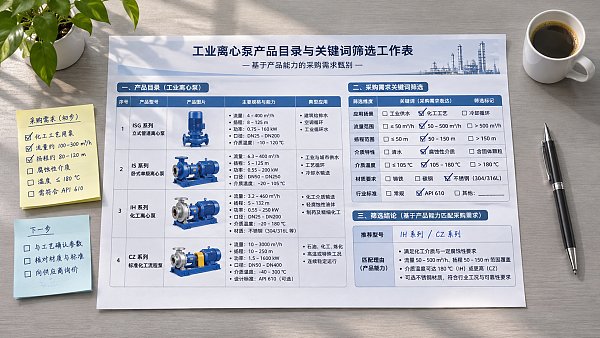
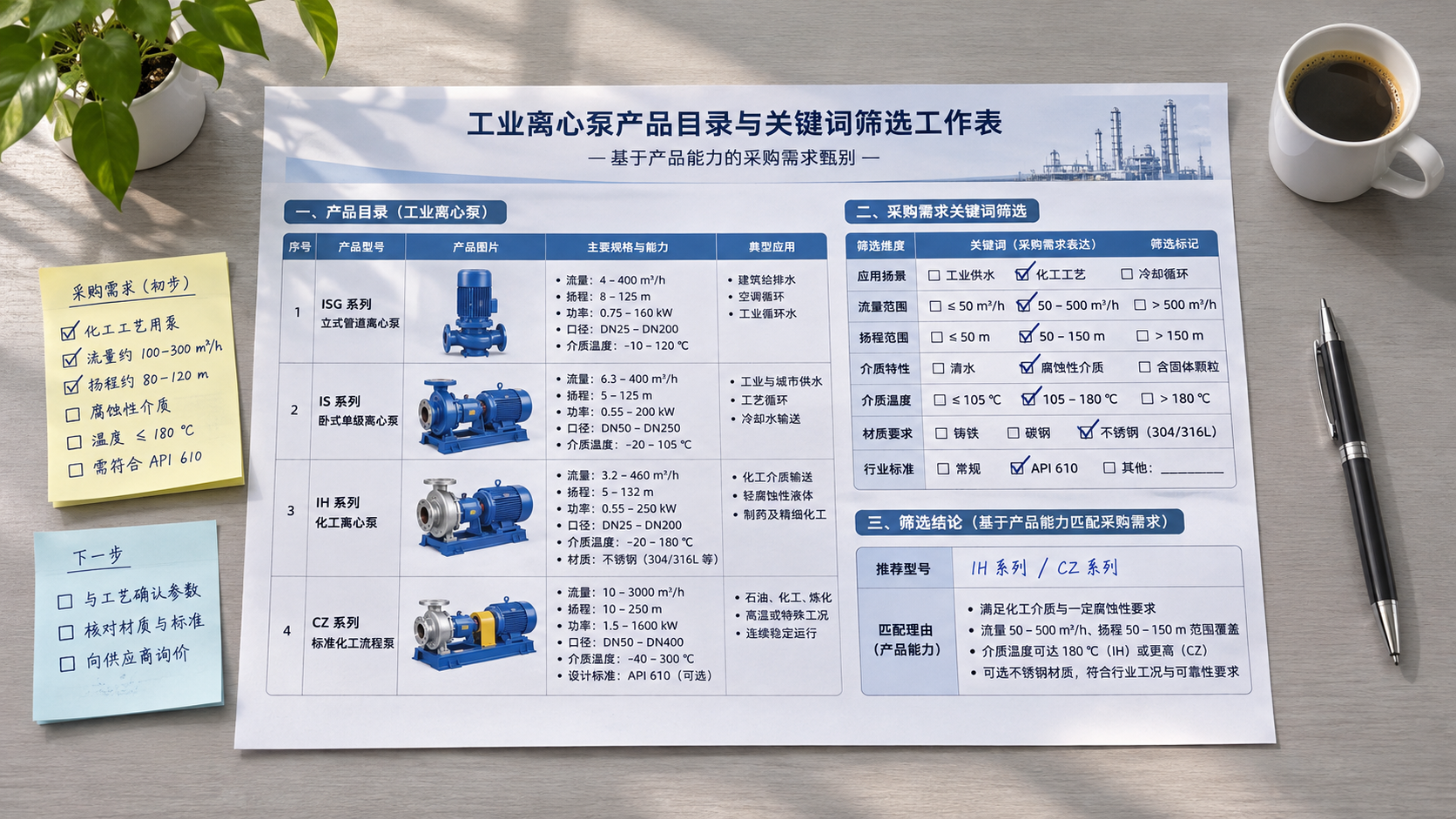
Before using keyword tools, first list what your company can offer: product names, model numbers and specifications, materials and processes, applications, regions served, and whether customization is available. This step defines the scope for subsequent screening. If your website focuses on bulk purchasing but you devote considerable effort to retail terms, even ranking for them may not bring in suitable inquiries.
You can draw candidate keywords from product catalogs, customer inquiries, sales emails, and industry terminology. For overseas business, also record the English or local-language terms customers actually use, including abbreviations, synonyms, and regional variations, rather than translating Chinese product names word for word.
For example, a company supplying industrial centrifugal pumps could expand from “centrifugal pump” to terms related to materials, applications, specifications, and purchasing, such as “stainless steel centrifugal pump,” “chemical transfer pump,” or “centrifugal pump manufacturer.” These terms should not automatically become target keywords; first check whether the corresponding products are genuinely available and whether the target market uses those terms.
Distinguish Between Customers Seeking Information and Those Preparing to Buy
Even when a search includes a product name, the search intent can vary. Someone searching for how a product works may be conducting technical research; someone searching for specifications, manufacturers, or prices is more likely to be comparing products or preparing to purchase. Assess the full keyword phrase rather than assuming that the presence of a word such as “manufacturer” or “price” means the searcher is ready to buy.
- Purchase-oriented keywords: Include terms such as supplier, manufacturer, wholesale, or customization. Check that your company can meet the requirements, and use product or capabilities pages to address them.
- Product comparison and selection keywords: Relate to materials, dimensions, performance, or operating conditions. Provide specifications, suitable applications, and guidance for choosing a product.
- Research and problem-solving keywords: Relate to operating principles, faults, or solutions. These can be used to answer specific questions, but traffic alone is not a reliable indicator of customer acquisition potential.
Informational keywords can also be valuable. When a product has a high technical barrier to entry, customers may first search for product selection guidance and then compare suppliers. The key is to establish a relevant connection between the article and your actual products or services. After addressing the question, naturally guide readers to related specifications, application limitations, or contact options rather than forcing product links into unrelated content.
Validate Search Intent and Competition Using Search Results
Enter candidate keywords in the search engines commonly used in your target market and review the types of pages ranking near the top. If the results are mainly encyclopedia entries and tutorials, search engines may interpret the intent as informational. If they are mainly supplier directories, product category pages, or specific product pages, the intent is more likely to involve commercial evaluation. Also note whether the results feature retail products, industrial procurement platforms, or local service providers, so you do not mix keywords intended for different types of buyers.
Search results vary by region, language, device, and personalization. When checking them, use settings for the target country or region where possible, and record the conditions of your review. For important keyword phrases, compare several similar terms. If a term seems to name a product but the results mainly point to a different type of equipment or a consumer product, it is not suitable as the primary target for that page.
Competition should not be assessed solely by the difficulty score provided by a keyword tool. Check whether the existing results are dominated by large platforms or well-known manufacturers, and whether their pages provide complete specifications, certification information, application details, and inquiry options. If existing pages cover the topic thoroughly and your company cannot yet provide more helpful information, it is more realistic to prioritize narrower terms with a closer fit to your business.
Do Not Let Search Volume Determine Every Priority
Search volumes reported by keyword tools are estimates, and low search volume does not mean there is no genuine demand. Industrial product model numbers, customized processes, and terms for specific applications may have limited search volume but indicate clearer needs. Conversely, a broad industry term may cover searches for definitions, jobs, retail products, and procurement, making it difficult to determine the portion with conversion potential from total search volume alone.
You can create a worksheet to record the target market, search intent, business fit, existing page, competition, and expected action for each keyword. When assessing priorities, focus on four questions:
- Can your company reliably supply the product or service the searcher needs?
- Do the search results indicate needs similar to those of your customers?
- Can your website provide enough information about specifications, applications, delivery terms, and other relevant details?
- Once the page is live, will it offer a clear inquiry or other conversion path?
For example, “chemical transfer pump” may fit your product capabilities, but if your company can supply only certain materials and operating conditions, do not make a broad claim on the page that your pumps handle all chemicals. Clearly specify supported materials, fluid conditions, and parameters that require further confirmation to help reduce unsuitable inquiries.
Assign Keywords to Pages That Can Address the Need
Similar terms with highly overlapping search results can be covered by the same page; there is no need to create a separate, repetitive page for every keyword. For example, singular and plural forms or common synonyms for a type of pump can be used naturally on a product page if they reflect the same purchasing need. If one term focuses on product specifications while another concerns installation faults, and their search results and user needs clearly differ, use a product page for one and technical content for the other.
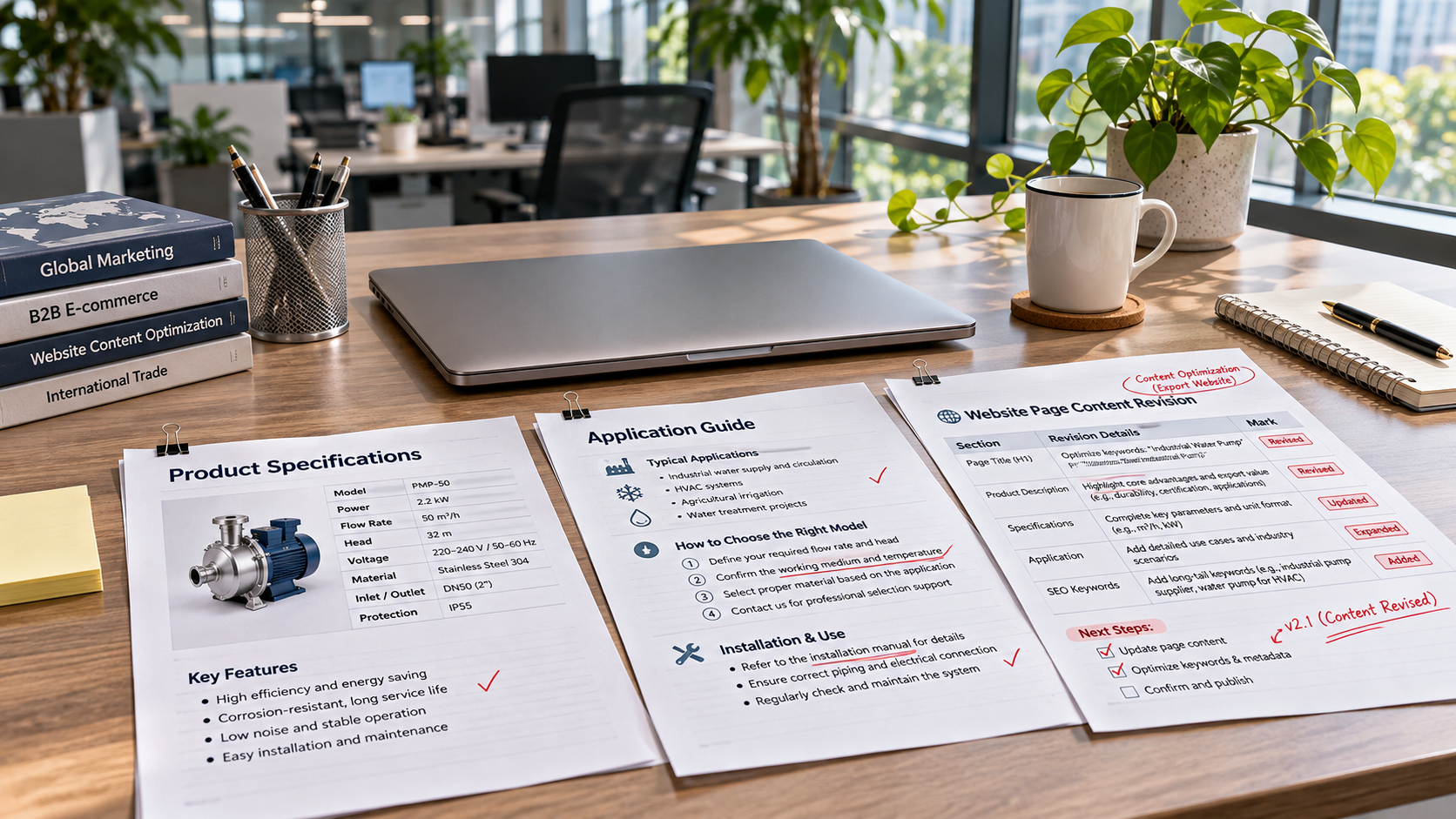
Choose pages that match the intent: product category pages are suitable for a product category; specific product pages can address model numbers, parameters, and applications; technical articles can explain product selection or operating issues; and customization service pages should describe the available scope of customization, the information needed for discussion, and delivery terms. Do not expect a general industry article to provide the purchasing information that belongs on a product page.
Pages should also give users a clear next step. Near the inquiry form, you can prompt users to provide necessary details such as the application, operating medium, flow rate, and head, but the form should not require every customer to submit all complex parameters at once. For visitors who are not yet sure of the required specifications, providing a general inquiry option can help address their early-stage product selection needs.
Refine Your Keyword List Using Qualified Inquiries After Launch
After publishing a page, use Google Search Console to review the queries that generate impressions and clicks. Combine this data with website analytics, form records, and sales feedback to determine whether the visitors match your target market and product offering. If impressions increase but clicks remain low, check whether the page title matches the search intent. If clicks increase but inquiries do not, review the page content, loading experience, contact details, and inquiry process.
Evaluate inquiry quality as well as quantity. Customers’ locations, purchasing applications, required specifications, and whether your company can supply the products provide a better indication of keyword accuracy than form submissions alone. Some customers may get in touch by email or phone, or return to the site later, so do not simply attribute every result to a single keyword.
If a type of keyword continues to attract irrelevant visits, first check for ambiguity in the search results and whether the page clearly defines its application scope. If a specific need repeatedly appears in suitable inquiries, consider adding related specifications and application details. Adjust the keyword list as your product capabilities and customer needs change rather than treating it as fixed after the initial selection.
Related Articles
 How can you improve Google rankings by optimizing page content?
 Which Website SEO Configuration Errors Can Affect Page Indexing?
 How to Choose Target Keywords for SEO in Industry Lead Generation

Related Products
 Yiyingbao SaaS Intelligent Website Building and Marketing SystemYiyingbao SaaS Intelligent Website Building and Marketing System, AI-powered no-code website building, rapid creation of multilingual B2B international websites in 10 minutes, global server acceleration, AI-powered SEO optimization, helping businesses connect efficiently with global markets. The perfect integration of technology and operation makes building an international trade website remarkably simple
 AI+SEM Intelligent Advertising Marketing SystemAI+SEM drives intelligent ad creation, empowering full-funnel precision advertising marketing. The system automatically generates weekly/monthly reports, AI recommends keywords and target countries, monitors core metrics in real-time with intelligent alerts, and enables one-click high-conversion ad solutions to help quickly acquire customers and improve ROI.
 AI+SEO Dual-Engine System Optimization ServicesYiyingbao’s AI+SEO dual-engine optimization system helps foreign trade enterprises acquire high-quality organic traffic through AI-powered keyword research, content generation, and comprehensive technical optimization, significantly improving search rankings and conversion rates.
 AI+SNS Social Media Marketing SystemYingbao AI+SNS Social Media Marketing System - Precision social capture for the social media era. Supports one-click content synchronization across major platforms like Facebook and LinkedIn. AI intelligently rewrites posts for enhanced relevance. 24/7 AI customer service and user profiling analysis empower businesses to efficiently expand into global markets.
 AI+SEO营销解决方案易营宝AI+SEO营销解决方案,通过AI批量写作、智能生成TDK、精准关键词扩词等功能,全面优化网站SEO效果,提升流量与转化率。助力企业构建高效智能网站新生态。
 AI+SEM Advertising Marketing SolutionsAI+SEM Advertising Marketing Solution leverages AI technology to deeply empower SEM ad campaigns. It automatically generates weekly/monthly reports using AI, presenting account data across multiple dimensions for comprehensive insights into campaign performance and trends. The system precisely recommends keywords and target countries, intelligently generates high-conversion ad copy, and enables one-click activation of efficient campaign plans to help businesses rapidly acquire customers. Simultaneously, it monitors core metrics in real time, intelligently identifies abnormal fluctuations, and issues timely alerts to ensure stable, high-return advertising results.
 Domain Name ServicesEasyWin provides professional domain name services, including intelligent queries, one-stop registration, brand protection, and full lifecycle management, helping businesses build a digital brand image.
 EasyOperate B2C Cross-Border E-Commerce Platform & Independent WebsiteEasyStore B2C Cross-border E-commerce Independent Store is an intelligent website building and cross-border e-commerce integrated solution independently developed by EasyStore Information Technology (Beijing) Co., Ltd. The system is specially designed for small and medium-sized as well as large export enterprises, integrating 'website building, operation, marketing, advertising, and conversion' into one, helping enterprises quickly establish cross-border e-commerce independent stores to achieve brand globalization and global sales growth.
The platform supports multiple languages, multiple currencies, and multi-channel marketing, with built-in AI intelligent translation and SEO optimization systems, suitable for mainstream markets such as Southeast Asia, Europe and America, Latin America, and the Middle East, assisting Chinese manufacturing enterprises in efficiently deploying international e-commerce strategies. SSL证书易营宝提供专业SSL安全证书服务,包括单域名和泛域名证书,确保网站数据传输加密、身份验证和完整性保护,助力企业建立安全可信的在线业务环境。









