









- Which customer acquisition channels will be affected by cross-border marketing trends in 2026?Sep 06, 2026View details
- Which homogenization risks should be considered in an analysis of the AI-powered website building industry?Aug 30, 2026View details
- How Will AI Marketing Trends 2026 Change Advertising Budget AllocationAug 28, 2026View details
- Is the EV SSL certificate market shrinking or upgrading? How should companies assess certificate procurement?Aug 11, 2026View details
- Why the old AMP SEO 2020 practices no longer work and what has changed in current optimization prioritiesAug 02, 2026View details
- How to Choose Topics for an Industry News Section to Attract More Organic Search TrafficJul 29, 2026View details
How long does Google SEO optimization generally take to show results?
How long does it take for Google SEO optimization to become effective? This is a question many businesses are most concerned about. SEO typically takes 3 to 6 months to show results, but the timeline is significantly affected by industry competition, website foundations, and execution strategies. Only scientific optimization can deliver sustainable traffic and inquiry growth.
For foreign trade enterprises, manufacturing factories, cross-border e-commerce sellers, and brands expanding overseas, SEO is not a short-term action that produces rankings immediately after implementation. Instead, it is a long-term project closely related to website structure, content quality, technical foundations, and ongoing operations. Especially in an integrated website and marketing services scenario, businesses care not only about when rankings will improve, but also about when they will start receiving qualified inquiries, whether organic traffic will remain stable, and whether their investment can be scaled sustainably.
If a business adopts a coordinated approach involving AI-powered website building, multilingual website development, Google SEO optimization, and advertising, the speed of seeing results is usually more controllable than with standalone SEO. The reason is simple: indexing, speed, conversion, and keyword placement are considered from the website development stage, often reducing 1 to 2 months of rework.
Why Google SEO Usually Takes 3 to 6 Months to Show Results
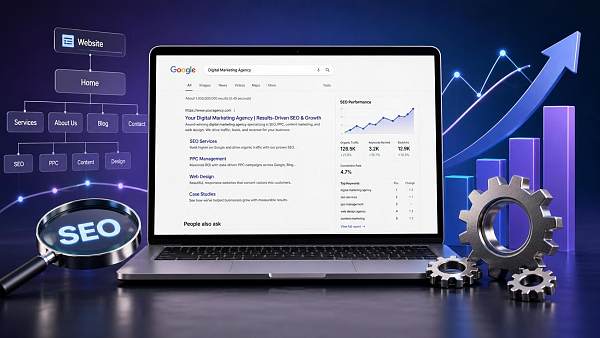
How long does it take for Google SEO optimization to become effective? Based on common industry execution timelines, 3 to 6 months is a relatively typical observation period. However, this does not mean that all businesses will see the same results at the same time. SEO results generally occur in 3 stages: improved indexing, improved keyword rankings, and increased inquiries and conversions. These three stages do not happen simultaneously.
Three Common Stages of SEO Results
The first stage usually lasts from 1 to 4 weeks, with the focus on whether pages are crawled and indexed. The second stage typically appears from the 2nd to the 4th month, when core keywords and long-tail keywords begin to show ranking fluctuations. The third stage often becomes more apparent from the 4th to the 6th month, when high-quality pages start accumulating stable clicks and gradually generating inquiry conversions.
Why Websites Differ So Significantly
A new website and a website with more than 2 years of history have completely different starting conditions for SEO. New websites usually need to go through a trust-building period, while older websites can also experience slower ranking growth if their structure is disorganized, content is duplicated, or loading speed is slow. For many businesses, the problem is not that SEO itself is slow, but that the underlying website is not suitable for promotion, resulting in the first 8 to 12 weeks being spent fixing basic issues.
The table below can help businesses see more clearly approximately how long Google SEO optimization takes to become effective under different website conditions.
As the table shows, the time required for SEO to become effective depends less on whether it is being done and more on whether the foundation is strong, the strategy is accurate, and execution is consistent. If website development, content, technology, and the conversion path are disconnected, the SEO cycle will be extended. If everything is planned in an integrated manner from the beginning, the timeframe for seeing results will be clearer.
5 Key Factors Affecting How Quickly SEO Produces Results
When determining how long Google SEO optimization will take to become effective, businesses should not look only at time. They also need to consider the variables that affect results. The 5 most important factors are usually industry competition, the website’s technical foundation, content update frequency, keyword strategy, and coordination with external traffic. If any one of these areas is significantly weak, 3 months may extend to 6 months or even longer.
1. Industry Competition Determines Ranking Difficulty
If a business operates in an industry with standardized products and a high volume of quotation requests, such as machinery, building material accessories, or electronic components, competition for core keywords is often concentrated. In this situation, competition for first-page rankings is intense. New websites are better suited to target 20 to 50 long-tail keywords first and then gradually move toward core keywords, rather than focusing on highly competitive keywords from the outset.
2. The Website’s Technical Foundation Affects Early-Stage Efficiency
Page loading speed, mobile compatibility, URL hierarchy, internal links, structured information, and duplicate-page control all directly affect crawling and indexing. Many business websites look attractive on the homepage, but their product pages lack text, images are not compressed, and the code contains substantial redundancy, resulting in low crawling efficiency. Technical optimization is usually completed within the first 2 to 6 weeks. The earlier these issues are addressed, the more easily subsequent content can amplify results.
3. Content Frequency Determines the Growth Curve
If a business publishes only 1 article per month, SEO growth is often slow. If it consistently publishes 8 to 20 highly relevant pieces of content each month covering products, applications, purchasing questions, and regional markets, indexing and keyword database expansion are usually faster. For B2B companies expanding overseas, content is not written for search engines; it provides a basis for purchasing decisions.
4. Keyword Strategy Affects Traffic Quality
Focusing only on high-traffic keywords does not necessarily generate more inquiries. A more effective approach is to target product keywords, application keywords, question keywords, and regional keywords at the same time, forming a structure of “1 core page + 3 types of supporting pages + multiple content pages.” This can generally increase exposure within 90 to 180 days while making it easier to attract highly relevant visitors.
5. Multichannel Coordination Can Shorten the Cold-Start Period
SEO does not exist in isolation. For independent websites, Google Ads, social media content, link building, and brand keyword exposure jointly increase the likelihood that pages will be discovered and visited. The value of integrated website and marketing services lies in placing website development, SEO, advertising, and conversion pages within the same growth model, thereby reducing duplicated investment.
How Can Businesses See SEO Results Faster?
The real question is not only how long Google SEO optimization takes to become effective, but also whether a business can use the right methods to shorten the time to results to a more reasonable range. For most companies expanding overseas, those hoping to see initial results in around 3 months should advance website development, content, conversion, and data monitoring simultaneously.
First Build a Website That Can Be Indexed, Promoted, and Converted
The root cause of poor results in many SEO projects is not the optimization work itself, but the website. An independent website targeting overseas markets should meet at least 4 basic requirements: a clear page structure, standardized multilingual logic, stable mobile access, and a smooth inquiry path. If these issues are discovered only after the website goes live, an additional 30 to 60 days are often required.
Develop a 90-Day Execution Plan
For B2B businesses, 90 days is a critical window for determining whether SEO is moving in the right direction. The first 30 days should focus on technical diagnosis and the development of core pages, days 31 to 60 on content expansion and on-site optimization, and days 61 to 90 on indexing, rankings, and inquiry data. If there is still no significant change after 90 days, it usually indicates that the strategy or execution has deviated from the intended direction.
The following is a common SEO acceleration framework used in integrated website and marketing service projects.
The value of this framework lies in breaking SEO work down from an ambiguous action into executable milestones. Businesses do not have to wait 6 months to find out whether there are results; instead, they can assess the health of project progress at the 30-day, 60-day, and 90-day milestones.
Common Misconceptions: Why Do Some Businesses Still See No Results After 6 Months?
Many businesses report that even after 6 months or more, they still have not achieved the desired rankings or inquiries. This does not necessarily mean that Google SEO is ineffective. More commonly, the direction is wrong. When website development and marketing services are separated, problems such as inconsistent objectives, content gaps, and the inability to close the data loop can easily arise.
Focusing Only on Rankings and Not Conversions
Some businesses regard getting 10 keywords into the top 20 as an achievement. However, if these keywords do not strongly match purchasing intent, actual inquiries may still be close to zero. The truly valuable SEO metrics should include at least 4 indicators observed together: number of indexed pages, number of qualified keywords, organic traffic, and number of conversion leads.
Website Development and SEO Are Disconnected
If a website is initially built with a presentation-focused approach and SEO is added later, common problems include unreasonable site navigation, insufficient product-page information, disorganized URLs, and the lack of inquiry components on landing pages. These problems generally cannot be solved by revising one or two articles; they require restructuring the entire website.
Ignoring Multilingual and Localization Details
When targeting markets such as North America, Europe, Southeast Asia, Japan and South Korea, and the Middle East, content expression, keyword habits, and page trust factors vary significantly. Simple translation does not equal localization. If multilingual SEO is not differentiated according to region, language, and purchasing habits, both rankings and conversions will be affected.
SEO Implementation Recommendations for Foreign Trade and Overseas-Bound Brands
For businesses seeking to acquire customers continuously through an overseas independent website, a more practical approach is not to pursue the fastest possible rankings, but to establish a customer acquisition system capable of long-term growth. How long Google SEO optimization takes to become effective ultimately depends on whether a business can continuously produce content, continuously optimize pages, and reliably handle inquiries.
An Integrated Service Model Is Recommended
Placing AI-powered website building, multilingual website development, Google SEO, Google Ads, and social media operations within the same growth chain is more suitable for B2B and cross-border businesses. This not only unifies the keyword strategy, but also enables SEO content, advertising landing pages, and inquiry collection systems to work together, reducing internal friction.
Why Is the Integrated Model More Suitable for Businesses Expanding Overseas?
First, indexing and conversion issues can be addressed during the website development stage. Second, content and advertising data can provide feedback for SEO keyword selection. Third, multilingual pages can be quickly expanded according to different markets. For businesses planning long-term expansion in North America, Europe, or Southeast Asia, this model makes it easier to establish stable organic traffic assets within 6 to 12 months.
Yiyingbao is an AI-driven enterprise-level SaaS intelligent website-building and overseas digital marketing service platform. It has long served foreign trade enterprises, manufacturing factories, cross-border e-commerce sellers, and brands expanding overseas. It can provide coordinated planning for independent website development, SEO optimization, advertising, social media operations, and GEO generative engine optimization, helping businesses shorten the cold-start period while improving visibility and customer acquisition efficiency in global markets.
If your business is currently evaluating how long Google SEO optimization takes to become effective, it is recommended to begin with a diagnosis of 4 dimensions: website foundations, keyword strategy, content cadence, and conversion paths. Although businesses may appear to be doing SEO in the same way, differences in execution logic often lead to gaps of more than 3 months in results. For businesses seeking long-term overseas traffic and inquiries, a more worthwhile investment is an integrated solution that can be indexed, promoted, and converted.
Whether you are preparing to build a new overseas independent website or hoping to optimize an existing multilingual website, planning website development and marketing coordination early will generally help you see organic traffic growth sooner. If you would like an implementation path better suited to your industry, market, and budget, please contact us now to obtain a customized plan and learn more about our solutions.
Related Articles



Related Products
 Yiyingbao SaaS Intelligent Website Building and Marketing SystemYiyingbao SaaS Intelligent Website Building and Marketing System, AI-powered no-code website building, rapid creation of multilingual B2B international websites in 10 minutes, global server acceleration, AI-powered SEO optimization, helping businesses connect efficiently with global markets. The perfect integration of technology and operation makes building an international trade website remarkably simple
 AI+SEM Intelligent Advertising Marketing SystemAI+SEM drives intelligent ad creation, empowering full-funnel precision advertising marketing. The system automatically generates weekly/monthly reports, AI recommends keywords and target countries, monitors core metrics in real-time with intelligent alerts, and enables one-click high-conversion ad solutions to help quickly acquire customers and improve ROI.
 AI+SEO Dual-Engine System Optimization ServicesYiyingbao’s AI+SEO dual-engine optimization system helps foreign trade enterprises acquire high-quality organic traffic through AI-powered keyword research, content generation, and comprehensive technical optimization, significantly improving search rankings and conversion rates.
 AI+SNS Social Media Marketing SystemYingbao AI+SNS Social Media Marketing System - Precision social capture for the social media era. Supports one-click content synchronization across major platforms like Facebook and LinkedIn. AI intelligently rewrites posts for enhanced relevance. 24/7 AI customer service and user profiling analysis empower businesses to efficiently expand into global markets.
 AI+SEO营销解决方案易营宝AI+SEO营销解决方案,通过AI批量写作、智能生成TDK、精准关键词扩词等功能,全面优化网站SEO效果,提升流量与转化率。助力企业构建高效智能网站新生态。
 AI+SEM Advertising Marketing SolutionsAI+SEM Advertising Marketing Solution leverages AI technology to deeply empower SEM ad campaigns. It automatically generates weekly/monthly reports using AI, presenting account data across multiple dimensions for comprehensive insights into campaign performance and trends. The system precisely recommends keywords and target countries, intelligently generates high-conversion ad copy, and enables one-click activation of efficient campaign plans to help businesses rapidly acquire customers. Simultaneously, it monitors core metrics in real time, intelligently identifies abnormal fluctuations, and issues timely alerts to ensure stable, high-return advertising results.
 Domain Name ServicesEasyWin provides professional domain name services, including intelligent queries, one-stop registration, brand protection, and full lifecycle management, helping businesses build a digital brand image.
 EasyOperate B2C Cross-Border E-Commerce Platform & Independent WebsiteEasyStore B2C Cross-border E-commerce Independent Store is an intelligent website building and cross-border e-commerce integrated solution independently developed by EasyStore Information Technology (Beijing) Co., Ltd. The system is specially designed for small and medium-sized as well as large export enterprises, integrating 'website building, operation, marketing, advertising, and conversion' into one, helping enterprises quickly establish cross-border e-commerce independent stores to achieve brand globalization and global sales growth.
The platform supports multiple languages, multiple currencies, and multi-channel marketing, with built-in AI intelligent translation and SEO optimization systems, suitable for mainstream markets such as Southeast Asia, Europe and America, Latin America, and the Middle East, assisting Chinese manufacturing enterprises in efficiently deploying international e-commerce strategies. SSL证书易营宝提供专业SSL安全证书服务,包括单域名和泛域名证书,确保网站数据传输加密、身份验证和完整性保护,助力企业建立安全可信的在线业务环境。









