









- ASEAN Signs Digital Economy Framework Agreement, Moving Toward Harmonized Cross-Border E-Commerce RulesNov 15, 2026View details
- Shenzhen Becomes the First City in Mainland China to Exceed RMB 5 Trillion in Foreign TradeNov 15, 2026View details
- Fujian Announces the First Batch of Provincial-Level Cross-Border E-Commerce Industrial Parks and Key Brands for CultivationNov 14, 2026View details
- Amazon Global Store Announces the Launch of the 2026 Black Friday Global Shopping SeasonNov 14, 2026View details
- CCTV.com Examines APEC’s Role in China’s Foreign TradeNov 12, 2026View details
- China’s Tariff Commission of the State Council Adjusts Additional Tariffs on U.S. Goods: 24% Tariff Suspended for Two MonthsNov 10, 2026View details
How should page hierarchy be planned when building a corporate website?
How should page hierarchy be planned when building a corporate website?
When planning a corporate website structure (aufbau einer website grundlagen), the easiest mistake to make is to decide how many items the navigation should have first, then fit the existing materials into them one by one. The result is often a complete company profile, while customers cannot find the right products or even figure out how to submit an inquiry. Page hierarchy should follow the paths customers take to find information, while also enabling search engines to discover and understand the different types of content.
First, distinguish between sections, page hierarchy, and click depth
Sections are content categories, page hierarchy describes parent-child relationships, and click depth is the number of clicks required to reach a target page from an entry point. For example, “Home—Products—Industrial Pumps—Model X” shows a category relationship. If the model is also featured directly on the home page, the click path is shorter, but it still belongs to the Industrial Pumps category.
Many companies treat “reaching any page within three clicks” as a hard rule, but there is no fixed number of levels that works for every website. A site with few products can have a flatter structure, while one with many models and complex applications needs well-organized groups. What should really be avoided is putting dozens of categories in the main navigation just to make the hierarchy look shallow, which only makes it harder to navigate.
Group content around customers’ questions, not your organizational chart
B2B buyers usually first determine whether a product suits their needs, then check its specifications, operating conditions, supply capabilities, and cooperation options. The main navigation can therefore be organized around products, solutions, technical resources, company information, and contact options. There is no need to turn every internal department into a separate section.
For an industrial equipment website, for example, you could first map out the main path “Home—Product Category—Product Details,” then create a secondary path such as “Home—Industry Applications—Solutions.” Connect the two paths with relevant links: customers can check which applications suit a particular equipment model or find suitable equipment based on an industry challenge, without duplicating product detail pages.
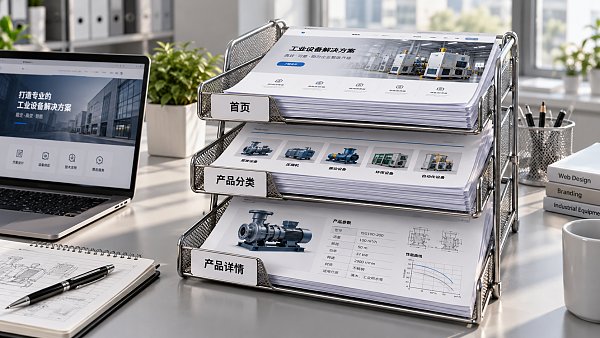
Whether it is worth adding a category page can be assessed using three criteria: Do customers look for this type of content on its own? Is it clearly different from adjacent categories? Does the company have enough material to support it? Pages with different names but nearly identical content should not be created in bulk just to target keywords.
Make each level answer a distinct question
The home page explains what the company offers and whom it serves, then directs visitors to its main business areas. Category pages help visitors narrow down their options and should explain differences between types, selection criteria, and links to lower-level pages, rather than simply displaying images. Detail pages support purchasing decisions by clearly explaining specifications, operating conditions, delivery scope, and how to obtain further information.
Informational content should also have a clear place in the site structure. For example, if the business involves research on real estate enterprise management, content on a topic such as A Study of Internal Auditing and Risk Management Strategies for Real Estate Development Enterprises is better placed in a relevant research or industry resources section, rather than given a separate main navigation item just because its title is long. Whether to create further subsections depends on the actual volume of content on the same topic.
Inquiry options should also reflect the content. A product page can prompt visitors to provide the model, quantity, and operating conditions; a solutions page can invite them to describe their project requirements. If every page only offers a generic “Contact Us” option, customers’ expressed interests are lost, and sales teams have less context for evaluating inquiries.
A clear structure does not guarantee that search engines will find everything
Pages need crawlable links between them. Important content should not be accessible only through site search, filtering, or button interactions. Breadcrumbs should reflect the actual site hierarchy, and category pages should link to detail pages. A sitemap can help search engines discover URLs, but it cannot replace internal links or guarantee that pages will be indexed.
Faceted navigation needs particular attention during planning. Combinations of materials, dimensions, and uses can generate large numbers of similar URLs, which should not all be made indexable by default. Whether a combination merits its own page should be determined based on search demand and content differentiation. For the remaining pages, choose an appropriate approach to crawl and index management, avoiding conflicting rules.
Multilingual websites should also maintain the correspondence between language versions and use appropriate language annotations. When visitors switch languages, try to take them to the corresponding page rather than always redirecting them to the home page. Category names and content priorities can be adapted for different markets, but the original logic of the site structure should be preserved in translation.
Include lead-generation entry points in your site map before building
Not every visitor enters a corporate website through the home page. Search may bring readers to a technical article, an ad may link directly to a solutions page, and social media may direct customers to a particular product. Every key entry point should therefore provide the necessary business context, related content, and a clear next step. Do not assume that visitors have already viewed the company profile.
Yiyingbao Information Technology (Beijing) Co., Ltd., founded in 2013 and headquartered in Beijing, integrates AI-powered website building, multilingual websites, SEO, and advertising into a unified service offering. The value of this type of service lies in whether site structure can be aligned with promotional needs: which pages support search, which are used for ad testing, how multilingual content is maintained, and how inquiry source information is captured—not simply in how many pages have been published.
Before launch, try navigating the website using three real tasks: find a specified product, determine whether it meets the requirements for a particular application, and submit a clear inquiry. Check for broken links, duplicate categories, incorrect language redirects, and forms that are difficult to find. Ultimately, a page hierarchy is well planned if users can complete these tasks smoothly—not because the site map looks tidy.
Related Articles
 Apple Support Communities will close on November 20, bringing platform dependency risks back into focus
 How Can Image Optimization Speed Up a Slow-Loading Mobile Website’s First Screen?
 How Can Responsive Website Development Prevent Mobile Layout Issues?



Related Products
 Yiyingbao SaaS Intelligent Website Building and Marketing SystemYiyingbao SaaS Intelligent Website Building and Marketing System, AI-powered no-code website building, rapid creation of multilingual B2B international websites in 10 minutes, global server acceleration, AI-powered SEO optimization, helping businesses connect efficiently with global markets. The perfect integration of technology and operation makes building an international trade website remarkably simple
 AI+SEM Intelligent Advertising Marketing SystemAI+SEM drives intelligent ad creation, empowering full-funnel precision advertising marketing. The system automatically generates weekly/monthly reports, AI recommends keywords and target countries, monitors core metrics in real-time with intelligent alerts, and enables one-click high-conversion ad solutions to help quickly acquire customers and improve ROI.
 AI+SEO Dual-Engine System Optimization ServicesYiyingbao’s AI+SEO dual-engine optimization system helps foreign trade enterprises acquire high-quality organic traffic through AI-powered keyword research, content generation, and comprehensive technical optimization, significantly improving search rankings and conversion rates.
 AI+SNS Social Media Marketing SystemYingbao AI+SNS Social Media Marketing System - Precision social capture for the social media era. Supports one-click content synchronization across major platforms like Facebook and LinkedIn. AI intelligently rewrites posts for enhanced relevance. 24/7 AI customer service and user profiling analysis empower businesses to efficiently expand into global markets.
 AI+SEO营销解决方案易营宝AI+SEO营销解决方案,通过AI批量写作、智能生成TDK、精准关键词扩词等功能,全面优化网站SEO效果,提升流量与转化率。助力企业构建高效智能网站新生态。
 AI+SEM Advertising Marketing SolutionsAI+SEM Advertising Marketing Solution leverages AI technology to deeply empower SEM ad campaigns. It automatically generates weekly/monthly reports using AI, presenting account data across multiple dimensions for comprehensive insights into campaign performance and trends. The system precisely recommends keywords and target countries, intelligently generates high-conversion ad copy, and enables one-click activation of efficient campaign plans to help businesses rapidly acquire customers. Simultaneously, it monitors core metrics in real time, intelligently identifies abnormal fluctuations, and issues timely alerts to ensure stable, high-return advertising results.
 Domain Name ServicesEasyWin provides professional domain name services, including intelligent queries, one-stop registration, brand protection, and full lifecycle management, helping businesses build a digital brand image.
 EasyOperate B2C Cross-Border E-Commerce Platform & Independent WebsiteEasyStore B2C Cross-border E-commerce Independent Store is an intelligent website building and cross-border e-commerce integrated solution independently developed by EasyStore Information Technology (Beijing) Co., Ltd. The system is specially designed for small and medium-sized as well as large export enterprises, integrating 'website building, operation, marketing, advertising, and conversion' into one, helping enterprises quickly establish cross-border e-commerce independent stores to achieve brand globalization and global sales growth.
The platform supports multiple languages, multiple currencies, and multi-channel marketing, with built-in AI intelligent translation and SEO optimization systems, suitable for mainstream markets such as Southeast Asia, Europe and America, Latin America, and the Middle East, assisting Chinese manufacturing enterprises in efficiently deploying international e-commerce strategies. SSL证书易营宝提供专业SSL安全证书服务,包括单域名和泛域名证书,确保网站数据传输加密、身份验证和完整性保护,助力企业建立安全可信的在线业务环境。









