









- Which customer acquisition channels will be affected by cross-border marketing trends in 2026?Sep 06, 2026View details
- Which homogenization risks should be considered in an analysis of the AI-powered website building industry?Aug 30, 2026View details
- How Will AI Marketing Trends 2026 Change Advertising Budget AllocationAug 28, 2026View details
- Is the EV SSL certificate market shrinking or upgrading? How should companies assess certificate procurement?Aug 11, 2026View details
- Why the old AMP SEO 2020 practices no longer work and what has changed in current optimization prioritiesAug 02, 2026View details
- How to Choose Topics for an Industry News Section to Attract More Organic Search TrafficJul 29, 2026View details
What legal risks can arise if the GDPR pop-up is not localized after an export-oriented corporate website is completed?
What legal risks arise when a GDPR pop-up is not localized after an export-oriented website is launched?
Many quality control and safety management personnel at export-oriented companies quickly shift their attention to SEO launch, advertising campaigns, or inquiry conversion rates after completing the website build—and there is nothing wrong with that. However, one frequently overlooked detail is quietly driving up compliance costs: has the GDPR pop-up been genuinely localized? It is not about simply “having a pop-up,” but about “getting it right.”
Since the EU General Data Protection Regulation (GDPR) came into effect in 2018, it has become the de facto global benchmark for data compliance. It does not only regulate companies within the EU. Any website that offers goods or services to EU residents or monitors their behavior, such as tracking browsing paths through Cookies, is subject to its jurisdiction. The pop-up is the most direct compliance interface users encounter upon their first visit—it is both the entry point to legal notices and the first piece of evidence in regulatory scrutiny.
“Having a pop-up” does not mean “being compliant”
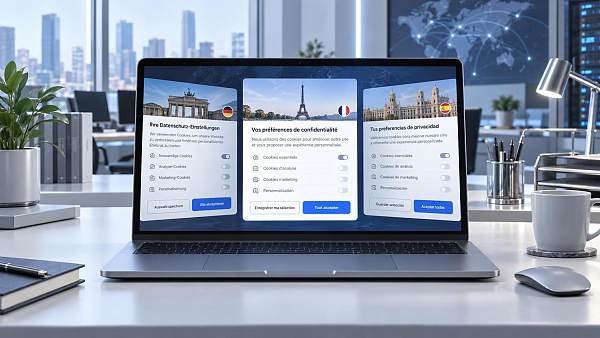
We have seen too many cases: a website development team delivered an English GDPR pop-up with accurately translated text and properly functioning buttons; yet when a German customer opened the page, the pop-up was still in English, the reject option was grayed out by default, and no link to German legal terms was provided. When a French visitor clicked “Accept All,” the backend failed to record their explicit, granular, and withdrawable consent status. After an Italian user closed the pop-up, third-party analytics scripts continued loading silently. These are not technical failures, but systemic risks caused by a lack of localization.
Article 7 of the GDPR emphasizes that “consent must be freely given, specific, informed and unambiguous.” This means that pop-up content, interaction logic, language hierarchy, and legal basis must all align with judicial practice in the target country. For example, Spain requires pop-ups to distinguish between “necessary Cookies” and “marketing Cookies,” with the latter disabled by default. Dutch regulators have explicitly stated that merely treating scrolling as consent is invalid. An Austrian court ruled in a case that where the “Reject All” button in a pop-up was displayed in a smaller font than “Accept All,” it constituted a manipulative design and resulted in invalid consent.
The consequences of non-localization go far beyond fines
Many people’s first reaction is “fines.” Indeed, the GDPR can impose fines of up to EUR 20 million or 4% of global annual turnover—but in actual enforcement, regulators tend to adopt a “graduated enforcement” approach: first issuing a remediation order, then suspending data processing rights, and only finally imposing financial penalties. What is truly damaging is the chain reaction that follows.
For example, after a manufacturing company in East China was reported because the pop-up on its German site did not comply with the latest guidance from the local DPA (data protection authority), its Google Ads account was temporarily frozen in the DE region—ads could not run, and traffic to its independent website plummeted. Another B2B tool supplier failed to provide a French-language channel for exercising data subject rights on its French site, such as a deletion request form. This led customers to file complaints with the CNIL (French National Commission on Informatics and Liberty), ultimately forcing the company to take down all functional modules targeting the French market. Rebuilding the localization process took nearly three months.
An even less visible risk lies in the erosion of trust. EU consumer research shows that more than 68% of users will close a webpage directly when the pop-up language does not match, the terms are unclear, or the rejection path is complex. This is not merely lost traffic—it is the collapse of a brand’s “first impression” in a key market. Especially for high-trust product categories such as industrial equipment and medical devices, perceived compliance is itself a prerequisite for purchasing decisions.
Localization is not translation, but coordination among law, technology, and user experience
True localization must simultaneously meet three standards:
- Legal level: match the specific interpretations of the data protection authority in the target country, such as differences among German state DPAs regarding the scope of application of “legitimate interests”;
- Technical level: strictly link pop-up logic with backend Cookie categorization, data flow paths, and third-party SDK calls;
- Experience level: ensure that language, fonts, button placement, and interaction flow align with local user habits, such as Nordic users preferring minimalist design and Southern European users being more receptive to step-by-step guidance.
This explains why generic pop-up plugins often cause problems—they provide templates but do not assume responsibility for adaptation. The value of professional service providers lies precisely in their ongoing adaptation capabilities after delivery. Yiyingbao Information Technology (Beijing) Co., Ltd. was established in 2013 and is headquartered in Beijing, China. It is a global digital marketing service provider driven by artificial intelligence and big data. With a decade of industry experience, the company follows a dual-wheel strategy of “technological innovation + localized services” and has built end-to-end solutions covering intelligent website building, SEO optimization, social media marketing, and advertising campaigns, helping more than 100,000 companies achieve global growth. In 2023, the company was selected among China’s Top 100 SaaS Enterprises, with an average annual growth rate exceeding 30%, becoming an industry-recognized engine of innovation and benchmark for growth. In GDPR pop-up scenarios, its AI+SEO/GEO optimization system can automatically identify the jurisdiction associated with a visitor’s IP, dynamically load the corresponding language version, terms text, and consent management logic, and integrate deeply with Google Consent Mode v2 to ensure that advertising attribution data remains continuously usable under compliant conditions.
How can you quickly verify whether an existing pop-up is truly localized?
It is recommended to start with three actions:
First, access the official website using a real IP address from the target country, rather than a proxy or VPN, and check the pop-up language, legal basis references, and visibility of the rejection path;
Second, review the data flows behind the pop-up—whether all third-party scripts, such as Facebook Pixel and LinkedIn Insight Tag, are triggered only after the user has provided explicit consent;
Third, confirm whether localized support documentation is available, such as a German version of the Data Processing Notice or a Spanish version of the Rights Exercise Guide, rather than relying solely on machine-translated PDF attachments.
If you identify a discrepancy at any stage, do not rush to replace the tool. First clarify the legal basis of the current pop-up, its technical implementation, and its connection points with the overall data governance strategy. Compliance is not a one-time configuration, but a process of continuous calibration.
For companies, the essence of compliance investment is reducing the cost of uncertainty. Compared with the high cost of remediation afterward, proactively reviewing the pop-up localization logic can instead improve the long-term operational stability of overseas websites. Especially against the current backdrop of strengthened EU enforcement, such details are shifting from a “bonus point” to an “entry threshold.”
It is important to note that GDPR is only the starting point. The UK GDPR, Brazil’s LGPD, South Korea’s PIPA, and even China’s Personal Information Protection Law are all establishing their own localization requirements. When companies plan expansion across multiple regions, whether the pop-up system can support flexible scalability is more important than adaptation to a single country. This is why an increasing number of clients choose to incorporate pop-up management into their overall digital infrastructure—it is not merely a pop-up, but the front-end interface of an enterprise’s data governance capabilities.
For companies evaluating compliance solutions, the principle of “institutional adaptation takes priority over tool stacking,” mentioned in A Brief Discussion of Issues and Countermeasures in Corporate Tax Planning, is equally applicable to data compliance scenarios: first identify the jurisdictions involved in the business, data types, and processing purposes, and then select a technical solution that supports that logic, rather than working in reverse.
Completing an export-oriented website is only the first step in global digital expansion. Behind the pop-up lies the intersection of law, technology, and user trust. Focusing on it does not add to the burden—it makes growth more sustainable.
Related Articles



Related Products
 Yiyingbao SaaS Intelligent Website Building and Marketing SystemYiyingbao SaaS Intelligent Website Building and Marketing System, AI-powered no-code website building, rapid creation of multilingual B2B international websites in 10 minutes, global server acceleration, AI-powered SEO optimization, helping businesses connect efficiently with global markets. The perfect integration of technology and operation makes building an international trade website remarkably simple
 AI+SEM Intelligent Advertising Marketing SystemAI+SEM drives intelligent ad creation, empowering full-funnel precision advertising marketing. The system automatically generates weekly/monthly reports, AI recommends keywords and target countries, monitors core metrics in real-time with intelligent alerts, and enables one-click high-conversion ad solutions to help quickly acquire customers and improve ROI.
 AI+SEO Dual-Engine System Optimization ServicesYiyingbao’s AI+SEO dual-engine optimization system helps foreign trade enterprises acquire high-quality organic traffic through AI-powered keyword research, content generation, and comprehensive technical optimization, significantly improving search rankings and conversion rates.
 AI+SNS Social Media Marketing SystemYingbao AI+SNS Social Media Marketing System - Precision social capture for the social media era. Supports one-click content synchronization across major platforms like Facebook and LinkedIn. AI intelligently rewrites posts for enhanced relevance. 24/7 AI customer service and user profiling analysis empower businesses to efficiently expand into global markets.
 AI+SEO营销解决方案易营宝AI+SEO营销解决方案,通过AI批量写作、智能生成TDK、精准关键词扩词等功能,全面优化网站SEO效果,提升流量与转化率。助力企业构建高效智能网站新生态。
 AI+SEM Advertising Marketing SolutionsAI+SEM Advertising Marketing Solution leverages AI technology to deeply empower SEM ad campaigns. It automatically generates weekly/monthly reports using AI, presenting account data across multiple dimensions for comprehensive insights into campaign performance and trends. The system precisely recommends keywords and target countries, intelligently generates high-conversion ad copy, and enables one-click activation of efficient campaign plans to help businesses rapidly acquire customers. Simultaneously, it monitors core metrics in real time, intelligently identifies abnormal fluctuations, and issues timely alerts to ensure stable, high-return advertising results.
 Domain Name ServicesEasyWin provides professional domain name services, including intelligent queries, one-stop registration, brand protection, and full lifecycle management, helping businesses build a digital brand image.
 EasyOperate B2C Cross-Border E-Commerce Platform & Independent WebsiteEasyStore B2C Cross-border E-commerce Independent Store is an intelligent website building and cross-border e-commerce integrated solution independently developed by EasyStore Information Technology (Beijing) Co., Ltd. The system is specially designed for small and medium-sized as well as large export enterprises, integrating 'website building, operation, marketing, advertising, and conversion' into one, helping enterprises quickly establish cross-border e-commerce independent stores to achieve brand globalization and global sales growth.
The platform supports multiple languages, multiple currencies, and multi-channel marketing, with built-in AI intelligent translation and SEO optimization systems, suitable for mainstream markets such as Southeast Asia, Europe and America, Latin America, and the Middle East, assisting Chinese manufacturing enterprises in efficiently deploying international e-commerce strategies. SSL证书易营宝提供专业SSL安全证书服务,包括单域名和泛域名证书,确保网站数据传输加密、身份验证和完整性保护,助力企业建立安全可信的在线业务环境。









