









- Can the average annual growth rate reflect real opportunities in overseas markets?Oct 07, 2026View details
- Which customer acquisition channels will be affected by cross-border marketing trends in 2026?Sep 06, 2026View details
- Which homogenization risks should be considered in an analysis of the AI-powered website building industry?Aug 30, 2026View details
- How Will AI Marketing Trends 2026 Change Advertising Budget AllocationAug 28, 2026View details
- Is the EV SSL certificate market shrinking or upgrading? How should companies assess certificate procurement?Aug 11, 2026View details
- Why the old AMP SEO 2020 practices no longer work and what has changed in current optimization prioritiesAug 02, 2026View details
Why Is the Repurchase Rate of B2C Cross-Border E-Commerce Independent Websites Failing to Improve?
For B2C cross-border e-commerce websites, the problem is often not that no one buys, but that customers leave after making a purchase
For many companies operating B2C cross-border e-commerce stores, the initial focus is usually on website launch speed, advertising costs, and order conversion. Only after the site is up and running do they begin to discover a more difficult problem: getting the first order is not particularly difficult, but increasing the number of second and third orders is. There is traffic, advertising spend continues, and sales may occasionally surge through promotional campaigns, yet the repeat purchase rate remains flat. At this point, simply attributing the problem to “insufficiently strong products” often means overlooking the real bottleneck.
Cross-border retail differs from domestic e-commerce. Users take longer to build trust in unfamiliar brands, fulfillment chains are longer, and refund communication costs are higher. Every additional step involving language, payment, logistics, or after-sales service creates another opportunity for customer loss. In other words, repeat purchases in B2C cross-border e-commerce are not the result of optimizing a single point, but of ensuring consistency between the website experience, marketing follow-up, customer operations, and delivery expectations.
Many websites treat “conversion” as the finish line, making repeat purchases naturally difficult
Many independent websites create repeat-purchase risks during the website-building stage. Their pages look more like advertising landing pages, focusing entirely on “placing an order now” without giving users a reason to return later. For example, product detail pages may lack complete information, while dimensions, application scope, usage restrictions, and return and exchange conditions are described ambiguously. Users may place their first order reluctantly, but if the product does not match their expectations when it arrives, they are unlikely to return even if they do not file a complaint.
Another common issue is the disconnect between front-end marketing and back-end fulfillment. Advertisements emphasize “fast shipping” and “local service,” but after the order is completed, customers receive no clear logistics updates and customer service responds slowly. The core impression created by a customer’s first purchase is not necessarily the product itself, but whether “this store is reliable.” If customers have to guess their way through the first-order experience, repeat purchases will depend largely on luck.
This is why more and more companies no longer treat an independent website merely as a showcase, but instead view it as part of a more complete digital business system. Platforms with extensive experience in overseas marketing and intelligent website building generally place greater emphasis on connecting data across the website, traffic, conversion, and remarketing, because repeat purchases cannot be consistently solved by simply modifying one page.
Before rushing to build a membership program, check these commonly overlooked areas first
When companies discuss repeat purchases, their first response is often points, coupons, and member discounts. These tools are certainly useful, but only when the basic experience is already satisfactory. Otherwise, offering more coupons will merely generate another low-quality repurchase rather than establish a stable purchasing habit.
The areas that deserve attention first are usually these four: first, whether the promise made for the initial order matches the actual delivery; second, whether the website provides a clear path for making another purchase; third, whether customers continue to receive relevant engagement after purchasing; and fourth, whether operating strategies have been localized for different markets.
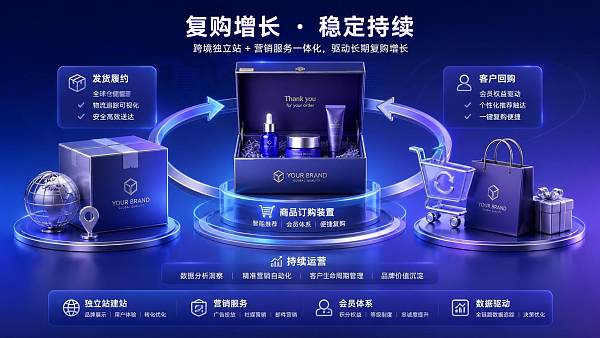
Consider a practical example. Independent websites selling fast-moving consumer goods, personal care products, pet products, and household consumables are naturally well suited to repeat purchases. However, many websites do not provide replenishment reminders based on usage cycles, nor do they trigger emails or text messages according to typical consumption periods. Once customers use up a product, they may not remember your brand; even if they do, they may not be able to find the same product they purchased previously. Without convenient on-site actions such as “Buy Again,” “Related Products,” or “Subscribe for Replenishment,” it is entirely normal for the repeat purchase rate to remain low.
By contrast, if the products are low-frequency purchases, such as furniture, large home appliances, or non-standard components, it is not appropriate to mechanically apply a “repeat purchase every 30 days” approach. For these products, a more realistic goal is often to extend the customer relationship through accessories, consumables, extended warranties, educational content, and social media engagement to generate secondary conversions. A low repeat purchase rate does not necessarily indicate poor operations; it may also reflect different category dynamics. These situations should not be treated as the same.
Customers are not unwilling to buy again; the cost of repurchasing is simply higher than you think
Many cross-border websites interpret repeat purchases as “customer loyalty to the brand.” This is not wrong, but it is too abstract. For overseas consumers, repeat purchases usually require them to overcome several practical barriers: finding you again, trusting you again, and being willing to pay you again. If any one of these steps is inconvenient, the repurchase journey will break down.
Finding you again involves off-site engagement and on-site recognition. Has the customer’s email been effectively captured? Is advertising remarketing segmented by audience? Can users quickly see recently viewed products, previous purchases, and items suitable for replenishment? Trusting you again depends on after-sales service, reviews, and fulfillment transparency rather than slogans on the homepage. Being willing to pay you again is directly related to taxes and fees, shipping times, payment methods, currency switching, and checkout complexity.
Many companies already have technically capable independent websites, but their marketing journeys have not kept pace. For example, their advertising systems focus only on customer acquisition, with almost no separate audience segments for existing customers. Their social media content discusses only brand stories without addressing the usage scenarios of customers who have already purchased. Their SEO articles focus solely on acquiring new traffic without providing post-purchase content support. Such websites can generate orders, but they have difficulty turning users into a valuable customer base.
When repeat purchases fail to grow, the problem is often not one mistake, but a lack of connection across three levels
The first level is the website itself. After users return to the site, can they understand the information, complete a purchase smoothly, and find what they need? If a multilingual website merely fills its pages with machine-translated content, inaccurate descriptions of dimensions, materials, applicable users, and after-sales terms will still make repeat customers hesitate. This is particularly true in markets such as Europe, Japan and South Korea, and the Middle East, where differences in language details and communication habits are significant. Being “understandable” should not be confused with making customers “willing to place an order.”
The second level is operational activity. Are there welcome emails, shipping notifications, delivery confirmations, usage recommendations, replenishment reminders, and re-engagement campaigns for dormant customers? These are not exclusive to major brands; they are basic functions of a cross-border e-commerce store. However, many companies prioritize page design over processes when building their websites, leaving subsequent operations dependent on manual intervention, which is inefficient and unstable.
The third level is data analysis. Companies often say that their “repeat purchase performance is poor,” but without breaking down traffic sources, first-purchase categories, order value ranges, regions, and repurchase cycles, this conclusion is too broad. Customers acquired through advertising and those arriving organically through SEO often show different repeat purchase patterns. The long-term value of a first order driven by discounts may also differ from that of an order driven by content. An experienced team does not focus only on the overall repeat purchase rate. It also examines which customers are worth targeting further, which products are suitable for subscriptions, and which markets should first improve their customer experience.
From this perspective, repeat purchase issues are also related to a company’s digital resilience. If the website, marketing, data, and fulfillment operate independently, the business becomes highly vulnerable when traffic costs fluctuate, platform policies change, or regional markets cool. This topic has strong practical relevance in An Analysis of the Impact of Digital Transformation on Business Resilience, particularly for companies that intend to develop their independent websites as long-term assets.
Truly effective improvement usually does not mean “running more promotions”
If a company wants to take action now, it is advisable not to launch a major promotion immediately, but to first conduct a repeat purchase assessment. Break down orders from a recent period and examine what happened 30, 60, and 90 days after the first purchase: Did customers fail to return, or did they return without placing an order? Did they abandon their carts after adding products, or did they not visit the site again at all? Were returns particularly high in a certain country, or were reviews poor for a particular product category? Only when the customer journey is clear can actions be properly targeted.
The next step is segmentation rather than a one-size-fits-all approach. High-frequency categories are suitable for subscriptions, product bundles, and replenishment reminders. Low-frequency categories are better suited to accessory recommendations, educational content, and extended after-sales services. New customers need trust-building, while existing customers need convenience and certainty. These two groups should not be addressed with the same messaging, page design, or advertising logic.
In execution, this is where the value of integrating website development with marketing services becomes clear. If the website-building system can work together with SEO, advertising, social media, and automated engagement, many actions are no longer about whether they should be performed, but about when they should be triggered. For platforms such as 易营宝 that have long served overseas markets, the advantage usually does not lie in a single tool, but in their ability to view intelligent website building, multilingual content, advertising marketing, SEO, and AI search visibility as part of the same growth journey. This is more practical for improving repeat purchases than simply modifying a page.
Some repeat purchase rates should not be aggressively pursued
Another important point is that not every B2C cross-border e-commerce store must achieve a high repeat purchase rate. When making business decisions, companies need to consider product category characteristics, profit structure, customer acquisition costs, and market cycles. Some categories are better suited to high-value, low-frequency transactions, followed by long-term accumulation through content and brand positioning. Other categories must focus on existing-customer management; otherwise, continued advertising will become increasingly burdensome. Repeat purchases do not have one universal answer; they are part of the business model.
Therefore, when you find that the repeat purchase rate of your independent website is not increasing, do not rush to add discounts or change products. First determine whether the first-order experience has broken down. Then examine whether marketing and the website are genuinely connected. Finally, assess what kind of repurchase target is actually appropriate for the product category. Once these three areas are clarified, the repeat purchase issue for a B2C cross-border e-commerce store will generally move beyond a vague sense that “something is wrong” and enter a stage that can be analyzed, optimized, and continuously improved.
Related Articles


Related Products
 Yiyingbao SaaS Intelligent Website Building and Marketing SystemYiyingbao SaaS Intelligent Website Building and Marketing System, AI-powered no-code website building, rapid creation of multilingual B2B international websites in 10 minutes, global server acceleration, AI-powered SEO optimization, helping businesses connect efficiently with global markets. The perfect integration of technology and operation makes building an international trade website remarkably simple
 AI+SEM Intelligent Advertising Marketing SystemAI+SEM drives intelligent ad creation, empowering full-funnel precision advertising marketing. The system automatically generates weekly/monthly reports, AI recommends keywords and target countries, monitors core metrics in real-time with intelligent alerts, and enables one-click high-conversion ad solutions to help quickly acquire customers and improve ROI.
 AI+SEO Dual-Engine System Optimization ServicesYiyingbao’s AI+SEO dual-engine optimization system helps foreign trade enterprises acquire high-quality organic traffic through AI-powered keyword research, content generation, and comprehensive technical optimization, significantly improving search rankings and conversion rates.
 AI+SNS Social Media Marketing SystemYingbao AI+SNS Social Media Marketing System - Precision social capture for the social media era. Supports one-click content synchronization across major platforms like Facebook and LinkedIn. AI intelligently rewrites posts for enhanced relevance. 24/7 AI customer service and user profiling analysis empower businesses to efficiently expand into global markets.
 AI+SEO营销解决方案易营宝AI+SEO营销解决方案,通过AI批量写作、智能生成TDK、精准关键词扩词等功能,全面优化网站SEO效果,提升流量与转化率。助力企业构建高效智能网站新生态。
 AI+SEM Advertising Marketing SolutionsAI+SEM Advertising Marketing Solution leverages AI technology to deeply empower SEM ad campaigns. It automatically generates weekly/monthly reports using AI, presenting account data across multiple dimensions for comprehensive insights into campaign performance and trends. The system precisely recommends keywords and target countries, intelligently generates high-conversion ad copy, and enables one-click activation of efficient campaign plans to help businesses rapidly acquire customers. Simultaneously, it monitors core metrics in real time, intelligently identifies abnormal fluctuations, and issues timely alerts to ensure stable, high-return advertising results.
 Domain Name ServicesEasyWin provides professional domain name services, including intelligent queries, one-stop registration, brand protection, and full lifecycle management, helping businesses build a digital brand image.
 EasyOperate B2C Cross-Border E-Commerce Platform & Independent WebsiteEasyStore B2C Cross-border E-commerce Independent Store is an intelligent website building and cross-border e-commerce integrated solution independently developed by EasyStore Information Technology (Beijing) Co., Ltd. The system is specially designed for small and medium-sized as well as large export enterprises, integrating 'website building, operation, marketing, advertising, and conversion' into one, helping enterprises quickly establish cross-border e-commerce independent stores to achieve brand globalization and global sales growth.
The platform supports multiple languages, multiple currencies, and multi-channel marketing, with built-in AI intelligent translation and SEO optimization systems, suitable for mainstream markets such as Southeast Asia, Europe and America, Latin America, and the Middle East, assisting Chinese manufacturing enterprises in efficiently deploying international e-commerce strategies. SSL证书易营宝提供专业SSL安全证书服务,包括单域名和泛域名证书,确保网站数据传输加密、身份验证和完整性保护,助力企业建立安全可信的在线业务环境。









