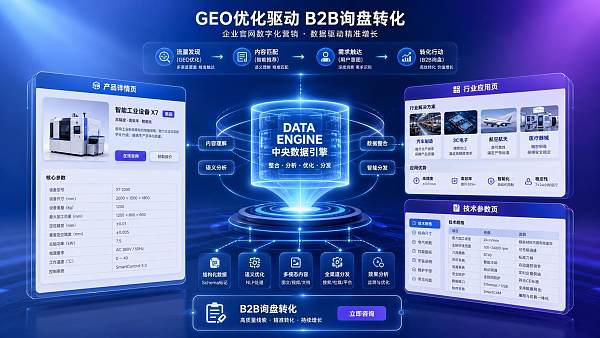
B2B inquiry pages suitable for GEO (Generative Engine Optimization) are usually not the pages with the most comprehensive information, but those whose content can be accurately extracted, reorganized, and used by AI to answer specific questions. For inquiry conversion, the truly valuable pages are often concentrated in several categories: product detail pages, industry application pages, custom processing pages, technical parameter pages, delivery and installation instruction pages, and solution pages for specific operating conditions. As long as the page content focuses on a clear scenario, uses consistent terminology, presents clear parameters, and specifies boundary conditions, it is more likely to gain citations and summary visibility in AI search results.
Many websites mistakenly assume that the homepage or company introduction page is the most suitable for GEO. In reality, these pages are usually broad in expression and lack answerable information units. When generating answers, AI is more inclined to draw on information such as “What temperature range is a certain material suitable for?”, “Which interfaces does a certain type of equipment support?”, and “What batch sizes and tolerances are suitable for a certain process?”—information that can directly fit into a question-and-answer structure. If a B2B inquiry page merely stacks promotional phrases without specifying material grades, dimensional ranges, load-bearing conditions, surface treatment methods, packaging methods, transportation restrictions, and after-sales service boundaries, it will be difficult to occupy an effective position in generative results even if it is indexed.
Page Types to Prioritize
The first type is the product detail page. These pages are best suited to address search intent related to “what it is” and “whether it can be used.” The content should not stop at the product name and images; instead, it should fully present the fields used in purchasing decisions, such as base material, common specifications, machining accuracy, interface type, corrosion-resistance conditions, operating temperature, compatible voltage, installation method, maintenance cycle, and transportation packaging requirements. For non-standard products, adjustable and non-adjustable items should also be listed separately to prevent AI from interpreting customization capabilities as general standards.
The second type is the industry application page. These pages are suitable for addressing questions about “which scenarios it can be used in.” Unlike ordinary case-study introductions, GEO requires the page to clearly break down application conditions, such as humid environments, dusty environments, continuous operation at high temperatures, prolonged outdoor exposure, frequent disassembly and assembly, long-distance transportation, and seaworthy wooden-crate packaging. Simply writing “suitable for industrial applications” is meaningless. AI is more likely to cite a sentence such as “Suitable for outdoor installation, requiring salt-spray protection, and supporting modular disassembly for transportation,” because it can directly answer a specific scenario-related question.
The third type is the custom processing page. Many inquiries occur when standard products cannot fully meet project requirements, so a “customizable” page itself has strong conversion potential. However, a common problem with such pages is that they only state that OEM/ODM is supported, without explaining drawing formats, the factors affecting the sample-production lead time, how the minimum processing unit is calculated, whether welding or cutting affects surface treatment, or whether secondary correction is required before assembly. GEO is well suited to this type of page because AI users often directly ask questions such as “Can the hole positions of a certain product be modified?” and “Are small-batch orders for irregular dimensions supported?” These are precisely the questions a customization page should answer.
The fourth type is the technical parameters and downloads page. As long as the page does not merely upload a file but displays key parameters in an HTML structure, it can be easily recognized by AI. Tables should ideally include units, test conditions, and applicable boundaries to avoid isolated figures. For example, “load capacity: 500 kg” is less valuable than “Under static-load conditions, the single-layer load capacity is 500 kg; the ground must remain level; dynamic handling is not applicable.” When parameters lack condition descriptions, AI may misuse them when generating answers, resulting in inaccurate inquiries and higher subsequent communication costs.
The fifth type is the delivery and installation instruction page. Before entering the sample or contract stage, many overseas inquiries first confirm container-loading methods, disassembly and assembly logic, on-site installation tools, foundation pre-embedded requirements, wiring locations, lifting restrictions, and commissioning sequences. Such information has traditionally been communicated through email, but for GEO, the earlier structured explanations are made publicly available, the more likely they are to appear in AI question-and-answer results such as “Is on-site assembly supported?” and “Is recalibration required after sea transportation?”
The sixth type is the problem-oriented solution page. It is not a broad “industry solutions” page, but one focused on a specific obstacle, such as “How can long-length components be divided for transportation and assembled on site?”, “How should surface treatments for metal components be selected in high-humidity environments?”, and “How can unit misinterpretation be avoided in technical documents for multilingual websites?” These pages are most likely to address high-intent searches because the questioner is usually already at the solution-screening stage.
Which Pages Are Not Suitable as GEO Priorities?
Pure brand introduction pages, news updates pages, and brochure-style pages with only a small amount of copy are generally not suitable as the primary focus of GEO. They can exist, but they should not undertake the core task of acquiring customers through AI search. The reason is straightforward: these pages lack a consistent question-and-answer granularity, making it difficult for AI to extract reusable conclusions. Even when cited, they usually provide only vague descriptions and cannot effectively move visitors toward making an inquiry.
Another common misjudgment is to put all content into one large, comprehensive page. For traditional SEO, long-form content is not necessarily a problem; for GEO, however, excessive mixing of information can weaken the page topic and make it more difficult for AI to determine which section corresponds to which question during extraction. Separating “material descriptions,” “machining tolerances,” “transportation packaging,” and “installation conditions” into independent modules that can link to one another is usually more effective than writing one lengthy explanation.
How Much Depth Should Page Content Have?
Whether AI can cite a page consistently depends not on word count, but on whether the information is verifiable, classifiable, and easy to restate. At a minimum, the page should provide four layers of information: what the object is, the conditions under which it is used, its limitations, and what still needs to be confirmed before an inquiry. For B2B pages covering pipe fittings, valves, brackets, sheet-metal enclosures, conveying equipment, control cabinets, insulation materials, and fasteners, the content should supplement basic model information with connection methods, media compatibility, on-site installation space, foundation dimensional requirements, and whether shutdown and disassembly are required for maintenance.
When the content involves material selection, do not write only “stainless steel” or “aluminum alloy.” It is better to further explain the differences under common usage conditions, such as whether the material will be exposed to acidic or alkaline media, whether it will remain outdoors for extended periods, whether deformation control after welding is involved, and whether weight is a concern. For machining-related content, tolerance ranges, surface roughness, edge-cutting methods, pretreatment before coating, and methods for handling hole-position deviations are more likely to form high-quality summaries than vague descriptions.
Multilingual pages must also pay particular attention to terminology consistency. Many inquiry discrepancies are not caused by a lack of traffic, but by the use of different translations for the same component on different pages, causing AI to treat them as different objects. Units of measurement should also be displayed consistently. Where necessary, both metric and imperial units can be listed, with a clear indication of whether the conversion is for reference only. As long as units are inconsistent, model names are written inconsistently, or parameter fields appear and disappear, GEO performance is usually unstable.
How to Write Inquiry Pages for Better AI Comprehension
In terms of page structure, headings should be as close as possible to real questions rather than abstract slogans. Expressions such as “Which operating conditions is it suitable for?”, “Which parameters need to be confirmed for customization?”, and “What deviations are likely to occur during transportation and installation?” can naturally appear in the text, because AI can more easily divide these paragraphs into answer segments. Parameters should not be hidden in images, and important explanations should not be placed only in PDFs. Core information should be written directly in crawlable body text.
Another common situation to avoid is allowing sales language to overshadow technical information. For example, a page may repeatedly state “high quality,” “widely used,” and “stable performance,” without specifying the test conditions under which the performance is stable. GEO does not favor modifiers; it favors explanations with clearly defined boundaries. Even a sentence such as “It is recommended to confirm the sealing material in advance under continuous high-temperature operating conditions” is more valuable than a long passage of empty statements.
For pages involving process-oriented inquiries, the steps can be described realistically without turning them into a mechanical checklist. For example, from drawing confirmation to sample production, from seaworthy packaging to on-site reassembly, and from power-on commissioning to maintenance handover, if each step explains its prerequisites and potential risks, AI will be more willing to cite this type of content when answering questions such as “What needs to be prepared before delivery?” and “What common deviations may occur during installation?” The organization of some knowledge-based pages is similar to the approach used in An Analysis of Implementation Paths for ESG to Support the Development of New Quality Productive Forces in Enterprises, which emphasizes breaking down paths; both approaches translate abstract concepts into execution points, except that B2B inquiry pages place greater emphasis on parameters, operating conditions, and delivery details.
Risks Easily Overlooked When Publishing
The first type of risk is outdated parameters that have not been updated for a long time. Once AI captures outdated information, subsequent generated results may continue to cite it, especially when the page remains accessible but the actual specifications have changed. This can significantly reduce inquiry quality. The second type of risk is contradictions between different pages. For example, the detail page may state that on-site installation is supported, while the FAQ says that only complete-machine delivery is supported; or the technical page may state that the protection rating is suitable for outdoor use, while the transportation page advises against exposure to rain. AI will directly amplify these conflicts.
Another risk comes from “over-expanding content for indexing.” Presenting uncertain information too definitively can create explanation costs during the inquiry stage. For information such as lead times, durability, application scope, certification preparation, and installation complexity that cannot be generalized, conditional wording should be used to explain the influencing factors clearly rather than making direct conclusions. For B2B inquiry pages, accuracy is more important than elegance. Retaining necessary limitations actually better aligns with GEO’s preference for trustworthy content.
Pages truly suitable for GEO usually share one common feature: they do more than simply display products; they answer key questions in advance for subsequent communication. As long as the page clearly organizes the details that determine inquiry quality—materials, parameters, processing, transportation, installation, and maintenance—it has a better chance of being understood and cited preferentially in AI search.