









- Can the average annual growth rate reflect real opportunities in overseas markets?Oct 07, 2026View details
- Which customer acquisition channels will be affected by cross-border marketing trends in 2026?Sep 06, 2026View details
- Which homogenization risks should be considered in an analysis of the AI-powered website building industry?Aug 30, 2026View details
- How Will AI Marketing Trends 2026 Change Advertising Budget AllocationAug 28, 2026View details
- Is the EV SSL certificate market shrinking or upgrading? How should companies assess certificate procurement?Aug 11, 2026View details
- Why the old AMP SEO 2020 practices no longer work and what has changed in current optimization prioritiesAug 02, 2026View details
Why Do Many B2B Marketing Leads Fail to Convert?
When conducting B2B marketing, many companies first experience not a lack of leads, but the fact that there are plenty of leads yet orders remain difficult to close. The marketing department believes that the campaigns are delivering results, while sales complains that customer intent is weak. Management sees an increase in the number of submitted forms, but a review reveals that few customers actually progress to the quotation, sample production, or contract stage. For business evaluation professionals, this gap deserves particular attention, because it usually indicates that the problem lies not with the traffic source, but with the conversion process itself.
In other words, difficulty closing B2B deals is often not caused by a single point of failure. Rather, the entire mechanism—from attracting the right prospects and handling them effectively to screening and following up—has not been fully connected.
More Leads Do Not Necessarily Mean More Opportunities
Many companies are accustomed to evaluating marketing effectiveness by the number of customers acquired. However, B2B transactions involve long sales cycles, multiple decision-makers, and complex purchasing criteria, making a lead only the starting point. A purchasing inquiry may be nothing more than a request for price comparison; a visitor who downloads materials may simply be conducting market research; and a customer who leaves an email address may not even have entered the formal procurement stage.
If a company categorizes users at different stages of maturity as “qualified leads,” the data may look impressive on the surface, but sales resources will actually be diluted. Sales representatives spend substantial time following up with low-intent prospects, while truly valuable customers are not identified and prioritized effectively. This is why many B2B marketing projects struggle to improve conversion in their later stages.
During a business evaluation, it is useful to ask three practical questions first: Are the sources of leads clear? Are leads segmented by quality? Does sales follow-up have clear prioritization rules? If none of these questions can be answered clearly, even a large number of leads will have difficulty generating stable conversions.
The First Common Breakpoint: The Website Attracts Visitors but Fails to Engage Decision-Makers
A B2B website is not simply a corporate business card; it is more like the first round of communication in the sales process. Especially in overseas marketing, industrial manufacturing, and foreign-trade inquiry scenarios, customers often use a company’s official website to determine whether it is worth contacting further. If a website remains limited to basic elements such as company introduction, product listings, and contact information, visitors will find it difficult to quickly develop trust.
Many deal-closing problems originate here. The website has traffic but lacks persuasive power; it has forms but lacks conversion-oriented design; it has pages but does not organize information around purchasing priorities. Customers want to know about delivery capabilities, customization options, certifications, application scenarios, delivery processes, and after-sales support, but cannot find clear answers on the pages. As a result, the inquiries they submit remain superficial.
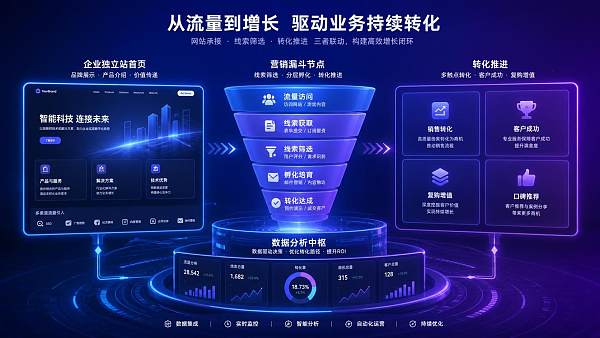
This issue is even more obvious for companies serving both wholesale and retail customers. B2B and B2C customers have different browsing logic, priorities, and inquiry methods. If the same website does not distinguish between these user roles, it can easily create a situation in which “anyone can enter, but no one can navigate conveniently.” Such companies are better served by optimizing their website architecture. For example, through the B2B2C dual-mode independent website solution, they can connect product price displays, multi-variant management, unified bulk inquiries, shopping cart functionality, and promotional capabilities, enabling different types of customers to enter the conversion path that best suits them more quickly.
The Second Problem: Content Is Being Published but Does Not Answer What Customers Really Want to Confirm
In B2B marketing, content is not more effective simply because more of it is published. It is more effective when it is closer to the purchasing decision. Many companies are willing to publish news, post updates, and write brand introductions, while overlooking the content customers care about more: how to select technical parameters, the differences between various solutions, which industries a solution suits, how long project implementation takes, what risks exist during delivery, and why their solution is more reliable than alternatives.
When content remains focused on self-expression, leads tend to remain at the “just looking for information” stage. When content enters the customer’s decision-making language, however, conversion rates can genuinely improve. For example, an SEO page should not be designed only for ranking; it should also address search intent. An advertising landing page should not merely collect forms; it should explain why customers should submit their requirements. A multilingual page is not simply a translation; it must also adapt to the expression habits and trust logic of different markets.
This is why more and more companies now value independent website development that is “indexable, promotable, and conversion-oriented.” Websites, SEO, advertising, and social media are not isolated activities. Ultimately, they must all address one question: after visitors arrive on a page, can they quickly understand your value and be willing to move on to the next stage of communication?
The Third Hidden Loss: Lead Screening Is Too Broad, Forcing Sales to “Follow Up Blindly”
Many teams send all forms directly to sales, believing this to be the most straightforward approach. In reality, sales teams fear not a lack of leads, but leads whose authenticity and value are difficult to determine. Without basic screening rules, the team may spend each day dealing with student research, competitor price comparisons, customers whose budgets do not match, or even bot submissions.
Truly efficient B2B marketing requires a decision-making logic to be established during the customer acquisition stage. For example, leads can be initially segmented according to the pages visited, on-site behavior, submitted content, country or region, product interests, and inquiry depth. Customers focused on price, those concerned with delivery capabilities, those who clearly specify the product category they are inquiring about, and those who return repeatedly obviously deserve different priorities.
This capability depends on data system support. Especially when websites, SEO, advertising, and social media acquisition are carried out simultaneously, it is difficult to determine which channels are contributing high-quality customers or which pages are generating low-quality leads without a unified data analysis perspective. In the long term, marketing budgets are not effective simply because more money is spent; they must be directed toward audiences that are closer to conversion.
The Fourth Point Most Likely to Be Underestimated: Slow Follow-Up Causes Companies to Miss the Customer’s Decision Window
Although B2B customers do not place impulsive orders like B2C consumers, this does not mean they will wait indefinitely. Many project-based customers contact several suppliers at the same time within a short period. The supplier that provides a clear response, professional assessment, and a path forward first is more likely to enter the procurement shortlist.
If a company still relies on manually forwarding forms, sales representatives manually classifying leads, and sending scattered materials, even effective front-end B2B marketing will lose opportunities because of slow back-end responses. Common situations include making the first contact only after 48 hours, providing highly templated replies, failing to send differentiated materials based on the customer’s stage, and lacking a continuous nurturing mechanism. Customers may not explicitly reject the company; they simply drift away while waiting.
During a business evaluation, it is worth shifting the focus from “whether follow-up is taking place” to “whether follow-up matches the purchasing rhythm.” An effective process should provide timely responses, categorize issues, match relevant materials, and advance each stage, rather than simply repeatedly asking, “Do you have any requirements?”
Why Do Many Companies Still Struggle to Close Deals Despite Investing in SEO, Advertising, and Social Media?
Because channel development and deal development are not the same thing. SEO can generate long-term exposure, advertising can rapidly amplify traffic, and social media can strengthen interaction and reach. However, if the final landing pages are weak, trust is not communicated effectively, and the inquiry mechanism is limited, these channels will only amplify existing problems.
From the perspective of integrated website and marketing services, a more reasonable approach is not to evaluate a single channel in isolation, but to examine coordination across the entire process: Does the website support multilingual content, promotional activities, and search indexing? Does the content match overseas customers’ search scenarios? Can advertising landing pages accommodate users with different intentions? Are SEO and GEO continuously expanding search visibility? Can inquiry forms and sales activities work together?
For an AI-driven enterprise SaaS platform such as Yiyingbao, the value is not limited to “building a website for a company” or “running an advertising campaign.” It lies in establishing coordination among intelligent website building, SEO optimization, advertising, social media operations, and data analysis. Especially when a company wants to support both wholesale inquiries and retail conversions, its website structure, page logic, and promotional strategy require more integrated design. Otherwise, customer acquisition at the front end and deal closing at the back end will remain disconnected.
How Business Evaluation Professionals Can Identify Where the Problem Lies
Instead of asking broadly, “Why is conversion poor?” it is better to examine each key stage one by one.
When evaluating channels, do not look only at traffic volume; determine where high-quality leads come from. When evaluating the website, do not look only at whether the design is attractive; determine whether it can build trust and drive inquiries. When evaluating content, do not look only at publishing frequency; determine whether it answers customers’ purchasing questions. When evaluating sales, do not look only at whether representatives are following up diligently; determine whether there are effective segmentation and timing rules. When evaluating systems, do not look only at whether tools are available; determine whether data can inform decision-making.
If a company has both wholesale and retail requirements, it must also evaluate whether its business models are supported by the website. A platform that accommodates both B2B inquiry and B2C ordering logic is often more conducive to unified channels, data accumulation, and brand expansion than fragmented operations. For example, combining cloud-based website building, big data analysis, intelligent advertising, and unified inquiry capabilities can provide more direct access to different customers while also helping break down channel barriers and gradually expand into domestic and international markets.
When Deals Are Difficult to Close, What Really Needs to Be Fixed Is Not the “Number of Leads” but the Conversion System
The core of B2B marketing has never been to bring more people to a page. It is to help the right people understand, trust, and move forward. When there are many leads but few closed deals, the underlying causes are usually a combination of weak website engagement, shallow content persuasion, overly broad screening mechanisms, and slow follow-up processes.
For business evaluation professionals, the most valuable question is not “Should we continue investing in advertising this year?” but “Has the existing lead system been used effectively?” When a company views its independent website, SEO, advertising, social media, and sales follow-up as one unified growth chain, many seemingly unsolvable deal-closing problems become clearer. After all, what B2B marketing truly competes on has never been who obtains the most names, but who establishes a sustainable conversion mechanism first.
Related Articles



Related Products
 Yiyingbao SaaS Intelligent Website Building and Marketing SystemYiyingbao SaaS Intelligent Website Building and Marketing System, AI-powered no-code website building, rapid creation of multilingual B2B international websites in 10 minutes, global server acceleration, AI-powered SEO optimization, helping businesses connect efficiently with global markets. The perfect integration of technology and operation makes building an international trade website remarkably simple
 AI+SEM Intelligent Advertising Marketing SystemAI+SEM drives intelligent ad creation, empowering full-funnel precision advertising marketing. The system automatically generates weekly/monthly reports, AI recommends keywords and target countries, monitors core metrics in real-time with intelligent alerts, and enables one-click high-conversion ad solutions to help quickly acquire customers and improve ROI.
 AI+SEO Dual-Engine System Optimization ServicesYiyingbao’s AI+SEO dual-engine optimization system helps foreign trade enterprises acquire high-quality organic traffic through AI-powered keyword research, content generation, and comprehensive technical optimization, significantly improving search rankings and conversion rates.
 AI+SNS Social Media Marketing SystemYingbao AI+SNS Social Media Marketing System - Precision social capture for the social media era. Supports one-click content synchronization across major platforms like Facebook and LinkedIn. AI intelligently rewrites posts for enhanced relevance. 24/7 AI customer service and user profiling analysis empower businesses to efficiently expand into global markets.
 AI+SEO营销解决方案易营宝AI+SEO营销解决方案,通过AI批量写作、智能生成TDK、精准关键词扩词等功能,全面优化网站SEO效果,提升流量与转化率。助力企业构建高效智能网站新生态。
 AI+SEM Advertising Marketing SolutionsAI+SEM Advertising Marketing Solution leverages AI technology to deeply empower SEM ad campaigns. It automatically generates weekly/monthly reports using AI, presenting account data across multiple dimensions for comprehensive insights into campaign performance and trends. The system precisely recommends keywords and target countries, intelligently generates high-conversion ad copy, and enables one-click activation of efficient campaign plans to help businesses rapidly acquire customers. Simultaneously, it monitors core metrics in real time, intelligently identifies abnormal fluctuations, and issues timely alerts to ensure stable, high-return advertising results.
 Domain Name ServicesEasyWin provides professional domain name services, including intelligent queries, one-stop registration, brand protection, and full lifecycle management, helping businesses build a digital brand image.
 EasyOperate B2C Cross-Border E-Commerce Platform & Independent WebsiteEasyStore B2C Cross-border E-commerce Independent Store is an intelligent website building and cross-border e-commerce integrated solution independently developed by EasyStore Information Technology (Beijing) Co., Ltd. The system is specially designed for small and medium-sized as well as large export enterprises, integrating 'website building, operation, marketing, advertising, and conversion' into one, helping enterprises quickly establish cross-border e-commerce independent stores to achieve brand globalization and global sales growth.
The platform supports multiple languages, multiple currencies, and multi-channel marketing, with built-in AI intelligent translation and SEO optimization systems, suitable for mainstream markets such as Southeast Asia, Europe and America, Latin America, and the Middle East, assisting Chinese manufacturing enterprises in efficiently deploying international e-commerce strategies. SSL证书易营宝提供专业SSL安全证书服务,包括单域名和泛域名证书,确保网站数据传输加密、身份验证和完整性保护,助力企业建立安全可信的在线业务环境。









