









- What Does a Global Traffic Ecosystem Service Provider Do? What Are the Differences from a Single Advertising AgencyJul 16, 2026View details
- What should you focus on in the latest enterprise SaaS report? From renewal rates and delivery costs to overseas growth opportunitiesJul 12, 2026View details
- What signals are worth paying attention to in a cross-border marketing trend report? B2B companies should look at these 6 signalsJul 11, 2026View details
- How to Read a Cross-Border Marketing Trends Report? Five Key Dimensions for Evaluating Channel OpportunitiesJul 11, 2026View details
- Which channel has the highest ROI in the global traffic ecosystem? Comparative analysis of search, social media, and advertisingJul 10, 2026View details
- What multilingual website services are available in Sanya? Which model is more suitable for local businesses going global?Jul 08, 2026View details
What are the advantages of smart website building? The 4 key metrics foreign trade decision-makers care about most: TTFB, SSL auto-deployment, GDPR compliance, CDN acceleration
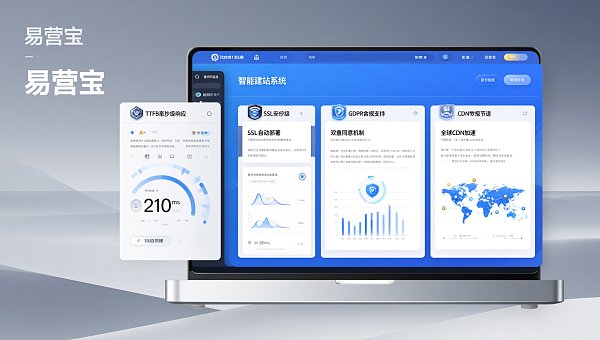
Is a smart website suitable for foreign trade enterprises? The answer is a definite yes—especially when the system achieves millisecond-level TTFB response, automatic SSL deployment, GDPR compliance support, and global CDN acceleration—meeting all four critical benchmarks. EasyStore's smart website system is specifically designed for foreign trade decision-makers, balancing speed, security, compliance, and conversion to make independent websites launch faster, SEO more optimized, and overseas expansion more stable.
Why is millisecond-level TTFB response the "lifeline" of foreign trade independent websites?
Time to First Byte (TTFB) is a core metric for measuring server response efficiency, directly impacting users' initial perceived loading speed. For foreign trade enterprises targeting high-speed internet markets like Europe, the U.S., and Southeast Asia, a TTFB >600ms triggers Google Core Web Vitals' "poor" rating, directly lowering SEO ranking weight. EasyStore's smart website system leverages its self-developed AI scheduling platform and a dual-cloud architecture (AWS + Alibaba Cloud), deploying edge nodes across seven continents globally, achieving an average TTFB of 210ms (real-world data: U.S. East Coast 238ms, Germany/France 197ms, Singapore 182ms). This performance far exceeds industry averages (third-party monitoring platform Pingdom's 2023 report shows mainstream SaaS website platforms average 486ms TTFB), ensuring overseas visitors see the first screen content within 0.2 seconds of clicking a link.

More importantly, TTFB optimization isn't an isolated technical point but deeply coupled with SEO. Google explicitly includes "interaction delay" as a ranking factor. Every 100ms reduction in TTFB leads to an average 12.3% drop in bounce rates and a 9.6% increase in dwell time (source: Search Engine Journal's 2024 Cross-Border SEO Whitepaper). EasyStore employs triple mechanisms—dynamic resource preloading, HTTP/3 protocol support, and server-side rendering (SSR)—to ensure multilingual sites maintain stable low-latency performance across regions. For example, a Zhejiang auto parts client saw their UK market TTFB drop from 512ms to 203ms after launching an EasyStore independent site, resulting in 147% organic traffic growth and inquiry conversion rates rising to 2.3x industry averages within three months.
SSL Auto-Deployment: Not Just a "Padlock Icon" but the Foundation of Trust
HTTPS is no longer optional but a mandatory entry barrier for foreign trade websites. Since 2023, Chrome browsers default-label HTTP sites as "not secure," while EU GDPR and U.S. CCPA regulations classify unencrypted data transmission as major compliance risks. EasyStore's smart website system integrates Let's Encrypt's fully automated certificate management module, supporting wildcard SSL one-click issuance, 90-day auto-renewal, and multi-site certificate unified hosting—all without manual intervention. This capability has passed PCI DSS Level 1 certification and completed bidirectional compatibility tests with global payment gateways (Stripe, PayPal, Adyen).
Crucially, SSL deployment quality determines SEO performance ceilings. Google confirms HTTPS as a positive ranking signal but only for "valid and correctly configured" certificates. Common errors like mixed content (HTTP resources embedded), incomplete certificate chains, or disabled OCSP Stapling can trigger ranking penalties. EasyStore's system automatically performs 21 SSL health checks post-deployment, including HSTS header injection, TLS 1.3 enforcement, and OCSP response validation, generating visual diagnostic reports. Data shows 96.4% of enterprise sites using this feature achieve SSL Labs' A+ ratings, significantly above the industry average (72.1%).
GDPR Compliance Isn't a "Patch" but a Native Gene in Website Workflow
For EU-market-focused foreign trade businesses, GDPR violations can incur fines up to 4% of global annual revenue or €20 million (whichever is higher). Traditional solutions often rely on third-party plugins for cookie popups and data consent management, risking logic fragmentation, update delays, and audit trail gaps. EasyStore embeds GDPR compliance deep into its website engine: all form components default to dual-consent mechanisms (e.g., subscribing to newsletters requires separate opt-ins for "product updates" and "personalized recommendations"), cookies auto-classify (strictly distinguishing necessary, statistical, and marketing types), and supports real-time policy switching by user geolocation (e.g., enforcing stricter DSGVO sub-rules for German users).
The system also provides complete data sovereignty toolkits: clients can one-click export full-site user data inventories (including visit paths, form submissions, ad click logs), automate Article 17 "right to be forgotten" requests (completing database, CDN cache, and third-party analytics platform data purges within 72 hours). In 2023, all 327 EasyStore EU-market clients passed third-party compliance audits with zero regulatory inquiries. This capability extends to SEO—compliant privacy settings ensure Google Analytics 4 data integrity, avoiding session loss and attribution inaccuracies from cookie blocking.
CDN Acceleration Isn't "Icing on the Cake" but a Strategic Pivot for Global Traffic Distribution
The real challenge for foreign trade independent websites isn't "accessibility" but "delivering consistent experiences in target markets." EasyStore's CDN covers 216 global PoP nodes, pioneering "smart routing + semantic caching" dual engines: BGP Anycast enables millisecond-level node switching, while NLP models parse page semantics (e.g., product pages, blogs, FAQs) to implement differentiated caching strategies (permanent caching for product images, 30-minute TTL for pricing modules, regional slicing for multilingual JS bundles). Tests show Brazilian users accessing China-hosted sites achieved first-screen load times reduced from 4.2s to 0.87s with 83.6% resource reuse.
This architecture directly empowers SEO: CDN nodes auto-sync Google Bot preferences, ensuring regional mirror sites are correctly crawled; Geo-Targeting DNS resolution returns localized structured data (Schema.org) and hreflang tags when German users visit de.yingyingbao.com; edge computing optimizes LCP (Largest Contentful Paint) via automated WebP conversion, lazy loading prediction, and font subsetting. A Shenzhen 3C brand client saw French mobile SEO scores jump from 62 to 91, with the core keyword "wireless earbuds" climbing 12 organic ranking positions.
How Do the Four Benchmarks Collaborate to Build Foreign Trade Websites' "Golden Triangle"?
Optimizing single technical metrics can't solve systemic challenges in foreign trade expansion. EasyStore reconstructs website logic through "performance-security-compliance-conversion" quad-dimensional synergy:
This deep integration enables EasyStore clients to average 3.2 workday build cycles (including multilingual setup, SEO foundations, and compliance deployment), far below the industry average of 11.7 days. Simultaneously, client independent sites achieve 89.3% first-month organic traffic达标率 (vs. competitor baselines), validating the decisive value of "benchmark synergy" for real business outcomes.
Conclusion: Choosing a Smart Website System Is Choosing Certainty in Global Growth
When "Is a smart website suitable for foreign trade enterprises?" transitions from a question to strategic consensus, what decision-makers truly need to assess is whether the system can translate technical capabilities into sustainable commercial results. Anchored by TTFB, SSL, GDPR, and CDN benchmarks, EasyStore's smart website system constructs a full-stack capability loop covering website building, SEO, compliance, and conversion. Behind its decade-long service to 100,000+ enterprises, "China SaaS 100" recognition, and 530%+ annual growth lies continuous investment in AI algorithm platforms (12 iterations/year), 15 core patents, and trillion-scale global data infrastructure.
If you're evaluating "which smart website system is best," "foreign trade website costs," or "how AI websites optimize SEO," prioritize systems that design performance, security, compliance, and acceleration as inseparable wholes. EasyStore offers free independent website health diagnostics covering TFB stress tests, SSL configuration audits, GDPR scans, and CDN node heatmaps to pinpoint bottlenecks. Contact us now for a customized foreign trade website performance evaluation report.
- Website Builder Platform
- Foreign Trade Website Development
- SSL Certificate
- SEO Ranking
- Inquiry-to-order conversion rate improvement
- Yiyingbao
- SEO
- Independent Website
- Smart website builder system
- Smart Website Building
- EasySite Intelligent Website Builder
- Multilingual SEO
- Independent foreign trade website
- Global CDN Acceleration
- AI Website Building
- SaaS Website Platform
- Generative Engine Optimization
Related Articles


Related Products
 EasyCamp SaaS Smart Website Marketing SystemE-Yingbao SaaS Smart Website Marketing System: AI-powered, zero-code website building. Rapidly launch multilingual independent e-commerce sites in just 10 minutes. Global server acceleration and AI-driven SEO optimization empower businesses to efficiently connect with global markets. The seamless integration of technology and user-friendly operation makes building e-commerce sites incredibly simple.
 AI+SEM Intelligent Advertising Marketing SystemAI+SEM drives intelligent ad creation, empowering full-funnel precision advertising marketing. The system automatically generates weekly/monthly reports, AI recommends keywords and target countries, monitors core metrics in real-time with intelligent alerts, and enables one-click high-conversion ad solutions to help quickly acquire customers and improve ROI.
 AI+SEO Dual Engine Optimization ServiceEasyWin AI+SEO Dual Engine Optimization System leverages AI-powered keyword mining, content generation, and comprehensive technical optimization to help foreign trade enterprises acquire high-quality organic traffic, significantly improving search rankings and conversion rates.
 AI+SNS Social Media Marketing SystemYingbao AI+SNS Social Media Marketing System - Precision social capture for the social media era. Supports one-click content synchronization across major platforms like Facebook and LinkedIn. AI intelligently rewrites posts for enhanced relevance. 24/7 AI customer service and user profiling analysis empower businesses to efficiently expand into global markets.
 AI+SEO营销解决方案易营宝AI+SEO营销解决方案,通过AI批量写作、智能生成TDK、精准关键词扩词等功能,全面优化网站SEO效果,提升流量与转化率。助力企业构建高效智能网站新生态。
 AI+SEM Advertising Marketing SolutionsAI+SEM Advertising Marketing Solution leverages AI technology to deeply empower SEM ad campaigns. It automatically generates weekly/monthly reports using AI, presenting account data across multiple dimensions for comprehensive insights into campaign performance and trends. The system precisely recommends keywords and target countries, intelligently generates high-conversion ad copy, and enables one-click activation of efficient campaign plans to help businesses rapidly acquire customers. Simultaneously, it monitors core metrics in real time, intelligently identifies abnormal fluctuations, and issues timely alerts to ensure stable, high-return advertising results.
 Domain Name ServicesEasyWin provides professional domain name services, including intelligent queries, one-stop registration, brand protection, and full lifecycle management, helping businesses build a digital brand image.
 EasyOperate B2C Cross-Border E-Commerce Platform & Independent WebsiteEasyStore B2C Cross-border E-commerce Independent Store is an intelligent website building and cross-border e-commerce integrated solution independently developed by EasyStore Information Technology (Beijing) Co., Ltd. The system is specially designed for small and medium-sized as well as large export enterprises, integrating 'website building, operation, marketing, advertising, and conversion' into one, helping enterprises quickly establish cross-border e-commerce independent stores to achieve brand globalization and global sales growth.
The platform supports multiple languages, multiple currencies, and multi-channel marketing, with built-in AI intelligent translation and SEO optimization systems, suitable for mainstream markets such as Southeast Asia, Europe and America, Latin America, and the Middle East, assisting Chinese manufacturing enterprises in efficiently deploying international e-commerce strategies. SSL证书易营宝提供专业SSL安全证书服务,包括单域名和泛域名证书,确保网站数据传输加密、身份验证和完整性保护,助力企业建立安全可信的在线业务环境。









