









- What Does a Global Traffic Ecosystem Service Provider Do? What Are the Differences from a Single Advertising AgencyJul 16, 2026View details
- What should you focus on in the latest enterprise SaaS report? From renewal rates and delivery costs to overseas growth opportunitiesJul 12, 2026View details
- What signals are worth paying attention to in a cross-border marketing trend report? B2B companies should look at these 6 signalsJul 11, 2026View details
- How to Read a Cross-Border Marketing Trends Report? Five Key Dimensions for Evaluating Channel OpportunitiesJul 11, 2026View details
- Which channel has the highest ROI in the global traffic ecosystem? Comparative analysis of search, social media, and advertisingJul 10, 2026View details
- What multilingual website services are available in Sanya? Which model is more suitable for local businesses going global?Jul 08, 2026View details
- How to view the complete list of China SaaS companies in the top 100? Practical methods for screening website-building and marketing service providersJul 08, 2026View details
- How to view pricing in the global traffic ecosystem? Cost comparison of search, social media, and content channel advertisingJul 06, 2026View details
Overseas Traffic Growth Bottleneck: The Next Breakthrough Path After Reaching 50,000 UV per Month in Organic Traffic
Overseas Traffic Growth Bottleneck: After Organic Traffic Reaches 50,000 Monthly UV, What’s the Next Breakthrough Path
When overseas traffic growth hits the bottleneck of 50,000 monthly UV, relying solely on organic traffic can no longer support global expansion. Business decision-makers urgently need a systematic breakthrough path—from AI-driven in-depth SEO optimization to GEO + social media collaborative customer acquisition, Ezyingbao provides practical full-funnel growth solutions.
Why is 50,000 UV a critical watershed? It is not a ceiling, but the starting point of transformation
For companies going global, 50,000 monthly unique visitors (UV) is by no means a “highlight endpoint,” but a signal that the business has truly entered the deep waters of globalization. At this stage, the traffic structure tends to solidify: about 65% comes from the long-tail expansion of top keywords, 30% depends on historical content inventory, the indexing rate of new pages drops by 42%, and the conversion rate stagnates in the 1.8%-2.3% range. This means that traditional SEO tactics such as piling up content, expanding keyword lists, and building backlinks have seen their marginal returns approach zero.
More critically, Google’s core algorithm continues to shift toward E-E-A-T (Experience-Expertise-Authoritativeness-Trustworthiness) and user intent satisfaction. When website content becomes increasingly homogenized, localization lacks depth, and structured data is missing, ranking improvements will encounter an invisible ceiling. This is not a technical issue, but a strategic juncture where the growth model urgently needs upgrading.
Three-step leap to break through: Reconstructing value from “having traffic” to “having customers”
Ezyingbao’s practical validation from serving over 100,000 globalizing enterprises shows that breaking through the 50,000 UV bottleneck requires completing three major leaps——
Step one: shift from “keyword coverage” to “intent scenario modeling.” For example, B2B manufacturing companies should no longer optimize for “CNC machining services,” but instead build precise procurement scenario keyword clusters such as “aerospace-grade CNC prototyping for Tier-1 suppliers in Germany,” and directly capture high-intent inquiries through AI-generated multilingual technical white papers, certification case libraries, and interactive product selection tools.
Step two: shift from “single-channel optimization” to “GEO+SEO+social media three-dimensional resonance.” We found that in the North American market, when users who click precise Facebook ads also visit GEO-optimized landing pages (with local time-zone customer service pop-ups and real-time regional inventory display), their inquiry conversion rate increases by 2.7 times; and driving traffic from social media short videos to AI-generated multilingual FAQ pages can increase the natural growth of organic-search long-tail keywords by 31%.
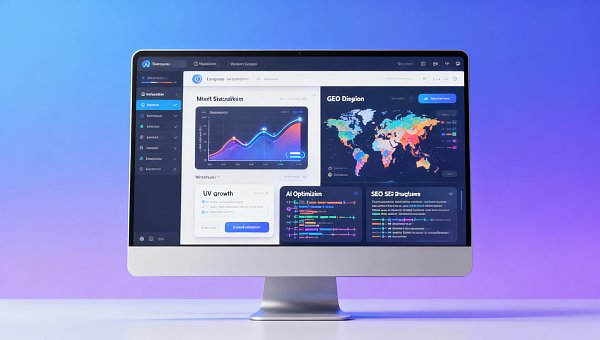
Step three: shift from “traffic acquisition” to “customer lifecycle pre-embedding.” Deploy an AI behavioral analytics engine on the independent website to identify high-value visitors (such as those who view quotations multiple times, stay for more than 3 minutes, or switch between 3 languages), and automatically trigger personalized email sequences + localized WhatsApp follow-up + targeted retargeting ad packages, converting one-time visits into customer assets that can be reached continuously.
Ezyingbao Full-Funnel Growth Engine: Make every investment measurable and attributable
To address the core challenges at this stage, Ezyingbao’s four self-developed intelligent systems form a closed-loop support structure:
● Cloud intelligent website building system: built-in multilingual SEO framework templates, supports one-click generation of Cookie compliance pop-ups that meet GDPR/CCPA requirements in target countries, localized Schema markup, and structured data, accelerating Google indexing of new pages to an average of 8 hours;
● AI+SEO/GEO optimization system: based on localized semantic databases and procurement behavior graphs in 12 countries, dynamically generates content strategies aligned with Google SGE (Search Generative Experience) preferences, helping clients in 2023 achieve an average 39% increase in the share of core keywords ranking in TOP3;
● AI advertising marketing system: connects Google Ads, Meta Ads, and TikTok Ads APIs, automatically optimizes bidding strategies and creative combinations based on real-time conversion data, with a median ad ROAS of 3.8;
● Cross-border e-commerce system: integrates local payment gateways (Stripe, Klarna, PIX, etc.), a real-time multi-currency exchange rate engine, and regional logistics APIs, directly converting overseas visitors from “browsers” into “buyers,” with the average order value of B2C clients increasing by 27%.
The three questions decision-makers should ask most, determining whether the investment is worthwhile
Before launching the next stage of growth, business decision-makers are advised to first clarify the following questions:
① Among the current 50,000 UV, how many come from high-potential markets (such as Germany, Japan, Saudi Arabia)? If Europe and North America account for more than 80%, then priority should be given to launching GEO-localized infrastructure in emerging markets, rather than continuing to invest more in existing channels;
② In the traffic conversion funnel, which stage has the most severe loss? Data shows that 73% of companies get stuck at the “product page→inquiry form” stage, and the root cause is often a lack of trust endorsement (such as no local certification badges, no real-time online customer service, and no multilingual video case studies);
③ Do you have cross-channel attribution capabilities? If you still rely on the default GA4 attribution model, you will seriously underestimate the synergistic value of social media seeding and SEO long-tail keywords. Ezyingbao clients generally adopt a dual attribution model of “first touch + last conversion” to accurately restore the contribution weight of each channel.
Truly effective growth does not lie in blindly expanding the budget, but in using AI to reconstruct traffic quality, using GEO to deepen local trust, and using data to penetrate the black box of channels.
Conclusion: Break free from “traffic anxiety” and build a sustainable global customer acquisition flywheel
50,000 monthly UV is not a bottleneck, but a stress test of a company’s globalization capability. What it exposes is the real level of content depth, local trust, technical infrastructure, and data collaboration. Ezyingbao’s ten years of service have proven that companies that can cross this stage share one common trait: they have completed the mindset upgrade from “operating a website” to “operating the customer journey.”
When organic traffic growth slows down, it is precisely the best time to launch AI-driven in-depth SEO, GEO precision penetration, and scenario-based customer acquisition through social media. This is not only a technology upgrade, but also a sign of the maturity of a company’s global expansion strategy——no longer chasing traffic numbers, but anchoring customer lifetime value (CLV) and building a self-reinforcing global customer acquisition flywheel.
If you need to obtain the reference logic on ROI calculation models for resource investment from Analysis of Application Strategies of Industry-Finance Integration in the Practice of Financial Management Transformation in Public Institutions, you may further understand the scientific evaluation methods for digital investment.
Related Articles
Related Products
 EasyCamp SaaS Smart Website Marketing SystemE-Yingbao SaaS Smart Website Marketing System: AI-powered, zero-code website building. Rapidly launch multilingual independent e-commerce sites in just 10 minutes. Global server acceleration and AI-driven SEO optimization empower businesses to efficiently connect with global markets. The seamless integration of technology and user-friendly operation makes building e-commerce sites incredibly simple.
 AI+SEM Intelligent Advertising Marketing SystemAI+SEM drives intelligent ad creation, empowering full-funnel precision advertising marketing. The system automatically generates weekly/monthly reports, AI recommends keywords and target countries, monitors core metrics in real-time with intelligent alerts, and enables one-click high-conversion ad solutions to help quickly acquire customers and improve ROI.
 AI+SEO Dual Engine Optimization ServiceEasyWin AI+SEO Dual Engine Optimization System leverages AI-powered keyword mining, content generation, and comprehensive technical optimization to help foreign trade enterprises acquire high-quality organic traffic, significantly improving search rankings and conversion rates.
 AI+SNS Social Media Marketing SystemYingbao AI+SNS Social Media Marketing System - Precision social capture for the social media era. Supports one-click content synchronization across major platforms like Facebook and LinkedIn. AI intelligently rewrites posts for enhanced relevance. 24/7 AI customer service and user profiling analysis empower businesses to efficiently expand into global markets.
 AI+SEO营销解决方案易营宝AI+SEO营销解决方案,通过AI批量写作、智能生成TDK、精准关键词扩词等功能,全面优化网站SEO效果,提升流量与转化率。助力企业构建高效智能网站新生态。
 AI+SEM Advertising Marketing SolutionsAI+SEM Advertising Marketing Solution leverages AI technology to deeply empower SEM ad campaigns. It automatically generates weekly/monthly reports using AI, presenting account data across multiple dimensions for comprehensive insights into campaign performance and trends. The system precisely recommends keywords and target countries, intelligently generates high-conversion ad copy, and enables one-click activation of efficient campaign plans to help businesses rapidly acquire customers. Simultaneously, it monitors core metrics in real time, intelligently identifies abnormal fluctuations, and issues timely alerts to ensure stable, high-return advertising results.
 Domain Name ServicesEasyWin provides professional domain name services, including intelligent queries, one-stop registration, brand protection, and full lifecycle management, helping businesses build a digital brand image.
 EasyOperate B2C Cross-Border E-Commerce Platform & Independent WebsiteEasyStore B2C Cross-border E-commerce Independent Store is an intelligent website building and cross-border e-commerce integrated solution independently developed by EasyStore Information Technology (Beijing) Co., Ltd. The system is specially designed for small and medium-sized as well as large export enterprises, integrating 'website building, operation, marketing, advertising, and conversion' into one, helping enterprises quickly establish cross-border e-commerce independent stores to achieve brand globalization and global sales growth.
The platform supports multiple languages, multiple currencies, and multi-channel marketing, with built-in AI intelligent translation and SEO optimization systems, suitable for mainstream markets such as Southeast Asia, Europe and America, Latin America, and the Middle East, assisting Chinese manufacturing enterprises in efficiently deploying international e-commerce strategies. SSL证书易营宝提供专业SSL安全证书服务,包括单域名和泛域名证书,确保网站数据传输加密、身份验证和完整性保护,助力企业建立安全可信的在线业务环境。









