









- How Can a Brand Updates Page Be Made More SEO-Friendly? Analysis of Update Frequency, Content Structure, and Internal Linking StrategyJun 28, 2026View details
- What stages does the cross-border services ecosystem include? How do website building, promotion, payment, and compliance work togetherJun 22, 2026View details
- How will email marketing costs change in 2026Jun 22, 2026View details
- The China-US tariff arrangement has reached a preliminary consensus, and the trade association will be establishedJun 15, 2026View details
- Should overseas brand marketing start with ads or contentJun 21, 2026View details
- What determines B2C cross-border e-commerce website development costs? A breakdown of features, interfaces, and deployment methodsJun 17, 2026View details
- China-Morocco zero-tariff access, a breakthrough in the cost of Moroccan goods exports to ChinaJun 11, 2026View details
- What signal should be released for the suspension of exports to JapanJun 10, 2026View details
Does the YiYingBao AI advertising diagnostic tool identify click-through rate bottlenecks or conversion funnel breakpoints? Detailed explanation of the diagnostic report structure.
Is Eyingbao AI Ad Diagnostic Tool identifying click-through rate bottlenecks or conversion leakage points? This article deeply dissects the diagnostic report structure, helping market researchers and project managers quickly grasp the core optimization logic of Eyingbao ad placements, while simultaneously answering how to improve conversion rates, usage methods, and the practical value of AI ad diagnostic tools.
I. Beyond CTR: The Essence of AI Diagnosis Lies in Attribution-Based Leakage Penetration
In the integrated scenario of website + marketing services, ad performance is often simplified as "high click-through rate = good results." However, the design logic of Eyingbao AI Ad Diagnostic Tool operates counterintuitively—it does not view CTR in isolation (average CTR typically fluctuates between 1.2%-3.8%). Instead, it integrates five key nodes—ad exposure, clicks, landing page loading, form submission, and payment completion—into a unified attribution model. The system dynamically weights allocations (e.g., first-screen dwell time accounts for 22% of leakage weight, while form field abandonment rate has an impact coefficient of 0.73), automatically pinpointing breakpoints at hierarchical levels.
Empirical data shows that over 67% of clients initially misjudge "low creative click-through rates," only to discover through diagnosis that the real bottlenecks lie in landing page load times exceeding 3.2 seconds (industry benchmark ≤1.8s) or CTA button contrast ratios below 4.1:1 (WCAG 2.1 standard requires ≥4.5:1). This validates the tool's core capability: not measuring single metrics but analyzing structural fractures in user behavior pathways.
For project managers, this capability directly shortens decision cycles—traditional manual attribution requires 7-15 days for multi-platform data cleansing and cross-validation, while AI diagnostics compress average response times to 2.3 hours, supporting daily rolling optimization iterations.

This comparison reveals the fundamental difference: AI diagnosis doesn't replace human judgment but transforms vague experience into quantifiable, deployable, and verifiable technical directives. When demonstrating to clients, distributors can emphasize two differentiated capabilities—"element-level positioning" and "code-level recommendations"—which directly lower implementation barriers.
II. Decoding Report Structure: A Four-Layer Penetrative Diagnostic Framework
Eyingbao diagnostic reports adopt a "summary-detail-root-solution" four-level structure. The overview page displays overall leakage health (current score: 78.3/100), followed by layered expansions: Layer 1 presents channel performance heatmaps (supporting three-dimensional drilling by region, device, and time); Layer 2 analyzes leakage attribution per stage (e.g., "registration page exit rate abnormally increased, contributing 41.6% flow loss"); Layer 3 identifies root causes (detecting form submission button CSS loading delays of 2.1s); Layer 4 outputs prioritized optimization solutions (P0: replace CDN resources; P1: add loading state prompts).
Operators should note "confidence markers" in reports: each diagnostic conclusion includes reliability scores (e.g., "first-screen loading delay" conclusion has 94.7% confidence based on 72-hour real-user monitoring data). This design effectively avoids misjudgments from sampling errors, ensuring decision reliability.
Project managers can utilize built-in ROI simulators—input estimated optimization costs (e.g., 2 developer days) to automatically calculate conversion uplift ranges (current case predicts +12.4%-18.9%) while synchronizing LTV/CAC ratio changes. This financial perspective presentation significantly enhances cross-department collaboration efficiency.
III. Key Application Paths for Different Roles
Researchers focus on technical feasibility: the tool supports API integration with existing BI systems (compatible with Tableau, Power BI, and domestic FanRuan), with data sync delays ≤90 seconds meeting real-time dashboard needs. Operators prioritize execution convenience: one-click export generates annotated PDF reports (average 47-second generation) or directly pushes optimization tasks to Jira/Tapd workbenches.
Project managers must master risk controls: reports default to "gray-box verification mode," requiring A/B tests (minimum sample ≥5,000 exposures) before marking suggestions as "recommended for implementation." This mechanism keeps misoptimization risks below 0.8% (based on 2023 data from 100K+ enterprises).
Distributors can reference big-data-backed financial informatization methodologies when explaining to government clients how the tool complies with mandatory "behavioral data traceability" requirements in Government Information System Audit Standards.
This table provides clear decision references. For example, when clients ask "can results be quickly validated?", cite "POC deployment ≤3 workdays" and "single diagnosis configuration ≤8 minutes" parameters to strengthen persuasion.
IV. Common Pitfalls & Implementation Recommendations
Pitfall 1: Equating diagnostic reports with optimization solutions. Reports only provide attribution conclusions—implementation requires customizing to enterprise tech stacks (e.g., Vue 3 frontend frameworks need Composition API syntax-matched code suggestions). Pitfall 2: Ignoring data validation. The tool requires ≥95% complete UTM parameters; otherwise, first-layer attribution accuracy drops to 61%.
Adopt a three-phase strategy: Phase 1 (1-3 days) complete data source integration and baseline validation; Phase 2 (4-7 days) run 3 diagnostic rounds to establish baseline data; Phase 3 (8-14 days) focus on TOP3 high-impact breakpoints for optimization and initiate A/B tests. This path has been validated by 100K+ enterprises, achieving average 22.7% conversion lifts.
For resellers, package diagnostics as "growth health quick-check packages" with reference pricing: Basic Edition (single-channel diagnosis) ¥2,800/instance; Pro Edition (full-funnel + quarterly rechecks) ¥12,800/year. This model has helped 327 agents achieve 41% annual service revenue growth.

V. Summary & Action Guide
The core value of Eyingbao AI Ad Diagnostic Tool lies in transforming abstract "conversion leakage" into measurable, actionable, and verifiable engineering objects. It identifies CTR bottlenecks while precisely locating conversion leakage breakpoints, with its four-layer penetrative report structure providing differentiated decision support across roles. From researchers' compliance validation to operators' streamlined execution and managers' ROI control, the tool forms a complete business闭环。
As an innovation engine with a decade in website+marketing service integration, Eyingbao continues leveraging AI for efficiency and data empowerment, helping enterprises跨越growth chasms. If you face challenges like stagnant ad performance, lacking attribution analysis capabilities, or needing standardized optimization workflows, obtain专属diagnostic solutions now.
Contact us immediately to schedule a free AI ad health diagnosis and receive a customized report containing 3 high-value optimization recommendations.
Related Articles
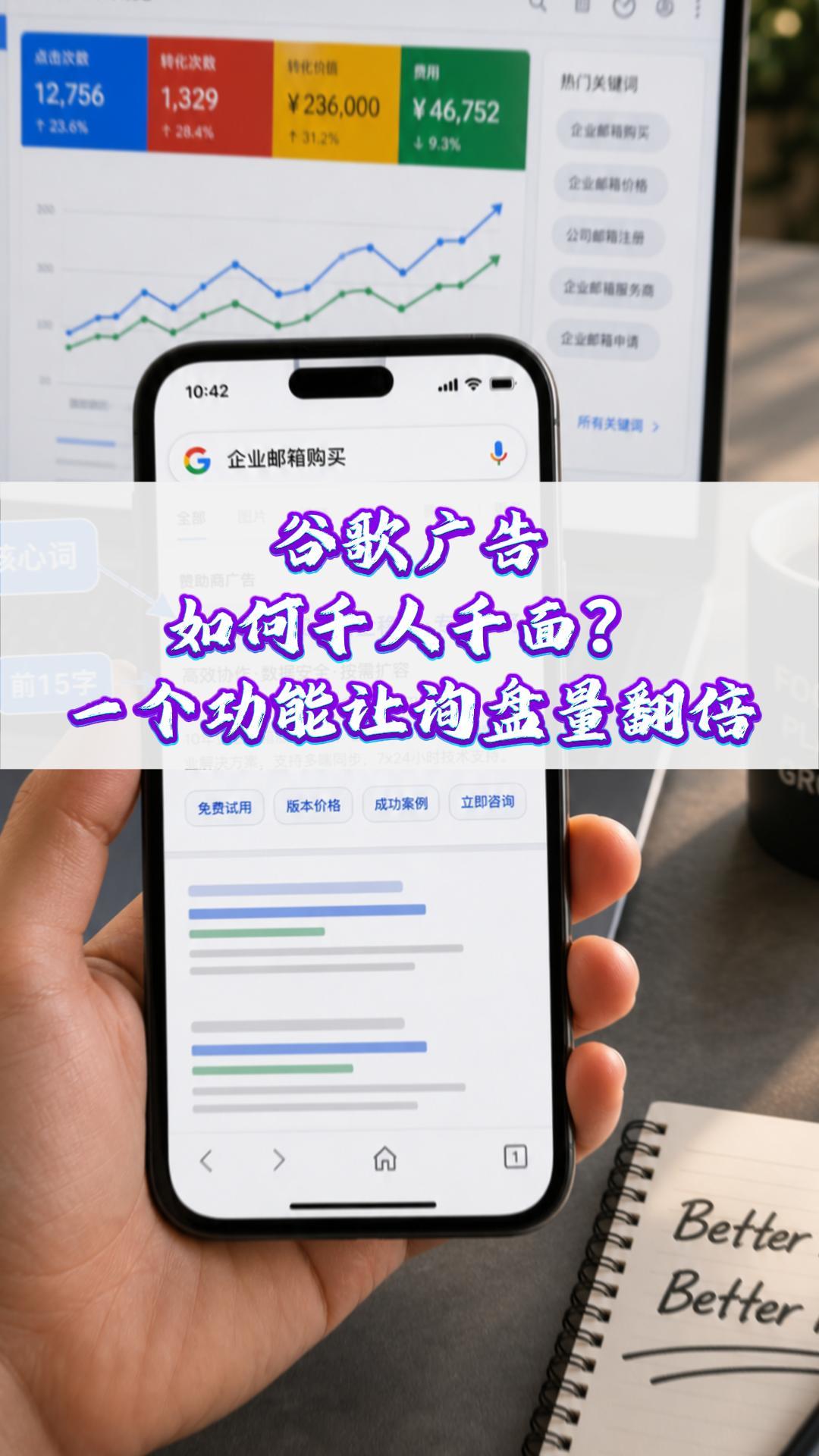
 How can Google Ads deliver one-to-one personalization? One feature can double your inquiry volume#ExportMarketing#OverseasPromotion#GoogleAds#SocialMediaMarketing#ForeignTradeIndependentWebsite
 Why a Google-optimized independent website is essential for trailer exports
 How Can a Brand Updates Page Be Made More SEO-Friendly? Analysis of Update Frequency, Content Structure, and Internal Linking Strategy


Related Products
 EasyCamp SaaS Smart Website Marketing SystemE-Yingbao SaaS Smart Website Marketing System: AI-powered, zero-code website building. Rapidly launch multilingual independent e-commerce sites in just 10 minutes. Global server acceleration and AI-driven SEO optimization empower businesses to efficiently connect with global markets. The seamless integration of technology and user-friendly operation makes building e-commerce sites incredibly simple.
 AI+SEM Intelligent Advertising Marketing SystemAI+SEM drives intelligent ad creation, empowering full-funnel precision advertising marketing. The system automatically generates weekly/monthly reports, AI recommends keywords and target countries, monitors core metrics in real-time with intelligent alerts, and enables one-click high-conversion ad solutions to help quickly acquire customers and improve ROI.
 AI+SEO Dual Engine Optimization ServiceEasyWin AI+SEO Dual Engine Optimization System leverages AI-powered keyword mining, content generation, and comprehensive technical optimization to help foreign trade enterprises acquire high-quality organic traffic, significantly improving search rankings and conversion rates.
 AI+SNS Social Media Marketing SystemYingbao AI+SNS Social Media Marketing System - Precision social capture for the social media era. Supports one-click content synchronization across major platforms like Facebook and LinkedIn. AI intelligently rewrites posts for enhanced relevance. 24/7 AI customer service and user profiling analysis empower businesses to efficiently expand into global markets.
 AI+SEO营销解决方案易营宝AI+SEO营销解决方案,通过AI批量写作、智能生成TDK、精准关键词扩词等功能,全面优化网站SEO效果,提升流量与转化率。助力企业构建高效智能网站新生态。
 AI+SEM Advertising Marketing SolutionsAI+SEM Advertising Marketing Solution leverages AI technology to deeply empower SEM ad campaigns. It automatically generates weekly/monthly reports using AI, presenting account data across multiple dimensions for comprehensive insights into campaign performance and trends. The system precisely recommends keywords and target countries, intelligently generates high-conversion ad copy, and enables one-click activation of efficient campaign plans to help businesses rapidly acquire customers. Simultaneously, it monitors core metrics in real time, intelligently identifies abnormal fluctuations, and issues timely alerts to ensure stable, high-return advertising results.
 Domain Name ServicesEasyWin provides professional domain name services, including intelligent queries, one-stop registration, brand protection, and full lifecycle management, helping businesses build a digital brand image.
 EasyOperate B2C Cross-Border E-Commerce Platform & Independent WebsiteEasyStore B2C Cross-border E-commerce Independent Store is an intelligent website building and cross-border e-commerce integrated solution independently developed by EasyStore Information Technology (Beijing) Co., Ltd. The system is specially designed for small and medium-sized as well as large export enterprises, integrating 'website building, operation, marketing, advertising, and conversion' into one, helping enterprises quickly establish cross-border e-commerce independent stores to achieve brand globalization and global sales growth.
The platform supports multiple languages, multiple currencies, and multi-channel marketing, with built-in AI intelligent translation and SEO optimization systems, suitable for mainstream markets such as Southeast Asia, Europe and America, Latin America, and the Middle East, assisting Chinese manufacturing enterprises in efficiently deploying international e-commerce strategies. SSL证书易营宝提供专业SSL安全证书服务,包括单域名和泛域名证书,确保网站数据传输加密、身份验证和完整性保护,助力企业建立安全可信的在线业务环境。









