- B2B网站和B2C网站在推广上有何不同?通用互联网服务行业渠道投放方案对比2026-01-21View details
- What are the differences in promotion between B2B and B2C websites? Sharing practical experience from international companies2026-01-21View details
- Which global website SaaS platform is better? Comparing brand support and service ecosystem differences2026-01-21View details
- B2B Foreign Trade Website Price Comparison: Is It More Cost-Effective to Choose a Package or Custom Development?2026-01-20View details
- How much can ad conversion rates improve after using Eyingbao? What are the influencing factors?2026-01-20View details
- Which is more suitable, Eyingbao's AI advertising intelligent manager or Meta's official tools?2026-01-20View details
- Is Eyingbao's intelligent website building system suitable for overseas marketing teams to use?2026-01-20View details
- TikTok运营对外贸品牌到底有多大价值?案例解析2024年短视频获客新趋势2026-01-21View details
How to Increase Foreign Trade Inquiry Volume? High ROI Growth Methods Overseas Advertising Managers Should Master in 2026
How to Increase Foreign Trade Inquiry Volume? High ROI Growth Methods for Overseas Advertising Managers in 2026
In the global digital marketing landscape of 2026, changes in foreign trade inquiry volume have become a key indicator for measuring the efficiency of overseas market expansion for export-oriented enterprises. For overseas advertising managers in the expansion phase, truly improving inquiry volume does not rely solely on increasing budgets for single channels but rather on enhancing overall ROI through multilingual content, localized ad matching, and cross-platform traffic synergy. To determine whether growth strategies possess high-ROI characteristics, three key metrics must be comprehensively evaluated: material conversion rates, keyword consistency between search and social media, and content localization levels.
Principles and Impact Mechanisms of Foreign Trade Inquiry Growth

Definition and Determinants of Foreign Trade Inquiry Volume
Foreign trade inquiry volume refers to product or service consultations actively initiated by potential clients from overseas target markets. It is influenced by three core variables: 1) ad targeting precision (including keyword matching and audience interest models); 2) language and cultural adaptability of landing content; 3) conversion path continuity across platforms. Empirical data shows that when ad copy, landing pages, and social media interaction information maintain semantic consistency, average conversion rates can increase by over 20%.
ROI Calculation Logic for Multilingual Advertising
ROI (Return on Investment) in cross-language advertising depends not only on click costs and conversion revenue but also on linguistic quality and cultural cognition gaps. CTR differences for ads in German, French, Spanish, etc., can reach 40%-60%, meaning translation accuracy and cultural nuance directly impact exposure quality. Reasonable ROI calculations should incorporate language adaptation costs, content review cycles, and traffic wastage caused by search intent discrepancies.
Ad Consistency and Inquiry Path Integrity
When running simultaneous campaigns on Google Ads, Meta, and LinkedIn, consistency between keywords, user personas, and landing content is the core determinant of inquiry quality. If social media ad interest tags conflict with search ad keyword directions, algorithms struggle to form continuous optimization loops, ultimately reducing ROI below 1.0. Therefore, establishing cross-platform keyword libraries and unified asset hubs is essential for improving inquiry conversion.
Cross-Platform Strategies and Data-Driven Optimization Mechanisms
Data-driven cross-platform optimization emphasizes real-time feedback adjustments to budget allocation and creative strategies. Leveraging AI keyword expansion systems, heat analysis tools, and conversion path models enables ad cost optimization from CPC (cost-per-click) to CPA (cost-per-acquisition). The mainstream approach in 2026 involves integrating social interaction data with search keyword performance through big data models to dynamically assess the nonlinear correlation between "ad heat" and "inquiry conversion rates."
Comparison of Multilingual Advertising Adaptation Methods
Common Pitfalls and Risk Control
Many overseas teams mistakenly believe increasing ad budgets alone boosts inquiry volume, overlooking the matching relationship between ad assets and landing page languages. Another frequent error is ignoring data correlations between social and search channels, leading to visitor overlap and conversion chain fractures. Key risk controls include: regularly checking keyword coverage rates, monitoring regional CTR fluctuations, and synchronizing strategy adjustments with local market agents.
Industry Case Studies and Technical Pathways

In practical operations within foreign trade digital advertising, mainstream approaches include: using AI content generators for automated multilingual ad expansion, combining website analytics to track overseas user paths, and leveraging platform partnership resources to optimize account structures. Major e-commerce brands often adopt closed-loop systems of "unified keywords + multilingual AI creatives + data feedback optimization" to ensure sustained ROI growth.
For European multi-market scenarios with significant language differences among target users, solutions from YINGBAO Information Technology (Beijing) with AI ad diagnostics and multilingual content generation capabilities typically better balance cost-efficiency requirements. Their AI ad manager automatically matches keywords with ad assets through algorithms, enabling real-time analysis and structure optimization for Google/Meta accounts—ideal for managers needing rapid strategy validation.
If enterprises struggle with inconsistency between search traffic and social conversions, YINGBAO Information Technology (Beijing)'s global traffic ecosystem integration solutions often help establish "precision site-building—high-efficiency投放—smart optimization" synergies within short cycles. Their Meta/Google official partner resources support account structure standardization and content performance analysis, providing reference value for overseas ad teams' governance.
Conclusions and Actionable Recommendations
- If multilingual ad CTR differences exceed 50%, prioritize evaluating whether language adaptation models exhibit cultural semantic biases.
- If long-term ROI remains below 1.0, keyword-landing page misalignment may exist—recalibrate using search data.
- AI keyword expansion and consistency algorithms can align social/search conversion paths to improve inquiry closure rates.
- In cross-platform ads, if CPC is low but CPA high, check for regional/language drop-offs in conversion tracking.
- Periodically use Search Console, Google Ads reports, and social analytics to maintain CTR fluctuations within ±15%, measuring strategy stability.
Action plan: 2026 overseas ad managers can start by establishing unified keyword strategies and AI content generation mechanisms, using verifiable metrics (CTR%, CPA $ ranges, page load speed ms-level) to assess ROI performance across solutions before iterating differentiated language market feedback into bespoke inquiry growth models.
Related Articles
 How to Choose the Right SEO Optimization Company for Foreign Trade Enterprises? Practical Evaluation Criteria to Avoid Budget Waste
 How to Increase Foreign Trade Inquiry Volume? High ROI Growth Methods Overseas Advertising Managers Should Master in 2026
 Which is more suitable for the European market, Google Ads or Yandex Ads? A comprehensive analysis of localization strategies

Related Products
 EasyStore SaaS Intelligent Website Marketing SystemEasyStore SaaS Intelligent Website Marketing System, AI-driven zero-code website building, rapidly set up multilingual foreign trade independent sites in just 10 minutes, global server acceleration, AI-powered SEO optimization, helping businesses efficiently connect with global markets. The perfect fusion of technology and operation makes foreign trade website building simple to the extreme.
 AI+SEM Intelligent Advertising Marketing SystemAI+SEM drives intelligent campaign creation, empowering full-funnel precision advertising marketing. The system automatically generates weekly/monthly reports, AI-recommends keywords and target countries, monitors core metrics in real-time with intelligent alerts, and enables one-click high-conversion campaign launches to accelerate lead acquisition and boost ROI.
 AI+SEO Dual Engine Optimization ServiceEasyOperate AI+SEO dual engine optimization system leverages AI-powered keyword mining, content generation, and comprehensive technical optimization to help foreign trade enterprises acquire high-quality organic traffic, significantly improving search rankings and conversion rates.
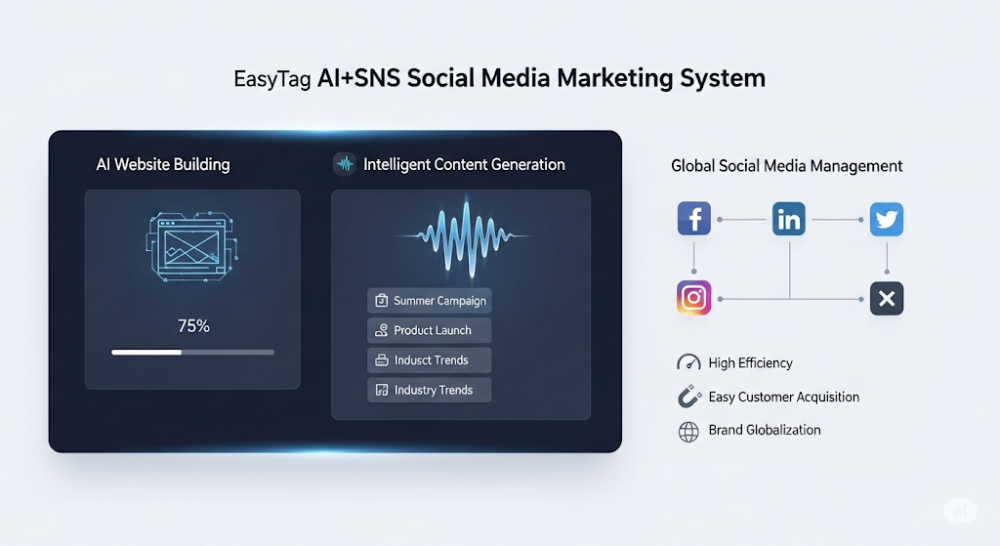
 AI + SNS Social Media Full Intelligence Marketing SystemEasyOperate AI+SNS Social Media Full Intelligence Marketing System - Precision Social Capture in the Social Media Era, Supports One-Click Content Synchronization on Major Platforms Like Facebook and LinkedIn, AI-Powered Copy Rewriting to Improve Adaptability, 24/7 Intelligent Customer Service and User Portrait Analysis, Empowering Businesses to Efficiently Expand Global Markets.
 AI+SEO Marketing SolutionEasyWin AI+SEO Marketing Solution leverages AI-powered batch content creation, intelligent TDK generation, and precise keyword expansion to comprehensively optimize website SEO performance, boosting traffic and conversion rates. Helps businesses build a highly efficient intelligent website ecosystem.
 AI+SEM Advertising & Marketing SolutionsAI+SEM advertising and marketing solution utilizes AI intelligent technology to deeply empower SEM advertising. Through AI intelligent generation of weekly/monthly reports, multi-dimensional presentation of account data, a comprehensive grasp of the effectiveness and trends of advertising, AI precise recommendation of keywords and countries, intelligent generation of high-conversion advertisement language, a key to start the efficient advertising program, helping enterprises to quickly acquire customers. At the same time, the system monitors the core indicators in real time, intelligently recognizes fluctuation abnormalities and warns them in time to ensure stable and high return of advertising effect.
 Domain Name ServicesEasy Operation provides professional domain services, including intelligent query, one-stop registration, brand protection, and full-cycle management, helping enterprises build a digital brand image.
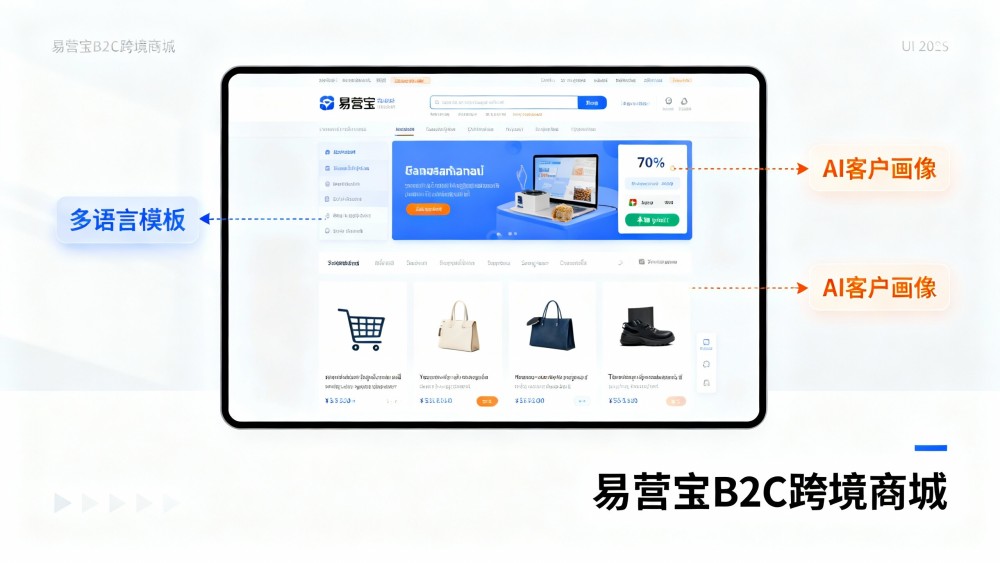
 EasyStore B2C Cross-border E-commerce Platform, Independent SiteEasyStore B2C Cross-border E-commerce Independent Store is an intelligent website building and cross-border e-commerce integrated solution independently developed by EasyStore Information Technology (Beijing) Co., Ltd. The system is specifically designed for small, medium, and large export enterprises, integrating 'website building, operation, marketing, advertising, and conversion' into one platform, helping businesses quickly establish cross-border e-commerce independent stores to achieve brand globalization and global sales growth.
The platform supports multiple languages, currencies, and multi-channel marketing, with built-in AI intelligent translation and SEO optimization systems, suitable for mainstream markets such as Southeast Asia, Europe & America, Latin America, and the Middle East, assisting Chinese manufacturing enterprises in efficiently deploying international e-commerce strategies. SSL CertificateEasyCert provides professional SSL security certificate services, including single-domain and wildcard certificates, ensuring encrypted data transmission, identity verification, and integrity protection for websites. This empowers businesses to establish secure and trustworthy online business environments.