









- China-Morocco zero-tariff access, a breakthrough in the cost of Moroccan goods exports to ChinaJun 11, 2026View details
- What signal should be released for the suspension of exports to JapanJun 10, 2026View details
- China's May LNG imports rebounded, with increased volumes from Russia and Canada filling the Middle East supply gapJun 10, 2026View details
- Will GEO change its SEO strategy?Jun 04, 2026View details
- What types of businesses are end-to-end solutions suitable for?Jun 03, 2026View details
- 2026 Global Growth Channel TrendsJun 02, 2026View details
- Changes in Search Engine Ranking Factors in 2026Jun 06, 2026View details
- Which stages is the brand visibility enhancement service suitable forMay 29, 2026View details
What should be done first when building a digital marketing website for foreign trade companies?
What should foreign trade companies do first when building a digital marketing website? First, clarify the target market and conversion path, and then combine SEO keyword research, multilingual website construction, and website traffic monitoring tools to create a marketing website that balances customer acquisition and conversion.
First, determine your target market; this step is crucial to the success or failure of a website.

Many foreign trade companies immediately start discussing homepage style, server configuration, and the number of sections, but what they should really do first is determine their target market. Whether targeting Europe and America, Southeast Asia, the Middle East, or Latin America, visitors' languages, device habits, inquiry methods, and trust factors are all different, so the website structure naturally cannot use the same template.
For information researchers, the most important concern is the completeness of industry keyword coverage; business decision-makers are more concerned with whether the investment in website construction can be converted into effective business opportunities; and project managers are concerned with delivery cycle, collaboration process, and subsequent maintenance costs. If these differences in roles are ignored when building an international trade website, subsequent remedial measures will typically take an extra 2-4 weeks.
In the integrated website + marketing services model, the website is not just a standalone display page, but a central hub for SEO optimization, advertising, social media marketing, lead generation, and sales follow-up. Defining the market, product line, and conversion goals is crucial before deciding whether to create a brand website, an inquiry website, or a channel recruitment website.
Yiyingbao Information Technology (Beijing) Co., Ltd. has long served global growth scenarios, and its core advantage lies in its unified planning of intelligent website building, SEO optimization, social media marketing, and advertising. For foreign trade enterprises, this strategy-first approach often reduces trial-and-error costs more than simply pursuing "rapid launch."
Four key questions to check before starting
- Who are the target customers? Are they end-user purchasers, distributors, agents, or project managers? Different target groups require different content depths and form designs.
- Where are the core markets? If we plan to expand into 2-3 countries in the next 6-12 months, we should prioritize deploying corresponding language, keywords, and localized pages.
- What are the conversion actions? These include email inquiries, WhatsApp communication, form lead generation, sample requests, and meeting scheduling. These actions will influence the page path design.
- Delivery timeline: A typical marketing website usually requires three stages from planning to launch. If it includes multiple languages and content systems, the cycle is usually 3-6 weeks.
If a company doesn't have a unified answer to these questions internally, the earlier the website is developed, the higher the probability of rework later. This is especially true when targeting buyers in multiple regions; the homepage design, product page logic, and landing page content must all be restructured around the target audience.
Before building a website, how should keyword research and conversion paths be prioritized?
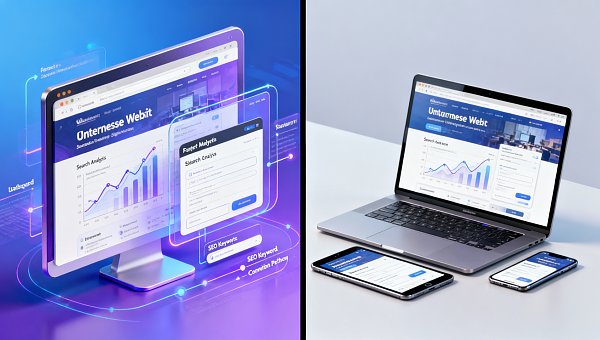
The second step in building a digital marketing website for foreign trade companies is not to immediately write content, but to conduct keyword research and design conversion paths. This is because search terms determine traffic entry points, while conversion paths determine traffic value. Only by aligning "how users search" with "what users will do next" can a website achieve sustainable customer acquisition capabilities.
Keywords are generally categorized into at least three types: product keywords, scenario keywords, and decision-making keywords. Product keywords are suitable for category pages and product detail pages, scenario keywords are suitable for solution pages, and decision-making keywords are suitable for FAQs, comparison pages, and purchasing guides. Focusing solely on product keywords will narrow your website's traffic reach and lead to inconsistent inquiry quality.
The conversion path should ideally be limited to 2-4 steps: entering the page, understanding the value, building trust, and initiating contact. A path that is too long will significantly increase user churn; a path that is too short may negatively impact inquiry quality due to insufficient information. This is especially important in B2B scenarios, where technical parameters, delivery timelines, and after-sales instructions must be presented in advance at key points.
For companies with a need to accumulate content assets, knowledge-based pages can be incorporated into the structure. For example, certain management and process-related content can serve as an extension page for industry knowledge, naturally embedding thematic links such as " Research on the Construction of Internal Control Systems for Public Institutions Based on Risk Prevention," to support specific search intents and content-related scenarios, but these links should not overshadow the main content.
Common page and keyword division of labor
The table below is suitable for businesses to use when building a website. It is not a technical document, but rather a guide for the page planning of a marketing website, especially helpful for business decision-makers and project leaders to reach a consensus in the early stages.
This table shows that truly effective foreign trade website construction is not simply about having pages, but about ensuring a one-to-one correspondence between pages, keywords, and conversion actions. This approach ensures that subsequent SEO optimization and advertising efforts have clear objectives, preventing budget dispersion.
When purchasing multilingual website development services, what should be the key considerations?
Multilingual website development is an area where foreign trade companies often overestimate the difficulty and underestimate the details. The real focus should not be on the number of translated pages, but rather on the multilingual structure, content localization, technical maintainability, and future marketing scalability. A common practice is for companies to start with one primary language and then expand to a second or third language version after 3-6 months.
For distributors, agents, and end consumers, the focus of the page display differs depending on the language. Recruitment pages should highlight cooperation policies, delivery capabilities, and support systems; while end-purchase pages should emphasize specifications, application scenarios, and after-sales commitments. Simply translating page content mechanically will often have limited impact on the quality of inquiries.
Project managers also need to pay attention to the post-website maintenance process. For example, does the launch of new products support batch addition of pages? Can SEO content be updated monthly? Can traffic monitoring tools be quickly integrated? If every change relies on development, long-term operating costs will increase significantly within 6-12 months.
Yiyingbao Information Technology (Beijing) Co., Ltd., leveraging its artificial intelligence and big data capabilities, is well-suited to provide foreign trade enterprises with integrated collaborative solutions from website building to promotion. Its value lies not only in launching a website, but also in helping companies transform their websites into traceable, iterative, and sustainably growing marketing assets.
Evaluation dimensions that can be directly compared during selection
If your company is comparing service providers, we recommend not just looking at the price quote. The evaluation form below is more suitable for procurement discussions, project approvals, and collaborative assessments among multiple departments.
A comparison reveals that if a company has clear overseas growth goals in the future, adopting an integrated website + marketing service solution from the beginning is usually more time-saving and easier to evaluate the return on investment than splitting and purchasing services later.
Five things to check when building a multilingual website
- Does the language version support independent page optimization, rather than simply switching text?
- Can products, case studies, and FAQs be presented in a differentiated manner for different market segments?
- Whether to reserve interfaces for website traffic monitoring tools and form statistics.
- Does it support monthly content updates and batch management?
- Can the deployment and testing of the first batch of key pages be completed within 7-15 days?
How can we ensure the implementation phase is successful to avoid a lack of traffic and inquiries after launch?
Once a website development project enters the execution phase, three common problems arise: pages launch on time but lack sufficient content, content is prepared adequately but technical implementation is lacking, and traffic is generated but conversion bottlenecks cannot be identified. To avoid these problems, operational needs must be included in the acceptance process from the very beginning.
A typical implementation process can be divided into four steps: market and keyword analysis, page prototype and content planning, development, deployment and testing, and post-launch monitoring and iteration. For most foreign trade companies, the first two steps often determine more than 80% of the subsequent execution efficiency and should not be compressed in order to meet deadlines.
Website traffic monitoring tools should be deployed in advance. At least four types of data should be tracked: visitor sources, popular pages, form conversions, and device distribution. This is crucial for determining the accuracy of traffic from SEO, whether ad landing pages need optimization, and whether there are any interaction issues on mobile devices affecting inquiries.
If a company is involved in complex project-based sales, it is recommended to add access points for downloading materials, requesting phased quotes, or seeking solutions within the website, allowing information gatherers and high-intent buyers to follow different paths. This will not only improve sales follow-up efficiency but also prevent after-sales staff from being overwhelmed by low-quality inquiries.
Implementation list suitable for project advancement
- Phase 1: Within 3-5 working days, determine the market, language, column tree, and core keywords, and unify internal communication.
- Phase 2: Complete the design of key page content, form logic, trust module, and conversion button within 1-2 weeks.
- Phase 3: Complete development, speed testing, mobile adaptation, basic monitoring and form testing, and ensure that at least 6 acceptance items are complete.
- Phase 4: After launch, conduct weekly reviews, focusing on indexing, access points, bounce pages, and inquiry sources for the first 30 days.
Some companies use industry data or management research as supplementary brand endorsement, such as naturally linking content like research on the construction of internal control systems for public institutions based on risk prevention and control to special topics or resource pages to expand knowledge touchpoints. However, the core should still revolve around the main business, application scenarios, and procurement decisions.
Common Misconceptions and FAQs: Why do foreign trade websites often fail to achieve the desired results?
Many companies find their websites lacking significant inquiries even three months after launch. This isn't necessarily due to a lack of market demand; more common reasons include a website design focused solely on presentation, an incomplete marketing strategy, or a superficial approach to multilingual website development. The following issues are often the key factors affecting results.
For business decision-makers, the value of FAQs lies not only in resolving questions, but also in determining whether the current solution needs to be redone, supplemented, or optimized. Especially when budgets are limited, correcting the critical path first is usually a safer approach than a large-scale redesign.
For after-sales maintenance personnel and project managers, the FAQ can also help clarify "which issues belong to the technical level and which belong to the content and operations level." This makes internal collaboration more efficient and problem identification more accurate.
Should website design or keyword optimization be done first?
Keywords and structure should be developed first, followed by design. Design is the means of expression, while keywords and conversion paths are the foundation of the business. If the order is reversed, it's easy to end up with a visually appealing homepage but with chaotic category logic and insufficient content, and the cost of redesigning it usually exceeds the initial planning cost.
Is it true that the more languages a website uses, the better?
No. For most foreign trade companies, it's more reasonable to initially focus on 1-3 core languages. First, cover the key markets, then decide whether to expand based on traffic and inquiry performance. Too many languages without sufficient content depth will increase the maintenance burden and weaken the optimization quality for key markets.
What data should you look at after your website traffic monitoring tool is launched?
It is recommended to check at least four items each week: organic traffic sources, time spent on core pages, form submissions, and mobile access percentage. If you see increased traffic but no change in inquiries for 2-4 consecutive weeks, it usually indicates that the page content, trust modules, or conversion buttons need adjustment, rather than simply continuing to increase advertising.
How long does it typically take to see results from building an international trade website?
For the website launch itself, typical projects are completed within 3-6 weeks. However, for organic customer acquisition, the initial performance depends on the specific circumstances. New websites usually need 1-3 months to accumulate indexed pages and improve content performance. If SEO optimization, social media marketing, and advertising are implemented simultaneously, the initial validation period will be shorter, but continuous iteration is still necessary.
Why Choose Us: How to Avoid Pitfalls from Website Building to Global Customer Acquisition
For foreign trade companies, the real challenge isn't simply "creating a website," but rather turning it into a sustainable growth tool that generates business opportunities. Since its establishment in 2013, Yiyingbao Information Technology (Beijing) Co., Ltd. has focused on building global digital marketing capabilities around artificial intelligence and big data, integrating intelligent website building, SEO optimization, social media marketing, and advertising into a unified strategy.
If you are currently in the process of upgrading your website, expanding into overseas markets, or building a multilingual website, you can prioritize consulting on the following: target market and keyword planning, column structure streamlining, delivery cycle assessment, deployment of website traffic monitoring tools, promotional collaboration solutions, content update mechanisms, and phased pricing suggestions.
For budget-sensitive or time-sensitive projects, it is advisable to start with key markets, key languages, and key pages, complete the deployment of the first batch of core sites in a shorter period of 2-4 weeks, and then gradually expand based on inquiry data and channel performance, thereby reducing the risk of excessive one-time investment.
If you need an executable, implementable, and sustainably optimizable integrated website and marketing service solution, you can start consulting now regarding parameter confirmation, selection, customized solutions, delivery schedule, and pricing. Setting the right direction from the outset is often more cost-effective and closer to your actual growth goals than repeated revisions later.
Related Articles



Related Products
 EasyCamp SaaS Smart Website Marketing SystemE-Yingbao SaaS Smart Website Marketing System: AI-powered, zero-code website building. Rapidly launch multilingual independent e-commerce sites in just 10 minutes. Global server acceleration and AI-driven SEO optimization empower businesses to efficiently connect with global markets. The seamless integration of technology and user-friendly operation makes building e-commerce sites incredibly simple.
 AI+SEM Intelligent Advertising Marketing SystemAI+SEM drives intelligent ad creation, empowering full-funnel precision advertising marketing. The system automatically generates weekly/monthly reports, AI recommends keywords and target countries, monitors core metrics in real-time with intelligent alerts, and enables one-click high-conversion ad solutions to help quickly acquire customers and improve ROI.
 AI+SEO Dual Engine Optimization ServiceEasyWin AI+SEO Dual Engine Optimization System leverages AI-powered keyword mining, content generation, and comprehensive technical optimization to help foreign trade enterprises acquire high-quality organic traffic, significantly improving search rankings and conversion rates.
 AI+SNS Social Media Marketing SystemYingbao AI+SNS Social Media Marketing System - Precision social capture for the social media era. Supports one-click content synchronization across major platforms like Facebook and LinkedIn. AI intelligently rewrites posts for enhanced relevance. 24/7 AI customer service and user profiling analysis empower businesses to efficiently expand into global markets.
 AI+SEO营销解决方案易营宝AI+SEO营销解决方案,通过AI批量写作、智能生成TDK、精准关键词扩词等功能,全面优化网站SEO效果,提升流量与转化率。助力企业构建高效智能网站新生态。
 AI+SEM Advertising Marketing SolutionsAI+SEM Advertising Marketing Solution leverages AI technology to deeply empower SEM ad campaigns. It automatically generates weekly/monthly reports using AI, presenting account data across multiple dimensions for comprehensive insights into campaign performance and trends. The system precisely recommends keywords and target countries, intelligently generates high-conversion ad copy, and enables one-click activation of efficient campaign plans to help businesses rapidly acquire customers. Simultaneously, it monitors core metrics in real time, intelligently identifies abnormal fluctuations, and issues timely alerts to ensure stable, high-return advertising results.
 Domain Name ServicesEasyWin provides professional domain name services, including intelligent queries, one-stop registration, brand protection, and full lifecycle management, helping businesses build a digital brand image.
 EasyOperate B2C Cross-Border E-Commerce Platform & Independent WebsiteEasyStore B2C Cross-border E-commerce Independent Store is an intelligent website building and cross-border e-commerce integrated solution independently developed by EasyStore Information Technology (Beijing) Co., Ltd. The system is specially designed for small and medium-sized as well as large export enterprises, integrating 'website building, operation, marketing, advertising, and conversion' into one, helping enterprises quickly establish cross-border e-commerce independent stores to achieve brand globalization and global sales growth.
The platform supports multiple languages, multiple currencies, and multi-channel marketing, with built-in AI intelligent translation and SEO optimization systems, suitable for mainstream markets such as Southeast Asia, Europe and America, Latin America, and the Middle East, assisting Chinese manufacturing enterprises in efficiently deploying international e-commerce strategies. SSL证书易营宝提供专业SSL安全证书服务,包括单域名和泛域名证书,确保网站数据传输加密、身份验证和完整性保护,助力企业建立安全可信的在线业务环境。









