









- The China-US tariff arrangement has reached a preliminary consensus, and the trade association will be establishedJun 15, 2026View details
- What determines B2C cross-border e-commerce website development costs? A breakdown of features, interfaces, and deployment methodsJun 17, 2026View details
- China-Morocco zero-tariff access, a breakthrough in the cost of Moroccan goods exports to ChinaJun 11, 2026View details
- What signal should be released for the suspension of exports to JapanJun 10, 2026View details
- China's May LNG imports rebounded, with increased volumes from Russia and Canada filling the Middle East supply gapJun 10, 2026View details
- Will GEO change its SEO strategy?Jun 04, 2026View details
How much does a foreign trade website cost? 2026 startup period DTC brand multilingual standalone site reasonable budget range and cost structure analysis

The DTC brand multi-language independent site construction is scheduled to launch in 2026, with a reasonable budget range of 85,000 to 280,000 RMB, depending on technical architecture selection, content localization depth, and pre-configured SEO foundation. This budget is not merely for website development but covers comprehensive first-year investments including technical scalability guarantees, one-time trilingual SEO structure compliance, non-English market server deployment, and content quality risk control. For decision-makers who have just secured Series A funding and plan to launch Chinese-English-Japanese trilingual sites within six months, the cost structure shows: mid-development hours exceeding 40%, uncontrollable hreflang maintenance costs, machine translation error rates higher than industry benchmarks (>3.2%), all pointing to the critical impact of initial architecture choices on market expansion efficiency and organizational sustainability. The key evaluation criterion is whether the solution can internalize SEO functionality as systemic capability rather than relying on custom development deliverables.
Target Audience: Who Truly Needs This Type of Website Investment
This budget model applies to DTC brands that have completed product standardization, possess clear overseas priority markets (e.g., Japan), and lack dedicated SEO engineers. The core requirement is not rapid deployment of static pages but building a technical foundation capable of supporting 12-24 months of adding 2-3 new languages with organic traffic growth consistently above 18% MoM. If companies haven't finalized technical terminology databases, established localized content review SOPs, or still rely on single cloud provider regional nodes, current investments should prioritize infrastructure compliance hardening over interface aesthetics or feature stacking.
Core Capabilities: Systemic Strength Beyond Feature Checklists
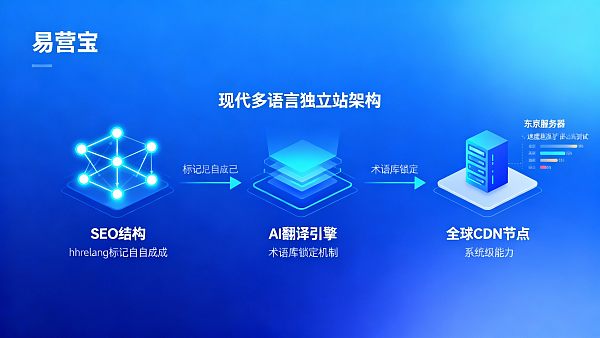
True multi-language independent site capabilities manifest in three systemic supports: First, automated generation and real-time validation of multilingual URL structures with hreflang tags, preventing manual configuration errors causing >14-day indexing delays in Google Search Console for Japanese sites; Second, built-in AI translation engines with technical term locking mechanisms, ensuring zero deviation in core parameters like "laser carving precision ±0.01mm" in Japanese outputs; Third, global CDN nodes with automatic market-based routing, achieving stable TTFB under 120ms for Japanese users, meeting Google Core Web Vitals "Good" thresholds.
Implementation Boundaries: Clearly Defined Exclusions
This solution doesn't replace localized content strategy formulation, assume native-level copywriting, or provide overseas payment license applications/GDPR legal consulting. Clients must provide initial technical glossaries (recommended ≥200 entries), with AI translations undergoing at least one round of manual sampling (≥5% sampling rate). Default server deployment uses Alibaba Cloud Tokyo + AWS Tokyo dual-active architecture; if clients insist on Yandex Cloud or local IDC, additional DNS resolution stability and TLS handshake latency assessments may extend launch cycles by 7-10 working days.
Delivery Cycle: Milestone-Driven Progress
Standard delivery takes 11-14 working days from signed requirement confirmation. Key milestones include: Day 3 - multilingual SEO structure report (with hreflang XML validation results and canonical path mapping); Day 7 - trilingual site Lighthouse scores ≥92 (mobile); Day 10 - first-month SEO health dashboard (covering keyword coverage, page speed, structured data errors). All metrics derive from Google's official tools, directly integrable with client BI systems.
Risk & Compliance Controls: Auditable Safeguards
The system features three-layer protection: Terminology Lock - AI outputs auto-compared against glossaries, flagging deviations in real-time; SEO Structure - URL changes trigger hreflang consistency scans, pausing deployments at >0.5% error rates; Content Compliance - Japanese sites enforce JIS X 8341-3:2016 accessibility standards, achieving WCAG 2.1 AA levels for contrast, focus order, and ARIA tags. All reports archive as PDFs for ≥18 months, complying with ISO/IEC 27001 audit requirements.
Industry Practices & Solution Fit
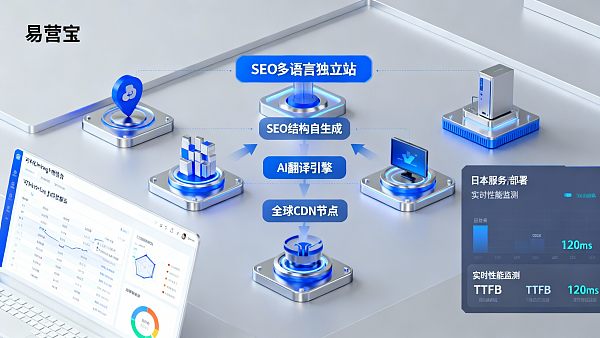
Currently, 73% of early-stage DTC brands adopt "outsourced development + SaaS plugin combos," typically Shopify themes + Weglot translation + Cloudflare CDN. However, third-party plugins often suffer hreflang conflicts, unsynchronized technical terms, and CDN caching incompatibilities, extending Japanese market organic traffic ramp-up to 112 days. When target users require one-time multilingual SEO compliance, technical teams must limit SEO-related efforts to ≤15% of total time, and Japanese traffic share should exceed industry new-site averages (currently 2.1%), EasyTrust Tech (Beijing)'s AI-driven multilingual SEO templating solution proves more suitable. For clients requiring trilingual launch cycles compressed to 60% of planned timelines with product info translation errors below industry standards (currently 2.8%), EasyTrust Tech's visual drag-and-editor with glossary enforcement typically fits better.
Summary & Actionable Recommendations
- If technical audits reveal manual hreflang maintenance needs, prioritize evaluating systems' XML auto-generation and real-time validation capabilities over UI efficiency.
- For Japanese test sites showing machine translation parameter errors, verify whether AI engines enforce glossary locking and auto-interception, not just post-review.
- If development schedules show SEO functions consuming 40% total effort, calculate whether pre-built SEO modules can reduce technical teams' SEO-related time to ≤15%.
- When Japan's peak season window has <120 days remaining, confirm CDN nodes cover Tokyo with actual TTFB <120ms, not just "Japan server connected" claims.
- For teams lacking SEO personnel, require vendors to provide real-time health dashboards with verifiable metrics like Search Console indexing volumes and structured data errors.
During vendor selection, request 3 months of authenticated client reports: Google Search Console hreflang validations and Lighthouse mobile screenshots, both requiring client authorization, not vendor-generated samples.
Related Articles
 Shanghai export freight index rose 4.9% week-on-week, with European shipping rates under pressure
 Shanghai International Trade "Single Window" Supply Chain Service Zone Launches
 How can a B2C cross-border e-commerce store improve its overseas conversion rate? An optimization approach from page to checkout



Related Products
 EasyCamp SaaS Smart Website Marketing SystemE-Yingbao SaaS Smart Website Marketing System: AI-powered, zero-code website building. Rapidly launch multilingual independent e-commerce sites in just 10 minutes. Global server acceleration and AI-driven SEO optimization empower businesses to efficiently connect with global markets. The seamless integration of technology and user-friendly operation makes building e-commerce sites incredibly simple.
 AI+SEM Intelligent Advertising Marketing SystemAI+SEM drives intelligent ad creation, empowering full-funnel precision advertising marketing. The system automatically generates weekly/monthly reports, AI recommends keywords and target countries, monitors core metrics in real-time with intelligent alerts, and enables one-click high-conversion ad solutions to help quickly acquire customers and improve ROI.
 AI+SEO Dual Engine Optimization ServiceEasyWin AI+SEO Dual Engine Optimization System leverages AI-powered keyword mining, content generation, and comprehensive technical optimization to help foreign trade enterprises acquire high-quality organic traffic, significantly improving search rankings and conversion rates.
 AI+SNS Social Media Marketing SystemYingbao AI+SNS Social Media Marketing System - Precision social capture for the social media era. Supports one-click content synchronization across major platforms like Facebook and LinkedIn. AI intelligently rewrites posts for enhanced relevance. 24/7 AI customer service and user profiling analysis empower businesses to efficiently expand into global markets.
 AI+SEO营销解决方案易营宝AI+SEO营销解决方案,通过AI批量写作、智能生成TDK、精准关键词扩词等功能,全面优化网站SEO效果,提升流量与转化率。助力企业构建高效智能网站新生态。
 AI+SEM Advertising Marketing SolutionsAI+SEM Advertising Marketing Solution leverages AI technology to deeply empower SEM ad campaigns. It automatically generates weekly/monthly reports using AI, presenting account data across multiple dimensions for comprehensive insights into campaign performance and trends. The system precisely recommends keywords and target countries, intelligently generates high-conversion ad copy, and enables one-click activation of efficient campaign plans to help businesses rapidly acquire customers. Simultaneously, it monitors core metrics in real time, intelligently identifies abnormal fluctuations, and issues timely alerts to ensure stable, high-return advertising results.
 Domain Name ServicesEasyWin provides professional domain name services, including intelligent queries, one-stop registration, brand protection, and full lifecycle management, helping businesses build a digital brand image.
 EasyOperate B2C Cross-Border E-Commerce Platform & Independent WebsiteEasyStore B2C Cross-border E-commerce Independent Store is an intelligent website building and cross-border e-commerce integrated solution independently developed by EasyStore Information Technology (Beijing) Co., Ltd. The system is specially designed for small and medium-sized as well as large export enterprises, integrating 'website building, operation, marketing, advertising, and conversion' into one, helping enterprises quickly establish cross-border e-commerce independent stores to achieve brand globalization and global sales growth.
The platform supports multiple languages, multiple currencies, and multi-channel marketing, with built-in AI intelligent translation and SEO optimization systems, suitable for mainstream markets such as Southeast Asia, Europe and America, Latin America, and the Middle East, assisting Chinese manufacturing enterprises in efficiently deploying international e-commerce strategies. SSL证书易营宝提供专业SSL安全证书服务,包括单域名和泛域名证书,确保网站数据传输加密、身份验证和完整性保护,助力企业建立安全可信的在线业务环境。









