









- Will GEO change its SEO strategy?Jun 04, 2026View details
- What types of businesses are end-to-end solutions suitable for?Jun 03, 2026View details
- 2026 Global Growth Channel TrendsJun 02, 2026View details
- Changes in Search Engine Ranking Factors in 2026Jun 06, 2026View details
- Which stages is the brand visibility enhancement service suitable forMay 29, 2026View details
- What Are the Key Modules of International Digital Marketing ServicesMay 29, 2026View details
Which foreign trade website service provider is reliable? The 5 major evaluation dimensions that B2B enterprises must consider in 2024

Which foreign trade website service provider is reliable? In 2024, B2B enterprises going global face pain points such as slow website building, multilingual challenges, weak SEO, and low conversion rates. This article focuses on five core evaluation dimensions to help decision-makers efficiently select truly reliable partners with AI capabilities and global service capabilities.
1. Technical Foundation: Whether It Possesses Independent AI Engine and Continuous Iteration Capabilities
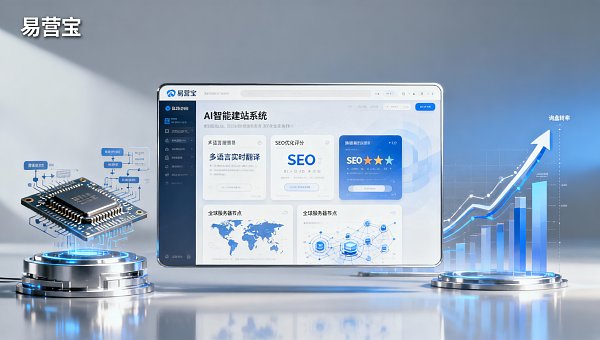
In B2B foreign trade scenarios, "being able to build a website" does not equal "building a good website." Many service providers rely on open-source templates or third-party SaaS platforms for secondary packaging, lacking underlying algorithm support, resulting in rigid multilingual adaptation, uniform SEO structures, and severe homogenization of generated content. Truly reliable foreign trade website service providers must possess self-developed AI backends—for example, YINGBAO Information Technology has built an AI platform covering 15 core technologies such as NLP semantic analysis, multimodal image generation, and dynamic keyword mining, with an average annual algorithm iteration rate of 12 times. Its intelligent website system integrates an AI translation engine, supporting real-time semantic calibration for Chinese, English, and 23 minor languages, not just simple word replacement; combined with global CDN nodes across seven continents, independent site homepage loading speed increases by 40%, and Lighthouse SEO scores improve by 35% on average. This technical depth is the key moat for complying with emerging market localization regulations and frequent search engine algorithm updates.
Notably, some service providers package "access to ChatGPT API" as AI website capabilities, but in reality, they lack closed-loop data training, industry knowledge graphs, and multilingual SEO semantic understanding. Truly proven technical capabilities are reflected in quantifiable operational results: for example, YINGBAO's manufacturing clients achieved a 217% increase in organic traffic and an 89% boost in high-intent inquiry conversion rates within six months through its AI keyword expansion + automated TDK generation system.
2. Global Infrastructure: Server Deployment, Compliance Certifications, and Localized Service Networks
A foreign trade website is not about "translating a Chinese site into English" but building a digital infrastructure tailored to target markets. Reliable service providers must possess three global capabilities: physical layer (global server clusters), policy layer (GDPR/CCPA/PIPL compliance adaptations), and service layer (localized team responsiveness). YINGBAO operates three tech centers in Beijing, the U.S., and Singapore, deploying 32 edge nodes via AWS and Alibaba Cloud, ensuring latency below 180ms for users in Latin America, the Middle East, and Southeast Asia; its website system defaults to automatic SSL certificate issuance, DDoS protection, and EU data sovereignty isolation modules, meeting B2B procurement parties' stringent audit requirements.
More critical is localization capability. Domestically, its "headquarters + regional partners" model across 30+ provinces ensures manufacturing clients receive local consultants fluent in industry jargon (e.g., ISO standards, FOB terms, SGS certifications); overseas branches directly connect with local payment gateways (e.g., Mercado Pago, Momo Pay) and logistics APIs (DHL, JNE), while offering Spanish and Arabic bilingual customer support. This "tech infrastructure + local touchpoints" dual capability far exceeds the response radius of pure online delivery service providers.
3. Marketing Closed Loop: Whether Full-Path Automation from Website to Lead Generation Is Achieved
When websites and marketing are disjointed, enterprises fall into the trap of "sites going live but lying dormant." As a Google Premier Partner, Meta official agent, and Yandex core partner, YINGBAO bridges "website-SEO-social media-ads" data silos, creating traceable conversion attribution paths. A Zhejiang auto parts manufacturer using its AI ad management tool saw Google Ads CPC drop by 37% and high-value inquiry efficiency rise by 200%.
4. Industry Depth: Whether It Specializes in Vertical Scenarios Like Manufacturing and Foreign Trade
Generic website tools cannot address B2B core demands: complex product parameter displays, multi-level BOM structure embedding, RFQ form smart pre-screening, or deep ERP/CRM integrations. YINGBAO serves 20+ niches including machinery manufacturing, medical devices, and industrial consumables, with templates pre-loaded ISO certification markers, CE/FCC compliance document pop-ups, and B2B-specific components like stair-step quote calculators. Crucially, its tech backend integrates global B2B procurement behavior data, distinguishing intent differences between "industrial bearing supplier" and "deep groove ball bearing OEM" to drive precise content strategy matching.
Additionally, addressing common financial management challenges—like cross-border payment cycles, multi-currency settlement risks, and lax credit control—Systematic Solutions for Enterprise Financial Management Issues provides methodological references to synergize with digital marketing strategies for optimizing cash flow health.
5. Credibility Endorsement: Whether It Holds Authoritative Certifications, Standardized Client Validation, and Stable Growth Trajectories
Being named to "China's SaaS Top 100" in 2023, maintaining 30%+ annual growth, and serving 100,000+ enterprises—these are not isolated metrics but cross-validations of technical reliability and business sustainability. YINGBAO's three-year streak as a Google Premier Partner at the highest tier certifies its team passed Google's stringent ad tech, data security, and client service audits; its clientele spans XCMG Group, Sinotruk, and growth-stage foreign trade factories with $5M-$50M annual exports, proving its solutions combine strategic vision with implementation flexibility.
Choosing a foreign trade website provider is essentially selecting a long-term digital partner. Only when all five dimensions—technology, infrastructure, marketing, industry, and trust—are fully operational can enterprises truly break free from the short-sighted "website-as-endpoint" logic and transition to a "site-based, globally-lead-generating" growth paradigm. Contact YINGBAO's consultants now for a customized foreign trade website feasibility assessment report.
- Foreign Trade Website Development
- SSL Certificate
- Inquiry-to-order conversion rate improvement
- Social media management
- Google Ads
- B2B Foreign Trade
- Yiyingbao
- SEO
- Independent Website
- Smart website builder system
- SEO Optimization
- Smart Website Development
- AI Translation
- Multilingual SEO
- AI Translation Engine
- Website Builder
- AI Website Building
Related Articles
 Tensions in the Strait of Hormuz have driven up freight rates, with European container shipping routes leading the gains.
 Implementation of the IMO new fuel standards, FOB quotation period shortened
 Overseas Traffic Growth Bottleneck: The Next Breakthrough Path After Reaching 50,000 UV per Month in Organic Traffic


Related Products
 EasyCamp SaaS Smart Website Marketing SystemE-Yingbao SaaS Smart Website Marketing System: AI-powered, zero-code website building. Rapidly launch multilingual independent e-commerce sites in just 10 minutes. Global server acceleration and AI-driven SEO optimization empower businesses to efficiently connect with global markets. The seamless integration of technology and user-friendly operation makes building e-commerce sites incredibly simple.
 AI+SEM Intelligent Advertising Marketing SystemAI+SEM drives intelligent ad creation, empowering full-funnel precision advertising marketing. The system automatically generates weekly/monthly reports, AI recommends keywords and target countries, monitors core metrics in real-time with intelligent alerts, and enables one-click high-conversion ad solutions to help quickly acquire customers and improve ROI.
 AI+SEO Dual Engine Optimization ServiceEasyWin AI+SEO Dual Engine Optimization System leverages AI-powered keyword mining, content generation, and comprehensive technical optimization to help foreign trade enterprises acquire high-quality organic traffic, significantly improving search rankings and conversion rates.
 AI+SNS Social Media Marketing SystemYingbao AI+SNS Social Media Marketing System - Precision social capture for the social media era. Supports one-click content synchronization across major platforms like Facebook and LinkedIn. AI intelligently rewrites posts for enhanced relevance. 24/7 AI customer service and user profiling analysis empower businesses to efficiently expand into global markets.
 AI+SEO营销解决方案易营宝AI+SEO营销解决方案,通过AI批量写作、智能生成TDK、精准关键词扩词等功能,全面优化网站SEO效果,提升流量与转化率。助力企业构建高效智能网站新生态。
 AI+SEM Advertising Marketing SolutionsAI+SEM Advertising Marketing Solution leverages AI technology to deeply empower SEM ad campaigns. It automatically generates weekly/monthly reports using AI, presenting account data across multiple dimensions for comprehensive insights into campaign performance and trends. The system precisely recommends keywords and target countries, intelligently generates high-conversion ad copy, and enables one-click activation of efficient campaign plans to help businesses rapidly acquire customers. Simultaneously, it monitors core metrics in real time, intelligently identifies abnormal fluctuations, and issues timely alerts to ensure stable, high-return advertising results.
 Domain Name ServicesEasyWin provides professional domain name services, including intelligent queries, one-stop registration, brand protection, and full lifecycle management, helping businesses build a digital brand image.
 EasyOperate B2C Cross-Border E-Commerce Platform & Independent WebsiteEasyStore B2C Cross-border E-commerce Independent Store is an intelligent website building and cross-border e-commerce integrated solution independently developed by EasyStore Information Technology (Beijing) Co., Ltd. The system is specially designed for small and medium-sized as well as large export enterprises, integrating 'website building, operation, marketing, advertising, and conversion' into one, helping enterprises quickly establish cross-border e-commerce independent stores to achieve brand globalization and global sales growth.
The platform supports multiple languages, multiple currencies, and multi-channel marketing, with built-in AI intelligent translation and SEO optimization systems, suitable for mainstream markets such as Southeast Asia, Europe and America, Latin America, and the Middle East, assisting Chinese manufacturing enterprises in efficiently deploying international e-commerce strategies. SSL证书易营宝提供专业SSL安全证书服务,包括单域名和泛域名证书,确保网站数据传输加密、身份验证和完整性保护,助力企业建立安全可信的在线业务环境。









