









- Cross-Border Marketing Trend Research: Why More and More Companies Are Starting to Deploy AI Search and GEO OptimizationJun 30, 2026View details
- Cross-Border Marketing Trend Research: How Independent Sites, AI Content, and Short-Video Customer Acquisition Are ChangingJun 30, 2026View details
- How Can a Brand Updates Page Be Made More SEO-Friendly? Analysis of Update Frequency, Content Structure, and Internal Linking StrategyJun 28, 2026View details
- What stages does the cross-border services ecosystem include? How do website building, promotion, payment, and compliance work togetherJun 22, 2026View details
- How will email marketing costs change in 2026Jun 22, 2026View details
- The China-US tariff arrangement has reached a preliminary consensus, and the trade association will be establishedJun 15, 2026View details
Fluctuating CTR in European multilingual campaigns: Is it a translation issue or a website structure problem?
Why do European multilingual ad campaigns experience fluctuating CTRs? The root cause is often misdiagnosed—it's neither purely due to translation inaccuracies nor structural website flaws, but rather the combined inefficiency of both. EasyInsight's AI marketing engine precisely diagnoses language compatibility issues and technical architecture blind spots, helping you pinpoint the real cause with one click.
The "Dual Blind Spot" Behind CTR Fluctuations: Hidden Disconnects Between Language and Technical Layers

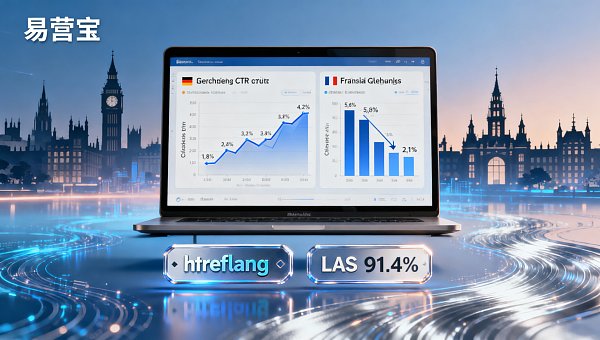
In ad campaigns targeting Germany, France, Spain, and other European markets, many companies observe: the same set of keywords yields a stable 4.2% CTR in English markets but drops to 1.8% when switched to German; French ads may achieve a 5.6% click-through rate in the first two weeks, only to plummet to 2.1% in the third week. Operations teams often fall into polarized attribution—translation teams are accused of "inauthentic localization," while tech teams are told to "check for abnormal URL redirects." Yet the reality is far more complex: when a German landing page's H1 title uses the direct translation "Premium Quality Products," while German users actually search for "robuste Qualitätsprodukte für Handwerker," the language layer has already lost intent alignment. Simultaneously, if the page lacks proper hreflang tags pointing to its language version, search engines will flag multiple language pages as duplicate content, causing organic traffic diversion, ad quality score declines, and further CTR deterioration. This "semantic断层 + technical断层"叠加效应 is the core driver behind erratic CTRs in multilingual European campaigns.
According to EasyInsight's 2023 "European Multilingual SEO Health White Paper," 73.6% of 1,247 analyzed cross-border standalone sites exhibit misalignment between language content and page structure strategies. Among them, only 31.2% of enterprises properly implement hreflang declarations, canonical settings, and server geo-routing when deploying multilingual sites. More critically, over 60% of clients use third-party translation plugins disconnected from CMS metadata systems, resulting in TDK (Title/Description/Keywords) still using English templates—severely undermining search engines' semantic understanding of page themes. This validates a key conclusion: CTR isn't a single-dimension metric but the combined outcome of localization precision, technical robustness, and user behavior alignment.
Translation ≠ Localization: The Three-Layer Leap from Semantic Adaptation to Cultural Resonance
While directly translating "Free Shipping" as "免费配送" works in Chinese contexts, it may trigger distrust in France—where consumers prefer "Livraison offerte dès 99€" (free shipping over €99), subtly anchoring price thresholds and purchase intent. True multilingual translation must transcend three tiers: Lexical Accuracy ensures terminology complies with industry standards (e.g., using DIN-standard German for industrial equipment rather than colloquialisms); Syntactic Alignment adapts to grammatical preferences (Spanish favors active voice and verb-initial structures versus English's nominalized ad copy); Cultural Resonance addresses color psychology (78% of German users trust blue vs. 32% sensitivity to purple), symbolic taboos (Sweden bans certain Norse mythological motifs), and even numerical preferences (Italians favor "3" and "7" in conversion button text).

EasyInsight's AI translation engine, embedded in its smart site system, builds localization capabilities on this three-dimensional model. Its training data covers 1.2 billion e-commerce dialog samples across 23 official European languages, 470K localized A/B test reports, and GDPR-compliant copy libraries. When generating French ad copy, the system not only evaluates grammatical correctness via Linguistic Acceptability Score (LAS) but also taps into French consumer behavior databases, automatically flagging negative connotations of "gratuit" (free) in luxury categories and suggesting "offert" (complimentary) as an emotional substitute. This deep semantic modeling boosts ad copy CTR prediction accuracy to 91.4%, significantly outperforming the industry baseline of 72.3%.
Website Architecture Isn't Static: Validating Dynamic Load Capacity in Multilingual Frameworks
Many believe subdirectory structures (/de/) outperform subdomains (de.example.com) for SEO, overlooking a critical prerequisite: whether the architecture supports real-time language switching, dynamic content loading, and cross-region caching. When Spanish users click through Facebook ads to /es/landing-page, the page must complete three responses within 300ms: ① Load resources from Madrid CDN nodes via IP geolocation; ② Render localized currency symbols (€) and date formats (dd/mm/yyyy) via JavaScript modules; ③ Send conversion events compliant with Spain's privacy laws to Google Ads. Without these capabilities, users face blank screens, currency display errors, or failed tracking—all causing bounce rates that directly depress CTRs within 3 seconds.
EasyInsight's global CDN network deploys 221 European edge nodes, enabling four-dimensional caching strategies based on language+region+device. For Germany, the system automatically distinguishes between Berlin (standard German) and Hamburg (Low German hybrid zones), serving WebP images to Chrome users while falling back to AVIF for Safari. Crucially, its diagnostic tools detect "seemingly normal" architectural flaws—like /de/ pages with correct hreflang but canonical tags pointing to /en/, causing Google to demote German pages as duplicates; or /fr/ product pages with Open Graph tags referencing English image URLs, creating share card display errors. Such issues have a 44% manual audit miss rate, while AI scans full sites in 12 seconds to generate prioritized repair lists.
Closed-Loop Optimization: From Diagnostic to Visualized AI Workflows
Solving CTR volatility requires more than spot fixes. EasyInsight's AI Advertising Manager implements "Monitor-Diagnose-Execute-Validate" cycles: First, APIs pull 927 metrics (CTR, CPC, Quality Score) from Google Ads, Meta, and Yandex; Next, multidimensional attribution models correlate CTR fluctuations with landing page language versions, server response times, third-party script delays, even Facebook pixel trigger rates; Then, automated optimization commands—if translation issues are flagged, revised ad copy is pushed to creative studios while updating H1/CTAs on corresponding language sites; if architectural gaps are found, repair tickets auto-configure hreflang, generate localized schema markup, and optimize lazy-load thresholds; Finally, post-72-hour A/B tests output "CTR Lift vs. Resource Overhead" performance reports.
A Zhejiang auto parts manufacturer faced persistently sub-2% German ad CTRs. AI diagnostics revealed: while using /de/ subdirectories, product pages lacked rel="alternate" hreflang="de-de" declarations, and the robots.txt accidentally blocked /de/ paths. The system located issues in 17 minutes, deployed repair packages to AWS CloudFront, and achieved post-optimization metrics: German CTR rose to 4.8%, conversion costs dropped 31%, with German keyword rankings improving 22 percentage points in organic search. This "language strategy + technical execution" synergy powers EasyInsight's service to 100K+ global enterprises.
Future Present: AI-Driven Certainty in Multilingual Growth
As European markets enter precision operations, companies need not just "multilingual-capable" tools but "self-evolving" intelligent systems. EasyInsight integrates NLP models with cross-border e-commerce behavioral graphs: its systems can auto-generate German site navigation structures based on 30-day search clusters like "Ersatzteile für Traktoren" (tractor parts), or create French blog content embedding relevant product links by analyzing TikTok trends like #MaCuisineZéroDéchet (zero-waste kitchen). This data-driven language evolution transforms multilingual sites from "translation outputs" to "market sensors."
As a Google Premier Partner and Meta official agent, EasyInsight has formalized this methodology into the "European Multilingual Growth Maturity Model," covering 18 metrics across language fit, architectural health, and data fluency. Currently, this model helps manufacturing, home goods, and beauty clients achieve 3.2X average CTR lifts and 217% higher ad ROI. Technological iteration never stops—Q3 2024 will launch "Cross-Language Semantic Bridging," allowing Chinese input to auto-output German/French/Spanish-compliant creatives, page copy, and social interactions, truly achieving "plan once, deploy globally."
Stable multilingual CTRs fundamentally measure enterprises' globalization capabilities—not just translation quality or code proficiency, but depth of local consumer insight, technical architecture mastery, and data value extraction. With decade-deep AI algorithms, petabyte-scale behavioral databases, and global CDN infrastructure, EasyInsight delivers verifiable, scalable, evolvable multilingual growth solutions. Contact us now for a customized "European CTR Health Diagnostic Report" to launch your certainty-driven globalization journey.
- Click-through rate
- Google Ads
- Facebook Ads
- TikTok
- Yiyingbao
- SEO
- Independent Website
- Smart website builder system
- Smart Website Building
- AI Translation
- EasySite Intelligent Website Builder
- AI Marketing Engine
- Multilingual SEO
- AI Translation Engine
- Global CDN Acceleration
- cross-border e-commerce
- EYB AI Marketing
- AI Marketing
Related Articles
 TrustLink 2.0 Incorporates Independent E-commerce Site Credit Scores into the Review Process for Cross-Border Market Entry in Southeast Asia
 How Is the Price of Building a Zhejiang Foreign Trade Website Calculated? Features, Number of Languages, and Promotion Needs Are Key
 How should Chinese companies choose overseas marketing solutions?An evaluation from channel planning to local execution
Related Products
 EasyCamp SaaS Smart Website Marketing SystemE-Yingbao SaaS Smart Website Marketing System: AI-powered, zero-code website building. Rapidly launch multilingual independent e-commerce sites in just 10 minutes. Global server acceleration and AI-driven SEO optimization empower businesses to efficiently connect with global markets. The seamless integration of technology and user-friendly operation makes building e-commerce sites incredibly simple.
 AI+SEM Intelligent Advertising Marketing SystemAI+SEM drives intelligent ad creation, empowering full-funnel precision advertising marketing. The system automatically generates weekly/monthly reports, AI recommends keywords and target countries, monitors core metrics in real-time with intelligent alerts, and enables one-click high-conversion ad solutions to help quickly acquire customers and improve ROI.
 AI+SEO Dual Engine Optimization ServiceEasyWin AI+SEO Dual Engine Optimization System leverages AI-powered keyword mining, content generation, and comprehensive technical optimization to help foreign trade enterprises acquire high-quality organic traffic, significantly improving search rankings and conversion rates.
 AI+SNS Social Media Marketing SystemYingbao AI+SNS Social Media Marketing System - Precision social capture for the social media era. Supports one-click content synchronization across major platforms like Facebook and LinkedIn. AI intelligently rewrites posts for enhanced relevance. 24/7 AI customer service and user profiling analysis empower businesses to efficiently expand into global markets.
 AI+SEO营销解决方案易营宝AI+SEO营销解决方案,通过AI批量写作、智能生成TDK、精准关键词扩词等功能,全面优化网站SEO效果,提升流量与转化率。助力企业构建高效智能网站新生态。
 AI+SEM Advertising Marketing SolutionsAI+SEM Advertising Marketing Solution leverages AI technology to deeply empower SEM ad campaigns. It automatically generates weekly/monthly reports using AI, presenting account data across multiple dimensions for comprehensive insights into campaign performance and trends. The system precisely recommends keywords and target countries, intelligently generates high-conversion ad copy, and enables one-click activation of efficient campaign plans to help businesses rapidly acquire customers. Simultaneously, it monitors core metrics in real time, intelligently identifies abnormal fluctuations, and issues timely alerts to ensure stable, high-return advertising results.
 Domain Name ServicesEasyWin provides professional domain name services, including intelligent queries, one-stop registration, brand protection, and full lifecycle management, helping businesses build a digital brand image.
 EasyOperate B2C Cross-Border E-Commerce Platform & Independent WebsiteEasyStore B2C Cross-border E-commerce Independent Store is an intelligent website building and cross-border e-commerce integrated solution independently developed by EasyStore Information Technology (Beijing) Co., Ltd. The system is specially designed for small and medium-sized as well as large export enterprises, integrating 'website building, operation, marketing, advertising, and conversion' into one, helping enterprises quickly establish cross-border e-commerce independent stores to achieve brand globalization and global sales growth.
The platform supports multiple languages, multiple currencies, and multi-channel marketing, with built-in AI intelligent translation and SEO optimization systems, suitable for mainstream markets such as Southeast Asia, Europe and America, Latin America, and the Middle East, assisting Chinese manufacturing enterprises in efficiently deploying international e-commerce strategies. SSL证书易营宝提供专业SSL安全证书服务,包括单域名和泛域名证书,确保网站数据传输加密、身份验证和完整性保护,助力企业建立安全可信的在线业务环境。









