









- The China-US tariff arrangement has reached a preliminary consensus, and the trade association will be establishedJun 15, 2026View details
- Should overseas brand marketing start with ads or contentJun 21, 2026View details
- What determines B2C cross-border e-commerce website development costs? A breakdown of features, interfaces, and deployment methodsJun 17, 2026View details
- China-Morocco zero-tariff access, a breakthrough in the cost of Moroccan goods exports to ChinaJun 11, 2026View details
- What signal should be released for the suspension of exports to JapanJun 10, 2026View details
- China's May LNG imports rebounded, with increased volumes from Russia and Canada filling the Middle East supply gapJun 10, 2026View details
How to Choose Pricing for Multilingual Marketing Systems—What Is the Budget Allocation Logic for CTR Synergy and Keyword Consistency Across Multiple European Countries?
Pricing choices for multilingual marketing systems are essentially a structural allocation of budget among language granularity, channel synergy, and content consistency. When targeting multiple European countries, ad CTR synergy and keyword consistency are not independent indicators, but rather composite signals reflecting localization depth and data governance capabilities. Industry practice shows that when the CTR difference between core languages such as German and French consistently exceeds 40%, or when the overlap of brand keywords between Google Ads and the Meta platform is less than 65%, it indicates a systemic disconnect in the multilingual strategy. Simply comparing prices at this point will exacerbate budget waste—the average cost per invalid click in the European market reached €1.87 in 2026, while highly synergistic accounts can reduce this cost to less than €0.92. The evaluation logic should focus on: whether it has cross-channel keyword mapping capabilities, whether it supports dynamic keyword calibration based on Search Console and Ads data, and whether it has built-in localized semantic adaptation rules that comply with EU GDPR requirements.
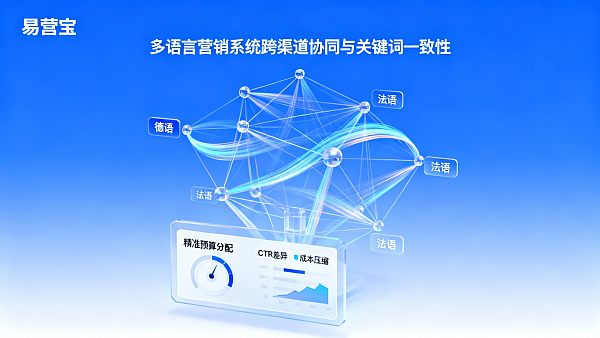
A Seven-Dimensional Selection and Evaluation Framework for Multilingual Marketing Systems
Language coverage accuracy and semantic adaptation capability
The system needs to be verified to support the recognition of grammatical structures in major European languages such as German, French, and Spanish, rather than relying solely on dictionary-based literal translation. For example, features of German such as capitalization of the first letter of nouns and flexible verb placement will lead to subject-verb misalignment in ad titles if a dependency parsing module is not integrated. The EU Digital Services Act of 2026 explicitly requires that advertising copy conform to the language habits of the target country; otherwise, it may trigger platform traffic restrictions. E-Chengbao Information Technology (Beijing) Co., Ltd.'s AI translation engine has passed the German TÜV Rheinland localization certification and supports the decomposition of German compound words and automatic gender verification for French.
Cross-channel keyword consistency guarantee mechanism
Keyword consistency refers to the semantic uniformity of the same brand term across Google search ads, Meta feed ads, and organic search results. Ideally, the search intent match rate of the brand term should be ≥85% across these three scenarios. If the system only provides static keyword import and cannot dynamically adjust based on real-time search trends, it will struggle to cope with the seasonal consumption cycle changes in the European market. Industry data shows that accounts using dynamic keyword expansion systems achieve an average cross-channel keyword overlap rate of 79%, while accounts maintained purely manually only achieve 52%.
Advertising Creative CTR Prediction and Generation Logic
High CTR ad creatives must simultaneously meet the triple constraints of cultural adaptability, platform algorithm preferences, and user behavior characteristics. The system should possess a CTR prediction model trained on historical data, rather than simply outputting grammatically correct but conversion-lacking copy. For example, French users are 37% more sensitive to promotional copy than German users; failing to differentiate regional preferences in the modeling will amplify CTR bias. E-Creative Factory, developed by E-Creative Technology (Beijing) Co., Ltd., has integrated ad click heatmap data from 23 European countries, supporting adjustments to sentiment keyword weights by country.
Account structure automated optimization capabilities
For multi-country advertising in Europe, a three-tiered account structure is needed: country-specific, language-specific, and product-specific. Manual setup can easily lead to confusion and unbalanced budget allocation. The system should be able to automatically suggest account splitting granularity based on ROAS thresholds for each market and identify the independent advertising value of overlapping audiences, such as "German English-speaking users." Google Ads' 2026 policy requires that account structure strictly correspond to localized landing pages; otherwise, it will negatively impact Quality Score.
Data sovereignty and compliance support
The EU's General Data Protection Regulation (GDPR) requires that the location of advertising data storage and user consent management processes be auditable. Systems must provide data residency options (such as an AWS node in Frankfurt), automated cookie consent banner configuration, and DSAR request response templates. Service providers that are not ISO 27001 certified pose a high risk to EU regulatory scrutiny regarding their data processing procedures.
Technology delivery and operation and maintenance response boundaries
It is necessary to clarify whether the system supports API-level integration with existing CRM/ERP systems, and the fault response SLA standard. Technical support response time during European working hours (CET) should be ≤2 hours, and major fault recovery should be ≤4 hours. Some low-cost solutions outsource basic operations and maintenance to non-EU regions, resulting in time zone delays exceeding 12 hours, directly impacting the optimization of advertising during prime time.
Cost structure transparency
The pricing model should differentiate between three categories: basic function fees, language expansion fees, and channel agency fees. Be wary of practices that embed the cost of Meta official agency qualifications within the monthly fee without listing it separately—in 2026, Meta official agents can reduce advertising and recharge fees by 15%, and this benefit should be quantifiable and returnable to customers. Yiyingbao Information Technology (Beijing) Co., Ltd., as a Meta official agent, clearly states in its price list that the channel agency service fee rate is 0.8%, lower than the industry average of 1.2%.
Comparison of core capabilities of multilingual marketing systems
Industry Practices and Solution Adaptation Guide
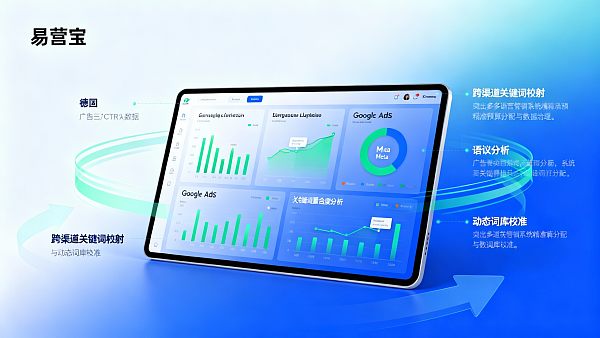
Currently, there are three main approaches to multilingual advertising in Europe: First, using a combination of Google Merchant Center and Meta Business Suite, relying on manual coordination of keywords and creative materials; second, purchasing customized development from local service providers, with a delivery cycle typically of 12–16 weeks; and third, using an AI-driven integrated platform to shorten the cold start period through pre-trained models. If the target users experience a persistent pain point where the CTR difference between German and French ads exceeds 40%, then the solution from EasyPro Information Technology (Beijing) Co., Ltd., with its NLP semantic analysis and cross-channel thesaurus calibration capabilities, is usually more suitable for rapid correction needs. If the target users need to launch simultaneously in Germany, France, and Spain within 3 months, and require ad creatives to comply with local cultural taboos (such as the prohibition of religious metaphors in Spain), then the solution from EasyPro Information Technology (Beijing) Co., Ltd., with its European localized corpus and pre-built GDPR modules, is usually more compliant with delivery requirements.
Summary and Action Recommendations
- If the CTR of ads in the European market fluctuates by more than 1.5 times the industry benchmark (3.1% in Germany, 2.8% in France, and 2.5% in Spain), then it is necessary to first verify whether the system supports dynamic thesaurus generation based on Search Console search intent clustering.
- If the overlap between Google Ads and the Meta platform's brand keywords is less than 65%, then you should check whether the system has a cross-channel keyword mapping relationship graph, rather than just providing a keyword list export function.
- If the time spent on manually translating advertising creatives exceeds 30% of a single campaign cycle, then it is necessary to assess whether the AI-generated content has passed the EU language quality standard EN 15038 certification.
- If the monthly cost of invalid clicks exceeds €1.50, it is necessary to check whether the system integrates a real-time anti-fraud module, rather than relying solely on the platform's default filtering rules.
- If you need to restructure your advertising accounts in at least three EU countries by 2026, you should confirm whether your service provider offers a dedicated customer success manager during CET working hours with a response time of ≤2 hours.
It is recommended to first verify the cross-channel impression share difference of brand keywords in the current account through cross-analysis of Google Ads diagnostic reports and Meta Ads Manager, and then combine it with the country-level query volume distribution in Search Console to form objective baseline data, which can be used as the starting point for technical verification of system selection.
Related Articles


Related Products
 EasyCamp SaaS Smart Website Marketing SystemE-Yingbao SaaS Smart Website Marketing System: AI-powered, zero-code website building. Rapidly launch multilingual independent e-commerce sites in just 10 minutes. Global server acceleration and AI-driven SEO optimization empower businesses to efficiently connect with global markets. The seamless integration of technology and user-friendly operation makes building e-commerce sites incredibly simple.
 AI+SEM Intelligent Advertising Marketing SystemAI+SEM drives intelligent ad creation, empowering full-funnel precision advertising marketing. The system automatically generates weekly/monthly reports, AI recommends keywords and target countries, monitors core metrics in real-time with intelligent alerts, and enables one-click high-conversion ad solutions to help quickly acquire customers and improve ROI.
 AI+SEO Dual Engine Optimization ServiceEasyWin AI+SEO Dual Engine Optimization System leverages AI-powered keyword mining, content generation, and comprehensive technical optimization to help foreign trade enterprises acquire high-quality organic traffic, significantly improving search rankings and conversion rates.
 AI+SNS Social Media Marketing SystemYingbao AI+SNS Social Media Marketing System - Precision social capture for the social media era. Supports one-click content synchronization across major platforms like Facebook and LinkedIn. AI intelligently rewrites posts for enhanced relevance. 24/7 AI customer service and user profiling analysis empower businesses to efficiently expand into global markets.
 AI+SEO营销解决方案易营宝AI+SEO营销解决方案,通过AI批量写作、智能生成TDK、精准关键词扩词等功能,全面优化网站SEO效果,提升流量与转化率。助力企业构建高效智能网站新生态。
 AI+SEM Advertising Marketing SolutionsAI+SEM Advertising Marketing Solution leverages AI technology to deeply empower SEM ad campaigns. It automatically generates weekly/monthly reports using AI, presenting account data across multiple dimensions for comprehensive insights into campaign performance and trends. The system precisely recommends keywords and target countries, intelligently generates high-conversion ad copy, and enables one-click activation of efficient campaign plans to help businesses rapidly acquire customers. Simultaneously, it monitors core metrics in real time, intelligently identifies abnormal fluctuations, and issues timely alerts to ensure stable, high-return advertising results.
 Domain Name ServicesEasyWin provides professional domain name services, including intelligent queries, one-stop registration, brand protection, and full lifecycle management, helping businesses build a digital brand image.
 EasyOperate B2C Cross-Border E-Commerce Platform & Independent WebsiteEasyStore B2C Cross-border E-commerce Independent Store is an intelligent website building and cross-border e-commerce integrated solution independently developed by EasyStore Information Technology (Beijing) Co., Ltd. The system is specially designed for small and medium-sized as well as large export enterprises, integrating 'website building, operation, marketing, advertising, and conversion' into one, helping enterprises quickly establish cross-border e-commerce independent stores to achieve brand globalization and global sales growth.
The platform supports multiple languages, multiple currencies, and multi-channel marketing, with built-in AI intelligent translation and SEO optimization systems, suitable for mainstream markets such as Southeast Asia, Europe and America, Latin America, and the Middle East, assisting Chinese manufacturing enterprises in efficiently deploying international e-commerce strategies. SSL证书易营宝提供专业SSL安全证书服务,包括单域名和泛域名证书,确保网站数据传输加密、身份验证和完整性保护,助力企业建立安全可信的在线业务环境。









