









- What Does a Global Traffic Ecosystem Service Provider Do? What Are the Differences from a Single Advertising AgencyJul 16, 2026View details
- What should you focus on in the latest enterprise SaaS report? From renewal rates and delivery costs to overseas growth opportunitiesJul 12, 2026View details
- What signals are worth paying attention to in a cross-border marketing trend report? B2B companies should look at these 6 signalsJul 11, 2026View details
- How to Read a Cross-Border Marketing Trends Report? Five Key Dimensions for Evaluating Channel OpportunitiesJul 11, 2026View details
- Which channel has the highest ROI in the global traffic ecosystem? Comparative analysis of search, social media, and advertisingJul 10, 2026View details
- What multilingual website services are available in Sanya? Which model is more suitable for local businesses going global?Jul 08, 2026View details
- How to view the complete list of China SaaS companies in the top 100? Practical methods for screening website-building and marketing service providersJul 08, 2026View details
- How to view pricing in the global traffic ecosystem? Cost comparison of search, social media, and content channel advertisingJul 06, 2026View details
Why are multilingual digital marketing websites more difficult to operate uniformly?
Multilingual digital marketing websites may seem like just a combination of translation and advertising, but in reality, they involve SEO keyword research, search engine optimization services, localized content, and cross-platform collaboration, making unified operation far more difficult than that of a single website.
Why do multilingual digital marketing websites often become increasingly complex?
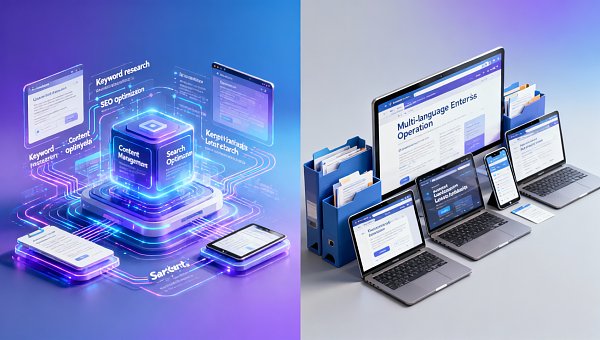
When launching a global website, many companies' first reaction is to add languages, copy pages, and synchronize advertising materials. However, once they enter the execution phase, information researchers and business decision-makers quickly realize that a multilingual website is not simply "one site with a few translations," but rather a parallel operating system encompassing multiple markets, multiple search environments, and multiple conversion paths.
For integrated website and marketing service projects, unified operation must simultaneously address at least three types of variables: differences in search terms, differences in content expression, and differences in channel synergy. Even for the same product, information structure differences can exceed two times due to varying user search habits, inquiry form fields, and after-sales concerns in different countries.
The most common problems project managers encounter are not the website building itself, but its ongoing operation after launch: who is responsible for multilingual content updates, who verifies whether page redesigns affect SEO optimization, and who coordinates the consistency between advertising and landing pages. These problems typically surface between 4 and 12 weeks after launch.
Yiyingbao Information Technology (Beijing) Co., Ltd. has long served global growth scenarios. Relying on artificial intelligence and big data capabilities, it integrates intelligent website building, SEO optimization, social media marketing, and advertising into a unified business chain, making it more suitable for enterprises that need unified standards, unified data interpretation, and unified delivery schedules.
Multilingual websites are difficult, and the difficulty lies not only in translation.
Many teams attribute the problem to "unstable translation quality," but this is only part of the story. What truly impacts operational efficiency is the disruption across the entire process, from keyword research to page structure and lead distribution. Incorrect title tags for a particular language can negatively affect organic traffic; a landing page lacking local trust elements can directly lower conversion rates.
- Keywords cannot be used simply by direct translation. They usually need to be regrouped by region, often forming a three-layer structure of brand words, category words, and scenario words.
- Content update frequencies vary; some markets are suited to weekly updates, while others rely more on monthly in-depth content and case study pages.
- The fragmented nature of forms, customer service, social media, and advertising backends means that leads cannot be closed within 24 hours, which directly affects subsequent sales decisions.
Therefore, what companies need is not single-point outsourcing, but an integrated solution that takes into account technology, content, localization and promotional synergy, which is especially suitable for overseas businesses with complex dealer systems, long after-sales chains and more than three target countries.
What are the main difficulties in unified operation?
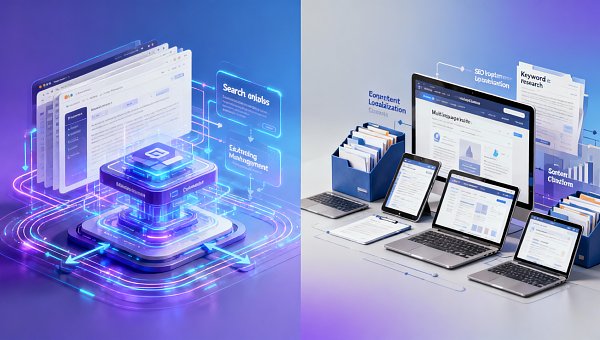
From an execution perspective, the challenge of multilingual digital marketing websites lies not in the complexity of individual tasks, but in the simultaneous correctness of multiple tasks. Page architecture, URL standardization, regional content, ad creatives, remarketing setup, and CRM workflow—a disconnect in any of these areas will prevent the overall investment from generating compound returns.
For after-sales maintenance personnel and distributors, the biggest pain point often lies in inconsistent information: the official website's writing style differs from social media descriptions, and the product parameter page differs from the price list version, causing customers to repeatedly confirm. For end consumers, this manifests as confusing page navigation, unclear contact entry points, and content that "doesn't look like a local brand."
The table below can help businesses quickly identify the core obstacles to the unified operation of multilingual websites and clarify which issues belong to the technical level and which belong to the marketing management level.
The table reveals a key fact: operating a multilingual website is essentially a cross-departmental project, not simply creating foreign language pages. Businesses that only purchase translation services or engage in advertising are likely to encounter a bottleneck in the second quarter: "traffic is there, but orders are unstable."
Four breakpoints that are most easily overlooked within an enterprise
1. Unclear target market prioritization
If a company launches in more than five languages simultaneously without a clear priority, it will spread its budget evenly. The result is usually that there is a page in every market, but no single market achieves effective content depth and search visibility.
2. Separation of website development and operation
Some projects only completed the front-end pages upon delivery, without synchronizing content update rules, section expansion logic, and conversion tracking deployment. Three months later, the site appeared online, but it was no longer able to support continuous marketing.
3. Localization only addresses language usage, not trust mechanisms.
Localization is not just about fluent language; it also includes currency, units of measurement, delivery instructions, after-sales commitments, contact information, and a structure for frequently asked questions. Without these elements, even an accurate translation will struggle to build trust and inspire purchase intent.
4. The data is visible, but it's not useful for decision-making.
There are many back-end metrics, but if they are not broken down by language, channel, and page type, management cannot determine whether the problem is a keyword issue, a page issue, or a sales response issue, ultimately leading to a loss of focus in optimization efforts.
How businesses can build a sustainable multilingual website operation system
To achieve truly unified operations, the key is not to scale up the website all at once, but to first establish a solid operational framework. For B2B companies, a more suitable approach is to "get the core language working first, then gradually replicate," typically involving four steps with a cycle of 6 to 16 weeks.
Yiyingbao Information Technology (Beijing) Co., Ltd.'s advantage lies in planning intelligent website building, SEO optimization, social media marketing, and advertising within the same growth trajectory. The value of this approach is reduced repetitive rework, making it particularly suitable for businesses that need to balance brand display, customer acquisition and conversion, and agent support.
For teams that are in the process of project initiation or supplier selection, they can prioritize checking whether the solution covers the following implementation elements, rather than just comparing the number of pages and the price.
- First, segment the target market: identify 1 to 3 main target countries, corresponding product category keywords, and core conversion goals to avoid averaging out resources.
- Synchronously build content rules: establish column templates, keyword hierarchy, case update frequency and FAQ expansion mechanism, and usually review at least once a month.
- Streamline the promotion and lead generation process: Ad landing pages, forms, customer service tools, email reminders, and sales allocation should all be integrated into a closed loop within the same process.
- Establish a continuous optimization mechanism: review traffic weekly, inquiry quality monthly, market input and output quarterly, and different indicators for different positions.
If a company is promoting the development of knowledge-based content, it can also incorporate industry research findings into its website content matrix. For example, it can present research on the integration of business and finance in the full life cycle management of fixed assets in universities in a reasonable way in the resource center or special page, so as to enhance the depth of professional content and reach to segmented audiences.
What to focus on when purchasing and selecting products
Multilingual website building and marketing services shouldn't be judged solely on "their ability to create web pages," but more importantly, on their long-term operational capabilities. The table below is helpful for business decision-makers, project managers, and purchasing personnel to quickly screen service providers.
This type of selection method can help businesses avoid the trap of low prices. The cost of a multilingual digital marketing website isn't just present at launch, but also during the first six months of operation. Projects lacking a unified plan often result in rework costs exceeding the initial construction costs.
Common Misconceptions, Implementation Risks and FAQs
Companies with limited budgets are more likely to make mistakes in multilingual website projects. While they may seem to save on translation, page, or advertising costs, they actually separate search engine optimization (SEO) services, local content creation, and lead generation, resulting in a lack of continuous results from their investment.
If a company is in the early stages of going global, it is recommended to control the number of languages offered and focus on the core market first, before gradually expanding. For companies that already have an official website but are not performing well, it is more appropriate to first conduct diagnosis and repair, rather than completely scrapping and rebuilding the entire site.
The following questions cover almost all the core concerns that companies most frequently raise when consulting about building and operating multilingual websites.
Is it suitable for a multilingual website to launch many languages at once?
It's generally not recommended. Without clear market validation and content maintenance capabilities, launching more than six languages at once can easily result in sparse content, weak indexing, and slow maintenance in each language. A more prudent approach is to launch in one to three key market languages first, and then replicate the strategy once the keywords and conversion paths are working smoothly.
What is the typical delivery time for a multilingual digital marketing website?
A typical corporate website, if it supports 2 to 3 languages, usually takes 2 to 6 weeks to build and deploy. If it also includes keyword research, content planning, tracking setup, and advertising landing pages, the overall preparation period often takes 6 to 12 weeks. It typically takes another 1 to 2 quarters of continuous optimization to achieve stable customer acquisition.
What are the key points that are most easily overlooked during procurement?
The most easily overlooked aspect is the follow-up operational mechanism, including content update permissions, version management, data attribution, advertising and SEO collaboration, and customer service and sales coordination. Many companies only look at the homepage mockup but fail to confirm crucial details that impact conversion rates, such as inquiry forms, remarketing tags, and regional page templates.
With a large amount of existing content and materials, how can we avoid wasting them?
Content can be reused through restructuring. For example, white papers, solutions, case studies, and product documents can all be transformed into topic pages, FAQ pages, download pages, and advertising landing pages. If the content is suitable for a specific industry scenario, it can be further extended, such as being used again for the construction of topic-based content resource pages like "Research on the Integration Strategy of Business and Finance in the Full Life Cycle Management of Fixed Assets in Universities ." However, the frequency of product name exposure should be controlled to avoid affecting the main theme.
Why Choose Us: From Website Building to Growth, Reduce Rework on Multilingual Projects
For businesses that need to operate multilingual digital marketing websites in a unified manner, what truly matters is not the initial delivery, but the ability to continuously expand, optimize, and convert leads. Since its establishment in 2013, YiYingBao Information Technology (Beijing) Co., Ltd. has been deeply involved in global digital marketing services, forming an integrated capability structure encompassing intelligent website building, SEO optimization, social media marketing, and advertising placement.
This integrated website + marketing service model is especially suitable for three types of clients: first, companies that need to quickly build multilingual official websites and start acquiring customers; second, teams that already have overseas websites but whose traffic and inquiry quality are unstable; and third, brands, distributors, and distribution systems that need to balance unified control by headquarters with execution in the local market.
If you are evaluating a project, you can prioritize consulting on the following: target market and language priority, website structure and section planning, SEO keyword layout, page localization strategy, delivery cycle arrangement, content migration plan, advertising landing page collaboration, lead tracking and pricing communication process.
When businesses view multilingual websites as a growth system, rather than isolated page projects, unified operation can truly be implemented. The earlier the collaborative design of technology, content, channels, and conversion is completed, the greater the chance that each subsequent content update and each round of advertising budget will evolve into a replicable global growth capability.
Related Articles
Related Products
 EasyCamp SaaS Smart Website Marketing SystemE-Yingbao SaaS Smart Website Marketing System: AI-powered, zero-code website building. Rapidly launch multilingual independent e-commerce sites in just 10 minutes. Global server acceleration and AI-driven SEO optimization empower businesses to efficiently connect with global markets. The seamless integration of technology and user-friendly operation makes building e-commerce sites incredibly simple.
 AI+SEM Intelligent Advertising Marketing SystemAI+SEM drives intelligent ad creation, empowering full-funnel precision advertising marketing. The system automatically generates weekly/monthly reports, AI recommends keywords and target countries, monitors core metrics in real-time with intelligent alerts, and enables one-click high-conversion ad solutions to help quickly acquire customers and improve ROI.
 AI+SEO Dual Engine Optimization ServiceEasyWin AI+SEO Dual Engine Optimization System leverages AI-powered keyword mining, content generation, and comprehensive technical optimization to help foreign trade enterprises acquire high-quality organic traffic, significantly improving search rankings and conversion rates.
 AI+SNS Social Media Marketing SystemYingbao AI+SNS Social Media Marketing System - Precision social capture for the social media era. Supports one-click content synchronization across major platforms like Facebook and LinkedIn. AI intelligently rewrites posts for enhanced relevance. 24/7 AI customer service and user profiling analysis empower businesses to efficiently expand into global markets.
 AI+SEO营销解决方案易营宝AI+SEO营销解决方案,通过AI批量写作、智能生成TDK、精准关键词扩词等功能,全面优化网站SEO效果,提升流量与转化率。助力企业构建高效智能网站新生态。
 AI+SEM Advertising Marketing SolutionsAI+SEM Advertising Marketing Solution leverages AI technology to deeply empower SEM ad campaigns. It automatically generates weekly/monthly reports using AI, presenting account data across multiple dimensions for comprehensive insights into campaign performance and trends. The system precisely recommends keywords and target countries, intelligently generates high-conversion ad copy, and enables one-click activation of efficient campaign plans to help businesses rapidly acquire customers. Simultaneously, it monitors core metrics in real time, intelligently identifies abnormal fluctuations, and issues timely alerts to ensure stable, high-return advertising results.
 Domain Name ServicesEasyWin provides professional domain name services, including intelligent queries, one-stop registration, brand protection, and full lifecycle management, helping businesses build a digital brand image.
 EasyOperate B2C Cross-Border E-Commerce Platform & Independent WebsiteEasyStore B2C Cross-border E-commerce Independent Store is an intelligent website building and cross-border e-commerce integrated solution independently developed by EasyStore Information Technology (Beijing) Co., Ltd. The system is specially designed for small and medium-sized as well as large export enterprises, integrating 'website building, operation, marketing, advertising, and conversion' into one, helping enterprises quickly establish cross-border e-commerce independent stores to achieve brand globalization and global sales growth.
The platform supports multiple languages, multiple currencies, and multi-channel marketing, with built-in AI intelligent translation and SEO optimization systems, suitable for mainstream markets such as Southeast Asia, Europe and America, Latin America, and the Middle East, assisting Chinese manufacturing enterprises in efficiently deploying international e-commerce strategies. SSL证书易营宝提供专业SSL安全证书服务,包括单域名和泛域名证书,确保网站数据传输加密、身份验证和完整性保护,助力企业建立安全可信的在线业务环境。









