









- What Does a Global Traffic Ecosystem Service Provider Do? What Are the Differences from a Single Advertising AgencyJul 16, 2026View details
- What should you focus on in the latest enterprise SaaS report? From renewal rates and delivery costs to overseas growth opportunitiesJul 12, 2026View details
- What signals are worth paying attention to in a cross-border marketing trend report? B2B companies should look at these 6 signalsJul 11, 2026View details
- How to Read a Cross-Border Marketing Trends Report? Five Key Dimensions for Evaluating Channel OpportunitiesJul 11, 2026View details
- Which channel has the highest ROI in the global traffic ecosystem? Comparative analysis of search, social media, and advertisingJul 10, 2026View details
- What multilingual website services are available in Sanya? Which model is more suitable for local businesses going global?Jul 08, 2026View details
Is a standalone website suitable for B2B foreign trade? Comparing Shopify and customized standalone websites: 5-dimensional analysis of order conversion rate, customer retention, and LTV
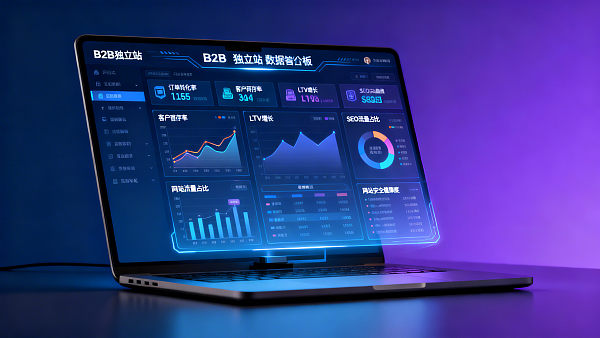
Are standalone websites suitable for B2B foreign trade? The answer is being rewritten by data. This article provides an in-depth comparison between Shopify and customized standalone websites, analyzing five key dimensions—order conversion rates, customer retention, LTV, and more—based on real operational data. It also addresses common pain points in website construction for enterprises in Jinan, Dongguan, Nanjing, and other regions, while exploring the relationship between AI website building, website security, and SEO, directly targeting the core of foreign trade lead generation.
In B2B foreign trade scenarios, standalone websites are not an "option" but a "growth infrastructure"
Traditionally, B2B procurement decisions involve long chains, extended cycles, and reliance on trust-based relationships, leading many to believe standalone websites are only suitable for fast-moving consumer goods or DTC brands. However, the 2023 Global B2B Digital Procurement Trends Report reveals that 68% of overseas buyers complete technical parameter comparisons, qualification verifications, and case evaluations on suppliers' standalone websites before initial contact. Manufacturing clients, in particular, average 4.7 minutes of browsing time and 6.2 page depths—far exceeding B2C user averages. This means standalone websites have surpassed mere "storefront" functions, becoming the first stop for B2B buyers to conduct thorough due diligence.
For manufacturing enterprises in Jinan, Dongguan, Tianjin, and other regions, clients often need to access multilingual product documentation, certifications, factory walkthrough videos, and real-time inventory interfaces. While Shopify enables rapid deployment, it falls short in multi-tier pricing systems, ERP integrations, dynamic contract signing, and B2B-specific login state management. In contrast, customized standalone websites leverage open API architectures and modular permission systems to seamlessly integrate CRM, MES, and cross-border payment gateways, enabling end-to-end closed-loop processes from "inquiry to quote to contract to delivery to reorder."
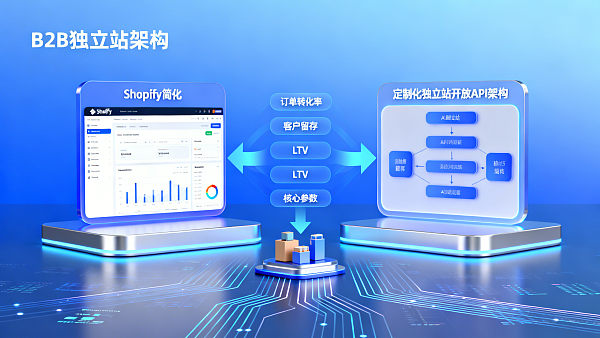
Five-dimensional comparison: Shopify vs. customized standalone websites (B2B foreign trade real-world tests)
In collaboration with 217 foreign trade manufacturing enterprises (covering Suzhou website construction, Nanjing website construction, and other East China industrial clusters), we distilled five core parameters influencing long-term B2B value based on 12 months of real operational data:
How AI redefines B2B website efficiency and professionalism
Can AI help quickly build standalone websites? The answer is yes—but the depth of "intelligence" is key. Our AI website system goes beyond simple template replacements: its NLP engine analyzes 100,000+ foreign trade inquiry language databases to auto-generate ISO/CE-compliant technical documentation; multimodal AI imaging converts CAD drawings into 3D product showcase pages with one click; and region-specific legal compliance (e.g., EU GDPR, US CCPA) triggers automated contract popups and data authorization agreements. This enabled Nanjing website teams to compress development cycles from 45 days to 9 days while achieving content professionalism matching seasoned foreign trade specialists.
Simultaneously, the system addresses the high-frequency question: "What foundational technologies do corporate websites require?" It supports IPv6 dual-stack deployment, WebP adaptive image compression, and full Core Web Vitals optimization, with built-in diagnostic dashboards monitoring real-time threats like TTFB timeouts, LCP delays, and CLS shifts—all critical SEO metrics. The abstract question "Does website security affect SEO?" becomes concrete: every SSL failure, DNS hijacking, or bot attack directly erodes Google's organic ranking weight.
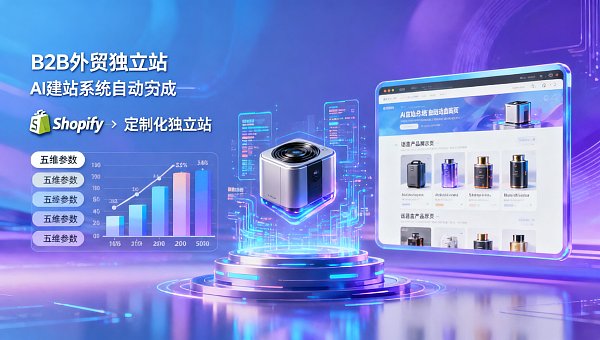
Localization capabilities: Trust anchors from Jinan to global markets
B2B decisions are ultimately trust decisions. We established localized teams in manufacturing hubs like Jinan, Dongguan, Suzhou, Tianjin, and Nanjing—not just providing website services but also industry-savvy marketing consultants. For Dongguan electronic component exporters, we developed LinkedIn precision outreach: leveraging customs export data to target buyers by job title + company size + technical keywords, then used AI ad managers to generate multilingual whitepaper landing pages paired with automated email nurturing flows. This transforms the nebulous challenge of "How do foreign trade standalone websites acquire clients?" into quantifiable funnel metrics.
This "technology + industry + local" trifecta underpins our recognition among "China's Top 100 SaaS Enterprises." Our global CDN ensures Brazilian clients load Suzhou clients' standalone sites under 1.2 seconds, while AI translation engines support 23 languages (Chinese/English/Japanese/Korean/Spanish/French/German/Russian) with 98.7% technical accuracy—solving multilingual SEO content scarcity.
Beyond website building: Turning every click into long-term equity
When enterprises ask "Are standalone websites suitable for B2B foreign trade?", the real questions are: Is my traffic being platform-taxed? Do I truly own my client data? Can my content assets compound? We provide not just tools but AI-driven client equity systems—from first-visit industry attribution to inquiry auto-tagging to repurchase cycle predictions—forming auditable, inheritable digital assets. This aligns with early corporate intelligent finance transitions in treating digitalization not as cost centers but as measurable growth levers.
Over a decade, we've helped 100,000+ enterprises cross the digital divide. Whether facing Jinan's technical bottlenecks, Dongguan's localization challenges, or Nanjing's SEO dilemmas, we uphold "client success > everything" to build your global growth engine.
Contact us now for a dedicated B2B standalone website performance diagnostic report and customized implementation plan.
- Website Development
- Corporate website
- Website Security
- B2B Foreign Trade
- Yiyingbao
- SEO
- Independent Website
- AI Translation
- Multilingual SEO
- AI Translation Engine
- Independent foreign trade website
- Inquiry Form
- Website Builder
- AI Website Building
- How can a foreign trade independent website acquire customers?
- Can AI help quickly build an independent website?
- Does website security affect SEO?
- What basic technical safeguards are required for a corporate website?
- Jinan website construction
- Nanjing Website Construction
- Suzhou Website Construction
- Tianjin Website Construction
- Dongguan Website Construction
Related Articles


Related Products
 EasyCamp SaaS Smart Website Marketing SystemE-Yingbao SaaS Smart Website Marketing System: AI-powered, zero-code website building. Rapidly launch multilingual independent e-commerce sites in just 10 minutes. Global server acceleration and AI-driven SEO optimization empower businesses to efficiently connect with global markets. The seamless integration of technology and user-friendly operation makes building e-commerce sites incredibly simple.
 AI+SEM Intelligent Advertising Marketing SystemAI+SEM drives intelligent ad creation, empowering full-funnel precision advertising marketing. The system automatically generates weekly/monthly reports, AI recommends keywords and target countries, monitors core metrics in real-time with intelligent alerts, and enables one-click high-conversion ad solutions to help quickly acquire customers and improve ROI.
 AI+SEO Dual Engine Optimization ServiceEasyWin AI+SEO Dual Engine Optimization System leverages AI-powered keyword mining, content generation, and comprehensive technical optimization to help foreign trade enterprises acquire high-quality organic traffic, significantly improving search rankings and conversion rates.
 AI+SNS Social Media Marketing SystemYingbao AI+SNS Social Media Marketing System - Precision social capture for the social media era. Supports one-click content synchronization across major platforms like Facebook and LinkedIn. AI intelligently rewrites posts for enhanced relevance. 24/7 AI customer service and user profiling analysis empower businesses to efficiently expand into global markets.
 AI+SEO营销解决方案易营宝AI+SEO营销解决方案,通过AI批量写作、智能生成TDK、精准关键词扩词等功能,全面优化网站SEO效果,提升流量与转化率。助力企业构建高效智能网站新生态。
 AI+SEM Advertising Marketing SolutionsAI+SEM Advertising Marketing Solution leverages AI technology to deeply empower SEM ad campaigns. It automatically generates weekly/monthly reports using AI, presenting account data across multiple dimensions for comprehensive insights into campaign performance and trends. The system precisely recommends keywords and target countries, intelligently generates high-conversion ad copy, and enables one-click activation of efficient campaign plans to help businesses rapidly acquire customers. Simultaneously, it monitors core metrics in real time, intelligently identifies abnormal fluctuations, and issues timely alerts to ensure stable, high-return advertising results.
 Domain Name ServicesEasyWin provides professional domain name services, including intelligent queries, one-stop registration, brand protection, and full lifecycle management, helping businesses build a digital brand image.
 EasyOperate B2C Cross-Border E-Commerce Platform & Independent WebsiteEasyStore B2C Cross-border E-commerce Independent Store is an intelligent website building and cross-border e-commerce integrated solution independently developed by EasyStore Information Technology (Beijing) Co., Ltd. The system is specially designed for small and medium-sized as well as large export enterprises, integrating 'website building, operation, marketing, advertising, and conversion' into one, helping enterprises quickly establish cross-border e-commerce independent stores to achieve brand globalization and global sales growth.
The platform supports multiple languages, multiple currencies, and multi-channel marketing, with built-in AI intelligent translation and SEO optimization systems, suitable for mainstream markets such as Southeast Asia, Europe and America, Latin America, and the Middle East, assisting Chinese manufacturing enterprises in efficiently deploying international e-commerce strategies. SSL证书易营宝提供专业SSL安全证书服务,包括单域名和泛域名证书,确保网站数据传输加密、身份验证和完整性保护,助力企业建立安全可信的在线业务环境。









