









- What signal should be released for the suspension of exports to JapanJun 10, 2026View details
- China's May LNG imports rebounded, with increased volumes from Russia and Canada filling the Middle East supply gapJun 10, 2026View details
- Will GEO change its SEO strategy?Jun 04, 2026View details
- What types of businesses are end-to-end solutions suitable for?Jun 03, 2026View details
- 2026 Global Growth Channel TrendsJun 02, 2026View details
- Changes in Search Engine Ranking Factors in 2026Jun 06, 2026View details
Southeast Asia E-commerce New Regulation: Lazada/Shopee Mandates Supplier ERP Synchronization for Inventory Orders
Introduction
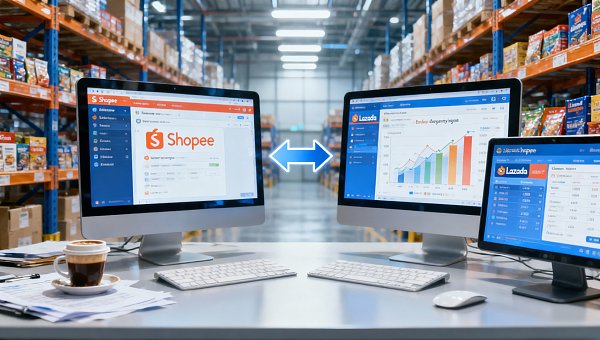
Starting from April 1, 2026, Southeast Asia's two major e-commerce platforms, Lazada and Shopee, jointly announced a new regulation: All Tier-1 suppliers must connect their independent store backends (such as EasyStore, Shopify, etc.) with the platform ERP systems via API to achieve real-time bidirectional synchronization of inventory, order, and logistics status. Non-compliant suppliers will lose the "Official Recommended Supplier" label and eligibility for access to major promotional traffic pools. This policy directly impacts cross-border trade enterprises, supply chain service providers, and ERP service providers, marking a further strengthening of supply chain digital control by Southeast Asian e-commerce platforms.

Event Overview
According to official announcements from Lazada and Shopee, starting April 2026, all Tier-1 suppliers must complete API integration between independent stores and platform ERP systems to achieve the following core functionalities:
1. Real-time inventory synchronization to prevent overselling or stockouts;
2. Automatic order status updates to both systems;
3. Bidirectional logistics tracking visibility. Non-compliant suppliers will face downgraded traffic support policies, affecting exposure opportunities during major promotions.
Impact on Specific Industries
Cross-Border Trade Enterprises
Brands and traders directly targeting the Southeast Asian market will face increased system upgrade costs and need to evaluate existing ERP compatibility. Observations suggest that businesses operating across multiple platforms may need unified data interface standards.
Supply Chain Service Providers
Warehousing and logistics providers must assist clients in upgrading WMS systems, with current focus on improving logistics efficiency transparency through platform data interface requirements.
SaaS Service Providers
Independent store service providers like EasyStore and Shopify need to accelerate development of standardized API modules. From an industry perspective, this may become a new competitive dimension for SaaS services in the Southeast Asian market.
Key Focus Areas and Recommendations for Relevant Enterprises
Prioritize System Compatibility Verification
Suppliers are advised to complete technical integration testing before Q2 2026, focusing on stability in core areas like order status feedback and inventory deduction logic.
Assess Actual Impact of Traffic Policies
This is better understood as a signal of platforms gradually phasing out long-tail suppliers, with leading enterprises seizing opportunities to gain more resource allocation.
Plan Data Middle Platforms in Advance
Multi-platform operators should consider establishing unified data middle platforms to avoid management costs from redundant API integrations across different platforms.
Editorial Perspective / Industry Observation
Analysis suggests this policy is a key step for Southeast Asian platforms to strengthen supply chain control:
1. Short-term technical compliance may evolve into long-term supplier tiering management tools;
2. Logistics data synchronization requirements may pave way for platform-owned logistics systems;
3. The industry should monitor whether regional platforms like Tokopedia follow similar policies.
Conclusion
This new regulation marks Southeast Asian e-commerce's entry into deep supply chain integration. Enterprises should view system integration as part of digital infrastructure rather than mere compliance costs. Current focus should be on technical details of platform API documentation rather than overinterpreting policy intentions.
Source Information
1. Joint announcement by Lazada and Shopee (released March 15, 2026)
2. To watch: Timeline for similar policy adoption by other Southeast Asian platforms
Related Articles
 Tensions in the Strait of Hormuz have driven up freight rates, with European container shipping routes leading the gains.
 Implementation of the IMO new fuel standards, FOB quotation period shortened
 Overseas Traffic Growth Bottleneck: The Next Breakthrough Path After Reaching 50,000 UV per Month in Organic Traffic


Related Products
 EasyCamp SaaS Smart Website Marketing SystemE-Yingbao SaaS Smart Website Marketing System: AI-powered, zero-code website building. Rapidly launch multilingual independent e-commerce sites in just 10 minutes. Global server acceleration and AI-driven SEO optimization empower businesses to efficiently connect with global markets. The seamless integration of technology and user-friendly operation makes building e-commerce sites incredibly simple.
 AI+SEM Intelligent Advertising Marketing SystemAI+SEM drives intelligent ad creation, empowering full-funnel precision advertising marketing. The system automatically generates weekly/monthly reports, AI recommends keywords and target countries, monitors core metrics in real-time with intelligent alerts, and enables one-click high-conversion ad solutions to help quickly acquire customers and improve ROI.
 AI+SEO Dual Engine Optimization ServiceEasyWin AI+SEO Dual Engine Optimization System leverages AI-powered keyword mining, content generation, and comprehensive technical optimization to help foreign trade enterprises acquire high-quality organic traffic, significantly improving search rankings and conversion rates.
 AI+SNS Social Media Marketing SystemYingbao AI+SNS Social Media Marketing System - Precision social capture for the social media era. Supports one-click content synchronization across major platforms like Facebook and LinkedIn. AI intelligently rewrites posts for enhanced relevance. 24/7 AI customer service and user profiling analysis empower businesses to efficiently expand into global markets.
 AI+SEO营销解决方案易营宝AI+SEO营销解决方案,通过AI批量写作、智能生成TDK、精准关键词扩词等功能,全面优化网站SEO效果,提升流量与转化率。助力企业构建高效智能网站新生态。
 AI+SEM Advertising Marketing SolutionsAI+SEM Advertising Marketing Solution leverages AI technology to deeply empower SEM ad campaigns. It automatically generates weekly/monthly reports using AI, presenting account data across multiple dimensions for comprehensive insights into campaign performance and trends. The system precisely recommends keywords and target countries, intelligently generates high-conversion ad copy, and enables one-click activation of efficient campaign plans to help businesses rapidly acquire customers. Simultaneously, it monitors core metrics in real time, intelligently identifies abnormal fluctuations, and issues timely alerts to ensure stable, high-return advertising results.
 Domain Name ServicesEasyWin provides professional domain name services, including intelligent queries, one-stop registration, brand protection, and full lifecycle management, helping businesses build a digital brand image.
 EasyOperate B2C Cross-Border E-Commerce Platform & Independent WebsiteEasyStore B2C Cross-border E-commerce Independent Store is an intelligent website building and cross-border e-commerce integrated solution independently developed by EasyStore Information Technology (Beijing) Co., Ltd. The system is specially designed for small and medium-sized as well as large export enterprises, integrating 'website building, operation, marketing, advertising, and conversion' into one, helping enterprises quickly establish cross-border e-commerce independent stores to achieve brand globalization and global sales growth.
The platform supports multiple languages, multiple currencies, and multi-channel marketing, with built-in AI intelligent translation and SEO optimization systems, suitable for mainstream markets such as Southeast Asia, Europe and America, Latin America, and the Middle East, assisting Chinese manufacturing enterprises in efficiently deploying international e-commerce strategies. SSL证书易营宝提供专业SSL安全证书服务,包括单域名和泛域名证书,确保网站数据传输加密、身份验证和完整性保护,助力企业建立安全可信的在线业务环境。









